Power Sander for Wood
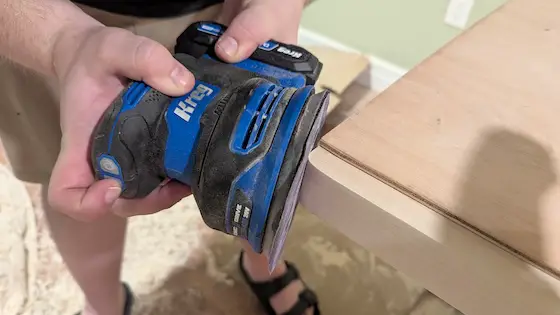
A battery-powered palm orbital sander rounded off this square corner in less than a minute. Copyright 2026 Tim Carter
Power Sander for Wood
I’m a big fan of sanding tools. You should be too if you desire professional results on all your projects. These magic tools also save vast amounts of time.
Days ago, I watched my son use a dandy battery-powered orbital palm sander to round off a square corner on a solid maple countertop. He transformed the sharp corner into a safe rounded corner in about 45 seconds. Without the power tool, he might have invested ten minutes or more.
A palm sander is a small vibrating machine. The one my son uses has a circular pad. It spins in an orbital motion much like you might swirl your hand on a window while cleaning it. This orbital motion helps prevent damage to the item you’re sanding. They’re marvelous inventions.
You can use a palm sander for many tasks. I like to assemble fine furniture from kits. A palm sander, in my opinion, is the best tool to create silky-smooth surfaces on the hardwood pieces before staining.
It’s best to practice with one on a scrap piece of wood if you’ve never used one. A palm sander is very easy to master once you match the correct grit sandpaper to the job at hand. Minimal pressure against the surface is all that’s required. Allow the tool and sandpaper to do the job, not your muscles. You can damage the tool if you apply too much pressure.
While he was doing this task, I was using my trusty belt sander. My job was to sand down the edge of a decorative board so it would fit the wavy contour of a long wall. Carpenters refer to this as scribing. It’s an art, to be sure.
A belt sander resembles an upside-down treadmill. The belts are normally 3 or 4 inches wide. The sander contacts about 18 square inches of material at once. It’s an aggressive tool that requires much respect.
My belt sander is a treasured tool. It’s a high-quality one made by Bosch. I’ve had this corded tool for almost forty years. I’m starting to think that it’s indestructible.
You can sand larger things with a belt sander with ease. Let’s say you want to smooth an outdoor picnic tabletop that’s been abused. A belt sander can make the table look like new in just minutes using several grades of sandpaper. A coarser-grit sandpaper is used for the initial sanding. You then switch to finer and finer grits to make the wood as smooth as glass.
I’ve found that moving the belt sander in a slow orbital motion is best to prevent damage. This tool can cut down into wood in a jiffy, creating damage if you’re not careful. I recorded a video showing how to use a belt sander on an oak tabletop.
Let’s say you can’t afford an electric belt sander. You can purchase a hand-powered tool that does almost the same thing. Some drywall finishers use a pole sander to smooth walls and ceilings. A sanding screen attaches to the flat pad at the end of the pole. New sanding screens do a great job of sanding rough wood.
Keep in mind that not all sandpapers are the same. The light-brown ones you see are almost always aluminum oxide grit. These possess a magical self-sharpening power as you use them. The red or orangish-red sandpapers contain garnet grit. The grit tends to round off and dull as you use the sandpaper. This paper is perfect to help burnish the object you’re sanding.
You can minimize your sanding effort by cutting away excess wood using rasps. A rasp is a hand tool that works just like a fingernail file. I always had one in my tool belt to help me cut away wood when working with wood siding and door and window trim.
The common rasp has both a flat and curved face. It also has coarse and fine cutting surfaces. It’s an invaluable, affordable tool you should own that will save you time. I just looked on Amazon, and you can get two of them for $7. What a deal!
CLICK HERE to purchase two great wood rasps.
I’m available to help answer any questions you have about sanding anything. Just use this link to set up a phone call: https://go.askthebuilder.com/coaching
Column 1682

Tim built custom homes and did ultra-custom remodeling for 20+ years before launching his Ask the Builder media presence. He was selected as one of the Big 50 by Remodeling magazine in 1993. This award gave birth to Ask the Builder in October 1993. Tim also operates https://DrawPlumbingPlans.com. His @askthebuilder YouTube channel was the first home improvement channel on YouTube.