Preventing Electrical Fires
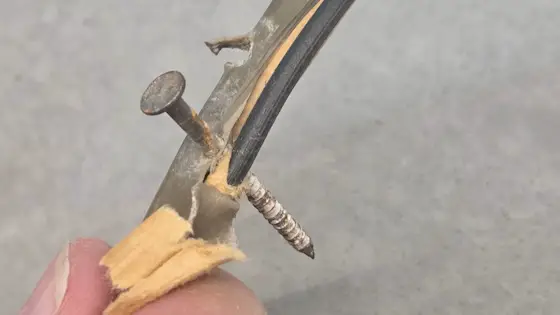
This electrical cable was punctured not once, but twice. The nail in the center contacted the bare ground wire and grazed the 0.38 mm plastic coating of the energized wire. This homeowner should go out and buy lottery tickets as soon as possible. Copyright 2026 Tim Carter
Preventing Electrical Fires Requires Common Sense
Copyright 2026 Tim Carter ALL RIGHTS RESERVED
I’ve been very fortunate to make friends with all sorts of people in my lifetime. One is a retired intellectual-property attorney named Ed. Ed and I developed a symbiotic relationship about thirty years ago. He would reach out to me for advice about home building and remodeling. I would tap into his deep understanding of trademarks and copyright law.
Ed called me days ago. He wanted to share something he discovered while doing some remodeling work for a friend. He was ripping out some drywall in a basement that had been nailed to 3/4-inch-thick furring strips. These wood strips were attached to the concrete foundation walls.
The person who installed the electrical wiring made a serious mistake. They created a 3/8-inch-deep notch in the wood strips. He/she then placed the electrical cable in this notch. Drywall then was installed in direct contact with the electrical cables. Two nails punctured one of the cables.
The one nail passed through the outer insulation of the cable and cut into the insulation of the neutral wire. The second nail pierced the center of the cable, coming into contact with the bare ground wire. This same nail was in contact with the thin insulation covering the energized wire. That insulation is less than 1/2 millimeter thick!
A 16-gauge steel stud guard plate placed over the cable would have prevented this issue. The current price of one of these lifesaving plates is less than 25 cents.
The homeowner has no idea how lucky they were. This is exactly how electrical fires can happen. Ed told me that the circuit was protected by a normal circuit breaker. The breaker would have never sensed the arcing that would have started the fire.
An arc is a miniature lightning bolt where electricity is jumping a gap. It’s no different than a spark plug in an engine. This high-temperature sparking has no trouble igniting plastic, wood, or paper.
The National Electrical Code now requires special arc-fault circuit interrupter (AFCI) breakers on a majority of branch circuits in homes. They’re designed to shut off the power when an arc is taking place that might ignite a fire. You can almost always switch out a normal circuit breaker and install an AFCI one in your electrical panel.
Electrical fires are nefarious. They can ignite at any time of day or night. They differ from water leaks. You can almost always see a water leak either by dripping water or a stain on a ceiling. An electrical fire can be smoldering out of sight, and you have no idea it’s happening.
Loose connections on outlets and wall switches can create arcs. Damaged appliance cords can expose bare wires that can subsequently arc. Rodents and squirrels can chew off the insulation on wires, exposing the bare copper. This happened at my own home, where pesky squirrels chewed the wires of my outdoor Christmas lights.
Light fixtures cause many fires. Old-fashioned incandescent light bulbs burn very hot as the filament glows white hot. A bare bulb in a closet or basement can create a fire if combustible materials come in direct contact with the bare bulb. Bulbs with too high a wattage can melt the insulation on the cable feeding the light fixture.
Extension cords have caused countless fires. The cord may not be rated for the size of the circuit breaker or fuse that’s in the electrical panel. The extension cord can overheat and start to melt the insulation long before the breaker or fuse would trip. Cords run under carpets can cause fires when the insulation gets worn off by foot traffic.
Portable space heaters are very problematic, especially those that might have a glowing elemint much like a toaster in your kitchen. Friends of mine almost lost their home to a fire caused by a space heater.
The heater was rated for 1,500 watts. They unknowingly plugged the space heater into a switched wall outlet in a bedroom. The wall switch was a rheostat that was only rated for 600 watts. The wife was in the bedroom when she noticed a wisp of smoke coming out of the wall switch plate. The rheostat was melting from the overload. If they had been sleeping or in another room, a fire would have ignited in the box inside the wall.
Bathroom exhaust fans have been the source of many a house fire. When was the last time you cleaned out your exhaust fan or blown dust off the fan motor? I doubt anyone takes the time to do this. A fan that’s coated with years of flammable dust can overheat if left running unattended. This happened to a neighbor of mine. The resulting fire was limited to the attic of the house, but the water damage to the rooms below was significant.
I’m available to answer any questions you have about preventing electrical house fires. I also coach DIY homeowners on how to install electrical wiring in a safe manner. Just use this link to set up a phone call: https://go.askthebuilder.com/coaching
Column 1692

Tim built custom homes and did ultra-custom remodeling for 20+ years before launching his Ask the Builder media presence. He was selected as one of the Big 50 by Remodeling magazine in 1993. This award gave birth to Ask the Builder in October 1993. Tim also operates https://DrawPlumbingPlans.com. His @askthebuilder YouTube channel was the first home improvement channel on YouTube.