Septic System and Leach Field
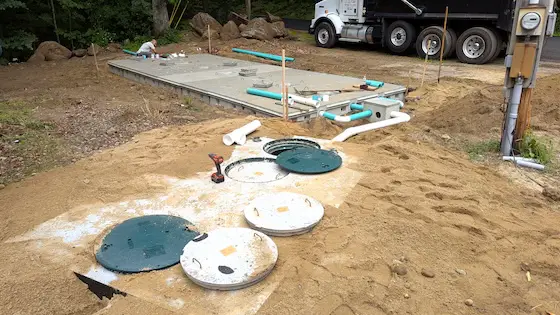
This is a very unique septic system installation. You can drive a car on top of the leach field! Copyright 2026 Tim Carter
Septic System and Leach Field
I’m willing to bet you an Aglamesis two-step hot-fudge sundae made with mocha-chip ice cream that you give very little thought to the many holes you use each day in your home. I’m talking about the holes at the bottom of your tub, shower, vanity sink, kitchen sink, toilet, and washing machine drain.
The things you put in all those fixtures just disappear into the holes, and you don’t give them a second thought. The truth is, you should care. I have to admit that for many years I didn’t care what I was putting into my house sewer. I felt the city sewer department would take care of things.
Your home may be connected to a city sewer. That was my reality for fifty-five years in the different homes I occupied in Cincinnati, Ohio. That all changed when I moved to rural central New Hampshire eighteen years ago. My new residence was connected to a septic system on my own lot.
Septic tanks are mysterious and magical. While you may never have seen the inside of one of these dank chambers, you have enough life experience to know how they work. Think about animal waste you’ve seen in lawns. Think about a compost pile you may use to recycle food waste from your kitchen.
A septic system in almost all cases consists of two components: the tank and the leach field. The sewer line from your home connects to one end of the septic tank. Inside the tank, there may be different chambers or baffles that work to help separate and break down the waste you inject or flush into the tank.
Let’s go back to the animal waste you may see on a hike or in someone’s lawn. The waste starts to decompose almost immediately. In hot, dry weather, it doesn’t take long for it to lose moisture. Insects work on it, and soon the feces has broken down to almost nothing. Within a short time, it completely disappears.
The same thing happens in a septic tank. While disgusting, you can see what happens inside a septic tank by just observing what happens in your own toilet. All you have to do is not flush a bowel movement. Come back to the toilet in a few hours, and you’ll notice the still water in the bowl has changed color while your body waste is starting to fall apart on its own in the bowl.
It’s important to realize that you should just put body waste, low-grade toilet paper and a minimum of small food waste into a septic tank. Never allow paint, other chemicals, grease, etc. into a septic system. The bacteria in your waste and the food will do an excellent job of breaking down the waste in the tank if you follow those rules.
When the septic tank is filled, each time you allow water and waste to enter the tank, an equal amount of treated wastewater leaves the tank through another pipe. This liquid contains microscopic dissolved waste. It travels into a buried distribution box. This box is about the size of a piece of luggage.
The distribution box divides the wastewater up and sends it into two, three, or four other pipes that extend out into the leach field. The pipes in the leach field are perforated. The wastewater slowly seeps through the holes down into a thick bed of sand under the pipes.
Bacteria and organisms in the sand and soil beneath the leach field consume the microscopic waste that’s in the water. It’s simply amazing when you think about it, but it’s no different than what happens to that bear scat you might have seen while on a hike in a state or national park.
Septic systems cost many thousands of dollars to install. This is why you want to treat one with the utmost respect and care. Should you send all the wrong things into your septic system, they’ll end up in the leach field. The leach field can’t handle car oil, extreme amounts of grease, latex paint, chemicals, etc. You’ll end up having to dig up and rebuild the leach field.
You should do the same thing if connected to a city sewer. Don’t succumb to the marketing claims of flushable wipes. These can clog your sewer pipes. They cause massive headaches for city sewers and the sewer plant pumps.
I recorded a video about seven years ago showing what really happens when you flush these wipes down a toilet. I urge you to watch it. Doing so might save you thousands of dollars. You can view just below:
Column 1676

Tim built custom homes and did ultra-custom remodeling for 20+ years before launching his Ask the Builder media presence. He was selected as one of the Big 50 by Remodeling magazine in 1993. This award gave birth to Ask the Builder in October 1993. Tim also operates https://DrawPlumbingPlans.com. His @askthebuilder YouTube channel was the first home improvement channel on YouTube.