Ask the BuilderAsk the Builder
Ask the Builder's on:

Subscribe to askthebuilder's videos

Air Conditioning
Asphalt - Blacktop
Brick
Building Tips
Cabinets
Caulk
Ceilings
Ceramic Tile
Checklists
Chimneys
Concrete
Concrete Defects
Concrete Installation
Condensation
Countertops
Deck Construction
Deck Maintenance
Design
DIY
Doors
Drainage
Drywall - Plaster
DVDs
EBooks - EDocs
Electrical
Energy Savings
Engineered Wood
Fences
Fireplaces
Flooring
Foundation
Garage Doors
Glue
Hardware
Heating Design
Home Builders
Home Depot Stories
House Plans
Hurricanes
Insects
Inspections
Insulation
Interior Walls
Kitchen
Lighting
Lots
Miscellaneous
Mold
New Construction
Online Courses
Outdoor Projects
Painting - Staining
Patio
Payments
Plumbing Design
Plumbing Supplies
Projects
Radiant Barrier
Remodeling
Retaining Walls
Roofing
Rough Lumber
Screened Porches
Sheds
Siding
Specialty Accessories
Stone
Storage
Structural
Stucco - EIFS
Tools
Trim Lumber
Vapor Barrier
Ventilation
Videos
Walk Throughs
Wallpaper
Windows
Glossary


Building Stairs

By Tim Carter
©1993-2008 Tim Carter
Summary: Building stairs is a difficult task. The following column is one method to help you build perfect, simple steps. This method works for interior or exterior stairs.
Author's Notes: Building stairs is a very hard thing to do. There are a number of products/methods out there that claim to make it easy, and some deliver as promised. But if your desire is to take a framing square and build a set of steps like I have done for years and you are a rookie carpenter, you better be prepared for problems.

It is impossible to describe the step-by-step process in the column below, because the newspapers across the land that run my column have a specific word count or column length I must hit each week. There simply was not enough room in the column to explain the entire process.

This is why I spent nearly two weeks writing an authoritative Ebook on the actual step-by-step stair-building process. If you want photos and exact instructions on how to lay out a set of steps, then I urge you to consider purchasing my Instant-Download Stair-Building Ebook. The Ebook contains years of my hard-earned personal experience and secret tips.

My method allows you to build the strongest set of steps possible. Do NOT build a set of steps where you notch the stringers! I explain why in my Ebook.

All AsktheBuilder.com products, including my Instant-Download EBook, come with a 100% Money-Back Guarantee. You have absolutely nothing to lose if you purchase it. I have a No Hassle - No Questions Refund policy.

DEAR TIM: I need to rebuild a simple interior staircase. What is the simplest and easiest way to tackle this project? When you cut those deep notches in the side stringers does that weaken the staircase? Are there any products or techniques that can simplify stair construction? Tony G., Reedsburg, WI

DEAR TONY: I sure hope you paid attention in math class and have some basic carpentry and sketching skills. You are going to need all of these to successfully complete the project. Stair construction can be very challenging and confusing. It is important that you follow all safety recommendations and building code requirements. If you pay attention to detail you will be able to complete the staircase in one day. If not, you better have a ladder nearby.
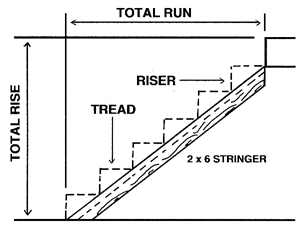
Take a notepad and make a simple cross section drawing of the existing staircase. Note the vertical distances between each step, and the vertical distance between the first and last step and each floor level. Measure the depth of each tread at the same time and record these measurements. Double check your measurements and drawing for accuracy. Note any gaps between each side stringer, and where these components touch the bottom floor and the sub-floor header.

If you are lucky, the vertical measurements between each stair tread and the depth of the treads will be consistent. Using a piece of rectangular (10 inches high by 14 inches long) cardboard you can make a stair angle guide that will allow you to recreate the top and bottom stringer cuts and the position of the treads before you remove the old staircase.


Author's Note: If you need step-by-step color photos of the stair-building process, you should consider my Stair Building EBook. This helpful guide is the answer to all of your frustration over the stair building process. Click the link and you will be amazed at what you will discover.


Place the cardboard rectangle against one side stringer with the 14 inch edge resting on one of the middle stair treads. Slide it back, so the 10 inch edge just touches the stair tread nosing above. Place a yard stick or other long straightedge on the stair tread nosings. Slide it up against the piece of cardboard. Use a pencil and trace a line on the underside of the straightedge. The result should be a triangle whose sloping leg connects one stair tread nosing with the one below. The bottom leg of the triangle will be your tread length and the vertical leg will be the riser height.

As you demolish the old staircase, make every attempt possible to salvage the side stair beams or stringers. The top and bottom angle cuts on these side stringers are the most challenging part of the project. If there were no gaps where the old ones met the floor and sub-floor header, you can use the old stringers as a template. This will save you hours of agonizing work and wasted lumber.
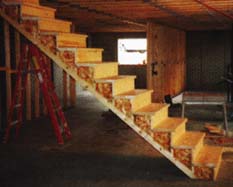
Trace the pattern of the old stringer onto your new side stringer. I like to use 2 x 10 or 2 x 12 lumber for strong staircases. I never cut notches in my stringers as this weakens the staircase. Cut along the traced lines and place the stringer in position. It should fit perfectly. Temporarily tack the stringer into position, so it will not fall. Starting at the top of the stringer, use your triangle template to mark the location of the top of each tread and the face of each stair tread nosing. Make adjustments, as necessary, to match your original drawing. Remember, the sloping line of the template must be parallel or in line with the edge of the stringer at all times.

There are some wonderful wood and steel products that simplify stair construction. You can purchase adjustable triangular wood blocks that screw or nail to a 2 x 6 or 2 x 8. Once applied to the stringers, you end up with the notched look but not the traditional weak staircase! These triangular wood assemblies allow you to create an infinite amount of riser and tread combinations to fit any situation.

You can also purchase simple L shaped brackets that are nailed or screwed to the side stringers. The stair treads rest on these strong metal brackets. These handy devices eliminate any need to notch the stringers or plow grooves to accept the treads. They can be found at most lumber stores that sell metal deck framing components.


Comments

Meshelle Humphres
18 Dec 2007, 14:01
Hi, I have a terrible problem at the entrance of my home. Seems we have a entrance that calls for a person to stepdown when coming into the livingroom. Our floors are wood laminate in both the foyer and the livingroom and the trim on this stepdown is broken or cracked all the time from being stepped on. Also the step down is a bit far for my mother who has short legs and lives in the house too. I can't seem to find anything to remedy this or a way to work in a step between the livingroom and the foyer...can you help?
Thanks,
Meshelle
Carlos Mario Villegas Henao
07 Jan 2008, 08:52
What are the measurements (tread and riser) of the famous "michelangelo stairs"? They are built (and mentioned) in the Bennington Monument in Vermont. Thanks.
AsktheBuilder
07 Jan 2008, 08:57
Carlos,
Next time I drive past, I will get out my tape measure........ Believe it or not, I do go by that giant obelisk two or three times a year.
Dylan Weaver
28 Feb 2008, 04:23
Hi, I have a question about hardwood finished stairs. I would like to know if the hardwood tread is nailed directly to the stringer, or if there is typically some type of subfloor that is attached to the stringer with the hardwood then laid on top? I assume it is probably the first way, but if it is the latter case, then would you have to account for the thickness of the subfloor in your unit rise and runs in order to maintain the goal rise and runs after the stairs are finished?
I just want to know the best way to have hardwood finished stairs. Thanks
AsktheBuilder
02 Mar 2008, 15:27
Dylan,
There are any number of ways to build steps as you describe. In fact, there are books on the subject. It sounds like you should get one as this is a very complex process.
Enrique Nunez
06 Apr 2008, 19:56
I have inside stairs that were installed using the method by which the stringer is attached to a plywood hangerboard, which is in turn, attached to the stairwell header. However, my hangerboard has developed cracks where it is nailed to the header. Although I don't believe my stairs will simply "fall out" if the hangerboard full cracks (they should be secured by more than this, shouldn't they?), I would like to fix the problem.

Is there an effective way to rectify the problem?

Rick
Henry Pollio
07 Apr 2008, 13:19
I am re-doing my stairs in my home.
I live in Hudson County NJ
No one seems to know what the height of the spindles should be. In other words, I know there has to be no more than 4" across, but I need to know the height of the spindles
32" 33" 34" 35" 36"?
I cannot seem to get the right answers.
Could you possibly tell me the correct height, once I put on the bannister.
Thanks again.
Henry Pollio
hennan1@comcast.net
GABRIELA B
09 Apr 2008, 13:34
HELLO, I AM STUDING INTERIOR DESIGN AND I HAVE TO MAKE A STAIRS OF FIVE STEPS WITH CORRUGATED CARDBOARD WITHOUT GLUE, AND IT SHOULD RESIST THE WEIGHT OF A PERSON.
IT IS POSSIBLE?? I NEED HELP PLEASE

P.S: I DONīT SPEAK ENGLISH VERY WELL, SORRY
Jeff Beckett
09 Apr 2008, 15:06
The total length of my stairs needs to be 96". My floor to floor height is 106" will this make my stairs too steep? And, how would I cut my stringers?
AsktheBuilder
10 Apr 2008, 07:43
Rick,
One way to rectify this is to build the stairs the way I show in my Stair Building EBook. To give you specific fixes, I would have to visit the job.

     View all comments
*Name:
Email:
Notify me about new comments on this page
Hide my email
*Text:
Security Image:

Visual CAPTCHA


Ask the Builder Comment Help

Helpful Comment Tips: If you need help with a problem, please try these things now before you type in a comment. You could discover your answer in just minutes.
  • Read ALL Comments Before Submitting One: If there are lots of comments that are already part of this column, there is a very good chance your question has already been answered by me or someone else.
  • Read Similar-Titled Columns First: The column above is almost always part of a two-or-three-part series. The answer to a question you may have is probably in a related column or in comments that are part of that column.
  • Read Columns in a Category: Take the time to read many columns in a category. The amount of information you will discover will amaze you.
  • SHARE a Story: Please share any tips or amusing tales of glory! Tell others what has worked for you. Maybe you have a disaster you want to discuss. Let's collaborate so we all learn together.
Don't show this alert again.