Efflorescence on Masonry
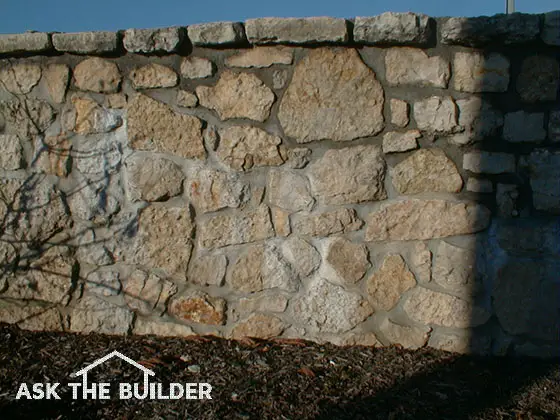
This wall has a bad case of efflorescence. The white minerals leaching from the mortar have seriously stained both the stone and the mortar.
Efflorescence on Masonry Tips
- Not a structural problem
- Salt in soil, brick or mortar is cause
- WATCH efflorescence videos below
- Do NOT wash with water!
- CLICK HERE to Get Tim's FREE & FUNNY Newsletter!
DEAR TIM: I feel our new home has some serious problems but our builder disagrees. The house is less than 6 months old but we have ugly white deposits that are leaching out of our chimney, a wing wall that juts from a corner of our home and a retaining wall
I feel there must be something wrong for this to happen. The more I scrub the worse the problem gets. What's wrong and what can be done to fix the problem? Andrew M., Loveland, OH
DEAR ANDREW: Don't put the noose around the builder's neck just yet. The white deposits you are seeing are probably not his fault, although there might have been some things he could have done during construction to minimize the presence of the powder.
No Harm No Foul
The first thing to realize is that these mineral deposits are just an aesthetic problem. They don't compromise the structural integrity of any of the masonry in and about your new home, but chronic water that gets into masonry can cause problems over time.
Source is Salts
The white powder you see is efflorescence. The brick, stone, concrete block, mortar etc. contain water soluble salts that are the source of the white deposits. Soil behind retaining walls can also contain these same salts.
These trapped salts are set into motion when water enters masonry. The water dissolves the salts and carries them through the masonry towards the surface. Sunlight and wind draw the water to the surface but as the water evaporates, the salts are left behind.
Years to Wear Out
The salts contained in the brick, mortar, stone, concrete block eventually exhaust themselves and the white mineral deposits simply go away. But salts within soil can persist for decades.
This is why efflorescence on the face of a retaining wall is almost impossible to cure unless you remove the backfill, clean the wall and apply an asphalt waterproofing compound on the back of the wall.
IMPORTANT TIP: Do NOT try to wash off the powder deposits with water or an acid-water solution.
Each time you try to wash the chimney and wall surfaces to remove the salts, you actually compound the problem. The water you use dissolves the salts again and carries them back into the mortar or the masonry.
The surfaces typically look fantastic when wet and you think you've solved your problem, but the white powder appears again when the surfaces dry within hours or days.
How To Stop It
To stop the efflorescence now, you must stop all water from entering the masonry surfaces. This is somewhat easy to do at the chimney and any exterior masonry walls, but far more difficult to do with the retaining wall.
If you stop the water, there is no transport medium to carry the soluble salts to the surface where you'll see them.
Efflorescence Video
Watch this video to grasp what you're up against.
Silane Siloxane Water Repellents
Your chimney and wing wall can be treated with a great silane-siloxane water repellent. This is a clear liquid you apply with a garden hand-pump sprayer. They'll travel deep into the masonry if you have a helper using a backpack leaf blower.
As you spray the wall with the clear liquid, the helper blasts the wall with the air from the blower. This air pushes the sealer deep into the masonry.
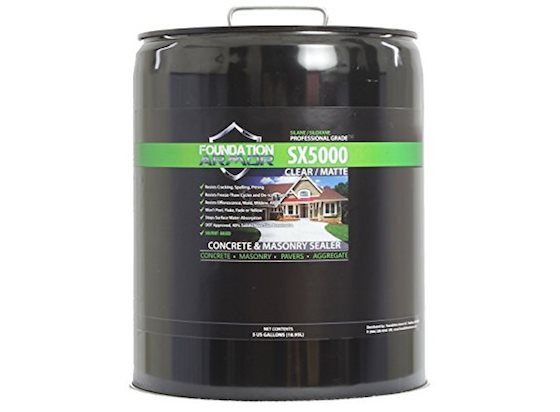
This is a magnificent silane - siloxane water repellent that soaks into concrete. CLICK THIS IMAGE NOW TO ORDER IT.
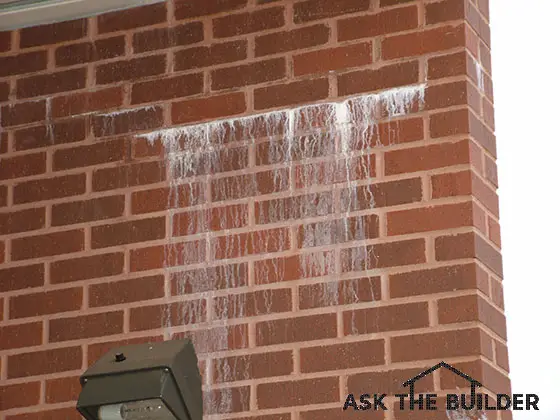
Here is classic efflorescence. This brick is at my daughter's school and is only 2-years old. This is a small wing wall and the top of it can get wet. Efflorescence is very common on new brick and stonework.
Retaining Wall Woes
The retaining wall that's backfilled with dirt should have been treated as it was built. The back side of the wall where the dirt touches it needs to be coated with an asphalt waterproofing compound.
If the wall builder had done this, even if it was just liquid asphalt, that would have stopped water infiltration into the wall.
Remove The Fill
It's very hard to do now as the fill behind the wall will have to be removed, the wall cleaned and allowed to dry and finally the back side of the wall can be waterproofed. Too bad this wasn't done when the wall was built.
It would have taken hours instead of the days it will now take to stop the efflorescence.
Mild Weather
I would not try to do any remedial work until the weather moderates. You want days where the temperature rises to 65 F or above to get excellent results from the sealants and water repellents.
Be sure to inspect the chimney crown for cracks that might allow water to enter the chimney's masonry core. If you discover cracks, you need a different elastomeric coating for the chimney crown.
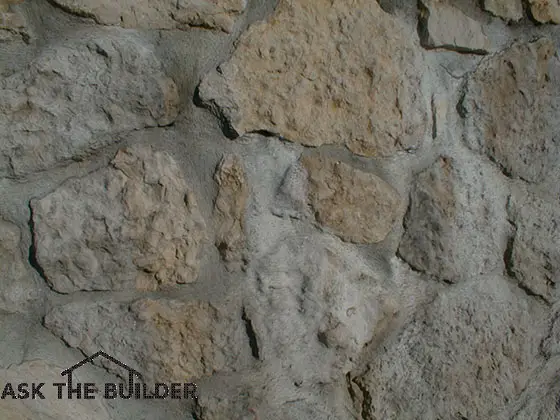
The one stone in the center bottom of this photograph is completely covered with a thick layer of minerals. It is perhaps the worst case of efflorescence I have ever seen other than deposits in a cave.
Tough Love Talk
I think you should have a discussion with your builder to see if he will help you out with the retaining wall fix. Perhaps he can excavate the fill and clean the wall and you apply the waterproofing compound. The builder can then backfill since he has access to equipment that can do it rapidly and easily.
Can You Wait?
Efflorescence happens. It is part of building new things. It eventually goes away on its own, but this process can take years, even decades. When possible, it's best to just let the problem diminish on its own.
Stopping water from entering masonry is the best way to make efflorescence stop. But it is not as easy as one might think. Water can enter masonry and travel up, down and sideways!
Rising Damp
You can actually get efflorescence on masonry walls caused by moisture in the soil that wicks up a wall. In Europe this is called the rising damp. It's almost impossible to cure this defect.
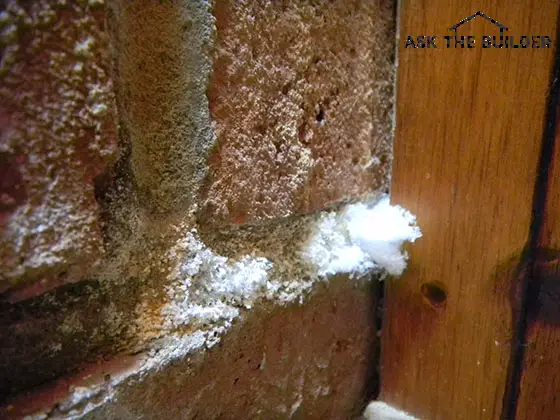
Efflorescence growing in the mortar of a brick fireplace. PHOTO CREDIT: Michael Hannum
Companion Articles: Efflorescence, Efflorescence on Masonry Surfaces, Efflorescence Removal, Efflorescence Publications
Over the years, I've seen many different spellings of efflorescence. Here's my growing list: effervesce, effervescence, effervescent, effleresants, effloreflance, efflorescence, efflorressance, effluorescence, eflorescence, eflorescents, ellforesce and ifflorescence.
Column 499

Tim built custom homes and did ultra-custom remodeling for 20+ years before launching his Ask the Builder media presence. He was selected as one of the Big 50 by Remodeling magazine in 1993. This award gave birth to Ask the Builder in October 1993. Tim also operates https://DrawPlumbingPlans.com. His @askthebuilder YouTube channel was the first home improvement channel on YouTube.
When our house was built 1 1/2 years ago, the builder put a finish over the brick. It looks like they took mortar & brushed it over the brick. It also had a tan or khaki color mixed in with it. The house has developed white efflorescent (?) stains in numerous places on the house. Is there anything we can do to get rid of the white stains. We live in Alabama.
You simply read all my past columns about Efflorescence. Type that word in my search engine.
is the white efflorescence harmful to my small children
No it is not harmful. I assume you don't allow them to lick it.
I have a retaining wall made of cinder block, with concrete poured into the middle space. Over the last 8 years, since my home and wall were built, the White Efflorescence Stains on the retaining wall have gotten pretty bad. It is at a point where my HOA are asking me to paint the short 3 foot wall. Of all the remedies I have read, including yours, not one mentions painting and what would happen if White Efflorescence Stains are painted over. Can you point me in the right direction on what I should do?
Thank you!
Tim,our chimney from flashing up was just rebuilt 2-3 months ago. After several heavy rainy days and high winds there is I guess by your description Efflorescence on almost the entire exposed brick. Should I wait for it to correct itself,then seal coat it,or is it best to buy a Eff. Cleaner,then seal coat it once it has dried. Our masonry co. said they had to wait for the mortar to dry before they could seal it ( if we wanted it sealed,it was an additional $450.00 that we could not come up with at the time). They however never mentioned that almost entire chimney would turn white.
I thank you in advance for any suggestions or advice you may have.
Please read all my columns on the topic, watch my videos and your answer is there. No need to spend more money.
I'm about to buy a house and this was what the inspector came up with on a 20 foot tall * 80 food wide rock retaining wall, built 16 years ago.
Neighbor's house sits about 15 foot tall on the other side of the wall.
"There is heavy calcium build up and wet areas along the east rock wall. This spalling ( when mortar dries out and loosens and or falls out) these areas need to be repointed ( new mortar packed in ). The areas where water is seeping out is possibly from a leak in the water lines ( from neighbors water supply lines ) water is seeping out thru the mortar joints and not the weep holes ( PVC conduit used for allow water to escape with out damaging the mortar) "
Is the statement accurate? Could the Efflorescence cause mortar to dry out and need to re-pointed? Do I need to re-seal or re-coat the wall?
In struck pointing the color is not grey , it becomes whiten with time. So how to make the struck pointing colored by original grey that is of cement so that to make it aesthetically beautiful.
Hi,
I am building a new house. My old house had Efflorescence / salt problem. Now all walls of my new house are built and by mistake i did not put plastic sheet on dpc. Only roof construction is left. I am worried about Efflorescence problem. How to prevent in future? Plz help. Thanks
I'm surprised everyone talks like this is just a cosmetic problem. Every builder or inspector I've ever talked to knows the white stains are a sign of water penetration. That means water damage, spalling and eventual failure. It's my understanding that the only real remedy is to solve the underlying water problem. In basement walls, one way is to insure water runoff is directed away from the basement with gutters or proper grading.
HI, I have this on the fireplace brick inside the house. I did have a water problem about 6 years which was fixed (i.e. the outside was dug out and sealed). The fireplace is partially buried underground and all brick, no concrete firebox. Is this a sign of new water damage? Any recommendations would be appreciated. Thanks.
Nancy,
Look below for the search bar or wherever it is on your mobile device. It searches columns on my website. Search for my Brick Veneer Water Leaks column. The efflorescence means water is still getting in somewhere. I have my suspicions where it is...... You and I can talk about it if you want:
http://shop.askthebuilder.com/products/15-Minute-Phone-Conversation-with-Tim.html
how do you deal with indoor efflorescence on an interior brick wall (we have a full masonry fireplace) the wall is approx 15 ft by 9 ft. Most of the efflorescence is at the top. What I would like to do is find a way to clean it all off and then paint the brick with drylok (tinted with a cream color). Any help or ideas would be great.
I think you better re-read the above column, watch ALL of my efflorescence videos and read ALL of my columns about the topic.
If you paint before you solve the water issue, you're WASTING your time.
Our home is on a raised foundation. The front of the house is primarily brick exterior. We recently discovered that at least one section of the front of the house has experienced dry rot in the floor joists that butt up against the brick. There is moisture seeping through the brick and even some small roots have penetrated the brick. There is a bay window above this section of brick. Unfortunately this issue was discovered at the end of a home remodel that is already over budget. I am looking for the most cost-effective long-term solution, but will consider an intermediate solution that would allow me time to save up for a more costly solution down the road. Once the brick and mortar are wet like this, is it too late to install flashing or some other moisture barrier once the floor joists have been repaired? What about waterproofing? I am concerned that if we replace the brick, the problem will just reoccur without some additional measure to stop it. I already have a general contractor, but I am not sure he has the expertise in this particular area to be giving me the best advice for the situation. Any recommendations?
no one has mentioned that when this condition occurs in the basement of a house, old or new, finished or not, it causes mold and mildew with all of the smells and allergic reactions that go with them. since the moisture is constant, the air never really dries out and everything in the basement smells. the only way to repair the problem is to dig away behind the foundation and waterproof the foundation from the outside to keep moisture from penetrating. as tim said, a simple matter when the house is being built, but a very complex and very, VERY expensive matter later. NOTE FROM TIM CARTER: Barbara, it's even more complex. If it's an old house that has no vapor barrier under the basement slab, water vapor will pour into the basement. Spending all sorts of money taking care of the exterior of the foundation to stop the water will yield only marginal results if you don't stop the water vapor coming from the slab.
Thank you. I feel better now and will follow your advice.
I need help. Don't have a handy husband so plan to fix things myself.
Diane,
You've arrived at the right location! Use my search engine on each page to get oodles of help.
Watch my videos.
Listen to my podcasts.
Read my columns.
No other home improvement website has as much information as I do.
Note I've done everything I demonstrate. Many other websites have no-names creating their content - people who have never done the work professionally.
Be sure to sign up for my FREE newsletter.
Tim,
Great website. I dealing with very hard crystals on my mortar joints on a fireplace with stone that was built 2 years ago. These will not brush away. any suggestions?
Good Morning, I have a house builet in 1923. I have lived here since 1992. Recently, in the last three years I started seeing Efforience at the base of my chimney.
It also has a small amount of clear liquid that seeps out. It is clear but kind of thick all from the based of my chimney located in the center of my house. I had my chimney bricks repaired and a hood installed as well but it continues to seep this liquid, and show signs of Efflorescence....