4 Way Switch – Really Easy – Watch the Video
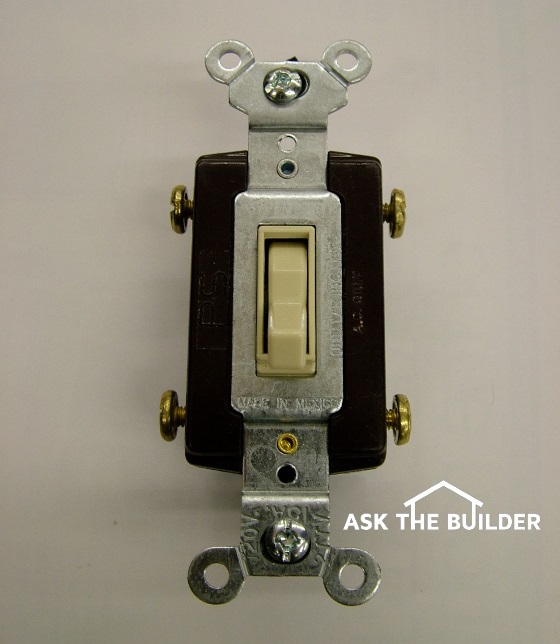
4-way switch - It has four screws plus the green grounding screw. You can discover other tips about 3 and 4-way switches here. PHOTO CREDIT: Tim Carter
"The first thing you need to know is that the 4-way switch is indeed a very special switch. It's got a total of FIVE screws on it!"
4-Way Switch TIPS
- Complex switch requiring great skill to install
- Has five total screws on it vs. a standard single-pole switch with just three
- WATCH 3 & 4-way switch videos below for help
- 4-way switch must be between two 3-way switches
- CLICK HERE to Get Tim's FREE & FUNNY Newsletter!
DEAR TIM: I'm pulling my hair out wiring a 4-way switch. What's the secret to 4-way switch wiring?
Do you need a special 4-way electrical switch or a 4-way light switch? At this point, my new wife thinks she married a dunce.
If you can teach me how to wire a 4-way switch, I'll be eternally grateful. If you can't help, I will be forced to admit defeat and will call an electrician. Robert M., Ft. Collins, CO
DEAR ROBERT: Listen, don't beat yourself up too badly.
Is a Four-Way Switch Hard?
There are many people who are flummoxed by the mysterious 4-way, or four-way, switch. I liken the 4-way switch, and its first cousin the 3-way switch, to the famous movie Wizard of Oz.
It's easy to get confused how to wire a 4-way or 3-way switch. This is why I created videos to show how it's done.
CLICK HERE to watch my video of how to install a 3-way switch. You need two 3-way switches to make a 4-way switch work.
CLICK HERE to read how to install a 3-way switch.
Free & Fast Bids
CLICK HERE to get FREE & FAST BIDS from local electricians if you're afraid of getting ZOTTED.
Is a 4 Way Switch Special?
The first thing you need to know is that the 4-way switch is indeed a very special switch. It's got a total of FIVE screws on it! (See photo above.)
A normal simple single-pole switch that you have to turn on a bedroom, closet or front-porch light only has three screws on it.
The two screws are for the incoming (line) and outgoing (load) power wire and the third screw is for the ground or earth wire.
Watch the following video to see a simple single-pole switch.
You need to really understand how current flows and is interrupted by a simple single-pole switch before you start to tackle a 4-way switch!
Single Pole Switch Video
This is what most of the switches in your home look like. You need to understand this before you graduate to a 3-way switch, much less a 4-way switch!
How is a 4-Way Switch Different from a 3-Way Switch?
A 3-way switch has three screws plus the green grounding screw. A 4-way switch has four screws plus the green grounding screw.
Multiple On & Off Locations
You use 4-way switches in situations where you want to control a light or other fixture from more than two locations. For example, the second-floor hallway lights in my own home are controlled at four different locations. To accomplish this, you must have two 3-way switches and two 4-way switches.
Where Does the 4-Way Switch Go?
A 4-way switch must always be in between two 3-way switches. I know this sounds confusing, but let's see how it is done in the real world if you were to remove the drywall or plaster from your walls and ceilings.
How To Wire A 4-Way Switch
The easiest way to understand how to wire a 4-way switch is to watch this video:
The traveler wires from the two 3-way switches attach to the screws on the four-way switch.
Connect the two travelers from one 3-way switch to the bottom two screws on the 4-way switch. It doesn't matter which traveler wire goes on which bottom screw.
Then connect the two travelers from the other 3-way switch to the top screws on the 4-way switch. Another key point is it doesn't matter which traveler wire you attach to which screw.
What Happens to the White Neutral Wires?
In all three boxes, you connect the white wires to each other with a wire nut. The white neutral wire that enters the first 3-way switch needs to travel through all the switch boxes until it eventually gets to the light fixture.
The white neutral wires NEVER get attached to any of the screws on the 3-way or 4-way switches.
You do the same with the bare copper wires and create a tailpiece of bare copper that connects to the green grounding screw on each switch. In each box, you are left with black and red wires. These connect to the terminal screws on the switches.
How Many 4-Way Switches Can You Use?
You can have many 4-way switches in a circuit as you want. As crazy as this sounds, you could have 10 switches control one light. This circuit would have the mandatory two 3-way switches and eight 4-way switches.
It's important to realize that all the 4-way switches fall in between the two 3 way switches. This is the only way the circuit will work.
How Do You Wire a 3-Way Switch?
To make any of these circuits work correctly, you must connect the wires to the right screws on the 3-way switches. WATCH my 3-way switch video now.
Look closely at the 3-way switches. They'll have a black screw and two brass ones.
Connect the black continuous-hot wire in box number 1 and the black wire that goes up to the light fixture in box number 3 to the special black screw on each 3-way switch.
The remaining two wires at each box connect to the brass screws on the 3-way switch.
Column 707

Tim built custom homes and did ultra-custom remodeling for 20+ years before launching his Ask the Builder media presence. He was selected as one of the Big 50 by Remodeling magazine in 1993. This award gave birth to Ask the Builder in October 1993. Tim also operates https://DrawPlumbingPlans.com. His @askthebuilder YouTube channel was the first home improvement channel on YouTube.

Tim, Great article! I simply LOVE 4 Way switches, but yes, they can be a challenge if you do not have a working knowledge of working with them. I have wired homes where multiple 4-Way switches have been installed in long hallways. The wiring is the same when wiring one or twenty, but the key is wiring them between two 3-way switches.
Keep up the Good Work,
Dave Rongey
Great info! I particularly enjoyed the YouTube video. However, I am finding it a little difficult to determine how to apply in a setting with walls where I cannot see how the wires connected from one switch to another . If I understand correctly, it's not the 4 way switch itself one has to be concerned about in order to get the circuit running as it should between 3 different switches, rather the key is for the 3 way switches to be correctly wired, with the 3rd wire playing the key role?
Any additional input would be appreciated.
Just watch the videos several times to get it clear. If you still need help, consider this: http://shop.askthebuilder.com/500-second-consult/
Thanks, very much appreciated. I had done everything right........so I thought but it would not work. However, after reading your article I realised that I had the black wire that went to the light on the wrong screw. It all made sense. Again, many thanks.
I watched your video on how to wire 3 and 4 way switches. IT made my job SO EASY. Thank you, as this was a real head scratcher for me. Now I actually understand how they work. And so does my garage light!
Hey, Guys-- this is simply, really ! This must mounted between 2 different
3-way switches. Lets say one wire is from the 3-way to your left--just use
2 wires from it and connect them to the TOP 2 terminals on the 4-way.
Now the wires coming from the 3-way to your right go to the 2 BOTTOM
terminals on your 4-WAY. There is NO white neutral wires to this at all.
There may be a bare copper ground wire to connect to the frame of the
4-way switch--if so use it.
Tim;
Love the video! Now then, how do you deal with knob & tube, duplex (like the REA installed in thousands of rural homes & out buildings or that old armored stuff that I think they call BX? Hard to determine which wire is the Neutral since the white paint has usually come off years ago. No grounds wires in these circuits although I think the armored stuff used the flex conduit as ground.
I know I'd just replace the wiring but how do you fish new wires without knocking out a lot of lath & plaster?
I have a problem I have a bathroom with 2 toilets and a shower in between them. Each toilet has a light switch and a light. The shower has a light. Each switch turns on the toilet light and the shower light. If both toilet lights are on, the shower light is on, if only one toilet light is on, the shower light is on. If both toilet lights turn off, the shower light turns off.
What kind of switches are in the toilets? Im looking to replace them with new ones. They seem to be 4 way, but there is only 2 switches. Also, at least one of the switches has a jumper jumping the bottom 2 screws.
Great info on wiring NEW circuits. Be advised in a REPAIR situation there's one additional factor - determining if one or both (or more) switches is defective. This does happen! It can throw a curve ball into your efforts. If the switches appear to have been wired correctly and still do not work (together)...suspect defective switch(es). I've seen relatively new switches that become defective in a short period of time.
Thank you so much for your video! I had a 4 way switch that I had replaced a while ago but wasn’t working properly. Stumbled across your video and learned I was making the mistake that most people make. Your visual and explanation was very clear and I am happy to say my light works properly again!