Hydraulic Cement
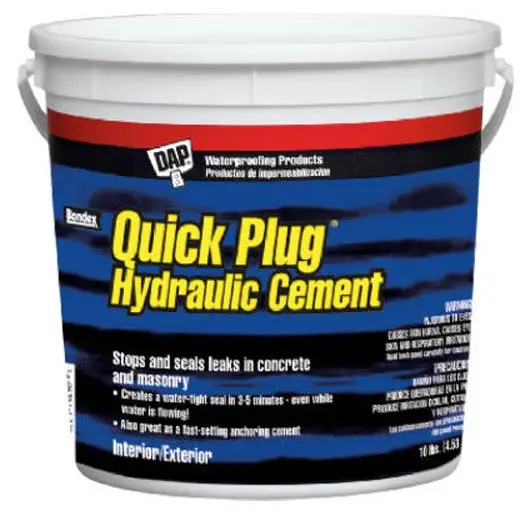
This is just one brand of hydraulic cement. CLICK THE bucket to have this brand at your home in days.
"You'll also get the best bond if you slightly dampen the concrete that will be in contact with the fresh hydraulic cement."
Hydraulic Cement Checklist
- Hydraulic cement expands as it hardens
- Surfaces must be dust-free
- Dampen surfaces that will contact the hydraulic cement for best bond
- Sets very fast - mix only as much as you can use in a few minutes
Related Links
Repair Concrete Block Cracks FAST!
Does Portland Cement Shrink?
Many homeowners don't realize that ordinary Portland cement shrinks when it dries. The shrinkage is very little, however, it does shrink.
This means that if you patch a crack or a hole using normal Portland cement or bricklayer's mortar, a very tiny leak may form after the cement dries.
Does Hydraulic Cement Expand as it Hardens?
Hydraulic cement expands as it hardens.
It expands because the cement contains expansive clays such as bentonite and a few others.
Expansive clays start to puff up when in contact with water. The best analogy is adding yeast to flour to make bread. The dough starts to rise increasing its volume.
Free & Fast Bids
Does Hydraulic Cement Stay Enlarged?
Yes, hydraulic cement retains its expanded size once it's hardened.
When the bread is baked, the larger size is permanently locked into place.
The same thing happens with the hydraulic cement. And it happens fast usually within minutes. The Portland cement sets up and the larger volume of the mixture is locked in place permanently.
Can You Slow the Setting Time?
Ice water will slow down the setting time of hydraulic cement. You can even freeze the hydraulic cement powder before mixing it to get a few more minutes working time.
Where Can I Use Hydraulic Cement?
In new construction I use hydraulic cement to
- fill the void areas in foundations around water pipes
- electric wire sleeves or conduits
- foundation form holes
- deep cracks in foundations
- any hole in a foundation
Is it Best to Remove Dust?
Get rid of all dust from the surfaces that will be in contact with the fresh cement. The dust will prevent a good bond between the old masonry surfaces and the fresh mixture.
Should I Dampen Existing Concrete or Masonry?
Dampen the concrete that will be in contact with the fresh hydraulic cement to get the absolute best bond. It doesn't need to be dripping wet, just spritz it so some water soaks into the dry concrete or masonry surfaces.
Author's Note: The following email comment was received from Art, a Cement Manufacturer's Representative in Southern California.
Hi Tim,
I hope you take this in the spirit in which it is intended and that is to just help your site be better. Your definition of a hydraulic cement is misleading. According to ASTM (American Society for Testing & Materials), a hydraulic cement is a cement that creates a chemical reaction when it comes in contact with water (hydration) and will cure under water.
Being a hydraulic cement in itself has nothing to do with expansion, although some hydraulic cements will shrink less than others, but this is due to them being a sulfoaluminate based cement, not a Portland cement and has nothing to do with them being a hydraulic cement. Being a sulfoaluminate cement is also the reason you have the shortened working times.
Thanks,
Art / Cement Mfg. Rep.
Column B119

Tim built custom homes and did ultra-custom remodeling for 20+ years before launching his Ask the Builder media presence. He was selected as one of the Big 50 by Remodeling magazine in 1993. This award gave birth to Ask the Builder in October 1993. Tim also operates https://DrawPlumbingPlans.com. His @askthebuilder YouTube channel was the first home improvement channel on YouTube.
This is a question thrown out there to anyone who might have an opinion. My situation is I have an artiesian well. It is approx 110 ft deep. The well is leaking around the outside of the casing and is causing a portion of my yard to revert to a swamp. I have dug around the casing. I have no idea how to stop the seepage and leaking. Appears no one in the business around me has any idea either. I am considerinf buying a few tubs of hydraulic cement from a local Lowes and dumping it in the space between the casing and the hole. I hope it will cure and plug the leak. Anyone care to give an opinion on my probability of success? Or I sure am open to a better idea.
Stuart, you need to schedule a 15-Minute call with me. There's simply too much to talk about and type.
How does the cost of hydraulic cement compare to portland cement? Is hydraulic cement appropriate for use in a patio that will be tied to the foundation of a home? I want to use this as a foundation for a sunroom eventually, but in the interim it will get plenty of rain and moisture.
Do you know if hydraulic cement will take an acid stain similar to what portland cement takes?
Regarding sulfoaluminate based hydraulic cements, are these a similar formulation to what the Roman's used based on volcanic ash in the flood plains of Vesuvius? I have always read that these roman cements were extraordinarily long-lasting under water, but that they took a long time to set and gain strength. This seems to contradict your statement that today's hydraulic cements set rapidly and you must work with them for 10 to 15 minutes.
Final question: do you happen to know if there is any commercial cement available in USA or Europe that is using a volcanic ask to create a Roman-type hydraulic cement? I'm looking for something that would be extremely durable in a wet environment.
Can hydraulic cement be used on granite foundations between stones?
Yes. It can be used on granite. I REVISED this column after seeing your question. Please go up and look at the new content.
How long is hydraulic cement "good" if stored dry in original packaging? The previous owner left some behind. Being thrifty, I don't want to buy more if this can be used for a small crack.
To seal a crack in a foundation that's leaking water, would you recommend epoxy or hydraulic cement? Having trouble finding a good comparison.
I'd use epoxy if the crack is wider than 1/8 inch. The best one I've found so far is right here. Be sure to order it with the special nozzle!!
http://www.askthebuilder.com/concrete-epoxy-repair-products/
What happens if you add much more water than recommended to where the hydraulic cement is more like soft ice cream instead of the 1:3 water to cement ratio. Will it harden and stay hard in a pool repair?
When you contacted the manufacturer of the product you're using, what did they say???? Once you report back, I'll weigh in.
Can I use the hydraulic cement to patch spaces between stone foundations
Yes, you can.
I used Hydraulic cement to fill a gap in my basement corners that was showing moisture. After 2 days (of rainy, snow thawing temps) there is now water pooling on top of the cement. Is it possible that it is water from mixing it thinner to be able to spread it out easier, or did I not use the right product and the ground water is making it's way up?
Because of his expanding qualities can hydraulic cement be mixed with Type S mortar mix to help strengthen the bond thinking of a ratio of 10 parts as to one part hydraulic
Same question Stuart had in 2012. My well fills my water storage tanks and the water exits when full via pvc. Water leaking and creating a bog. How to fill and seal the pvc to the cement tank?...
I have a brick court yard bounded on three sides by structures. One side is a stuccoed block wall. I notice that water penetration causes paint flaking on the other side of the wall, the bricks are bedded on sand and sand between the margins so water has free drainage around and below the bricks. I thought I might restrict the flow by introducing the dry hydraulic cement into around the bricks and dampen to set, and hopefully seal against future water penetration.
The area of the crack has been painted. Do I need to remove the paint first?
Thanks