Hydraulic Cement
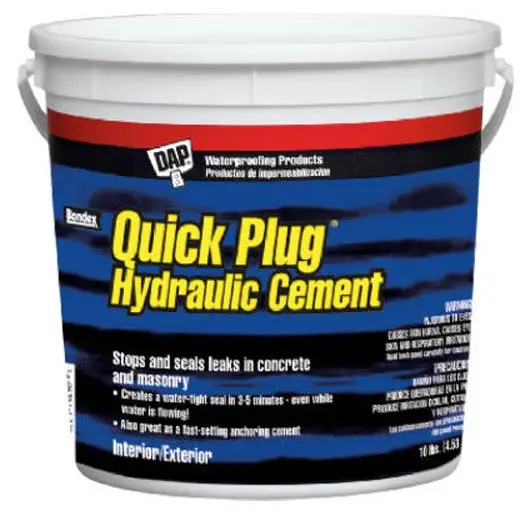
This is just one brand of hydraulic cement. CLICK THE bucket to have this brand at your home in days.
"You'll also get the best bond if you slightly dampen the concrete that will be in contact with the fresh hydraulic cement."
Hydraulic Cement Checklist
- Hydraulic cement expands as it hardens
- Surfaces must be dust-free
- Dampen surfaces that will contact the hydraulic cement for best bond
- Sets very fast - mix only as much as you can use in a few minutes
Related Links
Repair Concrete Block Cracks FAST!
Does Portland Cement Shrink?
Many homeowners don't realize that ordinary Portland cement shrinks when it dries. The shrinkage is very little, however, it does shrink.
This means that if you patch a crack or a hole using normal Portland cement or bricklayer's mortar, a very tiny leak may form after the cement dries.
Does Hydraulic Cement Expand as it Hardens?
Hydraulic cement expands as it hardens.
It expands because the cement contains expansive clays such as bentonite and a few others.
Expansive clays start to puff up when in contact with water. The best analogy is adding yeast to flour to make bread. The dough starts to rise increasing its volume.
Free & Fast Bids
Does Hydraulic Cement Stay Enlarged?
Yes, hydraulic cement retains its expanded size once it's hardened.
When the bread is baked, the larger size is permanently locked into place.
The same thing happens with the hydraulic cement. And it happens fast usually within minutes. The Portland cement sets up and the larger volume of the mixture is locked in place permanently.
Can You Slow the Setting Time?
Ice water will slow down the setting time of hydraulic cement. You can even freeze the hydraulic cement powder before mixing it to get a few more minutes working time.
Where Can I Use Hydraulic Cement?
In new construction I use hydraulic cement to
- fill the void areas in foundations around water pipes
- electric wire sleeves or conduits
- foundation form holes
- deep cracks in foundations
- any hole in a foundation
Is it Best to Remove Dust?
Get rid of all dust from the surfaces that will be in contact with the fresh cement. The dust will prevent a good bond between the old masonry surfaces and the fresh mixture.
Should I Dampen Existing Concrete or Masonry?
Dampen the concrete that will be in contact with the fresh hydraulic cement to get the absolute best bond. It doesn't need to be dripping wet, just spritz it so some water soaks into the dry concrete or masonry surfaces.
Author's Note: The following email comment was received from Art, a Cement Manufacturer's Representative in Southern California.
Hi Tim,
I hope you take this in the spirit in which it is intended and that is to just help your site be better. Your definition of a hydraulic cement is misleading. According to ASTM (American Society for Testing & Materials), a hydraulic cement is a cement that creates a chemical reaction when it comes in contact with water (hydration) and will cure under water.
Being a hydraulic cement in itself has nothing to do with expansion, although some hydraulic cements will shrink less than others, but this is due to them being a sulfoaluminate based cement, not a Portland cement and has nothing to do with them being a hydraulic cement. Being a sulfoaluminate cement is also the reason you have the shortened working times.
Thanks,
Art / Cement Mfg. Rep.
Column B119
19 Responses to Hydraulic Cement