Clay Soil Water Infiltration Inject Water
Clay Soil Settlement Water Injection TIPS
- Soil can move up and down
- Clay soil movement can be huge
- Keep soil constant moisture level
- Use drain tile to inject water or gravel tubes
- CLICK HERE to Get Tim's FREE & FUNNY Newsletter!
DEAR TIM: I recently started a room addition project that has a crawl space. My builder insisted on installing a drain tile pipe on top of the foundation footer. Since there's no basement below my room addition, I feel that the pipe is a waste of money. Would you do this on one of your projects? B. F.
DEAR B. F.: Hah, smart builder. You should hug him! The money you are spending for this pipe is a very wise investment. I feel that you're extremely lucky to have selected a knowledgeable builder.
Dual-Purpose Tile
Foundation drain tile systems serve a very important function. They're generally installed to provide a means to channel excess water away from your footing and foundation. However, if equipped with a simple optional pipe, they can also allow you to inject water along your footing and foundation. The value of this second point is frequently overlooked.
This is very important for structures that have shallow foundations and are in soils that have a fairly high clay content.
CLICK HERE to get FREE & FAST BIDS from local Builders who can construct your room addition.
Soil 101
Most houses or room addition projects are constructed on soil, not bedrock. Soil is made up of small deteriorated pieces of rock. However, these solid pieces only make up a portion of the total space that soil occupies.
The remainder of space is comprised of void areas. These empty areas can be filled with a combination of gas, air, or water in varying amounts. The closest thing I can compare it to is a sponge.
Because of these characteristics, some soils can cause tremendous problems if allowed to become alternately dry and wet. Certain clay soils expand when wet and contract when they alternately get wet and then dry.
Secret Soil Water Injection Video
Watch this video to show you how to get water fast into clay soils using a simple soaking hose. You can use this method if your builder didn't install a water injection pipe up from your drain tile.
Some clay soils react dramatically to moisture variations. They actually shrink and swell. Parts of Texas have clay soils that wreak havoc on homes that don't have fantastic foundations that can withstand the stress.
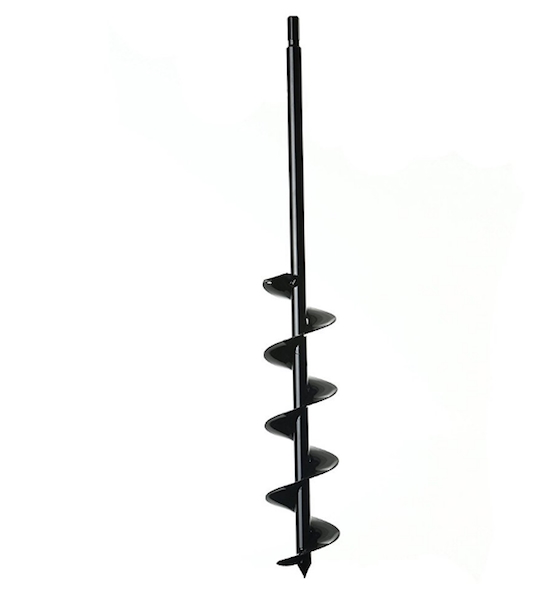
Use an auger like this that you attach to a cordless drill. You drill down into the soil and then put small pea gravel down into the hole. CLICK THE IMAGE TO BUY THIS GREAT AUGER NOW.
CLICK HERE to get FREE & FAST BIDS from local Builders who can construct your room addition.
Swelling Sponges
You can demonstrate this very easily with certain types of sponges. These sponges tend to shrivel up when dry, however as soon as you wet them they 'puff' up. Can you imagine how your house or room addition reacts when this happens to the soil surrounding your foundation and footer?
Trick the Soil
There's an interesting thing about these soils. When subjected to an even, constant state of moisture content, they usually don't shrink or swell. They have a strong tendency to stay the same size.
The trick is to maintain this delicate balance. Geologists have a fancy name for this condition -- dynamic equilibrium.
For those of you who have decided to stay with me on this, here's the payoff. Your drain tile system allows you to easily maintain this state of dynamic equilibrium. Here's how it works.
Add Water To Tile
During dry spells or drought conditions, you can inject water into your drain tile system. This allows you to trick the soil in contact with your footing and foundation. It will have no idea that it hasn't rained in months.
To be able to inject water easily, you must have your builder install a 'T' fitting in your drain tile system. A pipe will extend to the surface from this 'T' fitting.
This simple pipe allows you to easily inject the necessary water to saturate the soil surrounding your foundation footer.
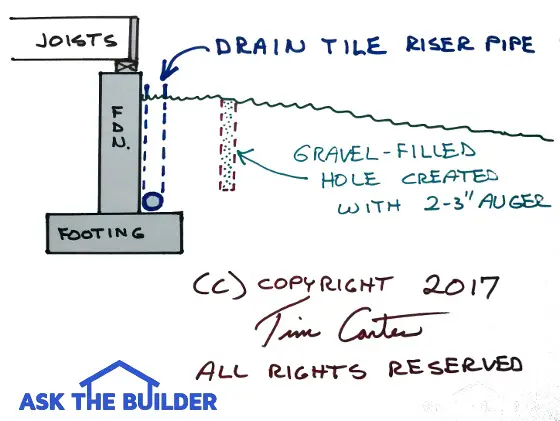
You should be able to figure this out. The dashed blue lines are the riser pipe that sticks up above the level of the grass or soil. © 2017 Tim Carter
Garden Hose On Low
I usually recommend that people insert their garden hose into this riser pipe, turn the water on low, and let it run overnight. If you do this once a week during drought, or very dry conditions, you generally will not have any problems. You must monitor the water flow carefully if you have a basement. If your foundation is not waterproofed, too much water might possibly cause a leak into your basement.
Soil Maps
You can check your soil characteristics by using a soil map. These maps and descriptions are usually available for free at your county offices. They're also available online in many instances.
Often they can be found in the agricultural department or the engineering and building department. These maps are prepared by geologists who specialize in soils. I highly recommend that you obtain one prior to building your next home or room addition.
CLICK HERE to get FREE & FAST BIDS from local Builders who can construct your room addition.
Column 014

Tim built custom homes and did ultra-custom remodeling for 20+ years before launching his Ask the Builder media presence. He was selected as one of the Big 50 by Remodeling magazine in 1993. This award gave birth to Ask the Builder in October 1993. Tim also operates https://DrawPlumbingPlans.com. His @askthebuilder YouTube channel was the first home improvement channel on YouTube.