HVAC Return Air Ducting
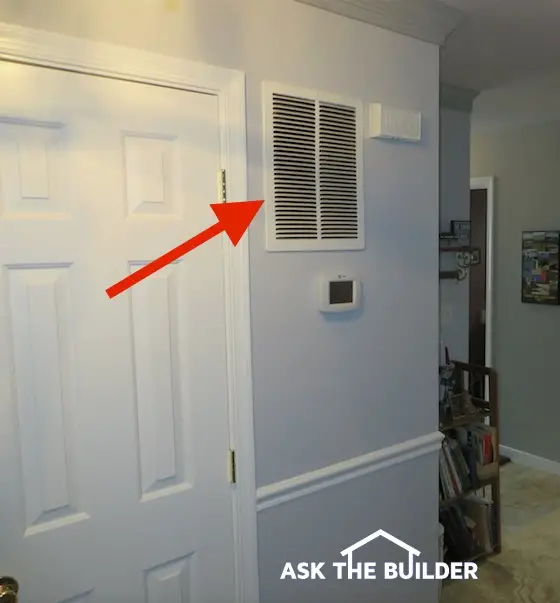
The red arrow points to a large wall-mounted return-air vent. The furnace or air handler is probably on the other side of the wall behind that door. How many return air vents should be in your home? The number MAY SURPRISE YOU! Copyright 2018 Tim Carter
HVAC Return Air Ducting - You Better Have One in Many Rooms
"An HVAC return air duct should be in every room except a bathroom and kitchen. They should be on interior walls across the room from the supply ducts that should be washing exterior walls with conditioned air."
Get FREE BIDS in hours from local HVAC companies to have new return air ducts installed in your home.
HVAC Return Air Ducting TIPS
- Return air is a MUST
- Locate on interior walls opposite supply duct
- Designed to vacuum air from a room
- Place high on walls if supply ducts are in floor
- Subscribe to Tim's FREE & FUNNY Newsletter
Two years after this column was published, it was still receiving comments. So Tim shared it again in his June 23, 2019 Newsletter.
Should HVAC Return Duct Be the Same Size?
The air ducts in your house should be designed exactly like the blood vessels in your body.
Think about it. Half of the blood vessels supply blood to every part of your body all the way to the tips of your fingers and toes. The other half of the vessels return the blood back to your heart. Along the return trip back towards your heart, the blood gets resupplied with oxygen and your heart sends it back out again.
Have you ever wondered how blood pressure can be measured accurately at the tip of your finger? This magic happens because the blood-vessel diameters decreases as they get farther away from your heart.
Your heart, like your furnace fan, creates a finite amount of energy each time it pumps. As blood is delivered to your shoulder, there's less energy left to deliver the remaining blood down your arm. If the blood vessels all the way to your fingertips stayed the same size as up at your shoulder, there wouldn't be enough energy to push all that blood and maintain the pressure at your fingertips.

Mother Nature designed your body this way for a reason. Your HVAC person needs to do the same thing with the supply and return ducts in your home!
If an HVAC installer laughs at this concept, show him to your door. He's not a professional and he doesn't know the most basic things about fluid, yes air is a fluid, dynamics!
What's the Best Location for Return Air Ducts?
Supply air from furnaces and air conditioners should be on outside walls. The return air vent openings need to be on the opposite side of the room so the conditioned air is pulled across the room.
If the supply ducts are in the floor, then the return air should be located up high. This pulls the air across your body.
If the supply ducts are high or in the ceiling, then the return-air ducts or grills should be low on a wall.
FREE Call From Tim Carter About Your Ducts - Set up a Call with Tim.
Related Links
Cold-Air Returns - Be More Comfortable
Static Pressure In Supply & Return Ducts Is Important
My House is Hot or Cold. Is This a Return-Duct Issue?
Yes, if your house is either hot or cold, I'll bet you have inferior or lacking return air ducts.
If you live in a home that has rooms that are either too hot in hot weather or are cold in cold weather you could have a return-air duct issue.
Return air ducts are necessary for just about every room. However, there are two rooms that I never place return air ducts - kitchens and baths. Let's try to keep the garlic odors and hairspray in these rooms if you don't mind!
The reason for return air is simple. Your furnace is simply a recirculating pump. Instead of pumping water, it is pumping air.
We need to get the air back to the pump. Furthermore, without a return air duct in each major room, the supply duct air has to "push" all of the air in the room out of the way as it makes its way towards you. The return air ducts help pull the air as it is being pushed.
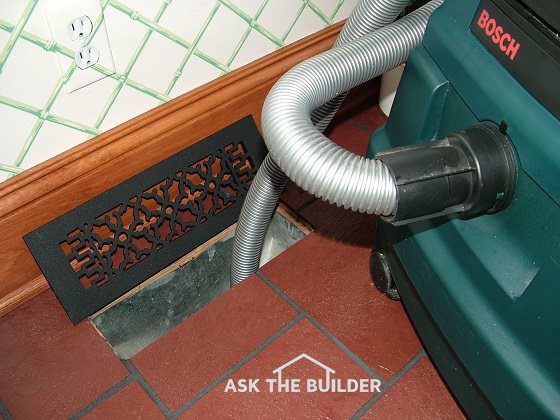
An HVAC return air can be in the floor, but they work much better on walls up about 7 feet. It's best to put them on an interior wall across the room from the supply duct. © 2018 Tim Carter
Where Can You Put Return Ducts?
If you have an existing ranch style home, installing return air ducts in each room can be done fairly easily. You do what we do in new homes.
You use the wall cavities as the duct. Think of it. Drywall that is nailed to 2x4s is really a duct - a box with 4 sides. All you have to do is cut out the floor immediately below the wall cavity as well as the bottom wall plate. Once you have created the opening, sheet metal will allow you to connect this to your existing return air system.
Two-story houses can be more of a challenge. You have to figure out a way to get return air from the ceilings of the second floor to the basement or furnace room.
Do you have a laundry chute that you don't use that often? Can it be sacrificed for the cooling cause? We have used these with tremendous success.
Sometimes, you can use a kitchen pantry closet or a hall closet. We have often been able to put a duct in one corner of the pantry or closet. This duct extends up to the second floor where it often lines up with an interior hallway wall.
Often you can collect the ceiling air through a network of flexible pipes in an attic. These pipes join together in one central location that permits you to run a duct down to the basement or a second-floor closet.
As a last resort, you may have to put a duct in the corner of a room(s). These can be drywalled easily. To effectively disguise it, you may build another one several feet down the wall. Shelves can be put between these two "stacks". If they are in a child's room, they can often be painted in a decorative manner as if it was intended for them to be there.
It was common in many older homes to have projections in rooms such as this. These bump-outs often were fireplace chimneys as they rose through to the roof.
How Do You Balance Return Air Flow?
If you want to really have a way to get the most bang for your return air buck, think of installing grill covers on the wall that have operating louvers. This will allow you to choke down rooms possibly on the first floor that are drawing too much air.
This, in turn, creates a greater suction in the rooms that really need cool air. This principle is no different than dampers which are used on supply lines to regulate airflow.
The grills with louvers are inexpensive and effective. On an older existing home that is being retrofitted for central air-conditioning, they are a must.
Go HERE to get FREE BIDS in hours from local HVAC companies to have new return air ducts installed in your home.
Do Old Homes Have it Backwards?
Do you have a house that is approximately 80 years old? If so, your supply ducts may be on inside walls. You may have a single giant return air grill on the floor or at the bottom of a staircase. This is all wrong.
Supply ducts should be located on outside walls, preferably under windows and near doors. The intent is to wash the exterior walls with heated or cooled air. You are trying to combat the heat or cold at its source.
The single giant return air grill in the floor balances the load at the furnace motor but does nothing to promote cross-ventilation in each room.
Here's an example of a giant return air grill near the floor. It's much better to put a return-air duct in each room.
What, you don't think you can match the hardwood flooring? Rubbish! Go to a first-floor closet and get the flooring from there. A good hardwood installer can make the repair and no one will be the wiser. Who cares if the flooring inside the closet doesn't match.
I wish you luck in your effort to stay cool. Don't hesitate to contact me if I can help. CLICK the Ask Tim navigation button at the top of this page.
Air Conditioning Sizing Considerations
Residential air conditioners, both central and window units, are like shoes. They come in various, different sizes. Buy the wrong shoe and you will be uncomfortable. It is no different with air conditioning.
Bigger Is NOT Better
So you really want your house cold. What are you going to do?
Buy a monster 5-ton central unit? That could be a mistake. If you put in a unit that is too powerful (produces too much cooling), it will short cycle.
It will turn on, blast out vast quantities of cool air, and then shut off. The result will be improper dehumidification. You will be cool and clammy.
The air conditioner needs to run for a sufficient time to squeeze out the humidity that has seeped into your house. You achieve the highest comfort when the air conditioner removes as much humidity as possible from your interior air.
How Are They Sized?
To properly size an air conditioner, one has to perform a heat gain calculation. In other words, you must determine how fast heat is getting into your house and what things inside the house are contributing to heat gain.
To perform the calculation, you need to know how much insulation is in your exterior walls, how much is in your attic, the size and type of glazing for each window, the type of construction of each window, extra special lights or cooking appliances that generate heat, compass direction that each wall of your house faces, etc.
In other words, you have to do some work to get the equipment sized right. Tables and charts have been around for years that convert these measurements into BTUs. Once you know how many BTUs your house is gaining, you can purchase the correct sized air conditioner.
When purchasing a unit, ask for these calculations! Don't just buy the same size unit you now have. Maybe it was not sized right. Maybe you have upgraded your windows or insulation. Maybe you added a small or mid-sized room addition or remodeled an attic space.
Replacing An Existing Unit - BEWARE!!
If you have an existing house that needs a new central AC unit, be careful! For you to achieve the published efficiency and performance that is sold to you by the salesperson, the interior coil housed in the furnace must be compatible and matched for size!
If it is not, the outdoor unit will struggle to keep your house cool. It is a question you must ask the installer. Make him/her prove to you that the interior coil will handle the outside unit.
Remember, the inside coil could have been wrong from the beginning! The original furnace contractor could have downsized one size to save money. The AC will work, but not as well as it should have!
This revised column was featured in the August 8, 2021 AsktheBuilder Newsletter.
Column B143

Tim built custom homes and did ultra-custom remodeling for 20+ years before launching his Ask the Builder media presence. He was selected as one of the Big 50 by Remodeling magazine in 1993. This award gave birth to Ask the Builder in October 1993. Tim also operates https://DrawPlumbingPlans.com. His @askthebuilder YouTube channel was the first home improvement channel on YouTube.
Barb, you get my Furnace Checklist.
Good information, thanks. I am considering remodeling my basement. My basement has a cold air return that services the first floor. It runs across the basement ceiling, perpendicular to the ceiling joists, sitting right below them. This return spans my entire basement. during the remodel I could just box it in, but the size of the return after boxing and then covering with sheetrock or paneling would really create a low-point in the room. The return is rigid foam about 12 in x 12 in, so its bottom point is below the main beam that supports the first floor joists. Are there any options for changing the shape of that return to a lower profile, so it doesn't come down a full 12 inches?
I have the exact same question. The return ducts in my basement are exactly 1/2" below the top of my head (ask me how I know). I'm hoping that a shallower, wider duct would give me an equivalent volume of airflow with less frontal lobe damage. Could I swap my 8" x 14" duct with 5" x 22-1/2", or are there fluid dynamics issues that would make this not an equivalent amount of airflow? Thanks!
Rick,
Time for a 15-Minute Phone Call!
I am remolding a 97bottom year old farm house and i put central heat and air in it so i was wondering if you can put the cold air return duct in the ceiling in one corner and the actual duct in the ceiling in the other corner.
Christopher,
Possibly. Lots to discuss. Consider my 15-Minute Phone Call
i live in an 2 bedroom 1200 sq ft hi rise condo in atlanta ga. the hvac unit is in the center of the apt and supply lines are install up high ( since AC is predominately needed due to climate and the heat is easily retained from the concrete mass. the closet is only slightly larger than thewidth/ depth of the hvac unit. suplly is facing upward. the return is located on the bottom of the unit directly facing the floor. directly underneath the unit is a 50 gallon electric water heater. the space between hvac and water heater below is 3 inches. even if i switched out water heater to something like point of se on demand i am at a loss of how to run return lines from the two bedrooms. the living room is fine as this closet is in the living room. is there a way to use the skinny tube return?
Jim, your question requires lots of typing, plus I have some questions for you so I can give you the correct answer(s). I only do pithy answers here in the comment section. If you want to protect the investment you have in your house and not waste time or money *hoping* you make the right decision, you should talk to me on the phone for just 15 minutes. It'll be the best investment you've ever made in your home!
I have a two story home. The duct work for the return upstairs goes nowhere. The main floor has no duct work and only runs through the joists in the wall is this normal?
No.
I have bought my house and the bed room was added but there is no return vent.. The room is cold almost 10 degrees less than the rest of the house ,,
Should I open ahole in the bottom of the closet that lead to the living room and but admell fan to blow the cold air from the bottom to act like return
..
As I know cold air stay down and hot up what I think ?
your question require lots of typing and I have some questions for you. You should consider investing in a 15-Minute Consult with me. Look at my cart for that. Lot's to discuss. I just do short pithy answers here.
We have a 7year old house, very little or no cold air return upstairs. The registers are there, but they never cut through the floor to the basement. They, heartland homes, placed plumbing pipes through them and braced them at the floor with 2x4's, blocking everything. I ran a snake with a camera down them. Is this legal or correct or do I have a solid complaint against them? I'd rather not cut through all my newly painted bedrooms on my dime. Really frustrated with the mechanics of this builder.
This is a code issue. You know who to call.
I just did an inspection on a contemporary house built in 1985. It is a 2 story house. The heat is hot water / base board. There is central AC. There is only one Return (which is on the second floor directly under the air handler). What are the implications of this? Also, when we had the fan running the air coming through the vent was VERY loud. It was a wooshing sound. Is this normal? how can we preven this?
Gregg, Walter, this is what my 500-Second Consult is all about. Click the Shop icon at the top of the page!
I live in a single floor ranch house in the northeast (Western NY State). I'm building a fully insulated, airtight, multi-use soundproof room in my basement. It will mainly be a home theater/lounge type area. The space is not a pure rectangle but almost. The last 10 feet of the room shifts over about 6 feet. In total it's about 3450 cubic feet of area. I have a capped off 6" supply run stubbed out about 2 feet from the furnace plenum that was intended for heating/cooling the basement.
I plan to "y" or tee that stub and run two separate supply runs. Each will use a damper door for seasonal flow control adjustment. Each run will supply one end of the room. Given that, I expect I'll need one return line for each supply line introduced to the room.
I've been told I don't need return air vents in the room but I'm not buying that. I've read that the returns should be 1.5 times the supply volume to assure proper air flow but I've also read they should be equal. I assume that refers more to the trunk line volumes so I was simply expecting to run two 6" return lines to the room from the existing cold air trunk to match the two 6" supply lines. I thought I'd place the return registers opposite each other (about 15 feet apart) midway between the supply registers so they each draw from the center of the room. Is this a plausible location?
I may be over simplifying things but will using two 6" heat/AC supply runs and two 6" return lines be sufficient for my room volume? I'm not looking to rework my HVAC system I just want to make sure that I can heat and cool the room to a reasonable comfort level. I don't have zone heating which means the thermostat is upstairs so this new room is going to be at the mercy of the upstairs living area but hopefully, I can use the dampers to achieve a decent comfort level for watching movies or just hanging out with friends.
Any advice as to whether I'm on the right track or not?
Its a rule in hvac if you have any unit change out say from three ton to now a three and a half ton ac that the return air duct is at least 18 inch to 20 inch return remember its only going to give what it gets so if you have no velocity out of the registers threw out of the home look to insure that its not running on too small of return air flow duct and filter grill air can
When ever you change out a split system unit were the condenser or out door coil is changed in order to get the seer rating seasonal energy efecancy rateing value of this the indoor coil must be matched to the new condenser and or change the metering device in some cases this may be posible but its allways best replace indoor air handler and evap coil to get top performance out of the new seer ratio wich is nothing more than a larger out door coil.
I had an addition put on to back of house and the return air vent was along the baseboards on the wall underneath a window, this ultimately became the opening into the addition, thus closing off the return vent. I would like to place a floor register for return air just next to the doorway using the floor joists as the return in the basement ( which is how they currently are). Problem is the space I want to put new return falls right next to current return bay. How can I transition the new return vent into the old bay ( joist are 2 x 10 ).
I have a 4yr old two storey home in Ontario Canada, I am finishing the basement with 1 Family room - 1 Office/Bedroom - 3pc washroom plus workshop and utility room areas. Ive installed the heating ducts already but I need to know if its essential to install cold air returns in all or some of these basement spaces, if so does it need 5" ducting or will 4" be sufficient. Also in the basement should the side wall duct grills be at the top or bottom of the walls, in the rest of the house on the ground floor the return air registers are at floor level while on the top floor bedrooms the return air registers are at the top of the walls.
Any assistance appreciated.
Rgds; John/
I have 6 inch supply line for HVAC in two new bedrooms but can only put in 5 inch lines for return without some major remodeling how much problem will this create?
Thank you.
We have a 2 story house with a crawl. Recently we installed
heat pump duct work. the installer installed duc vent into floor not wall.
Is this ok? Should the duc be installed above the floor for better
operation? thanks nancy
You need one of my 15-Minute Phone consults. Too much to type.
I have a two-story house with a walk out basement. The basement is 10° colder in the summer then the rest of the house can I put a cold air return in the basement? I would like to circulate the cold air from the basement to the rest of the house it's a finished basement.
Yes, you can do this to capture the cooler air. Just be aware that in a few days the basement will be hot and humid. What's more, you could set up a condensation issue in the basement as you introduce lots of humidity on the cooler wall and floor surfaces. Mold follows condensation.
Multiple return ducts? So, bought house. It's 30 years old. Looks like the added the central air later on in it's lifetime. Blower unit is in the attic . It's a 2 story raised ranch. In the attic, it looks like a quick , lazy job. One end of the attic, is the unit with a 2x 2 feet intake duct in the ceiling of the hallway just under the unit. The outgoing air duct goes from one end to the other of the attic with several off shoot ducts to the outer walls of the upper rooms. But is also just holes in the ceiling of the upper floor. Just along the outside wall. Is this correct installation. I myself, think not. We're should the intake duct or ducts be located. And the out going air ducts. Should they be in ceiling or walls? Upstairs, downstairs, etc... Cheers!
I suggest you read all my ductwork and HVAC columns for your answers..... All the info you need is right here at my website.
I had a new 3-ton unit installed in 2010. It replaced a 2.5 ton. My house is 1200 sq ft ranch with ducts in the crawl space. The original duct work is 14 inches and I have been told I need to increase to 16 inches. I have broken straps and sagging and it looks like something has been chewing on the cover. Do I need to repair the 14 inch or tear it all out and install 16 inch? My return in floor is 14X20. Is this correct size for a filter?
You simply get the correct filter that fits into the rack with no gaps.
Another possible return air duct is an abandoned chimney. I have a 90 year old house with a chimney running up the center of the house. It was knocked below the roofline when the roof was shingled last. I knocked it down even more, built a cap for it, and ran insulated flex duct to each bedroom, then made a connection between the chimney and return duct in the basement.
Hi, I have a two story house one year old and the bedrooms upstairs are colder in the winter and hotter in the summer by close to 10 degrees depends which room. Of course the builder sends his HVAC company to tell you everything is working within spec, the house temp not comfortable at all. I noticed the the return is using the cavity which is drywall and joist but doesn't have sealant anywhere just an opening. How do I know if the problem is with the return? Another thing that I have noticed is I have few ducts for the heat/cold are running on the outside walls. Please let me know what you recommend.
I recommend you purchase one of my 15-Minute Phone consults.
Tim, we just bought a 47 yr old ranch in St. Louis, MO. It's 1000 sf, 3 small bedrooms and 2 baths (one very tiny). There is only one air return vent in the hallway; it's 14" x 30". Should I replace it with vents in all the other rooms? 3 Bedrooms and living room? We have a kitchen but no dining room. Those are all the rooms. The vent in the hallway is huge and almost touches the two bedroom doorways on either side of it. I want to put new 1x4 trim around the doors but it won't fit because of the big vent. Thanks.
If you want the best heating and cooling experience, you'll have your supply registers on exterior walls and a return air in each room on the opposite wall. The air is PULLED through the room. You NEVER put a return air in a kitchen or bathroom.
Hi Mr Carter , I know this can't be right, this was done before I purchased the house . The previous owers had some work done from a well known co in the area and they added I think two or three return ducts one is at the highest point in the the two story house in the hallway. but It runs down from the attic to the basement in the square box that the chimmeny runs .
Hi Tim,
Thanks for the info. I am confused by one thing, you say to use wall cavities as a return but a lot of other thing I've read including a code for homeowner's book says this is a no-no because there's no way to make an adequate seal. I have a small ranch (900 sqft footprint + half finished basement.) Since the walls are all being redone anyway, should I just put in the proper vent boxes?
Believe me when drywall is screwed to the wall studs that creates the return air duct, it' pretty sealed!
My house is about 60 plus years old there was horse hair round the windows for insulation . Humidity can b very high in the winter we constantly have to run a dehumidifier in the house and nothing can b against the outside walls in the rooms or mould can appear . Can u run wall returns if house only has a crawl space
Yes you can if you have a great installer.
Good information.
Your section on reversed air flow in older homes was almost funny. When I read 80 year old house, ducts in internal walls, and particularly the one giant return air vent, I felt like you were sitting in my living room as you wrote it. Having never seen such a large return air vent (15" x 30"), it was researching the proper size of a return vent that brought me to your site. I say almost funny, because at the end of that you say all wrong.
I just recently bought the house, and while I wouldn't say it in disrepair, it does certainly need serious updating and has been neglected by previous owners. After reading your article, I now realize that I am going to have to get a HVAC guy to overhaul my heating/ac system, and that because of the serious ineffeciency of my current system, it is much more of a necessity than just an improvement. I also now have more of an idea of what I will need to ask the contractor and the kinds of things to look for and ask about to maximize efficiency. Thanks for the information, at least until I have to pay the HVAC contractor. All I really wanted to know was if my return was too big. LOL.
I have a question for you guys. I am renting a little cottage that previously had electric baseboard heat. They have now installed a furnace which they seem to have used some of the old duct work for the installation. I'm noticing a slight moldy smell in the house now which is very similar to what the basement smells like, mind you it is a dirt floor basement. Anyway, I investigated the return duct and indeed they used old ductwork. when I take the grate off of the duct, I can see there is a very dirty black fiberglass like lining inside of the duct that seems to be the source of the smell. My question is shouldn't the company that installed the new furnace have also installed a new return duct or at least ripped out that dirty filthy insulation and replaced it? Do you think I can just rip that stuff out? could it be asbestos? any suggestions comments/feedback?
Our return on the second floor is part of the same run as the return on the first floor (both feet into the handler in the basement). Will this EVER draw enough air from the second floor of a cape cod?
Secondly, the return is just part of the void in the walls, and on the second floor it is open to the bathroom plumbing, as well as all floor voids and one bathroom (!). Could I DIY the metal sheathing for the return, do you think? I'm small enough that I could crawl down in there and screw and seal joints....
Thank you,
An uncomfortable, but enterprising, gal from Tennessee
I have a 1,100 square foot raised ranch with forced hot air. The duct work runs between the two floors - lower level has ducts in ceiling while the upper level has the ducts in the floor. I am looking at adding central air - will it suffice to just use the existing duct system or should i have the system installed in the attic with ceiling ductwork on the upper floor?
This is a little complex. I don't have the time here to answer you in the detail required. If you make a mistake here, you'll be uncomfortable and the fix is THOUSANDS of dollars. You may want to consider my 15-Minute Phone Consult.
I currently have a Trane 4 ton unit. My return air is a 20x25x1 with a duct diameter of 16". The tech told me the size was good enough and did not need a second one. Is this correct and if I need another one what size do you recommend?
Thank you!
Read my past columns about AC Sizing. Type that into my search engine here. You have to do calculations to determine your Heat Gain. Once you know that, then you can get the correct tonnage. Do NOT GUESS or HOPE it's right.
I have a 60+ year old colonial in Connecticut with central heat/air. Supplies and returns at bottom of walls in most rooms downstairs and upstairs. I also have a laundry chute we don't use in the upstairs landing, between all 3 bedrooms. Upstairs is very warm in the summer. If I were to convert the laundry chute, are you suggesting I convert it to a return-air instead of a supply? Furnace/air handler is in basement.
Hi,
If each bedroom of a 3 bedroom house have A/C supply and the only return is in the main hallway, what should I be checking for in terms of overall system functionality?
Hi, I'm currently finishing our new build and noticed that our HVAC contractor put a vent right next to the front door!!! I was told by some friends that it is absolutely a bad idea to have the vent by the front door since every time we open the door we would loose hot/cold air?. When I asked my builder and contractor about it I was told they always put a vent by the front door for the same reason my friends who are also contractors warned me about, that when we do loose he warm air we need the vent to be close by the door so that it could hear up the room quicker. can you please advise of having a vent by a front double door is acceptable and if their is any exception to have one there?
Thank you
I live in a nightmare house constructed in 1987, San Diego, 2- story, 2100 sq ft. cathedral ceiling in living and dining room. 4 ton AC and 80% carrier (1987 model). They really botched the cold air return and eventually located it in the family room about 5 feet away from the furnace and water heater sitting on a 2 foot tall "box" in the furnace room. The return was way too small and I've managed to open it to only 300 sq in. I think I can double this by moving the water heater about 6" and adding another bar grille filter assy above the first. But they are both downstairs, which is typical of SoCal construction. Should I make every effort to put on on the 2nd story? It might cost a fortune if it's even possible. Up stairs is always too warm in the summer. Thanks
I am currently installing a air circulation system in my 2300 square foot home. I heat with a wood heater in the center of the home and it is to warm in the center, but the ends of the house are chilly. My plan is to place 2 registers on each end of the house and use them as return air. each one would connect to 8 inch flexible insulated duct which would run about 35 foot each to a Y. The inline fan is a 10 inch fan supposed to deliver 780 CFM. I would connect the motor to the 10 inch on the Y and exhaust the air over the stove with 10 inch flexible ducting. This would circulate warm air through the home. My question is will flex duct be sufficient on the negative side of the fan or would two 8 inch duct not be able to handle the vacuum? Is my sizing in the ducts adequate? Any help would be greatly appreciated!!! Thank you very much.
Thank you! This was very interesting to read as I have an exam tomorrow on HVAC 🙂 Cheers from Toronto, Canada.
I'm buying a condo, 1750 SF, 2 br 2 bathr, totally open floor plan 15x29 great room with vaulted ceiling to 2nd floor loft bonus room nothing else on 2nd. No cold air returns anywhere, in main first floor hall big wall vent down low I assume is a return. Central gas heat and AC. What and where do you rec returns?
Hi. I'm having a home built and the return vent for the second floor is actually in my master bedroom on the ceiling. I have never heard of it being placed in a bedroom before. Since its located there, the builder made cutouts for vents over the two bedroom doors. Is this common? I'm use to it being in the hallway area. Should I be concerned?
I have a 2200sq ft home with 4 levels, it was built in 2012. I have 6 return vents in the home with the one being closet to the unit being the only one with a real suction return vent connected. Is there a law or ordinance when a builder builds that they are required to connect these vents? They put grill. overs over cut outs in 5 out of 6 rooms which are located upstairs.
Silly question. I have a cabinet I want to put near my cold air return. How much space should I leave?
I have a two bedroom 1200 sq.ft bungalow with floor registers in all rooms with two large 6"x24" floor grills in the central hallway.
The one grill draws return air from the open concept living-dining room as well as from two registers in the sunroom. This grill is farthest from the furnace fan.
The second grill within 24" of the return to the furnace fan and draws air from two bedrooms and two bathrooms.
Q. Would it be better to close off part of this one closest to the furnace or the first one or neither?
Hi I was wondering if it OK to run my apt ac system without one of the ceiling vents installed? I took it off to clean the large amount of buildup dust, and when it kicked on it seems like there is a lot more air coming out of the duct than when this vent is in place, which is rusting anyway. thank you
My supply's are on the floor and my returns run all the way up the wall with a vent opening low and high. Each one has a grille and a register but not all rooms have them installed the same. I'm trying to figure out if the register with the close-able louvers should be installed on the top or the bottom. I would think in the winter I would want to draw the heat down through the bottom vent so would want the louvered vent installed on top so I could close it in the winter months. I guess that would mean in the summer I would open the top and I would be returning through both openings. Am I correct in my assumption?
I just revised the column above and cover your situation with new content. Look for what I say about the Location of the return air grills / ducts.
Hi Tim, I love your Ask The Builder site. Recently I had my A/C and heater replaced and noticed that in the return duct just above the unit in the basement of my ranch house there is a return at the top just under the floor a return duct that is 15in wide 10in high is that a good idea? I just noticed because of the location of the unit. Thank you for any info you can give me, Frank
Extra bit of helpful info: returns (vents) are to be at least ten feet from a gas or other combustible furnace so as to avoid back or negative pressure and draw carbon monoxide into the supply registers. Keep this in mind when renovating a basement.
Hi.
I'm a Home Inspector & recently ran into an interesting scenario I'd love your opinion on.
While inspecting an apartment, I found the Heat Pump in the utility room located on the balcony. The return duct vents directly into utility room and the HVAC unit has an open return in-take, making the utility room into part of the return for all intents and purposes.
This is the first time I've encountered this. Is this an acceptable design?
Look forward to your answer. Thanks in advance.
Tony F
return venting directly into the utility room (which is on the balcony) and the HVAC system in the utility room
I'd not do it this way. Usually the return air is cut into the side / bottom of the air handler so the squirrel-cage fan moves it across the A-coil.
The way you describe it, there's probably very little suction on the return grills in the rooms as the device is satisfying its appetite for air with air from the utility room.
Tim, thanks for your article on air returns. It was very informative. I have lived in my apt for 7 yrs and just recently some smokers moved into the apt above me. I have been smelling smoke and wondering where it was coming from. I've determined it is coming in through the return vents in my 2nd floor hallway. Okay now for the strange part. I shined a flashlight into the return vents and all I can see is the wall and studs. It has no ductwork at all!?! Does this seem odd to you? The supply vents in each room do have ductwork. My apt is an old early 1900's home completely renovated. The apt above me is actually the third floor of the home. I thought that info might be helpful. If the supply vents are just holes in thw wall it is no wonder smoke is leaching in from upstairs especially if their supply vents are directly above mine. Thanks for your expert insight. -Steve
No. It is not odd. It's normal to use studs and wallboard as the chase for return air.
I have a 1,981 sq ft home in hot and humid southeast Louisiana with a 4 ton split system still running R-22. The 24"x 24"x 24" ceiling return air insulated metal return air box is chocked down on the top to a 14" flexible duct about 10' or so with a curve to the intake of the horizontal air handler. Do you see any pitfalls in cutting open the top of the return air box to the full 24"x24" and entirely wrapping the box to the ceiling sheetrock with a well sealed 2" duct board to build a new chase to the air handler to increase cfm? I've been told by a professional HVAC company the set-up the builder installed in 2006 is essentally reducing the functional capacity of the system to a 2 or 2.5 ton system due to the cfm deficientcy across the evaporator coils. The new duct board return would have a vertical rise approximately 24" to 36" above the the existing box and then a verticle bend to allign with the rear of the air handler and another final vertical turn to connect to the air handler with the 24"x24" duct board. Do these 90 degree bends present significant problems or anything else I'm considering? If this works out, I intend to tie in another 12"x12" R-8 flex duct from the master bedroom, a 27' straight run. I would greatly appreciate any advice you can offer with this project. Thank you.
I have a small american four square 2 story and basement with no returns to my 3 bedrooms on second floor. The house is stucco and is ballon framing with no insulation in between the wall cavities.Can i run my supply lines up through the outside wall cavities to the bedrooms.Thanks
My home was built in 1938 & most of the return air is located under windows. Vents are on the opposite internal walls.
My old cap cod style has the typical problems that result in an either too hot or too cold upstairs but actually my question is a superficial one...
should I put floor length drapes/curtains in front of the return air covers OR should I make sure they are always completely unencumbered?
It irks me to have short curtains but I don't want to burden my system... I've hung long curtains high to leave exposed the returns but it looks like highwater pants & I'm still irked.
I'd appreciate input_
Thanks for your time!
Sounds like there's an easy fix!!! Why not just reverse the plenums down in the basement???? Make the current RETURN air plenum the SUPPLY and vice versa.
Problem solved!!! I say this assuming all the duct lines are run correctly and sized to deliver the correct CFM to each room.
Read my Duct Sizing columns too.
i'm just looking for an answer. i have an addition, that needs more air flow. i've already decided to put an in-line blower to help with the air flow to the addition. the question is, i have two main air returns. the one vent is in the main part of the house which is a few feet from the biggest cooling and heating return vent. i want to move it across the room and reduce the size of the outlet vent. the second return vent is in the addition to the house. it has three supply vents for cooling and heating. if i move the main return vent, the secondary return vent is only a few feet away in the attic. it's separated by walls and doors from the main part of the house. (a mother-in-law living area). can both returns be joined together?
Hi Tim, I just moved into a one level 1500 sq foot home on a slab. A previous homeowner added ceiling supply vents and turned all the sub slab vents into intakes. We stuck a camera down the vents and found that they were not properly connected, leaving gaps and allowing radon to seep through the vents into the home. We have to seal up these vents and add new intakes. The HVAC is in the middle of the home. The living area in one half and the sleeping area in the other.
The HVAC person we hired wants to add ONE vent directly from the unit into the living area. He stated because it is a small home with no carpeting this would sufficient. I am worried about proper circulation.
The other recommendation we had was add one vent in the living and one in the ceiling by the back bedroom hallway. Why has no one offered to add a vent in each room? are we not asking the right questions? what do you recommend? thank you for you time,
Janine,
I recommend you re-read my above column and follow my recommendations. The HVAC person is not paying the bill and he's most certainly not going to live in the house. You are. You're in charge.
If you need more help, you can talk to me on the phone:
http://shop.askthebuilder.com/products/15-Minute-Phone-Conversation-with-Tim.html
Hello Tim,
We live in a 900 sq ft 1 story ranch-style home built in 1963. We just had our air ducts cleaned today and have realized that the 2 filters that we currently use in the furnace are doing very little for the air quality in our home. The air return hole is in the ceiling just outside the furnace closet door with just a cover (no filter) and no matter how much we clean our home, that cover gets filthy dusty and all that dust was accumulating inside the duct to the furnace. We are wanting to remove the cover of the return hole and install a Filtered Return Air Grille where the hole is and remove the 2 filters we currently use in the furnace itself. Our problem is, the dimensions of the whole are irregular and we can't find a Filtered Return Air Grille to fit the hole. The dimensions of the hole opening are 14 3/4" x 18". My question is, would it be okay to reduce the hole size by adding pieces of wood to make it a 14" x 14" which we have found that size of Filtered Return Air Grille? I don't want to do this if it's going to be a fire hazard by not allowing enough return air to get in. Please let me know your best advise in this situation. Thank you for your time! -Diana
Hi Tim,
I just wanted to thank you for the great info you’ve put together. I just installed a new 60,000 BTU Bryant furnace in my 1700sq ft 2-level townhome, which had ceiling inlets but no returns in the basement. Well, the furnace immediately began throwing high temperature limit fault codes and shutting down. My HVAC guy said that we needed to add returns low in the walls of the two downstairs bedrooms. We cut a 6” hole in the return plenum at the furnace, and ran flexible insulated ducting through the ceiling and into closets in each room, then used an elbow to access the wall cavity as a chase. With the low wall returns in each downstairs bedroom, we eliminated the fault codes, and the downstairs rooms are much warmer. Additionally, I expect to pull some of that cool are from downstairs back into the furnace, easing the load on the AC in the summer.
Your guidelines allowed me to map out a route to get returns into each downstairs room, and my HVAC guy was in full agreement that this was the best fix.
Thanks!
WOOT!!!!! The rhetorical question of the day is:
WHY didn't the installer understand the concept of conveyor belts in the first place???
Or how a furnace needs an EQUAL amount of air coming in as going OUT of the extended plenum????
Jeez Louise!!!
Hey Tim, I have an older two story house with three giant air returns ,one at the bottom of the stairs ,one in the kitchen and one in my dining room. I am trying to remodel my basement and these giant air return ducts are making it difficult. Is there any way to minimize these air ducts or put them somewhere else.
Hi, All
I'm doing some minor kitchen remodeling, installing a built-in oven/microwave cabinet next to a 9' high wall which has a cold air return cavity about 1' wide. I need another inch of width to squeeze the cabinet into place. Can i "shrink" the cavity from the full width of the 2x4 studs to 1x4? There 6 cold air registers in the house...4 up and 2 down...and the cavity i "hope" to shrink a little returns from the 2nd floor master bedroom. Will this put a strain on the system?
Thanks!
Hi - I have an air flow problem with my furnace that causes it to cycle on and off due to over heating. I suspect not enough return air flow and an undersized A coil are causing the problem. My question is - Is it possible to intstall a bypass with damper that bypasses the the A coil? you could open the bypass during heating season so that some hot air flow bypasses the A coil providing additional air flow and close it during cooling season so that all air flows through the A coil.
back ground
-- recently changed our thermostat from a battery powered digital thermostat to a smart thermostat and noticed that the thermostat powers off while the furnace is running and then comes back to life after about 2 minutes. ( R wire that powers the thermostat goes to zero volts and then 2 muinutes later goes back to 24 volts. I suspect that it is cutting out on the high temperature switch on the burner chamber.
-Replacing the filter ( it was very dirty) and cleaning the AC coil improved the situation but if its trying to make up a temperature difference of more than 3 degrees F, it will still cut out on high temp.
- will be adding some additional returns where I can.
- older house built in 1962.
- about 700 square feet added on to the house 10 years ago.
- heat ducts were added, no additional returns were added.
Mario,
I solve complex issues like this over the phone. Lots to discuss. Far beyond a one-sentence reply here.
Here's how to set up for the investment so you're comfortable:
http://shop.askthebuilder.com/products/15-Minute-Phone-Conversation-with-Tim.html
HELP! I bought a single story 1950's style rancher in Norfolk, VA. I just paid $8,500 CASH to put in a brand new 2.5 ton (I think) HVAC system in our house. Our living room and kitchen have a vaulted ceiling and our contractor installed brand new duct work and vents in each room and 4 total in the kitchen and living room in the vaulted ceiling area. Since he installed it the weather has been hot, over the last 7-10 days it's been between 90-100 everyday. The HVAC unit is been overwhelmed, we've set it to 75 degrees but there have been days where I come home at 4-5pm and it's 87 degrees IN THE HOUSE. I've gotten up at 7:30 in the morning and the thermostat says it's 77 degrees inside and we have it set at 75 degrees. We have one register in the house which is on the floor of the vaulted ceiling area. We called the contractor and explained what was going on and he came right out the next day (today). He says basically "It is what it is" and that everybody deals with this hot weather. He said we were unreasonable, Am I?
No. You're not unreasonable. An AC system that's been designed properly will keep the house at 70 F even if the outdoor temperature is 105 F.
You should do one of my phone consults to sort all this out. I just did one for a CA doctor who had the exact same problem.
http://shop.askthebuilder.com/products/15-Minute-Phone-Conversation-with-Tim.html
Tim:
Great article on return ducts! I'm renovating by my 2 story center hall colonial here in NJ and like the scenario you describe, I've only got the one return in the upstairs hallway for the 3 ton split system, handler in the attic. I'm now comfortable running supply trunks and now want to add returns in the upstairs bedrooms. I'm thinking of adding takeoffs to the return box in the attic but am unsure if each return added needs its own filter. Any guidance is appreciated
David,
No, you don't put a filter in each branch. You only need one filter down near the squirrel-cage fan in the air handler.
I recently bought a house that’s has a den in the back. The return in the den is about 18” away from a ceiling diffuser. THe den is about 14’ x 21’ and has two diffusers. I’m concerned that 1 diffuser is so close to the return. Should I be concerned? The previous owner made some questionable choices like putting an interior door on what should be an exterior, and I’m working on fixing things as I can. Will the return being so close to the diffuser cause the den to be warmer than the rest of the house? The door issue was fixed, but I wasn’t sure if that is the only reason the den was so warm. Thanks
I believe I said in the above column that supply and return registers should be across the room from one another.
This way the air has to flow across the room before it's taken back to the air handler.
I have raised ranch built in 1971. we got rid of the smallest bedroom and made the bathroom bigger and a bedroom bigger. When doing this we got rid one of the cold air returns, so now the big bedroom is cold. Can we put the original cold air return back in. (if we can find where it is?
Tracey,
Yes, try to put it back in.
I'll jump right to the question; Our HVAC unit requires a 16" x 20" x 4" filter located on the unit. I noticed that the opening in the air return ducting in the hallway is 12" x 15". I wanted to install an air filter at the return location in the hallway ceiling to avoid having to go into the attic to replace filter. Can I install a filter as small as the 12 x 15 inlet size? The duct between there and the unit is 16".
Yes, you can do that.
Our hvac installer is putting in two air source heat pumps to condition our 2nd floor home in Massachusetts. He has the supply in bedrooms in the ceiling near windows. He told us he is planning to put the returns in bedroom closet ceilings – is that the best solution? I thought they typically go low on an interior wall across the room from the supply? If it is in a closet, will it be effective?
Mark,
I think I answer you above. You get ONE CHANCE to get this right. Perhaps it's worthy of one of my simple phone consults?
https://shop.askthebuilder.com/products/15-Minute-Phone-Conversation-with-Tim.html
I live in a 100 year old home in the PNW that was designed pretty much the opposite of what you recommend. The main floor has 3 supply and 3 return registers (all on the floor), but the supply is interior and returns are under windows along the exterior.
Thankfully our climate is pretty temperate here. That said, I am looking at installing central air before summer hits. There are zero return registers upstairs (3 bedrooms, and 1 bath). The closest return is a 20"x14" in the floor near the bottom of the stairs, which is also near the center of the main floor.
New ducts are probably a non-starter, so I'm looking into Tamarack in-door or transfer grilles in the walls, to maintain pressure balance if the bedroom doors are closed. Do you think this is a total waste of effort/money given the design of the house and lack of upstairs return registers? Should I look at other means given our relatively mild summers? E.g. window units?
Thanks!
Matt,
This requires one of my phone consults. Far too much to type my friend.
https://shop.askthebuilder.com/products/15-Minute-Phone-Conversation-with-Tim.html
Hi Tim. We have a 21-year, old 2-story, ~2500 sq ft 4-bedrook home in St. Louis. It has 2 HVAC units. One in the basement and one in the attic with the 2 compressors outside. We recently replaced both HVAC units. Access to the attic is through a ceiling panel in the hallway. Because of the difficulty in getting into the attic to change the filter, the contractor installed a ceiling return air grill frame in the hallway so we could easily change the filter. However, this requires we keep all doors open upstairs as the air returns in the rooms were disconnected. This poses a privacy issue as the 4-bedrooms are upstairs and not everyone wants them open.
One solution involves adding new wall returns that connect to the central hallway. The downside is privacy as sound would travel directly to the hallway.
One idea I had was to use the old returns in each bedroom and hallway that were sealed off. Could they be connect to each other so that even if some doors are closed, the old returns can still pull air from each other. Does this make sense? Any ideas would be appreciated.
There's lots going on in this dilemma. Several moving parts. It requires a discussion and I facilitate those using this product:
https://shop.askthebuilder.com/products/15-Minute-Phone-Conversation-with-Tim.html
Great article as always, Tim!
How does this work with small duct, high-velocity systems? My house was built in the 60s, with the compressor outside and the handler in the attic of my rambler; the ducts snaking through the entire insulated attic and popping through the ceiling of each room in the house. Only one return is located in the ceiling of our hallway, but I'm not sure how more could be installed (if that's even a thing with these systems).
Hi Tim, I recently replaced my builder installed AC system, 4-ton condenser and 4-ton evaporator coil, with a new 3-ton condenser and 4-ton evaporator coil. I've noticed a steady uptick in humidity since this was done, and when I ask, I am told this was done to raise the SEER of the system. I am looking for suggestions on how to maintain the SEER factor and still lower humidity in the house. IMO, match the coil to the evaporator...Looking for other suggestions to improve.
you are wrong about the return duct sizing. Due to return air coming back a lower velocity the ducts tend to be a size bigger.
Zac,
I hate to tell you this, but you're wrong. By default the return air coming into the air handler is moving at the same velocity as the air going out. If it wasn't there'd be a vacuum somewhere.
As I state in my column, the return air movement must balance the supply air just as the blood flow in your body is equal.
This is really a common sense issue when you stop and think about it.
Hi Tim, we live in a mobile home. Our havoc inside unit and return is in our laundry room. We have a major problem with dust. We have added extra filters thinking that might help with the dust but it doesn’t help. Are we having this problem because the return is in the laundry room next to the washer and dryer? Any suggestions would be greatly appreciated.
I have a 1800 sqft home and there is only one return vent in the house. The house was built 2 years ago. Should there be 2 return vents? The unit outside has had to have repairs 2 years in a row. Our return vent we have is a 20x20x1.
I believe your answer is in the above column.
My High / Raised ranch has 3 returns. One downstairs outside of the laundry / HVAC room. Always open, near the floor. Upstairs main hallway across from the thermostat and up high. I was told when the CAC was installed (into the existing heating then new heating system) to close that return during the winter. A 3rd one inside the master bedroom (but not in the bathroom). Again, high, above the closet door. I understand that heat rises, but does it make sense to close both upstairs returns during the winter?
this is great info..but every house I looked at in vegas has 1 return. The ones that had vaulted living room ceilings had the return right under the central unit. none of the rooms on the second floor had returns. Most of the homes were built in the late 90's to 2005
I have an old house that was retro-fitted with air-conditioning. Radiators for heat. I want to re-install an interior door to close one room off when needed. This door would then open against the only return air duct on the first floor. It would not be flat against the return duct, of course, and I could put something there that would keep the door a couple of inches from the duct. The alternative is to have the door open against built-in bookshelves, which is not ideal. What do you think?
Hello,
Should I insulate return ductwork in the basement. it is along the length of the ceiling and right now it completely covered (neatly) with the metal tape that seals insulation on ductwork. I guess they did it for aesthetic purposes. I also have one small question. I have a brand new furnace and notice there are some holes (screw holes) that are open and I can feel the a/c leaking out. Should I cover all those neatly or leave that part alone.
Thank you so very much.
No.
I am in the process of finishing my basement and would like to add a cold air return. I have a buildout around my electric panel that i can use for a floor to ceiling channel for the return, but i am limited on space connecting to the existing cold air duct in the ceiling, would a 4" collar be sufficient for the connection from the channel to the existing ductwork?
That should work fine.
My house gets a lot of moisture. I’m going to be putting in central air with ductwork which I currently do not have. Is a dehumidifier option worth it? Does it work well? Also we have allergies and asthma, is a UV lift worth it too? My house is 2800sq ft. What size unit?
These are questions you ask the manufacturer of the product you're considering.
How can I find where my return is for my a/c unit? My husband said it's on the bottom of the inside unit because that's where the air goes into the unit. It's also where the air filter is that we clean.
Is this correct???
most information i have got out of anything ive seen on internet so far. Wish i could find the information on the type b vent, the requirements for the furnace room. Such as, intake air questions: louvered doors, grills in wall, or outside air requirements. What happens if the return is in the room with the gas furnace.
How to calculate electric use?
I live in an apartment with one air return vent for a heat pump that services the entire 1020 square feet of living space. The heat & air vents are on the ceilings in each room. The unit is in a closet. There is a large vent on the closet door. This is where the air intake is. Should the blades on the vent on the closet door point up or down?
Hello!
I have a conundrum that I have been unable to solve. Years ago, previous owners of our 120-year-old house installed the (lone) downstairs return vent in the (now unusable) fireplace. We really want to move this return so that we can at least put a wood stove in the fireplace, or even better, use it as a real wood-burning fireplace as it was intended. This seems to be a unique problem, and both of the HVAC contractors we tried to get quotes from never got back to us after looking at it. There are old, unused vents in the baseboards from an older setup. They are roughly 10x12". Can the return air come from several of these instead of the one larger one in the fireplace?
Ann
Hypothetically, a 2-stage air handler has a 25" x 25" filter totaling 625 square inches.
Is more than 625 square inches (allowing for grille louver displacement) return air surface needed?
If so, how much more return air can be drawn through that 25" x 25" filter by the blower?
I've seen it stated that the air handler/coil require at least 200 sq in per ton of the AC rating.
If this (200 sq inch return air per ton of the AC rating) is correct, is it a hard and fast rule?
Hi, i have a retail shop space with an open ceiling design. I want to install a 3Ton A/C ductable unit with 2-3 diffusers. Do i have to install return air ducting?
Thanks
I have an 80-year old house with heat ducts right next to the two large return ducts on the first floor. The basement also has two grills opening into the return plenum, at floor level.
The heat seems to flow up from the ducts which are next to these returns, then right down into the return system, never really circulating in those rooms.
this is great, thankyou
Sir, I am going to install three returns in my three rooms. My house is a range house. The HVAC company installed one return in each room on the celling. I asked to install the returns near the floor, I was told that the returns in the celling will do just fine.
I live in Atlanta GA, my house is 1680 sq feet. I appreciate your comments. Joseph
My installer put 2 returns in a few rooms. One a foot from the floor and one on the same run, but higher. Should I make him comeback? What repair should be done.
I live in a condo. We are having a major project in progress. They had to remove drywall in the living room ceiling and found a cold air duct setting on the batt insulation. The project manager wants to put this cold air return duct on an exterior wall and allow outside air come in this cold air return duct. Is this an issue with condensation and extra work on the heat exchange in the furnace. I feel closing off or just putting this return duct back where it was above the batt insulation.
Appreciate your comments.
Russ Canter
I have a room that needs a return air duct. The main return air duct is on the other side of the wall from the room. Would a jump duct leading to the ceiling next to the existing return air duct be sufficient for my use case or do I need to splice into the existing return air duct?
Hi, we have a Goodman HVAC and on top of the furnace is a Aprilaire air filter unit. The filter lies flat not sideways. When we put a new filter in, which way is the arrow suppose to go. Face up or down?