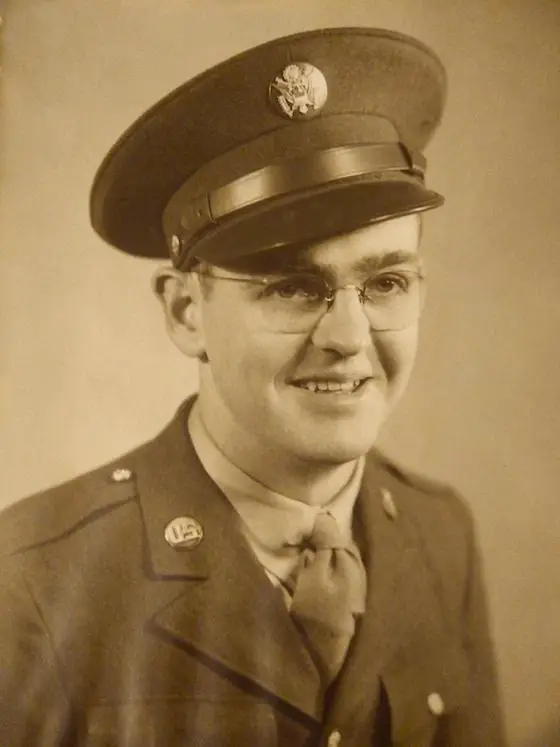
PFC Melvin Carter
Author's Note: The following text appeared in Chapter One of the Adventures & Advice book that I wrote at the request of my youngest daughter. I also shared the book with my other two older children. This book is not available to the general public as it was a special gift to my children, my older sister, and a very small select group of my friends.
It's important to realize that my father, PFC Carter, passed away before any of my children were even a glint in my eye. The details of his life in what you're about to read are what he might have shared with my children had he been able to sit them on his lap and talk about who he was and what he did.
I only came to appreciate and deeply love my father years later after he had been worn down by life and the horrors of what he experienced in the great World War II. My mother, sister, and I sent him back to Heaven when I was a very young man.
Grandfather Melvin Carter
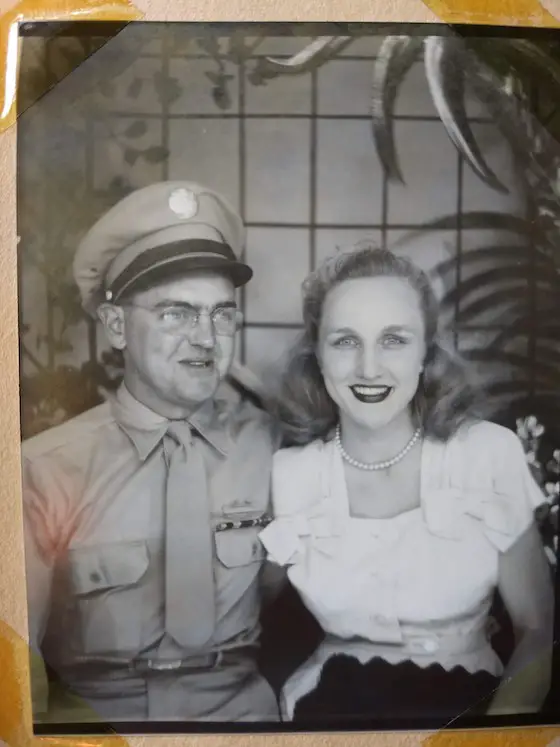
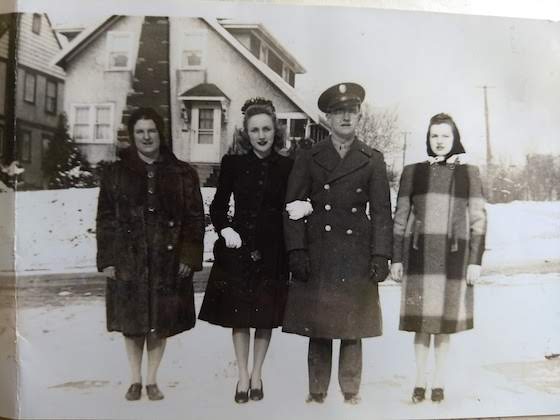
Your Grandfather Carter looks pretty smart in his US Army uniform, doesn’t he? He’s beaming because he’s sitting next to your grandmother no doubt! This photo was taken in June of 1945 after he returned from the hellish experience of World War II. The photo was taken at Coney Island amusement park in Cincinnati, Ohio. Many people went to Coney Island before Kings Island ravaged and plundered its customer base.
My dad was born on April 10, 1917. That was just four days after the USA entered World War I in Europe. His middle name honored the tiny hamlet where he was born, North Vernon, Indiana. His father, William Columbus Carter, was born in 1846. That made him 70 years old at the time your grandfather was conceived!
Your great-grandfather was a country veterinarian in the middle of nowhere. North Vernon, Indiana is a sleepy town now, so you can imagine what it was like in the early 1900s.
I have no clue when the family relocated from Indiana to New Richmond, Ohio, just fifteen or so miles upstream on the Ohio River from downtown Cincinnati. But before ending up in New Richmond, they must have relocated to Cincinnati, not too long after my dad was born, because my great-grandfather is buried at the Baltimore Pike Cemetery in Cincinnati.
I do know that my dad’s mother, Ida, married three times. Ida remarried a man with the last name Steinbrecher. This is why all the urgent telegrams she received about her son during World War ll were addressed to Ida Steinbrecher. I don’t have a record of this but Ida’s second husband must have died and Ida, not wanting to be lonely, remarried a third, and final time, to Louis Nitzel. Ida passed away in 1957 and her final resting place is in Spring Grove Cemetery in Cincinnati, Ohio.
Your grandfather, his four sisters, and one older brother lived in or adjacent to a boarding house operated by his mother, Ida Steinbrecher Carter. I was five years old when my grandmother passed away. I have a dim memory of seeing her on her deathbed in a house just off Beechmont Avenue in Mt. Washington.
Your grandfather's oldest sister was my Aunt Margaret. She dated and married your grandmother’s older brother, my Uncle Louie. Your grandfather must have run into Louie at the boarding house and at some point, Uncle Louie hired him to help collect money from jukeboxes that Louie owned in local bars and other places of disrepute.
World War II started when your grandfather was twenty-one years old. He enlisted in the US Army to fight our enemies just like millions of other young men. He traveled to at least two Army camps across the US. His first training camp was Camp Pickett in Virginia where he was in Company A of the 6th Medical Training Battalion. He was trained as a battlefield medic and ambulance driver.
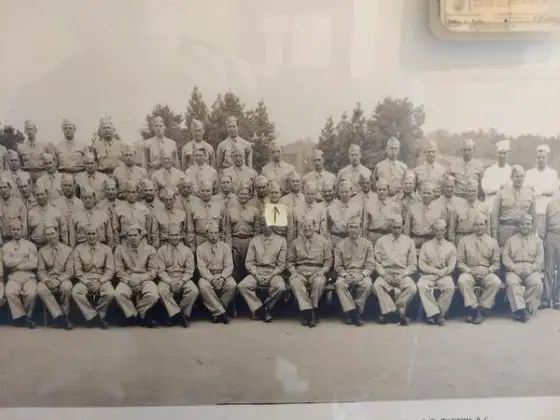
After Camp Pickett, he was sent to gorgeous Camp White in Oregon. He then was sent to Camp Carson in the Rocky Mountains of Colorado. He must have been in awe, as my guess is he’d never before seen snow-covered mountains like these.
Your grandfather was shipped to North Africa from Camp Carson on April 29, 1943. He was assigned to the 11th Field Hospital Medical Detachment, 180th Infantry, 45th Division. He was now a Thunderbird.
During the war, the 45th Infantry Division (including the 180th Infantry Regiment) served under different higher headquarters at different times, but its combat service was primarily:
-
In Sicily, as part of II Corps under Lieutenant General Omar Bradley, which in turn was under the U.S. Seventh Army commanded by Lieutenant General George S. Patton.
-
In the Italian campaign, under VI Corps of the U.S. Fifth Army.
-
Later in France and Germany under XV Corps and other tactical army‑level commands, but not the U.S. Second Army.
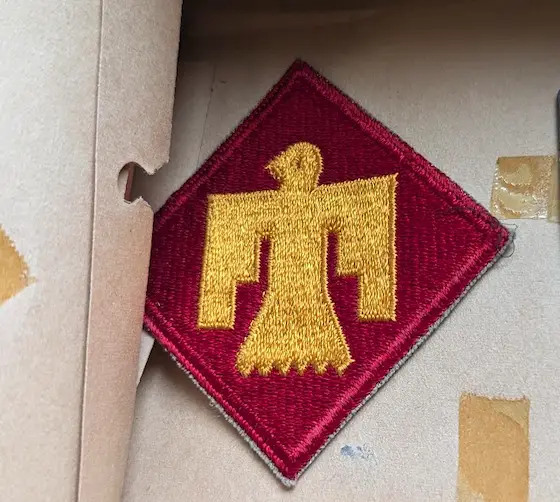
This is the original 45th Division Thunderbird patch in the scrapbook created by my mother of all of Dad's WW II information. Copyright 2026 Tim Carter
US and British troops were fighting the Germans in North Africa, and it was also a staging ground for the invasion of Italy at Anzio Beach. I don’t believe your grandfather was part of the invasion force. My research leads me to believe that once the beachhead was established and the Germans were being pushed up towards Rome, his battalion landed some days after the primary invasion.
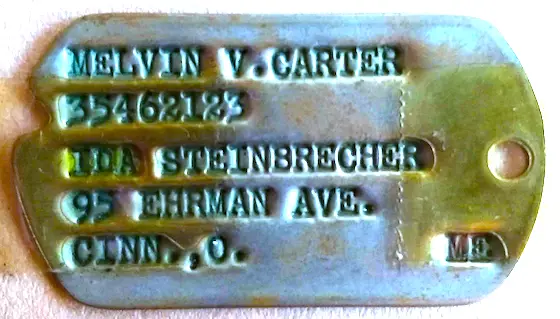
He worked his way from Anzio to Rome, and was part of the force that liberated the city of Rome from the clutches of the Nazis on June 4, 1944. Based on photos, your grandfather took while in Rome, he appears to have gotten some time off while in this ancient city. However, just days later, on June 12, 1944, he was wounded in his left forearm by a Nazi bullet.
The wound was not serious, and he was still able to be part of the fighting force. He also contracted malaria while in Italy. An old newspaper clipping talks about how he was recovering from it before being shipped to southern France.
I’m not clear how he made it to southern France as the Allies continued to push the Germans back towards Berlin, but on October 5, 1944, his unit was sent to the front lines. They engaged the Germans the following morning and the battle raged on all day. As sometimes happens in battle, one side can run out of ammunition. This happened to your grandfather’s unit.
# # # Author's Revision - February/March 2026
I've taken a great interest in the last two months to discover more about what happened during the weeks/months before my father was captured.
Dad was in the 45th Division. This unit found itself chasing the Germans from southern France all the way up to the German border. He was shipped from Italy to the beaches of southern France as part of Operation Dragoon. The intent of this operation was to complement the forces that landed on the beaches of Normandy in June 1944. Dad's 45th Division started pushing the Germans up from southern France. The Americans had captured Epinal, France by September 24, 1944. The Germans offered up some significant resistance protecting the flank of their retreating main army.
The 45th Division crossed the Moselle River and took the town of Rambervillers on September 30, 1944. This unit stayed in the vicinity of Epinal and Rambervillers the first week of October. A very dear friend of mine who lives close to the US National Archives in College Park, Maryland, is in the process of researching the unit's morning reports for that period.
I asked the Perplexity.ai LLM about where to find information about the position of the 180th infantry the first week of October, 1944. It suggested reaching out to the 45th Division Museum in Oklahoma City and to check with a Facebook group dedicated to the 45th Division.
I did reach out to both, and the Facebook group produced what I believe, to be the exact location.
There was a bloody battle in the forest south and a bit east of Frémifontaine, France. This webpage has a succinct summary of the battle. The details match up with the letter just below, written by my dad's best buddy PFC Vance Hollman. Here's an excerpt from that webpage with details about the fierce battle:
"In the first week of October 1944, in the dense forests of the Vosges Mountains, 2nd Battalion, 180th Infantry Regiment, teetered on the brink of total annihilation. German troops and tanks surrounded all three of its rifle companies (E, F, and G), along with their H Company heavy-weapons attachments. Supply routes and communication lines had been severed by intense artillery and tank shelling.
Most of an entire infantry company (F), along with its heavy weapons attachments, was captured in that forest. The remaining two battalion companies, E and G, lost more than half of their men in hand-to-hand combat after exhausting their ammunition. After fighting throughout the day and night, they attempted to fight back through to their own lines through the dark woods, encountering enemy strongpoints and firefights in the darkness, only to find enemy troops using 180th’s foxholes."
A very good friend of mine who's also a subscriber to my newsletter offered to help me gather more data to pinpoint the exact location of where my Dad was captured. He also used AI to help. One of the answers he received mentioned a French Facebook group that might shed light on the location.
I joined the group, and within five hours, a local resident, Jean-marie Siret, who is the leading expert in the world about the battle, shared the name and location of the farmhouse. Jean-marie said in his reply, "The farm was completely burned down and demolished during the fighting that took place in the surrounding area for most of October 1944. Today, a memorial plaque marks its location and commemorates what happened there. Coordinates: 48.2654 , 6.70472"
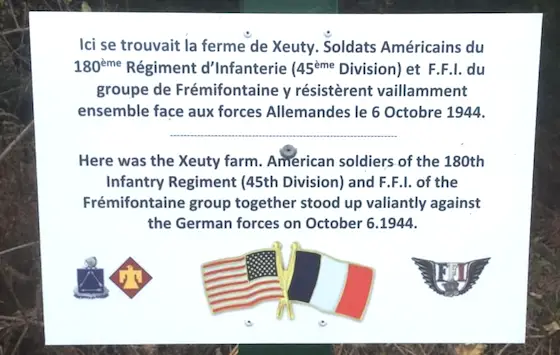
This is the memorial marking the location of the Xeuty farmhouse. My dad was captured just meters away from this sign.
I was overwhelmed with emotion. Jean-marie's father-in-law was a member of the FFI who fought beside those in Company F. He shared with me, "The FFI fighting beside the soldiers of Company F were five and not three. My father-in-law was also present, and he was not taken POW. With a buddy, he crossed the German lines, and both succeeded in escaping.
My father was a medic attached to F Company in that battle. On October 4, 1944, an American patrol came across the large Xeuty farmhouse. The Germans were using it as a forward command post. Our troops forced them to evacuate the farmhouse, and we began to use it for the same purpose.
On October 5th, the Germans were being pushed back. That night, reinforcements came by rail in the small river valley below. October 6th was the day the Germans counterattacked.
E, F, and G companies found themselves surrounded as the day wore on. F company was spread out around the Xeuty farm. My dad was tending to the wounded on the battlefield as the fight raged on. A week earlier, the Germans executed three other medics with head shots. Medics are supposed to be non-combatants. It's against all codes of honor to shoot one. My dad suffered a head wound on October 6th in the battle. I'll never know if it was from a bullet intended to kill him or shrapnel.
Late the night of October 6th, Company F ran out of ammo, and the farmhouse was overrun. My Dad was in the cellar caring for seventeen wounded soldiers. He didn't abandon them and was captured. He received the Bronze Star for his bravery.
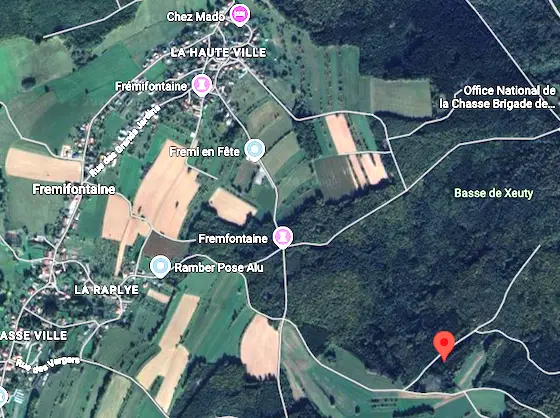
The red balloon marks the location of the Xeuty farmhouse. RIP, Dad!
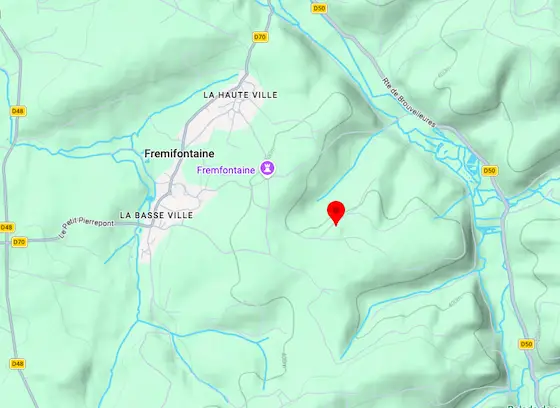
This map shows the hilly terrain of Frémifontaine, France. The red balloon is the Xeuty farmhouse.
Friends of mine who have been in combat tell me the side that runs out of ammo first gets overrun. That's exactly what happened to my Dad.
The fighting at Frémifontaine was some of the fiercest in WW II. Many of those who survived were haunted by the near-death experiences they suffered. I'm now starting to understand why my dad suffered from his extreme PTSD all these years after coming home. He was 100% disabled by the PTSD.
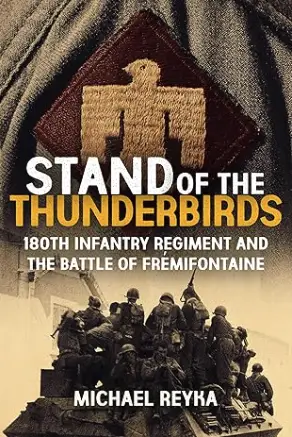
Stand of the Thunderbirds is an excellent book written by Michael Reyka. His father was fighting in the same battle about 1/2 mile from the farmhouse. Michael's description of the battle is riveting. I suggest you read the book.
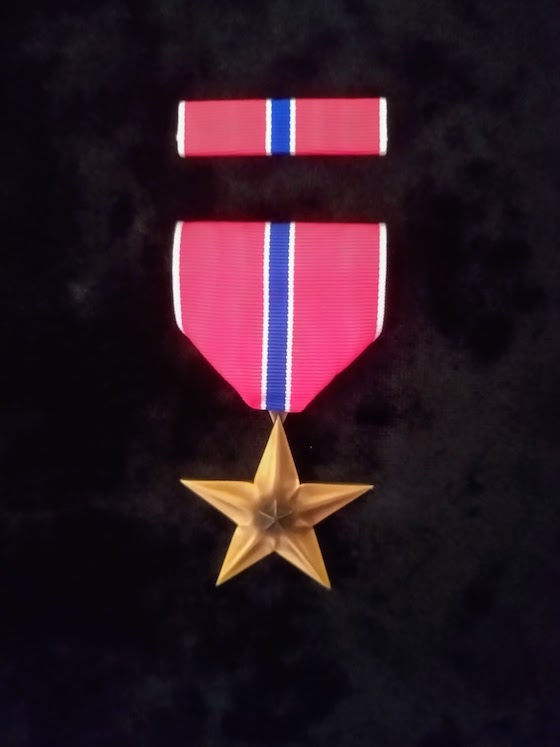
This is the bronze star Dad got for not abandoning his men in the basement of the farmhouse.
# # # END OF REVISION
The Germans captured your grandfather on October 6, 1944. I have a very dim memory of my mom saying that he could have avoided capture, but he stayed with his injured soldiers to provide aid and comfort for them.
A newspaper clipping that your grandmother saved indicated that his best friend and tentmate, Vance Hallman PFC, was able to somehow escape capture. I suspect that Vance was not sent out on patrol at the same time your grandfather was dispatched with his rifle company.
Vance wrote a letter to your grandmother, dated November 8, 1944, sharing the details of the battle and your grandfather’s capture.
I’ve transcribed the actual letter here:
France
8 Nov 1944
Dear Jeane,
The letter that I’ve been waiting for came last night and it was yours of Oct 24 telling me that the War Dept had notified you of Carter being missing in action. I would have written you sooner, in fact I did write you all about it but I destroyed the letter after thinking it over and decided to wait until you had heard from the WD.
I wrote Mary all about it and told her to write you so you’ve probably heard from her by now. But in case you haven’t I’ll tell you about it and I hope this relieves you and his mother of a great part of the anxiety that you must be in.
First of all I want to tell you that Carter is only a prisoner, and I know that relieves you some because the WD never gets into detail and it’s human nature for us to expect the worst when it involves someone we love. Those three words “missing in action” cover a lot of territory and I can imagine how you all felt when you got the telegram.
Carter was an aid man with one of the rifle companies and on Oct 6 there was a big battle in the forests that (Please excuse the two kinds of paper, I didn’t know I was so near out of the other.) lasted all day and up into the night. The enemy broke through our lines and Carter’s Company was surrounded. There were many casualties so Carter and some of the men carried them into a farmhouse and down into the cellar where he could give them medical attention.
About dark that evening the enemy encircled the house and took Carter and the seventeen wounded men prisoners. Some of the other men that were at the house with Carter made a break for it and got away but Carter chose to stay and take care of his wounded buddies who might have died otherwise. Knowing Carter like I do, I don’t believe he would have left those buddies of his under any circumstances and Jeane, don’t you think any of us has forgot that heroic deed and he will certainly get recognition for it from the War Department.
I talked to one of the men that were in the house with Carter who made a break for it and got away, and he praised Carter very highly for his sacrifice. Jeane, the Germans were seen evacuating Carter and the wounded men from the house that evening with the help of five more of our medics that were captured the same time Carter was. So he has five more of his buddies in the medics that are prisoners with him.
They were litter bearers and were in a jeep on the way up to the house to get the wounded men that Carter was looking after, when they were captured.
Jeane, we’ve had reports from medic prisoners and they say the medics get the best of treatment, and they also get priority on the list of exchange prisoners which is very good news.
Yes, Jeane, I do know that you and Carter mean everything to each other and I can readily understand that, and Mary and I are looking forward to being with you all when this war is over. You’re right, we’re going to have a swell time together after this mess is all over, and I don’t think that’s so long off either. Carter and I already have a trip to the Indianapolis races and one to Florida planned.
I miss him very much, we used to lie in bed at night and talk about you and Mary and make all kinds of plans, etc. He’s a swell guy, Jeane, and I’ll be seeing more of him after this war. A fellow doesn’t find friends like Carter every day. He’s one of the best friends I ever had and I feel as if I’ve known him all my life.
Jeane, I received your other two letters sometime ago and this is the reason I haven’t answered them. I sincerely hope that I’ve taken away some of the worry off your and Carter’s mother and if there’s anything else you want to know or anything that I can do for you please don’t hesitate to call on me, I’m sure Carter would do the same for me.
Sincerely yours,
Vance Hallman
I’d love to know more about this and how terrifying it must have been. Imagine having one or more German soldiers, possibly with their bloodlust overflowing, pointing their rifles at your chest.
Another newspaper clipping recounting the battle and capture, states that he also suffered a head wound from a bullet. He was sent to Stalag II-B in Poland after his capture. This camp was located in the far northeastern corner of that occupied country. The newspaper clipping states he ate potato peels to stay alive and went without bread for weeks at a time.
He received a Purple Heart for this injury. Far greater than the gunshot wounds were the psychological injuries he suffered. These would bubble to the surface once back home and would plague your grandfather for the rest of his life.
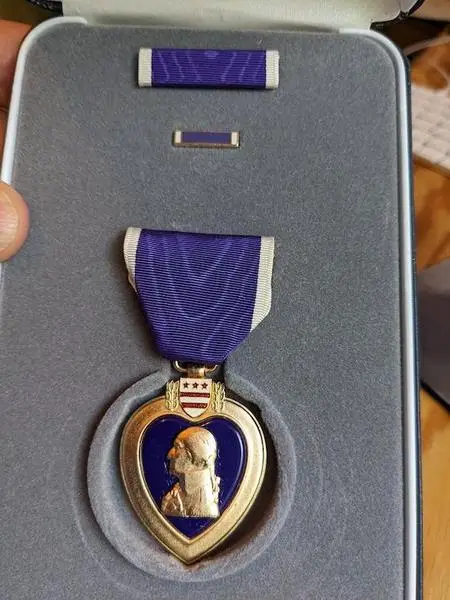
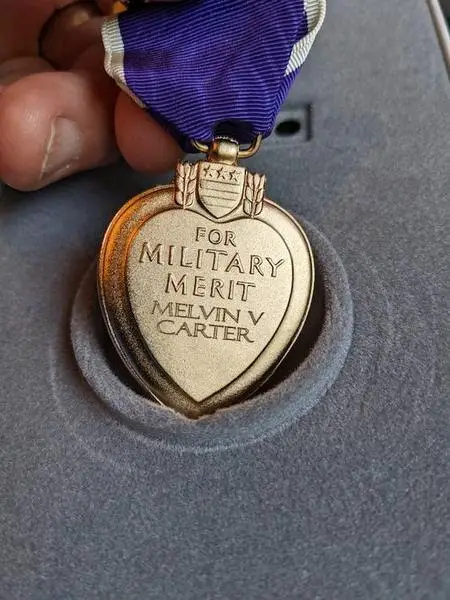
Your grandmother told me many years after your grandfather died that he had an unpleasant time in the German POW camp. He lost quite a bit of weight and I remember a story told once at the dinner table about him being hit by one of the guards. Dad had cursed at the guard out of frustration and the guard either knew English or could simply understand what my dad was trying to convey.
In April, 1945 Dad’s POW camp was liberated by advancing Russian forces that were beating the Germans back towards Berlin. Your grandfather shared the story of how on that day he and all the other prisoners awoke to find all their guards had abandoned them.
They heard a rumbling sound and a Russian tank crashed through the prison gates. Dad and all his POW buddies were fearful that they might be killed, but the tank commander opened his hatch, popped his head out, went back into the tank and brought out a 5-gallon fuel container.
The container didn’t contain gasoline. It was filled with vodka and they all had a giant liberation party right there in the POW camp!
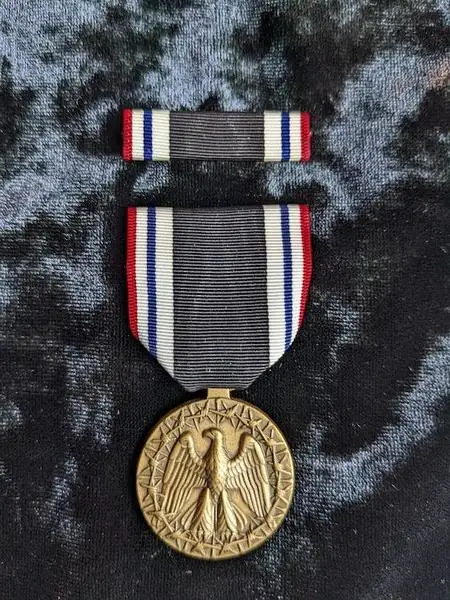
This is my dad's POW medal. Pretty somber black overtone wouldn't you say?
The war ended not too long after this and your grandfather was moved to the coast of France to await a transport ship to take him back home to his sweetheart, your grandmother. Here is the first letter he sent to her once he was liberated from the POW camp.
Germany - May 6 - 45
My Dearest Darling,
Honey just a few lines to let you know I am well and getting along fine. I know you have been waiting seven months to hear from me and I know you have thought I have been dead but when you are a prisoner you are not allowed to write much but I did write you a few letters whether you got them I don’t know.
Honey here is the main thing you want to hear right now. I am at an airport waiting for a plane to take me to the coast of France where I will (missing verb) the boat for home and I should be there within a month. Well honey right now I am very tired and sleepy so I will close until tomorrow with all my love.
Yours forever,
Melvin
He got back from Europe on June 2, 1945. He was sent to Camp Atterbury in nearby Indiana. They were married within weeks on June 14, 1945.
His experiences on the battlefield, the fear of being killed when his unit was overrun, and then the seven months in a German POW camp caused permanent debilitating injuries to your grandfather’s psyche. He suffered from severe depression that, unfortunately, was made worse by electroshock treatments administered by the Veterans hospital psychiatrists.
Doctors back in the late 1940s and 1950s thought this was the best way to treat depression, just like hundreds of years ago doctors thought that bloodletting was the way to cure sick patients.
Should you want to see disturbing and vivid examples of this electro-shock treatment, watch the movie One Flew Over The Cuckoo’s Nest with Jack Nicholson. Based on what I’ve discovered, each successive shock treatment intensified the depression so the doctors were setting up your grandfather for failure. I don’t blame them, nor should you. They were doing the best they could do at the time.
I don’t have a clear picture of the time period from 1945-1955, but my guess is it was a tumultuous time for your grandmother. She was not alone as tens of thousands of other young wives were dealing with their tormented soulmates. There’s a reason why the three-word saying war is hell rings true.
At one point, my Uncle Raymond, Aunt Thelma’s husband, got your grandfather a job at the massive Cincinnati Milling Machine factory. I have one faded memory of Dad either leaving for or coming back home from the plant. He had on dark blue pants and shirt and was carrying a metal lunchbox.
I also have a sad memory of his escalating torment. One warm summer day, he and Mom were involved in a heated discussion. It was close to my birthday and evidently, he wanted to rescind his promise of taking me and some friends on some sort of birthday outing. It might have been an afternoon at Putt-Putt miniature golf. I was quite young and I remember sitting on the front porch crying as I heard Mom’s frustrated voice. I can’t tell you how that discussion or the day turned out, but I’m sure it wasn’t the only time that things that should have been easy were instead a challenge.
It’s important to realize that back then, at least in our family, these hardships were not discussed. It might have been too painful for Mom to do. She might not have had the energy. She might not have wanted to frighten your Aunt Lynn and me any more than we already were. She might have thought that all of it was nice-to-know but not need-to-know information for our young minds.
The downside of being kept in the dark about my dad was that as I grew older, I began to resent his behavior. I couldn’t understand why he stayed home all day sleeping on the couch listening to country music over and over on the hi-fi while all my friends’ dads went to work each day.
The thought of not working was hateful to me. The animosity between us climaxed while I was in high school. I was working seven days a week at Skyline Chili. Monday through Friday, I worked from 4 until 7 p.m. to help out with the dinner rush. I’d miss dinner with the family and would bring home a pint of chili, a packet of diced onions, and a packet of cheese.
I’d eat it at the kitchen table in my favorite red-glass bowl, and Dad would come in most nights to watch me. I look back now and understand why he did this. He wanted to be with me and discover how my day had been just like how I want to hear about your days now. He’d be smoking a cigarette and the stench of it nauseated me. This just added to the dark cloud hovering over us. I so wish I could go back in time and change my behavior as it wasn’t Dad’s fault he was suffering. I was just too young to understand his pain and his own feelings of shame.
Fortunately, I began to mature as I made my way through college. The resentment faded and your grandfather and I began to become friends. I’d talk to him about what I was learning in geology and he was genuinely interested.
Once I graduated from the University of Cincinnati in June of 1974 with my geology degree, I started my own little remodeling business. Not a year passed before I had purchased my first house at 2865 Minto Avenue in East Hyde Park.
I remember one day your grandfather stopped by to watch while I worked. It was a beehive of activity and he just stood there for about an hour shaking his head in amazement at the scope of the project and what his son was doing.
Mom told me years later he was really proud of me. He knew I was tackling what for him would have been an impossible challenge.
Your grandfather’s health had always been poor. His sedentary lifestyle mixed with his heavy smoking was a recipe for nothing but bad things. When I was in grade school he had revolutionary surgery where they installed artificial arteries from just below his heart all the way down both legs. I remember crying about this in school the day of his surgery because I knew it was very serious.
In the middle of August 1976, he went for a normal doctor’s visit and the doctor listened to his heart. He was in the middle of an arrhythmia episode and the doctor told him to get to the hospital immediately.
Your grandfather didn’t last a week. He was in intensive care, had multiple heart failures, and was brought back to life with defibrillators. Your grandmother, your Aunt Lynn, and I watched one of these terrifying events happen. I’ll never forget it.
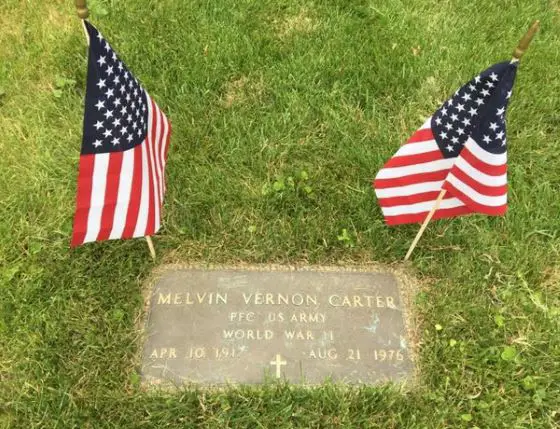
We sent your grandfather back to Heaven on August 21, 1976, while I was living in the starter home in Hyde Park. I remember your grandmother calling to tell me he had passed away. I have many regrets about your grandfather and one is not being by his side as he passed. He died alone in his hospital room and it bothers me to this day. Your grandfather was still a young man as he was only 59-years-old. His final resting place is in Spring Grove Cemetery in Cincinnati, Ohio, near the rear exit.
Not a week goes by that I don’t think about my dad. There are so many things I’ve done that I wish he could have seen. It would have been so cool to have him stop by while I was building the house in Amberley. He would have been speechless at all the carpentry involved in that huge project! I think he’d be really proud of how my life has turned out. I know he’d be proud of you!
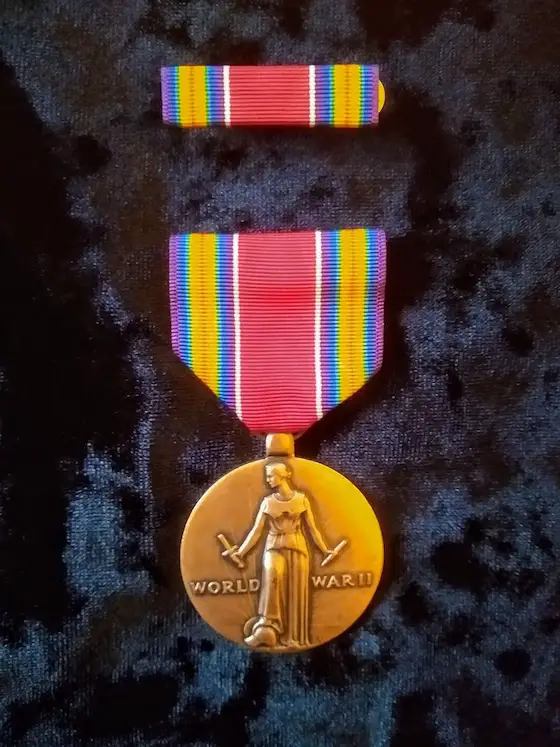
This is the WW II Victory medal I imagine all service members got once they got back home.
This column was featured in many of Tim's Newsletters.
Memorial Day Tribute - May 24, 2020 Newsletter
Mother's Day salute to my Mom and her Bright Red lipstick.

Tim built custom homes and did ultra-custom remodeling for 20+ years before launching his Ask the Builder media presence. He was selected as one of the Big 50 by Remodeling magazine in 1993. This award gave birth to Ask the Builder in October 1993. Tim also operates https://DrawPlumbingPlans.com. His @askthebuilder YouTube channel was the first home improvement channel on YouTube.
Tim, thank you for sharing this intensely personal (though sadly, more common than we would like to think) bittersweet story with us. In those days, people just kept so much inside. It was hard on everyone in the end, and led to many misunderstandings. God bless your dear father, and all victims of war. There's a special place in Heaven for the wives and families who stand by and do their best to support their hurting soldiers.
That was fantastic. Thank you for sharing.
Whatever angst you may feel about your relationship with your dad those final years can be relieved by your sharing that experience with others, in that we can learn from that experience, and work to improve our relationships with those in our lives. That pain is not lived in vain.
Thank you for sharing, and thank you to your dad for his service to this great country.
John
Wow, Tim, what a story. Your memory of your father is amazing and heartfelt. I'm sure your daughter is extremely proud of the work you've done to bring your father's memory to life.
Thanks for sharing.
What a tribute ! You and your father and undoubtedly your love ones are wonderful people.
Tim,
Thanks so much for sharing this deeply personal story. With the help of the internet and God (mostly God), I am hoping to transcend time, space and dimensions with a belated, "Thank you for your service to America", to your Father and Grandfather to your children.
Tim, take care and stay safe.
PS Happy Birthday to your daughter.
Very touching. A perfect tribute this Memorial Day. It's so sad he and your family had to endure the emotional damage from his service to our country.
I know he would have been proud of you on many levels. The book is just one of them. You help people every day to make their lives easier and their homes more livable.
My Dad served in WWII also 101st Airborne.
Hi Tim what a tremendous gift you have given your children in telling the story of their grandfather. I live in Indianapolis and am familiar with the places you spoke of in Indiana. Thank you so much for sharing this chapter of your book with us.
Tim,
That was beautiful writing of a sad-proud-heroic story about your fine Dad. Thanks for sharing! We all appreciate his service. My own Dad was unable to serve, after going through to enlistment process, due to cardiac issue they found, which ended up being his demise at age 75. But, he always said how much he regretted not being able to serve his country in WW2.
Thanks Tim for sharing about your dad. Over the years you’ve shared snippets, but reading through your chapter on your dad fills in the full picture of a wonderful, generous man. I think his son has gone that same path and probably made up for his dad’s circumstances with a double dose of zany humour too
My father, from Ohio, served in WW II and also did most of his training at Camp Carson, arriving in December 1942. He has a number of photos in a scrap book from his days there. He eventually was sent overseas to England in June 1944 and then on to France. He was severely wounded, losing his leg above the knee, in September 1944 in France. Medical rehab brought him back to the States where he spent nearly a year at a VA facility in Battle Creek, MI. He recovered from his physical injuries and best I could tell, any associated psychological challenges. He passed away in 2005. But of course there are so many times since then when I wish I could speak with him further about his experiences. That's great that you've documented your father's story for your family and sharing with us readers.
Tim:
Thanks for sharing this poignant story. We should be thankful that most of us never had to experience the horrors of war as many of our veterans did. Later in life, my Uncle told us that he served in Germany after the official end of war in 1945. He said that as an 18 year old, he never understood why the killing just didn't stop. This is not well known in history, but old scores had to be settled among the various ethnic and national groups of displaced persons. He had to kill another man in self defense and it haunted him for the rest of his life. May God bless those veterans who struggle with these harsh memories.
On this Memorial Day, thank-you for sharing your father's war story with us. The sacrifices made by all these heroes and their families for present and future generations is truly appreciated. My father was in the Air Corp but the war ended before he was ever sent overseas. We recently transcribed hundreds of letters between him and my mother from 1943 to 1945. They wrote to each other DAILY. It was a very rewarding experience.
Thanks Tim, for the story about your father and what he went through. A brave man. He endured a lot, your relationship with him was strained at times but he still loved you. He would be proud of your success. My father was also a medic and ambulance driver with the 109th Med. Battalion, 34th Division, went through the North Africa campaign, barely escaped capture at Faid Pass (according to his buddy, we heard years later at Dad's funeral), then also went through the Italian campaign, finishing the war in Italy.
Thanks for sharing Tim. Thank you for his sacrifice and your family's. God bless
What an amazing story Tim! Thank you for telling it formally to your family and sharing it with us. Many war veterans regardless of which war they serve seldom feel comfortable talking about their experiences. You did your father and others a service by telling it best. He would be proud!
Perhaps some of us are wondering if your dad was honored for being a hero sticking with his wounded
fellow servicemen? You noted he received a Purple Heart. He surely deserved to be recognized more than that with a hero's commendation or medal or both.
I can relate to your experience with useless shock treatments. A close member of our family also had these treatments in the 1970s. After 17 years of mental illness, she finally experienced a long-lasting piece with the correct mix of medications. At one point we thought we lost her emotionally.
Thankfully, she lived another 17 years and never suffered from critical mental issues again.
Best regards for sharing your family history.
Thanks for posting this. Always good to read real history by folks who were involved. It seems that I get more from your internet columns that the ones I read in the Washington Post which is where I first heard of Tim Carter!
Thanks again
A very touching story Tim,I can only imagine what these Men went threw. My father was fighting on the other site of the world then, Okanwa, I think God he made it back too.
Thanks Tim
Thank you for sharing. Unfortunately, he paid dearly for his service, yet we benefited significantly from the service and sacrifices of so many in that war. Again, thank you.
World War II was a unspeakable tragedy. The list of perpetrators is long. Most Germans were not Nazi. Most soldiers followed orders on all sides. All sides committed war crimes, a situation that has yet to be addressed in public. Truth is the first casualty of war.
Electroshock therapy is like shorting out the car battery to get the dead lamps in the headlights to work. We still do not have any solutions for mental illness. All "treatments" are harmful, no matter how well meaning our intentions are.
Your father deserves respect. Daniel
Thank you for sharing, Tim. To the greatest generation!
Thanks again for linking this.
Great story, Tim. It mirrors a lot of the experiences of that generation. War IS hell and let's hope nobody ever has to go through a war of that magnitude again. You brought a tear to my eye remembering MY dad who served in WWII as well. He never talked about what he went through, we had to hear it in bits and pieces from others who served with him.
Thanks.
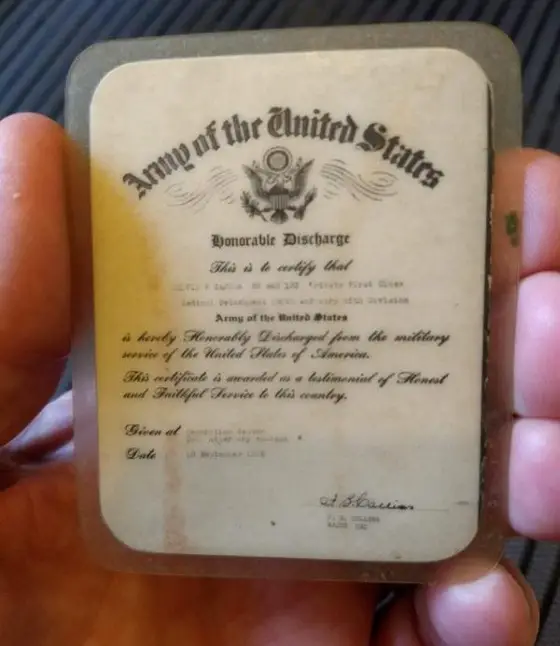
I noticed he was honorably discharged from the "Army of the United States" My late father was discharged the same way. My father claims that if you were drafted, your discharge would read Army of the United States. If you were enlisted it would read United States Army.
Have any insight on this?
Beautiful tribute.
Hi Tim,
What a remarkable recount of your father's life during the war years. You and your family must be grateful to have so many details of his time and places he went.
So many families don't.
Thanks for sharing his, and your story on this Memorial Day. Seems, for so many, it's just a long weekend.
My dad left the University of North Carolina to work in the Wilmington NC shipyard at the beginning of the war. I was born there during that time. He did go into the Navy, but remained stateside in Chicago and San Francisco.
He worked as drywall finisher during the building boom after the war.
So many families...so many stories!
Thanks,
Jim
Thanks for reminding us of what is truly important. My family and I are are very lucky, my dad made 95 on April 19. He was sent to France after the D-Day invasion at 18 years old. He was wounded in action and received a purple heart. Thankfully he recovered and served with the occupational troops for a short time after the war. He is very proud of his service, as are we. His biggest regret is missing the invasion! You spoke of treatments by doctors, educators were not too different. Being from south Louisiana, my mother did not speak english and I am sure my dad new very little when entering school. If they were caught speaking french at school, (their only language at the time) they were punished. My dad was left handed and if caught writing with his left hand he was punished. He became ambidextrous. How times have changed! One thing was they always loved this country! Bless you and your family Mr. Carter and God bless America. Kim
Thank you for sharing.
Thank you for sharing your personal story about your Dad and the impact it had on you and your family.
May his memory, and the memory of those who sacrificed dearly for our country, be eternal.
As a veteran of Vietnam (Combat Medic) I admire your dad's devotion to duty and sacrifice tending to his wounded comrades.
Dad is smiling at you, from heaven above, as you reach out to others through your website.
Thank you for what you do.
This moved me almost to tears. Thank you for sharing it!
Tim, thank you for putting this in your newsletter. Thank you for your father's service and sacrifice. Without men like him our republic would nbot exist. I am a retired Air Force Major/B-52 pilot. My only "war" experience was deploying to Moron Air Base, Spain to help plan missions for B-52s during Desert Shield/Desert Storm. I am thrilled and thankful I never had to use my training to fight a nuclear war. I have a long family history of military service with ancestors who fought in every war starting with the French and Indian War. That's on my mother's side. My father's parents immigrated from Ireland just a little before WWI. His father was a fireman (the kind that stokes the coal fired furnaces, not the kind that puts fires out.)at the Remington Arms plant in Bridgeport Connecticut, so he was exempt from the draft. My father was drafted in WWII and met my mother when she was assigned to the Army Air Forces office he supervised. She was a WAC Clerk/typist. WACs, of course, took non combat jobs so that more men could be trained in combat positions. I also had two uncles who fought in WWII. One was a Seabee, the other an infantry man who described his service as landing in Italy and walking to GermanyAgain thank you for printing this and for your ongoing efforts to fight those domestic enemies. Keep it up.
He truly was a hero Tim. So sorry for the torment he went through after he got home. He is in heaven and no longer has any pain.
Thank you for sharing this on Memorial Day. It was heartbreaking but also heartwarming. So sorry that your Dad passed all too soon, but I am very thankful for his actions in WWII that benefit us still today.
Tim, Thanks for sharing the memories of your father. My father was also a WWII veteran. When he returned to civilian life, he became an alcoholic and it didn't make for a good family situation for my mother, brother and I. Our relationship with dad was not pleasant for many years. I don't know if it could have been improved through therapy and a better understanding of his war experience, but I look back and wish that I could have had more empathy. He too died alone in a Veterans hospital and I regret not being there as well. He shared with his econd wife regrets about not being a good husband and father to us, so he had a good heart. Again, thanks for sharing.
It is a little hard to type my comment because of tears in both eyes. It is wonderful that you did the research for your and your family's benefit. Thank you for sharing it with us.
My father went through France and Belgium and ended up on Guam, fortunately without being wounded or imprisoned. He didn't want to talk about anything concerning WWII.
The Rockford, IL WWII annual reenactment gave you and I a small hint of what it was like to fight a war, but nothing we see, hear or read about can truly represent what military and civilian victims of war experienced physically and mentally.
Thank you for this remembrance and appreciation of your father. It is beautifully written.
Thank you so much for sharing this memory of your father. His sacrifice and anguish brought tears to my eyes. Our country could do more to address the mental health issues of returning veterans.
Hello Tim,
Just read your Dad's WW2 story. It's Rememberance Day here in Canada and I just returned from the War Cenataph. My two grandfather's and Great Uncles returned from WW1 as changed men. Two were never far from the bottle. I was raised by the one Grandfather (who also served in WW2) as my father, a pilot in WW2 went down after returning home in 1950. An Uncle in the Cdn Army went up the boot of Italy at the same time as your Dad. Your Father would have been proud of your accomplishments.
I then read your little trick on putting a small-holed cap on the roof sewer vent. I was thinking of extending ours stack because it's often a foot or two beneath snow. But now I may not be so ambitious. I never though about the Bernouli (or Venturi) Effect. With it extended too far it might "catch" more wind. The low pressure caused by wind flowing over the top might "suck" water out of a trap or two. Thanks. You provide a great service.
Bryan from Northern Ontario
Thank you for sharing your story. Your dad was a hero. And I am sorry for the suffering he and your family went through.
My dad served another way. He was an engineer, and "frozen" at his job at Curtis-Wright (later, McDonald-Douglas) at St Louis. One thing he worked on was the Canberra Bomber Project (didn't realize that until I saw his obit). Later he helped develop the the Apollo Moon Rocket.
I "lucked out". 3 months after I was discharged (1962) my whole unit was shipped to Nam.
Sad story. My Dad died at 59. He was an alcoholic and he came back somewhat disabled with trench foot. He was in the battle of the bulge and feared the 88's. He also said he craped in his pants jumping into a foxhole with a dead German. He use to laugh at us kids watching war movies. His metals got stolen when he was in the hospital. I regret not being close to him but I respected him. Had a few beers with him. I was busy working on my own life using the GI bill to attend trade school.
Thank you for sharing your story. My father also spent the end of the war in a German Prison Camp. He would not talk much about it other than the 3 words, "War is Hell".
Wow Tim, that’s a a beautifully written piece. I hope people think long and hard about what it takes to keep our freedom this weekend in the US. We, here in Canada, got a strong taste of what the possibility of losing it might feel like the past few months with our Prime Minister. It’s nothing close to what your father and others suffered in the war, nor what is going on in Ukraine, but it does make one realize how quickly things can change and how much we still need to stand up for what’s right and our God given freedoms.
Wishing you a peaceful and happy Memorial Day.
I too had uncles and cousins shot out of the sky, survived (or not) POW camp and had ships sunk out from under them. No one ever talked about their sacrifice for our freedoms. In fact, until their coffins were draped with Old Glory we weren't aware some had even served.
My Dad was exempt, being a dairy farmer, but he was still affected by relatives trauma. Also had good friend die from Agent Orange. He wasted away losing extreme weight 180 to 65, hair & teeth. I carried him to toilet, wiped him, carried him back to bed and held his hand when he died - will never forget.
Tim,
What a great tribute to your father. He was a true hero which I know you’re proud of his valor!
My father was in the navy and landed the first wave of marines on Omaha beach. My dad, like others did not talk about their experiences. He said they had a job to do and did it. He finally started to talked to me later in his life about his stint in the navy.
He was fortunate and did not have to endure what your father experienced.
They truly were the Greatest Generation!
Thank you for sharing you fathers story and thank for his service and sacrifice he gave for his country!
Sincerely,
Rob Schedel
Dear Tim,
Thank you for your memorial to your father and The Greatest Generation who served in WW2! Those of us who are combat veterans understand and agree with your comments about duty, bravery and selfless dedication.
Slow hand salute to PFC Melvin Carter and all veterans of WW2!
Dear Mr. Carter,
Thank you for sharing your dad's story with us. I truly enjoyed reading it.
I't's been my privilege to be a History teacher for the past 27 years in SW Ohio, most recently in a small town called Arcanum. When I was a very young teacher, way back in 1996, one of my students asked his grandfather to come in and speak with the class. He shared his experiences at D-Day with the class. What amazed me was, even after 52 years, he still teared up speaking about it.
One final thing. I thought you might enjoy hearing about my Great-Uncle John who fought, and died, in World War I. He was killed in combat in November 1918, just a few days before the armistice. The injuries must have been severe because, when his body was brought home, the Army would not allow the casket to be opened. They even sent a soldier to ensure it was not disturbed. Needless to say my great-grandmother was traumatized and wanted the casket opened to ensure that it was her son. I have a suspicion that she did not trust the War Department. The night before the funeral, my grandfather Tom, and his brother Early, took whiskey (probably moonshine since this was in the hills of Eastern KY) to the funeral home and proceeded to get the guard so drunk he passed out. They opened the casket and confirmed that inside the casket was the body of their brother.
Again, thank you for sharing your story.
v/r
Kevin Stanley
Your sharing of your father's life was very touching and I appreciate the additional information beyond what you told me when we went to the WWII reenactment. I know little was said about my father when you, your son and I were together, but your wishes to go back in time struck home. My dad was in the Engineer Corp and went through France and England before being transferred to Guam, but he never would discuss details of the war and looking back there was a distance between us that by High School I should have been able to recognize, but we did have fun together in the Boy Scouts and visits on my grandfather's farm in Missouri. I hope there will be a reunion when my time is up.
What a beautiful story and thanks for sharing. I am a WWII buff and personally have known many who served then. They truly were "The Greatest Generation."
Thank you for sharing such a great story. I am a WWII buff and have known many men including my dad who were part of "The Greatest Generation."
Your parents were married on my fourth birthday and soon to be President Donald Trump's birthday. You can be very proud of your father's service for our country.
Tim,
Forgive me to transgress into your description of your father that you wrote for your kids only. I don’t know what attracted me to do this but let me tell you that you are a hell of a guy that turned out to be such a successful professional that has become a household name. Sheer hard work & absolute focus on what you did that helped your career growth.
Long live Tim.
Mirza S Baig
Tim, Thank You for this newsletter. That You for telling us all about YOUR dad. I will be giving a talk about Memorial Day @ our Church This Morning. Served 1968-1970 in Army. Was So nearsighted they sent me to Germany Not Vietnam. Will use some of your Newsletter in my Talk is that okay? God Bless you Tim
Dear Tim, I so appreciated Dad's story. I too wrote about my Dad's WWII in the Storyworth book Meghan and Brent gifted me last Christmas. My Dad was 31 when he was drafted to be a bomber maintenance bomber crew chief. Similar to your Dad went to North Africa, then to Italy and Germany. He had a photo of Mussolini and his mistress hanging on the town square. He NEVER talked about his war time. I saw him cry only 2 times in his life: he told about some of his crew "his boys" he called them, were shot down, captured and sent to a prison war camp. Some escaped but a few were captured and shot by the SS. The survivors came back & shared what happened. Their story was told in the movie "Great Escape" which caused Dad to talk about it after he had viewed it. It tore him up. The other was he had to see the body of one of his coworkers who fell off a grain elevator. He cried and cried and told us it reminded him of a "flyboy" he took out of a plane that had returned. The boy died right there and he said he had the same blood on his mouth as this coworker. We can never understand what happened to them but you loved your Dad and that's what counts I think. My Mom was a battle front line nurse-anesthetist in France and Germany. She told LOTS of stories. I think each person deals as best they can their war. We had parents (your mom too) as wonderful examples of what it means to be a patriot and life survivors. Again, thank you for sharing. Christy
Your story about your father reminded me of my father's life. He was also in WW2 with the navy in the Pacific. He drove landing craft in the Guadalcanal battle. His boat was hit by enemy fire and he spent some time on the island attached to the Marines. He never would talk about what it was like but I'm sure it was bad. He never ate rice again so that should tell something life on the island. Thank you for your story Tim.
This is such a beautiful story of your dad. It brought tears to my eyes, just thinking of all the veterans with similar stories. Thank you for sharing..
Reading this with tears in my eyes. Thank you for sharing your father's story. This Memorial Day 2024 my heart is heavy but, I am thankful as I remember those I served with in the Air Force that made the ultimate sacrifice for our country.
Wonderful story and well written, thank you for sharing it.
I see that your father was honorably discharged from the Army of the United States. Like my father who was also has the same discharge. He was a Draftee. The enlisted discharge would read United States Army. (Just one of those little factoids). My father worked at the Watertown Arsenal as an apprentice starting in 1939, was drafted shorty thereafter, and was deferred until D-Day. His most important contribution was in 1939 when given a crate full of the newly made M1 Garand rifles to diagnose and solve the problems. It appeared many had the tips of the firing pins broken off. He looked at the drawings for the part which was fully hardened steel. He made a few heat treated spring steel test pins. They all worked fine. The idea was sent to the Springfield armory, nothing was heard back. When in basic training, he could tell that they did something to implement the change, as the sound in burst mode 2 or 4 rapid fire (en-block 8 no high capacity magazine). sounded rhythmic not erratic as with the fully hardened steel firing pins.
He was disappointed in his military service as it was just recovering military hardware from the battlefield during the demobilization. But then there was other ways he served the nation than in combat. Dad passed away in 2012, buried with military honors. Had zero problems with having this arranged with the help of a local veterans organization.
Tim,
Thank you once again for sharing your Dad’s story during and after the war. It’s a great thing you are doing to record these events and memories for your kids, and grandkids, and future generations of Carters! Thank you and your Mom for your Dad’s service to America.
God Bless our Melvin Carter .
Tim, I know I've read this account of your dad's life before, but it was just as emotional the 2nd time around. Of course it brings back memories of my dad and our relationship. Your dad was a great man and I know from your writings that he loved you although your relationship wasn't what you would have wished it to be back then. If it wasn't for men like your dad, this world would be a different place. Thanks for this tribute and God Bless you!
Lawrence
Thank You Tim. What an experience. I look forward to the day/s when wartime activities END. Billy Joel wrote an amazing song in the 90s "Two Thousand Years".
Yet here we sit with Gaza & Ukraine on our hands. Like you i do believe there IS a god, but S/He has "conditions". ie. There you go Children, go play in the traffic. It's up to YOU all, to carve out your own futures..to choose Peace over War; Love over Hate, etc. Do we need another 2000 yrs, maybe ? WHY ? Blessings to you for what you choose to do in our world. Thank YOU.
Remarkable, Tim. Thank you for sharing the story of your dad, Melvin Carter, a member of our nation's Greatest Generation. The narrative is compelling both because it is so complete and, in the best sense, so ordinary. This young man did his duty, as did hundreds of thousands others so that we can enjoy the legacy of freedom. He and his generation saved the western world from totalitarianism. Two things especially got me choked up: the stunning photo of your parents (took my breath away for a moment), and the story about the victorious Soviet tank commander sharing his vodka! Manly virtue and goodwill can come in many forms.
I have been blessed on this Memorial Day by reading your account of PFC Melvin Carter.
Tim, I was blessed to read your book you wrote for your sister about your Dad, his service to our country and the experiences of you and your family after his return from war. There are so many things in life we don’t understand in the moment. We have had some tremendously difficult times understanding the things that God has permitted in our life of ministry and business. The emotions of the moment are more informed now but still at times debilitating. Waiting on the realization of “all things work together for good” and holding on to the promises is a work in process.
Thanks for sharing and blessings to you and your family!
What a story about your father! Thanks for sharing.
Thank you for sharing, Tim! Many in the veterans groups I subscribe to as a Vietnam War vet, comment how they are still fighting the war because of the experiences they had - even if they were not wounded or wear a Purple Heart that reminds them. You were wounded as well, indirectly, due to your father's experiences. Your writing indicates you are still suffering some guilt. But, it is difficult as a young person to understand war experience. I pray you peace, my friend.
Tim,
Thanks for sharing your father's story. I had an uncle (in Europe) and a stepfather (Pacific theatre) who served in WWII. Neither one talked of their service during the war.
Greg
Please add my thanks to those from many others for sharing this well-written and fascinating story. Both my parents served in France in the final years of the war, my mother as an RN and my father as an officer in the Medical Administration Corps, both First Lieutenants. They took part in the Battle of the Bulge, in which my father earned a Purple Heart for an injury. They were married in France immediately after the war ended, and I was born a little over a year later. I’m so glad neither of them experienced the horrors your father lived through. He was truly a hero, and you are justifyingly proud of his service. I myself enlisted in the Army during the Vietnam War, but was fortunately assigned to a Top Secret intelligence operation in a Germany that was much kinder to Americans than that shown at the time your father visited there. Thanks again for a very heart-felt story and a wonderful tribute to a man who, in a very real sense, gave his life for our country!
Thank you Tim for sharing your father's story. My father fought in WWII and the Korean War. He was 18 years old when he was drafted. At one time, things were so bad, that my grandparents were concerned that he might go awol trying to escape some of the horrors he experienced. It was hard for me to imagine what life would have been like for a young person to be removed from life as they have always known it and thrown into the middle of a war. We would ask him questions sometimes but he would say very little about it. It was obvious that he had experienced some very hard things. I know it sounds strange, but when my dad was older and started going to the VA for medical needs, he was meeting others his same age that faced the same situations, and therefore able to talk about what they experienced. I felt like that provided some healing for my dad, from the weight he had carried all those years. Your story has provided a little insight to what my dad may have experienced. Thank you.
Hello Tim,
I was just reading the story about your dad. In July, the longest bike race starts again in France: The Tour de France. Stage 14 is on July 18th, the route is a little bit east, but very close to the village you mentioned. This stage: Mulhouse to Le Markstein shows the landscape and villages. There is a ~2.5hr live stream on Peacock that follows the 93.5 miles. The commentators from NBC are excellent, they explain the countryside and of course the race. Just Google Mulhouse France, which is a interesting old city, beside old buildings there is also a French railroad museum. I was born and raised just across the Rhine River in Bad Krozingen (Freiburg) Germany. I used to hike and ski in the Vosges mountains and loved it.
Edmund, wow! Many thanks for this tip. You can bet I'll tune in.
Tim - Thanks so very much for sharing your very heartfelt story of your Dad’s wartime experience…and the aftermath of that experience and how it affected you. Take care.
Thank you for sharing your father's story. I had four uncles who served in WW11 and all came home as alcoholics. I understand more about their demons after reading your father's story. You mentioned he was employed by Cincinnati Milling Machine for a while. I worked there for 38 years before the Oakley was sold. I was forced to retire from the purchaser on 12/31/2000. The name was changed to Cincinnati Milacron about 1974. Thank you also for your website and all the help you give to people.