Ventilating Attics in Hot Homes
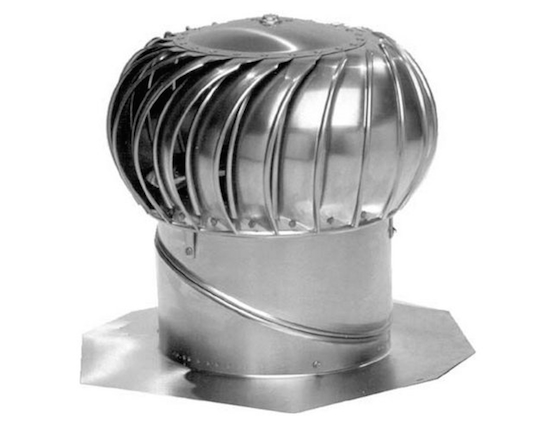
Ventilating attic space is super easy using a standard turbine vent. They come in different colors. Some have external braces. This one you see is Made in the USA. CLICK THE IMAGE TO ORDER ONE OF THESE GREAT TURBINE VENTS.
Revised March - 2018
Ventilating Attic Spaces - Do It With Turbine Vents
DEAR TIM: What about ventilating attic spaces in a Cape Cod style home that has a short knee wall in the upper level? I've asked three different contractors and received three different answers.
The attic and second-floor areas get stifling hot in the summer months. I'm getting new shingles installed and thought this might be the time to make changes. Joan S., Royal Oak, MI

CLICK this image and listen to Ask the Builder podcasts! Copyright 2018 Tim Carter
Related Links
Turbine Vents Are Easy To Install
Hot Garage Ventilation - It's Not Easy
DEAR JOAN: You could have told me your house was a ranch, a colonial, tri-level, Victorian, etc. and my answer would be the same. High attic temperatures are a reality in just about any traditionally built home that gets direct solar radiation.
I've been in attics in the middle of the summer where it was nearly impossible to breathe. Sweat burst from my skin within seconds of entering the inferno. My best guess put the temperature somewhere near or above 140F in these wretched confined attic spaces.
Free & Fast Bids
CLICK HERE to get FREE & FAST BIDS from local contractors who can install attic ventilation fans.
This makes sense when you discover the surface temperature of the outside of a normal roof approaches 160 F on a summer day.
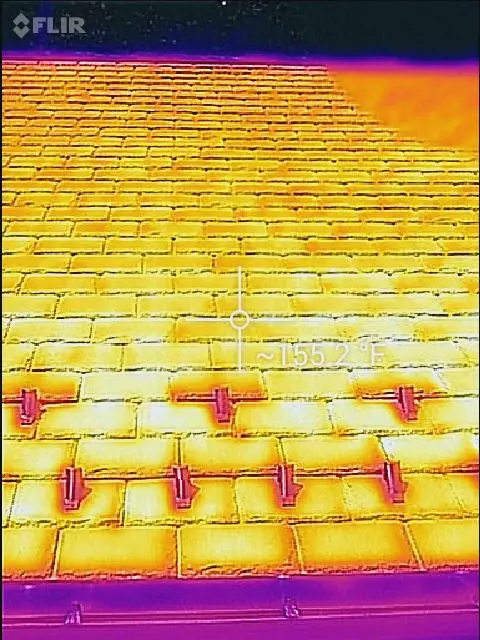
This is a photo of my own roof I took in the summer of 2015. I took it with a FLIR thermal camera attached to my smartphone. You may be able to see the white crosshairs and the temperature next to them: 155.2 F. CLICK THE PHOTO NOW TO HAVE THE FLIR CAMERA DELIVERED TO YOUR HOME.
Infrared Heat Cooking The Sloped Attic Surfaces
Your Cape Cod home offers distinct challenges with respect to combating high temperatures and infrared heat. The bottom of the steep roof rafters typically rests on top of the first floor walls.
As they rise and meet at the center of the house, they create a smaller livable space on the second floor. Small vertical half or knee walls intersect the underside of the rafters. Most Cape Cod homes have a small flat ceiling area in the center of the second-floor living area. The rest of the ceiling space is created by the underside of the roof rafters.
Little Space To Insulate
The slanted ceiling is a huge problem area. Many Cape Cod roofs are framed with 2 x 6s and on rare occasions, 2 x 8s. The small vertical knee wall allows carpenters to use smaller dimensional rough lumber.
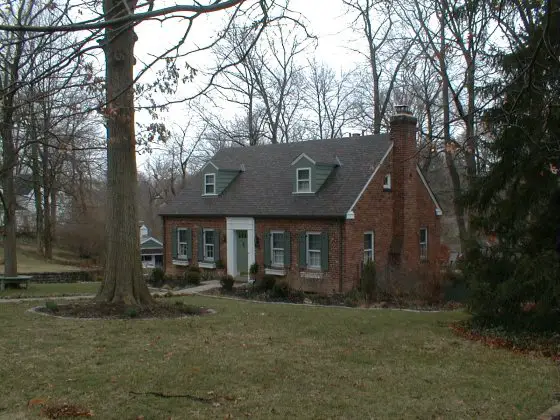
This Cape Cod home is easier to ventilate. Two turbine vents on the back roof will do a fantastic job so long as the front and rear soffit vents are clear and allow air to flow towards the turbine vents.
But this small lumber leaves very little space for both insulation and the required free air space above the insulation. Free air space above all insulation is a necessity. It is the conduit that permits the free flow of cool air through an attic space.
You Must Move Lots Of Air
To effectively cool your attic, which in turn helps to keep the finished living space cool, you must constantly exhaust hot attic air. The air in an attic gets hot not unlike air that gets heated in a furnace.
The actual roof surface temperature can soar to nearly 160F in direct sunlight on a hot summer day at noon. This intense heat passes through to the wood roof sheathing and wood rafters
Even though they do not glow as would a cooking element in an oven, they're radiating enormous amounts of heat. The air in the attic collects this heat and in turn, transfers it to the insulation. The actual insulation gets hot and transfers its heat directly to the finished ceiling. This is called conductive heat transfer.
CLICK HERE to get FREE & FAST BIDS from local contractors who can install attic ventilation fans.
Ventilate Attics Using Wind Power
I love using Mother Nature's wind power to exhaust hot air from attics. Wind-powered turbine vents do a magnificent job of pulling vast amounts of hot air from attic spaces. These inexpensive devices can be installed by your roofers in less than 30 minutes.
A typical home needs three turbine vents. I like to put them on the backside of a roof so they are barely visible from the front yard. Be sure to buy turbine vents that have external bracing instead of internal braces.
Powered Attic Ventilation Fans Move the Most Air
Electric-powered attic ventilation (PAV) fans will also move lots of air. But these fans can develop so much suction they can actually draw air from inside your home.
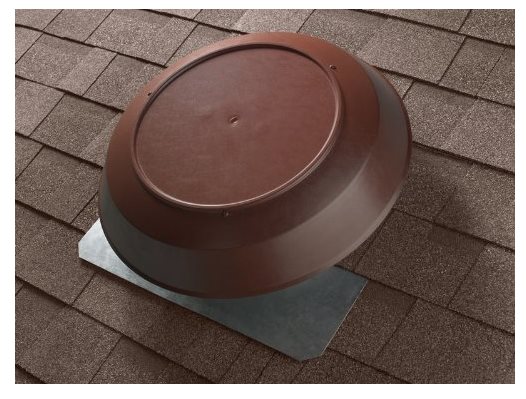
This is an attic fan powered by electricity. They can move up to 1600 cubic feet of air per minute. Some are more powerful. CLICK THE PHOTO now to have this at your home in days.
If you use an air conditioner, this can be bad as you draw expensive cool air from your finished living space up into your attic. PAVs, as well as turbine vents, require abundant soffit ventilation or low-roof static pot vents that allow cooler outside air to readily enter the attic as hot air is exhausted.
Radiant Barriers Are Great - Dust Hurts Efficiency
I increased the comfort of my own home by installing radiant barrier chips. These highly reflective thin pieces of plastic act like mirrors and reflect heat back to its source.
They work exactly like a piece of aluminum foil that covers a casserole dish. But a single layer of any radiant barrier can lose its ability to reflect heat if it gets covered with dust. This is why the chips are so much better.
When the chips are installed tens of thousands of them float down onto the insulation. Look closely and you will discover that you might have six or seven layers of the radiant barrier on top of one another. The top layer may get dusty over time, but the chips just below work like they are brand new.
More Insulation Doesn't Mean Cooler House!
Adding more insulation will not necessarily make a house cooler. In fact, it can add to the heat load after the sun goes down. Insulation is designed to slow the rate of heat transfer.
That's great if you have a warm home and don't want the heat to seep into a cold attic. But you want your insulation, especially that which touches up against your ceilings, to be as cool as possible. If the insulation is hot, it slowly liberates this heat back towards the attic.
The best way to keep insulation cool, as well as attic air, is to move lots of air through the attic space. Even though the outside temperature may be 90 - 98F, it is much cooler than 140 - 160F. Your home air conditioner works very hard to combat extreme attic temperatures. Lower the attic temperature even by 15 - 20F and you will save money and be cooler.
CLICK HERE to get FREE & FAST BIDS from local contractors who can install attic ventilation fans.
Column 509

Tim built custom homes and did ultra-custom remodeling for 20+ years before launching his Ask the Builder media presence. He was selected as one of the Big 50 by Remodeling magazine in 1993. This award gave birth to Ask the Builder in October 1993. Tim also operates https://DrawPlumbingPlans.com. His @askthebuilder YouTube channel was the first home improvement channel on YouTube.
My attic gets extremely hot during the summer. I have a walk up attic in a colonial home, so I use my attic alot for storage. What can be done to get rid of the hot heat. I know that there are attic exhaust fans that can do the job, but I don't know which one would be the best for my house. Do you come out to do free estimates?
Hi! We have a 113yo wood American foursquare and the pointed roof gets FULL sun. The attic is a walk up and the previous owners insulated the floor and we insulated the ceiling in preparation for finishing it off. It does have two passive vents that barely do anything and the house was built with closed eaves, the attic suffocates! AC barely reaches our 2nd floor as it is so I debated a powered fan to exhaust the hot air and intentionally create a vacuum to the upstairs. I also have a freestanding AC unit that I would duct in as well up there.
Do you think my plan will work? any other solution to try? I've had an HVAC tech check it out and he suggested the fan.
Thank you!
Your answer is different from Joe's. He claims that a roof vent half the size of the soffet intake will do.
Well, that's odd. I don't see Joe anywhere.
Hi Tim, I have a ranch house, 28'x44', with a 1232 sq. ft. attic and installed two 14" Lomanco Whirleybird turbine vents on the roof. Each one is 11' from the edge according to the instructions. Should I put another one in the middle of the roof like you say to do? Thank you.
You can't have too many turbine vents. I'd have five if it were me.
Hi Tim, We have a ridge vent on our ranch. Does that negate the benefit of installing a turbine vent?
Thanks!
No it doesn't. Ridget vents do NOT exhaust hot air. Hot air rises. For air to go out a ridge vent on it's own with no pulling force caused by wind, it needs to go DOWN about three inches. That's not happening with our current Laws of Physics here on Earth.
Several years ago, I installed solar powered attic vent on the gable of the house along with soffit vents all around the house, it exhausts the hot air, the more sun, the faster it runs. The temperature of the attic is typically about 15 degrees hotter than the outside air. In Arizona, that means it may get to 140 degrees on a 115 degree day. In the future, I may install radiant barrier to help that even more.
Dear Tim
I have a16 x24 foot barn type shed that is our hunting cabin. I insulted with R30 between the 2x6 rafters. I am covering the ceiling with corrugated tin. I am experiencing condensation in the light box and when I turn on the light it shorts my generator will a ridge vent work?
I'll bet you're heating with a wood stove. Lots of humidity in the air. Condensation is happening on the cold/cool metal surfaces.
A ridge vent will do little to solve the issue.
I don't think I'd ever put in a metal ceiling. I'd do a wood ceiling and the batts would have to be unfaced.
That plus several turbine vents and you should be good.
Two inches of airspace above the fiberglass. Soffit vents. Air MUST MOVE over the top of the insulation.
Can I install turbines if my passive ridge vent is not moving enough air to cool my attic adequately ?
Yes you can install turbine vents, unless an evil hex has been cast upon you by my fellow New Hampshire wizards for some reason.
They usually get upset if they discover you prefer Ben & Jerry's ice cream instead of Aglamesis.
Tim, I have a newer Owens Corning Duration Terra Cotta w/Algae Resistance Protection shingled roof. I had my roofer stop last week & showed your email w/copper flashing on cap shingles. He will not install copper on my Terra Cotta shingles as he's seen too much copper turn greenish & he knows I will not like that. However, he said he will install zinc strips which will do the same to slow algae growth. So I looked on line I believe the zinc strips will be too obvious on my shingle color & have read sometimes zinc strips cause grayish film on shingles. I RESPECT your knowledge & look forward to your reply. Dudley Tucker
Dudley,
Your roofer is right if you decide to live in your house in about 50 years.
The copper is going to turn a deep NUT BROWN in about 6 months.
It then takes a long time for it to go green.
My question is: Do you sit outside and stare at your roof or do you several times a month inquire about your savings account balance?
I ask because if you don't do the copper you're going to part with LOTS of money.
Buy the copper from me now:
http://shop.askthebuilder.com/copper-roof-strips/