How To Repair Concrete Driveway Cracks

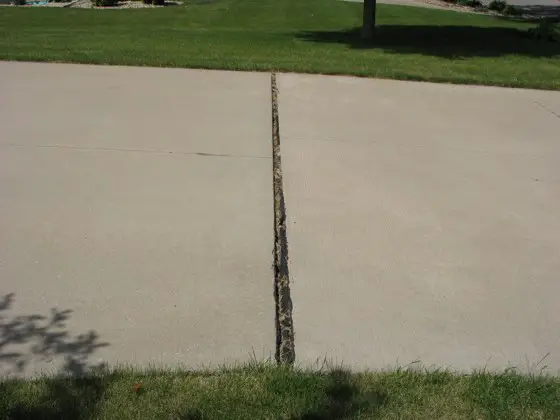
DEAR TIM: My concrete driveway has eight large slabs. The driveway slopes down from my garage to the street. The straight-line gaps between the slabs has enlarged, some cracks are as wide as 2 inches now. I patch them and they open up again. Is there a guaranteed way to repair these cracks so I don't have to do it every other year? What's happening and how would you fix the cracks? Ed S., Steator, IL

DEAR ED: Concrete cracks of any type are the bane of many a homeowner. They can be in flat slabs, retaining walls, foundation walls and steps. Concrete has fantastic compressive strength, but usually only ten percent of that in tension when you try to pull or stretch it apart. This lack of tensile strength explains, for the most part, why concrete cracks.

Let me say right away that it's impossible to completely cover this topic in this tiny column. Entire books have been written about concrete crack repair. I'm just going to try to focus on your situation and give you an interesting option.

This crack is now 2 inches wide and opens up every year. It can be filled and made to look presentable. Photo Credit: Ed Sedlacko

First, your slabs look to be in great shape other than the gaps between the slabs. This makes the repair job much easier to do so that you get results that are aesthetically pleasing. It's important that the repair not detract from the overall look of your driveway, but still be functional.

If you try to fill the cracks with a hard material like more concrete that contains small aggregate like pea gravel or very coarse sand, it will eventually crack as well. The gaps you have are far too wide for most institutional and commercial caulks designed for filling concrete cracks.

Doing a specialized and exhaustive search on the Internet, you may discover some product used by airports, state departments of transportation or other owners of massive amounts of concrete pavement that will fill those massive cracks. But the look of the repair may not be in your best interest.

As crazy as this sounds, I'm going to suggest you repair the cracks with wood. I know this may sound quite nonsensical, but wood and concrete have been used for years together. It was a fad in the 1950's and 1960's to install redwood slats in-between concrete slabs and sidewalks in modernistic homes that were popular in that time period. I've personally inspected houses with this combination and the redwood used had lasted for well over 25 years.

Because of the natural water repellents that are in redwood, it would last for decades, even though it was exposed to moisture in a slab on the ground. Using some new water repellents and drainage aids, I believe you can get strips of wood to last at least thirty or forty years, if not more.

The first thing you need to do is clean out the gaps between the slabs to the thickness of the slabs. Scrape off any old patching tar with a stiff putty knife and remove residual tar or asphalt compounds with mineral spirits and gentle scrubbing with a wire brush.

Dig a 4-inch wide trench along the sides of the slabs from the crack or gap closest to the house all the way down to the street or sidewalk. This trench should be a deep as the slabs are thick.

Fill the trenches on either side of the driveway with small rounded pea gravel. This gravel is the size of marbles or actual peas that you eat. Do the same for the gaps between the concrete slabs, but stop filling the gaps about 2 inches from the top of the slabs.

Purchase some redwood or other fine-grained lumber like teak that's naturally resistant to rot. Cut the strips of wood to fit each of the gaps making sure the shape of the strips is wider at the top than at the bottom. This tapered shape will allow you to tap the pieces of wood into the gaps between the slabs with little effort.

Each strip should be cut so that it's 1 and three-quarter inches from top to bottom. This dimension allows the wood to be recessed below the top of the slabs about one-quarter inch.

Before you install the wood, completely coat all the sides, edges and ends with three coats of a high-quality synthetic resin water repellent. It's very important that the ends are well coated. In fact, I would dip the end of each piece of wood into the can of the sealant for at least two minutes allowing the water repellent to be drawn deeply into the end grain.

Once the wood strips are in place, fill any small gaps between the wood and the concrete slabs with medium sand. The sand will be natural looking and it will finish off the job nicely.

The pea gravel under the wood strips and on the sides of the driveway acts as an interconnected series of drainage channels that will remove any standing water from around the wood. This will significantly extend the life of the wood strips.

Column 938

May 30, 2012 AsktheBuilder Newsletter & Tips

This past weekend was a mixture of work and relaxation for me. I hope you had a great Memorial Day Weekend, and you reflected on those who offered up the ultimate sacrifice so that you have the freedom to read this newsletter that I'm allowed to write. All too often I feel many take our freedom for granted.

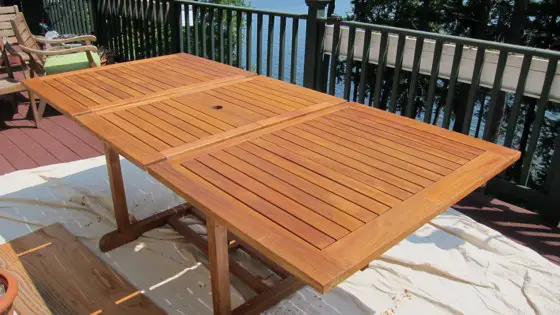
On Sunday, I cleaned a wonderful teak table that's on my deck. My daughter Kelly helped me with this job. Early the next morning, I sealed it after it had dried. Visit my Restoring a Weathered Teak Table page at my website to see dramatic before and after photos and secret links to the products I used to achieve the stunning results!


Tip of the Week - Difference Between an Impact Driver, Drill and Screw Gun

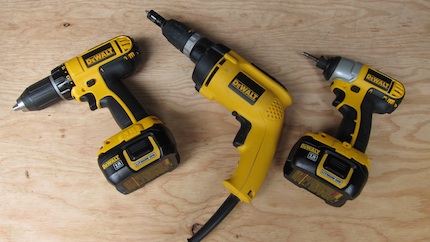
Check out the photo. Sure, the tools are all the same color and they all spin, but what's the real difference?

The common electric drill needs very little explanation - it accepts drill bits ranging in size from 1/16th-inch usually up to 3/8-inch diameter and sometimes 1/2-inch diameter. A variable-speed motor in the tool allows it to spin very slowly or quite fast providing you with great control should you choose to use it.

A screw gun is very similar to a drill but it accepts bits that fit the slots in different screws. An adjustable clutch on the tool allows you to tell the screw gun when to stop turning. This prevents the screw from snapping. It also allows you to control how far you drive the screw into the material. In the case of drywall, you want the screw head recessed below the surface, but not so deep as it tears the paper from around the screw head.

An electric impact driver is much like a screw gun. It accepts all sorts of driving bits and even smaller sockets. The internal clutches and gearing provide enormous torque at low speeds so that you don't strip the head of the screw or nut. While you can use low speeds on a drill and a screw gun, you simply don't get the torque. This single feature makes in impact driver invaluable.

Here's the drill / impact driver combo kit I've been using lately, but I expect to be testing a kit from both Bosch and Milwaukee very soon.


Hong Kong Subscribers and Photos

Do you live in Hong Kong? Or, do you have any great street photos showing the typical buildings, architecture, etc. from street level? Do you have photos of side streets, back alleys, etc.? My son needs them for a video game project. I'd be eternally grateful if you could forward a few to me. The higher the resolution the better.


Impressive Space Station and Northern Lights Video

Russell Morris, who lives in Queensland, Australia, sent me a link to a delightful video that you might enjoy. It's a respite from some boring home improvement video I might ask you to watch!


LAST Chance for Shed Videos

My DIY shed project on Kickstarter is just about to close out. I need your help to make the goal. You get some amazing swag if you back the project.

IMPORTANT NOTE:If you back the project at the $30 level, you'll get the entire video series for that one-time low price. I guarantee you that you'll never, ever be able to get the 100-plus videos I plan to tape for that price. I'm serious. This is your last chance.

If you *ever* plan to build a shed, you'll find these step-by-step videos invaluable. There are going to be over 100 videos total in 30 different ebooks about each phase of the project.

When the ebooks that contain the videos are in my shopping cart, you'll see them at $7 each. That means the entire video series will be priced at $210 if you buy the ebooks/videos one at a time.

But for the next week, you can get each ebook for just $1 each. That's an insanely low price.

If you're a long-time subscriber to this newsletter, you know that I meant what I say. You'll never see this low price again.

Go ahead, back the project right now. You'll not regret it for a moment.


Lumber Strength and Grades

You may not be aware that different species of lumber have significant differences in strength. And within each species, the actual grade of the lumber can have an impact on its strength.

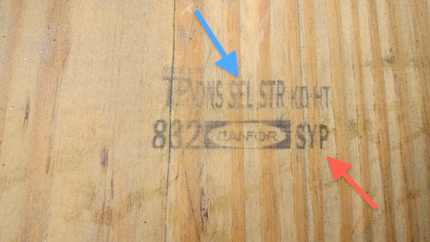
In the photo below, you can see the arrows point to both the species of wood and the grade. The blue arrow points to the grade with SEL meaning *select*. The red arrow points to the species with SYP meaning Southern Yellow Pine.

For example, Douglas Fir is perhaps one of the strongest framing lumbers while hemlock is not all that strong. I say this assuming you're comparing two pieces of lumber the exact same size and thickness.

Southern Yellow Pine is a species I used regularly when I was building, and it's a very strong wood. It also accepts chemical treatment very well, which is why it's often the species you buy when you get lumber that you use outdoors.

The fewer knots one finds in lumber, the better its grade. Knot-free or nearly knot-free lumber is often graded select. You then step down to #1 and #2 grades as the knots become larger and there are more of them in each piece.

If you want a really informative brochure that talks about both hardwoods and softwoods, including photos, tables, and a great glossary of wood terms, you should download the FREE Hardwood Handbook put out by the Southeastern Lumber Manufacturers Association.

WARNING:It's a pretty big file, so if you click the link, go do something else while it downloads. You'll enjoy it!


Cleaning Tip of the Week - Aquarium Algae

Sandy shared with me how she used Stain Solver to clean years of algae from aquarium rocks. She said, " ... the Stain Solver produced amazing results without the worry of any harm to the fish."

To get rid of any hard water deposits on the glass of the aquarium you'll need either white vinegar or muriatic acid. These chemicals can absolutely harm the fish!!!


Upcoming Tool Reviews

Oh, I've got some tool reviews ready to do the later part of this week! I'll be shooting a video of two Milwaukee 4.5-inch grinders, a RotoSaw and a Senco Finish Nail Gun.

The second week of June I'll be getting my annual dose of new Bosch and Milwaukee tools as I'll be attending their annual tool conferences. It's always a pleasure to see all the new power and hand tools.

REPLY to me. Tell me what tools you want me to review. I'm SERIOUS. Click "Reply" and tell me. The same is true for products. What New Products do you want me to review? You have to Reply - I've got mystic powers, but ESP is not one of them. :->>>

Restoring a Weathered Teak Table

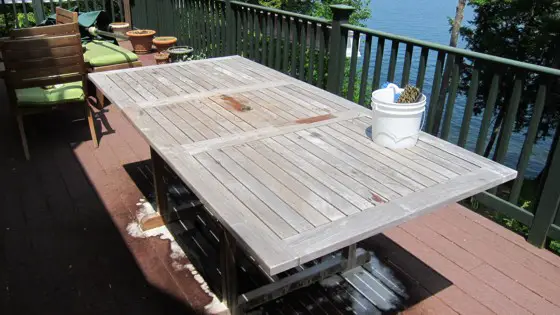
The weathered, gray teak table in the photos below shows how the original sealer succumbed to Mother Nature. You can see grease stains near the center of the table.

Stain Solver oxygen bleach was used to remove the failed factory-applied sealer, all the sun-damaged gray wood fibers and the grease.

I used Extreme Defy, a synthetic-resin water repellent, to seal the table. It comes in different colors, but my wife Kathy likes the Cedar Tone color because it resembles what the teak looks like when it's wet.

NOTE FROM TIM CARTER - Founder of AsktheBuilder.com - posted October, 2016: I no longer would apply Defy deck sealer to any exterior wood that I own at my own home.

Tim Carter

The weathered table before.

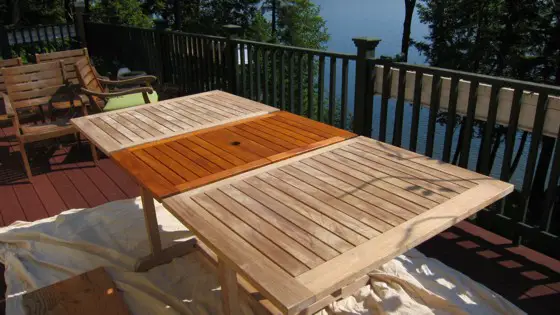
The table is now clean and dry and the center panel has been coated with the new water repellent.

The weathered table after cleaning and sealing.

All photos by Tim Carter.

If you want to submit pictures and the story behind your project, CLICK HERE to go to the Before & After Submission Page.

May 22, 2012 AsktheBuilder Newsletter & Tips

I hope you had a swell weekend. Mine was spent in Maine on my ham radio helping 120 bicyclists stay safe. The club I belong to, CNHARC, was the official communications provider for The Seacoast Bike Tour.

Saturday was uneventful, but on Sunday around noon two cyclists got tangled up and crashed just minutes after I had passed them while I was on roving patrol looking for problems. One woman had to be transported to the hospital. I’m hoping she’s okay.
Nubble Lighthouse

On Saturday, one of the rest stops the cyclists checked in at was on the coast in Maine. It was at the infamous Nubble Lighthouse. All I can say is that it was one of those rare days when it appeared a tanker filled with deep-blue dye crashed spilling its cargo into the ocean. The water was so blue!

Smart Money Magazine

I was interviewed yesterday and today by a very intelligent young woman named Jennifer Wieczner. She reached out to me about a story concerning DIY videos. After doing some research, she discovered that I have quite a following on YouTube and have lots of DIY videos as you already know.

But she needs YOUR help. She asked me moments ago if I knew of any homeowners who had watched a DIY video that led them astray, or caused them to waste money because the info in the video was wrong or incomplete.

Has that happened to you? Have you had a bad experience watching a DIY video? Jennifer needs to hear from you NOW. Please Cc: me in the email as I’d love to hear the story as well. Time is of the essence. She’s on deadline. That means email her NOW. Jen's email address is: [email protected]

Tip of the Week - Exterior Painting

Are you going to paint outside this year? If the surface already has paint on it, you really need to clean it to get fantastic results. Paint is just colored glue. Dirt, grease and sun-damaged old paint pigment all get in the way of a good bond.

Pressure washing does NOT remove all the dirt. If you want to get the surface clean, you need to wash it like you do your car - with a sponge, brush or surface agitation. I prefer to use a brush that’s used to clean RV’s. These are soft enough so they don’t scratch the paint of the RV, but stiff enough to get off the dirt.

To remove algae, mildew and sun-damaged paint pigment, my Stain Solver does an amazing job. Look below, the 9-pound size is now on sale.

Win an iPad!!!!

If you’re on Facebook, remember I told you months ago you should be, you can possibly win an iPad (16 GB and WiFi only). You only have nine days to react.

You need to take photos of an outdoor project you made with real wood. It could be a deck, gazebo, arbor, fence, porch, raised garden bed, etc. It just needs to be an exterior project made from REAL wood.

On June 1st, the photo you submit to the Wood Facebook fan page may be the one that wins!

Go to the following page, LIKE the page, post your photo, and tell them the city/state where the project is, when the project was constructed and WHY you chose real wood. It’s that easy. Get the camera out NOW and take your photo. Hurry! CLICK HERE TO ENTER.

Concrete Crack Repair

I’ve written in the past about using epoxy to repair concrete cracks. It can be a cracked driveway, cracked foundation, cracked patio, etc. Some epoxies are stronger than concrete and some have great flexibility.

I was sent some great concrete epoxy by the Roklin Company. They have a fantastic epoxy system that just may work for you. They also have concrete surface repair products as well as asphalt repair products.

These deserve a serious look if you have concrete or asphalt that needs attention. Good News! I negotiated a 15% discount for you! Use this promo code before it expires: ATB15 CLICK HERE TO SEE the PRODUCTS.

I did NOT get paid anything to write the above. I’m simply impressed by this company’s products.

Stain Solver Sale

Stain Solver Oxygen Bleach

I’m having a Memorial Day Clean Up Sale. The 9-pound size of Stain Solver is now on sale. You get a 15% discount. The photo you see is the 2-pound size. The 9-pounder comes in a one-gallon white plastic bucket.

But here’s the catch. Only 300 people get it at this price. Oh, and you get Free Shipping too with the Sale Price. CLICK HERE TO GET TO THE SALE.

If you want the discount and have some cleaning to do, you need to order *now*. You can only get this discount at the AsktheBuilder.com shopping cart. It’s not for sale on the Stain Solver website. I guarantee you we WILL SELL OUT of this size.

Mosquito Devices

Do you own one of those mosquito magnet machines that runs on propane? Or some other large-scale machine that claims to keep a bigger area free of mosquitoes? Have you had success or failure? What machine do you have that works best?

Deck Stain Test

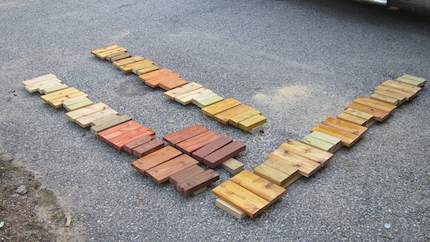
The official AsktheBuilder Deck Stain Test has begun! I’m testing 16 different deck stains, some tinted, some toned and some clear. This is a real live test in real conditions down on my dock. The sun blasts my dock from sunrise until mid afternoon. There’s no shade. This is going to be a long-term test that runs for at least two years, possibly three. Here’s a photo of the pieces of wood that were just stained and out drying.
Deck Stain Sample Test Pieces

Four pieces of wood were stained with each stain - two each of treated lumber and two of cedar decking. One piece of treated and cedar lumber is being put in my garage attic out of sunlight and rain. These will be taken out of storage and put up against the outdoor samples from time to time to show how the stains are doing. I’ll take side-by-side photos.

I’ll have the first results available at the end of summer. We need to let Mother Nature work on the wood for at least three months. I’m sure you’ll be stunned by the results!

Sincerely,
Tim Carter
Do It Right, Not Over!

Hold Down Anchor Tips

DEAR TIM: I'm building two things this summer but can't figure out how to get started. One is a deck that's going to rest on concrete piers that will be buried in the ground. The other project is a screened-in porch that I want to put on an existing large patio. How do I connect these structures to the concrete so the wind doesn't blow them away or the posts don't shift from the concrete piers? What else can you share about this conundrum? Wayne H., Ogunquit, ME

DEAR WAYNE: You've got two aggressive projects ahead of you. I'd love to have a screened-in porch here at my house, but where I want to put it just won't work out. I'm pretty envious of you.

There are all sorts of ingenious metal framing connectors that are available to solve your two problems. They're commonly called hold down anchors. As you might expect, they come in different sizes, models, etc. depending on the structural loads of the structures.

Furthermore, you can purchase anchors that are embedded in wet concrete or are added later after the concrete has hardened. With your deck piers, you can embed strong anchor bolts in precise locations that can then connect to the metal hold down anchors. The challenge is ensuring the anchor bolts are exactly where they need to be.

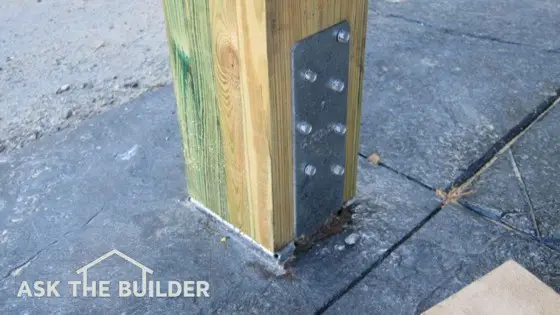
Hold Down Anchor

You only see part of the metal hold down anchor that's connected to the wood post. The rest of the metal anchor is deeply buried in the concrete slab. Photo Credit: Tim Carter

Your screened porch on the patio will require you to use a post base anchor that you connect to the slab with a stud anchor that's pounded into a hole you drill in the slab. To achieve maximum strength with such an anchor, you may want to employ some special concrete epoxy that helps hold the anchor in place.

Be sure if you use the epoxy, that the hole is dust free. This is really good advice even if you don't use the epoxy. The stud anchor will hold much better if there's no dust in the hole. Do NOT look at the hole or have your head over the hole when you blow it out with compressed air. You can get abrasive concrete dust in your eyes.

It's better to remove this dust with a wet-dry vacuum using a small stick to stir up the dust in the hole making sure the hole is completely free of debris.

It's very important to use approved fasteners with the metal hold down anchors. You may completely compromise the system using inferior nails or screws. For example, you may use the proper bolt or anchor to connect the anchor to the slab or concrete pier, but then use roofing nails or some other weak screw to connect the anchor to the wood posts that support the deck or the screened porch.

The manufacturers of the hold down anchors sell the correct bolts, screws, fasteners to make up a system that will provide you with all the structural integrity you need for both jobs.

Your biggest challenge, in my opinion, is the layout of the wood posts. You want both the deck and the screened-in porch to be square. If your deck is not too high off the ground, I've used a simple system for years that's helped me get the concrete piers perfectly positioned so the wood posts are centered on the concrete.

I install the outer frame of the deck first getting is perfectly square and level. I just use temporary support posts to hold up this frame. These temporary posts are 2 or 3 feet away from where the real posts will be.

I can then use a plumb bob suspended from where the center point of the support posts will be on the frame above to tell me on the ground where the center of the post will be as it rests on the concrete pier. This allows me to put the required anchor bolt in the perfect spot for the hold down anchor.

The layout for your screened-in porch is much easier. All you have to do is create the square or rectangular outer dimensions of the porch using 2x4s that are nice and straight. Position this box on the concrete slab where you want it.

Be sure the sides of the box are not bowed and that opposite sides of the box or rectangle are the exact same measurements. If the porch is perfectly square, make sure the sides of the box are the exact dimensions. If a rectangle, be sure it's a true rectangle.

Once you know the dimensions are the same, when the diagonal measurement across the square or rectangle are exactly the same, your box is square. Take a pencil and create the outline of each corner of the box while the wood is perfectly positioned. You'll now know where to drill the holes in the slab for your anchors.

You can watch an informative video showing the concrete pier that hold down anchors connect to. Just type "precast concrete deck pier video" into the www.AsktheBuilder.com search engine.

Column 936

May 15, 2012 AsktheBuilder Newsletter & Tips

This past weekend Mother Nature treated the Northeast to some delightful spring weather. Saturday and Sunday were spectacular, with Saturday one of those stunning clear days. We get fall in reverse up here.

Right now all the deciduous trees that are crimson, orange, yellow, etc. in the fall are various shades of green. The picture below does not do it justice. I should have taken the photo on Saturday when there was less haze. It's stunning to see in person.

Spring in the Northeast

Next weekend, I'll be volunteering for another worthy cause - The Seacoast Bike Tour. It's a two-day event put on by the Breathe New Hampshire organization. I'll be one of several ham radio operators providing communications between Portsmouth, NH and Ogunquit, ME.

We're needed all along the course in case bikers get hurt, need repairs or get lost. I'll be staying overnight in Ogunquit, ME, if you want to do a dinner meet up this Saturday. Email me and let me know. 73s to all you hams out there. W3ATB clear on your final.


100+ Step-by-Step Shed Building Videos

Would you like your own DIY dream shed? Of course you do! Would you like:

  • to watch a FUNNY video of me including bloopers?
  • to be part of the process creating 100 or more videos?
  • to get some AsktheBuilder.com swag?
  • to help me help thousands of other homeowners fulfill their shed-building dreams?

I thought so. Please click here, watch the video, read the product description and above all else pledge so we can reach the goal!

Take a SERIOUS LOOK at the $30 pledge. I doubt that you'll ever see me again give you an eBook that has tips, photos and multiple videos for only $1 each. When the finished eBooks are loaded to my shopping cart, they will be priced at $7 each. Only 300 people get the video series at this massive discount price. You'll regret not being one of those 300 people.

^ ^ ^ Go Back Up Now ^ ^ ^ Re-read the above paragraph. I'm not kidding. Read it three times if you have to.

If you have questions about this project, click Reply and ask me.


Quick Deck-Building Tips

Are you going to build a deck soon? Here are some important tips.

If you're going to attach the ledger board to the house, do it with through bolts not lag bolts. Through bolts have a washer and a nut on the one side. Lag bolts can and do fail all the time.

In case you attach the ledger board in direct contact with the house, be sure to install flashing over the top and partially down the face of the ledger so water can't get behind the board. The flashing needs to be behind the siding or trim above it.

Finally, do not install the decking tight to the house. Leave a 2-inch gap so water can flow readily to the ground below past the front of the ledger board. This gap will not be an issue because your feet are never ever that close to the wall. You can close up this gap making it about 1-inch where a doorway opens to the deck.


Your Newsletter Suggestions

You might be one of the subscribers that sends in very helpful suggestions each week. I read each one and appreciate them all. One suggestion that keeps coming up, but I've resisted implementing, is a simple button.

Connie finally convinced me to try it this past week when she emailed,

"Tim, you give us great information each week. I'd love to see special features in your newsletter, and some of your subscribers like me would like to give back since you give to us. I've emailed you several times suggesting you solicit donations, but you keep saying 'No'. Personally, I want more product and tool reviews. If you get enough donations each week, maybe you can use it to hire another writer or tool tester to help you."

DUH!!!! Connie's comment was one of those V-8 forehead slap moments. I strive to create a great newsletter, and I'd like to do more tool and product reviews, but I've just not had the resources. Most of all, I've resisted soliciting donations for all sorts of reasons.

Perhaps it's time to see if Connie is correct. Do you want more tool and product reviews or something else in the newsletter? I've got a young carpenter that's a great writer and wanting to work for me. If you contribute just a small amount of money each week or month, I could use it to give you more of what you want.

Nothing would make me happier growing the AsktheBuilder.com team to give you even BETTER information each week. Plus, I like being a job creator. We need more jobs right now!

If you decide to donate using the safe PayPal button below, be SURE to reply letting me know what you want me to do. I'll do my best to get this in motion.


Tool Reviews in the Queue

Connie's right, I sure want to do more tool reviews. In fact, I have two tools here now waiting for me to start testing. One is the RotoZip 5.5 amp RotoSaw. It's the Original Spiral Saw. Think of it as a hand-held tiny router that has special drill bits that have cutting edges on the SIDES of the bits.

Several days ago, I received two Ryobi ProTip Spray Painting tools. One is an 18-volt cordless tool and the other one is a corded tool. Both have great soft-sided carrying cases and lots of features. I just glanced at the reviews for this sprayer at Amazon.com, and unfortunately most of them are not 5 stars. We'll see what happens in my test.

What other tools do you want me to test? Is it a Milwaukee or Bosch power tool? I've been invited to their annual editors conferences that happen one month from this week. Tell me what you want me to look at.


Tip of the Week - Fast and Easy Flagstone Patio

Do you want to create a patio that's immune to the worst Mother Nature can dish out? Try as she may, she can't wear away flagstone quickly. Flagstone is a dense stone that usually has lots of quartz in it. Quartz is a primary mineral found in granite - need I say more?

Read this past column of mine to see how to create a patio in a day or two with a little help!


Concrete Pier Design

Are you building a deck or any other structure that needs a pier foundation? Would you like your concrete slab that's in a cold climate to be immune from frost heaving? If so, you need to read about how to properly build concrete piers that will not lift up out of the ground.

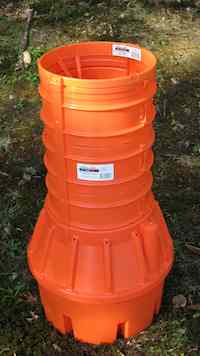
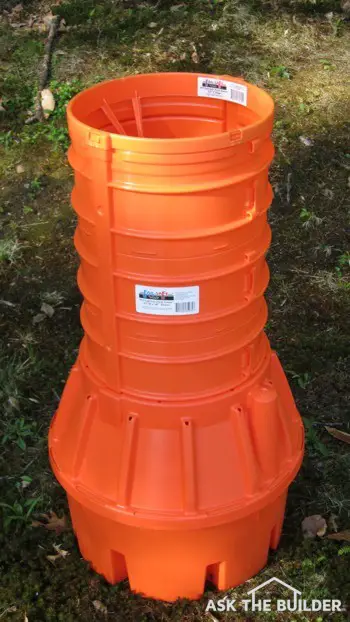
I'm using a plastic form like this for the concrete piers for my shed. You'll discover all about them in the recent column I wrote about this innovative product. This is a real time saver on the jobsite and it's perfect for you if you've never installed a concrete pier before.

If you try to do it the old way, you'll struggle for sure. This form makes it so easy. Read my concrete pier design column for all the sweet tips to help you get it done right!


How to Grout Ceramic Floor Tile

The first week of February, I uploaded How to Grout Ceramic Floor Tile to the Amazon Kindle store. I gave them a 90-day exclusive on it. Now I'm allowed to sell it from my own store as an Instant Download PDF file. It contains tips, photos and four step-by-step videos showing you how to grout ceramic floor tile.

If you're planning on installing ceramic floor tile, you really need this eBook. If you mess up the grout, you'll have a nightmare on your hands.


Cleaning Tip of the Week - Cleaning Patios

You may not own a pressure washer but need to clean a patio. Oxygen bleach does a great job, and it won't harm any plants nearby.

Yes, you want to use Stain Solver! Watch this video to see how it's done.

Sincerely,
Tim Carter

May 8, 2012 AsktheBuilder Newsletter & Tips

I spent the end of last week discovering a way that you and I can start to collaborate on all sorts of exciting building and remodeling projects. I'm blazing a trail into uncharted territory using a new platform called Kickstarter.com.

What does all this mean to you? If everything goes as planned, you're going to be treated to some great video content that I've wanted to create for you for years, but simply didn't have the resources to do it.

The brilliant minds behind Kickstarter.com have solved that problem. As you can imagine, it's pretty exciting for me to be right at the brink of having some of my knowledge-sharing dreams come true.

I love doing videos about building and remodeling, but there's always that troublesome financial aspect. I have to pay the bills to create the content. Ugh. The free model of giving away this content that's been a hallmark of the Internet is simply no longer providing enough revenue to produce the videos. Many video producers like me are having to come up with imaginative ways to create the content you need.

In a few minutes, you're going to discover how we're going to work together to create this unbelievable video content. Thank you, Kickstarter.com!


Tip of the Week - Extra Storage Space

Is your house cluttered? Do you constantly bump into things in your garage when you open the door to get into or out of your car? You probably need a shed.

Most sheds are built with 8-foot-tall walls. You can increase the storage capacity of your new shed by a whopping 25 percent for next to nothing!!! How? Just use 10-foot wall studs instead of the standard 8-foot studs.

The amount of time to install the stud is the same. The cost difference is hardly anything. You just have to spend a little more for exterior siding and sheathing. But in return, you get lots of BONUS storage space for years to come!

Want to know more about building sheds? Wait till you see what I have for you just below.


Screen Printing T-Shirts

Do you know the ink science and fine points of screen-printing T-shirts? I need to know the best process that creates the longest lasting graphics. If you work in the industry or have great info to share, please reply to this email. Change the Subject Line to: T-Shirts Tim


Great Folding Closet Door Hardware

There's a good chance you've had issues with folding closet doors in the past. In almost all cases, the chattering, sticking and failure to stay closed can be traced to inferior hardware.

You can get easy-to-install folding hardware kits from LE Johnson that are perfect for remodeling or new construction. I can't begin to tell you how well LE Johnson door hardware is. I've used it on my jobs for years, and you can find it in all the homes I built for my family!
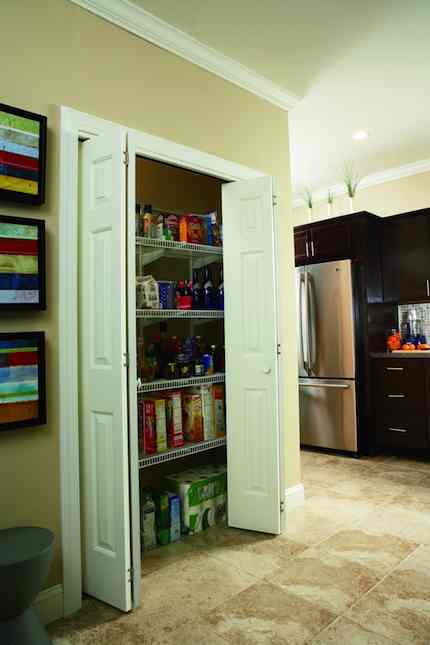
LE Johnson Folding DoorsThe "positive pivot locks" ensure the top pivots stay in the track. The pivots surface mount on top of the doors, so that's a huge time saver. The track the pivots glide in comes with a factory-applied wood finish. You can paint it too.

Everything mounts on the door jambs, nothing on the floor! That's a huge improvement and allows for a gorgeous carpeted look. The brackets allow for easy adjustment of doors that may be warped. LE Johnson's engineers have thought of everything!

You can't beat the lifetime guarantee. What more do you want to know? Oh, where to buy this sweet hardware kit? Easy! Just visit the LE Johnson website to buy the hardware.

LE Johnson paid me to provide this writeup. But understand that I only do this for products I'd use in my own home. I realize you want to know about the things I use too.


The Shed Project

Here's the exciting news. I'm building a wonderful shed starting the end of June, and I really want and *need* you to become part of the process. The Shed category at my website is one of the most popular ones each and every spring and summer. If you're like most, it's no wonder. There are so many things you can do or store in a shed.

The reason I'm building the shed is simple. I want to create for you, my readers and subscribers, the most authoritative and detailed DIY step-by-step videos of the shed building process. Right now I've already identified well over 100 videos that will be put into about 30 separate eBooks explaining each step of the building process.

When each eBook is loaded to my shopping cart, it will be priced at $7 each. You may only need to buy one or two to explain a step about the process. If you need all the eBooks, they will be deeply discounted when purchased as a set.

But I'm not trying to sell you shed eBooks. I'm trying to get your help to create them. However, If you do want to buy some, just wait till you see the enormous discount that 300 people are going to get. Oh my, each eBook in the series for just $1 each!

I've looked and looked online, and I can't find anything that contains the amount of detail I intend to show you in each video. I want to share my knowledge so you can build the shed you've always dreamed would magically appear in your backyard.

I've done hundreds of simple DIY videos over the years, but never have I attempted to tackle such a large video project all at once. The costs to do this from start to finish are staggering. The prices for materials, videographer, editors, etc. all add up quickly.

This is very similar to the process of making a television series or even a motion picture. Hours and hours of video will need to be shot and edited. This is completely different from the three or four 90-second videos like you normally see me do.

Just like a movie producer needs help from the big film studios in Hollywood, I need your help now to make this happen. If you decide to assist to make this video series a success, we'll start doing more of these projects together. Think about all the possibilities: remodel a real bathroom start to finish, remodel a kitchen so you discover all the things you need to know. I think you get the picture.

I already know what you're thinking because my buddy Chuck told me you'd be uttering, "What's in it for ME, Tim?" I get it, that's normal. Well, there's lots in it for you, but we'll get to that in a moment.

In the past few weeks, I've stumbled across a website called Kickstarter that makes it easy for you and I to work together on any number of new projects. I'm serious, if you want to work side-by-side with me for a day or two to discover secret building tips I've marinated for over 40 years, then you'll be able to do it.

If you'd rather just watch the shed project each day from the comfort of your own home while viewing it through a webcam, then you'll be able to do that.

If you want the exact plans, all the 100 or more step-by-step videos of the entire shed-building process as it happens, you'll be able to get that.


Here's how it works

Let's say you decide you want to help me make my dream come true - the creation of all these great videos for you. All you do is pledge, not give, some amount of money. You can pledge as little as $5, and you'll get something in return. The link to the project is just below.

You may be one of the thousands of subscribers over the years that have requested AsktheBuilder.com hats and T-shirts. Well, the day is here! There's going to be all kinds of swag including hats and T-shirts.

Be aware this is not a charity project - I'm NOT asking for a donation. By pledging, you become part of this event. If you help fund this project, I give you something in return.

Here's how it works. I have to set a funding goal for the project, and that goal MUST be met within a certain amount of time - in this case 30 days from the day I make the project live on Kickstarter.com.

The payments for projects on Kickstarter.com are all handled by Amazon.com for safety and security. If you have an Amazon.com account or purchase from there regularly, it's EASY to pledge, cave-man simple in fact. Amazon does NOT charge your credit card when you pledge. They just hold onto the information and wait to hear if the project reaches its goal after 30 days.

If we don't reach the goal in 30 days, your pledge evaporates and you owe NOTHING. The project then doesn't happen, and we just move on.

Let me make that clear. If the project doesn't meet the funding goal, then your credit card does NOT get charged. This is a great built-in safety, as it ensures the project will succeed as it has enough money to pay the bills!

I'm confident you will want to help me to create all the videos so you can use them to build your dream shed.

I'm sure you're curious about how all this works. Please go to the Kickstarter FAQ page and poke around. That way when the project launch happens, you'll be totally up to speed. FEEL FREE TO send me questions. I'll absolutely answer them for you. Are you ready to go see the project? Click here to go to my shed project on Kickstarter.com!


Geothermal Heating and Air Conditioning - Do the MATH First!

I was reading a short article in the April 2012 edition of Remodeling magazine. A remodeler named John Tabor located in Rockville, Maryland, decided to put in geothermal heating and cooling in his house.

So as not to tear up his entire yard to install the piping, he went vertical, drilling three 450-foot-deep wells into solid rock. He should have had a clue living in *Rockville*. He could also have looked at a soil map or geologic map before he decided to do it this way to see what he was up against. But I digress, being a geologist.

Cutting to the chase, he spent $88,000 on the entire system. The article said he got a 30% Federal tax credit and some other county and state rebates. Let's say he was *lucky* and John got 50% of the project paid for by you and me with all the tax credits and rebates. That's what happens when you get tax credits. The rest of us taxpayers foot the bill.

For him to start to SAVE money, he first needs to PAY BACK the $44,000 plus any interest he's paying in financing costs. Once he does this, he FINALLY gets to say he's SAVING money.

Let's say, for sake of discussion, that his total heating and cooling bill in his mild Maryland climate is $2,000 a year. The article says John's heating and cooling bills have dropped 33 percent. That's swell!

You have to be careful in your savings calculations because fuel costs can go up and down and the weather and temperatures are not consistent. Last year was a pretty mild winter. It's very complex trying to calculate the real payback, trust me.

But using our crude math, this means each year John has $660 in savings to use to pay off the $44,000 plus interest. Let's not even take the interest into account.

In 67-years, he's able to pay off the $44,000! Yippeeeeee! Oh, he needs to pay off the interest too. All the math wizards are going to email me about inflation, present value, future value, etc. I get that. Let's just do some rough math here for sake of discussion. Keep in mind that it's entirely possible for fuel costs to drop as we develop more of our natural gas resources.

Suffice it to say, John is not going to be SAVING money for many years. Be sure you do the math to see when you actually will save money before you ever get talked into some fancy energy-saving project.

I've already received some email from subscribers that actually have received a payback, but realize every case is different.


Cleaning Tip of the Week - Dishwasher Detergent ALERT!

A few months back, I talked about how the manufacturers of dishwashing detergent changed their formulations. Well, I'm convinced there are now more problems.

Because the new formulation was not cleaning as well and consumers were complaining, I think the soap manufacturers have decided to solve the problem by adding more pumice or fine silica sand to the liquid and powdered soaps. This added material makes the soap much more abrasive.

Worn glassesAdding abrasive compounds to dishwashing machine detergents is nothing new. You need this grit to get dishes clean as just spraying soapy water on dishes inside your dishwasher will not get them clean.

Here at the Carter house, coffee mugs, measuring cups, etc. are showing accelerated and damaging wear to any printing on the glassware. The measuring cup in the photo used to have bright red markings. The blue mug used to have white and red printing on it.

If you have valuable china, mugs, plates, etc., you better start washing them by hand. I could be totally wrong, but all of this pain is being caused by government regulations. If this is the case and you know about them, share them, and I'll provide an update next week.

You can add my Stain Solver to your dishwasher if you want. It does a great job of not only cleaning and helping to sanitize your dishes, but it also DESTINKIFIES your dishwasher in case it has a moldy odor.

Sincerely,
Tim Carter
Concrete Pier Design

DEAR TIM: I've heard all kinds of things from friends about concrete foundation piers. To say the least, I'm confused. Some say you just dig a hole and fill it with concrete. Others say you need to be sure it's the right size and shape. Still others say you need to include steel in it. Can you tell me why one would use concrete piers and how you would install them? Are there any products that make it easy for a homeowner? Krista B., Wake Forest, NC

DEAR KRISTA: I'm sure you realize that you need to be careful about taking advice from well-intentioned friends. This is true even if one of them is in the construction industry. Each day I run into folks who have been building for decades using a particular method. It turns out, unfortunately, that they've been doing it wrong all those years.

Concrete piers are vertical structural elements that support the weight of a building or structure. I'm sure a structural engineer would give you a more accurate description, but for the layman, think of them as table legs. The legs of a table support all the weight of the table and things on the table. If the table legs are on a solid floor, the table doesn't sag or tilt.

PHOTO CAPTION: This colorful plastic concrete pier form comes complete with reinforcing steel. It's easy to assemble with no tools and put into place. Photo Credit: Tim Carter

The same is true for concrete foundation piers. The concrete piers act as the table legs. If they are designed correctly, and placed on solid ground or to a depth that the friction on the sides of the pier is greater than the load placed on the pier, the piers and the structure will not move. That's a good thing!

Some ground beneath houses or buildings is deep sediment where the bedrock can be hundreds of feet below the surface. In these cases, structural engineers rely on the friction between the poured concrete and the soil or sediment to create stability. For the average homeowner that's using a concrete pier to support a deck, room addition or even a home, this is not a big issue. If in doubt, just hire a structural engineer to assist in the design of the pier.

Most concrete piers used around the average home for a deck or other structure are usually no more than 24 or so inches in diameter at the base of the pier. As the pier rises up and out of the ground, it can reduce in size to as small as 10 inches in diameter. The bottom of the pier should always be below the frost line in the area.

If you're building in the northern hemisphere, piers on the north side of a building that might find themselves in the shade should probably go at least 6 or 8 inches deeper than the frost line. The frost can go deeper into the soil in ground that never receives direct warmth from the sun's rays in the winter months.

It's also very important, in my opinion, that the bottom of the pier be wider than the top. The wider base helps distribute the weight of the structure over more soil. This adds to the stability of the design.

A pier design that's wider at the bottom than the top also helps offset the force of the wind on the structure. The concrete pier acts like an anchor in a wall. It requires enormous upward force to pull a one-piece concrete pier out of the ground that has a wide base. If you use a proper hold-down anchor that's connected to the pier with a long anchor bolt embedded in the concrete, your shed, deck or structure should not blow over.

It used to be hard to create a concrete pier that had this shape. You had to first pour the wide bottom in one concrete pour, carefully place reinforcing steel in the base and wait a day. Then you had to install a heavy-duty cardboard tube that extended up towards the surface. You then filled this with concrete. Believe me, it was not easy.

But now you can purchase a plastic concrete pier form that has the correct shape, it comes with all the needed reinforcing steel pre-cut and pre-bent! The steel fits into slots and holes in the concrete form so the concrete flows around it perfectly. These forms are easy to snap together with no tools, and they're easy to level on compacted soil. You pour all the concrete in minutes saving at least one day in the building process.

You can purchase precast concrete piers for your project, but the trouble is they are heavy - I mean really heavy. You'll need a backhoe or small crane to put them into position. It's possible that you can devise a method to move them by hand or with a group of people, but don't count on it.

Don't underestimate the importance of the reinforcing steel in the concrete piers. It's often overlooked. Steel adds enormous strength to concrete. Be sure the soil under the pier is stable and compacted before you place the concrete pier form and pour the concrete.

You can watch two informative videos that show precast concrete deck piers and the innovative plastic deck pier form at www.AsktheBuilder.com. Just type "building a deck pier video" or "precast concrete deck pier video" into the AsktheBuilder.com search engine.

Column 934

May 6, 2012 AsktheBuilder Newsletter & Tips

Happy Sunday, unless of course you're on the other side of the International Date Line!

If you're a new subscriber in the last five days, this is NOT a normal AsktheBuilder.com newsletter. The real newsletter comes out in two days.

Last Tuesday, I promised that I would let you know about the DIY Shed Building project this weekend.

As you can see in the photo, I made good progress! The shed is almost complete! It just needs the windows and doors installed.

Turn on Images to see AWESOME Shed Model, Seriously!

Yes, I know I missed April Fools Day by six weeks. What you see here is a finished scale model of the shed you and I are going to build together.

The reason I'm building the shed is to create the most detailed set of step-by-step videos that will show you how you can build your own shed.

The video series is going to be the closest you can get to me actually coming to your house to help you. As much as I'd love to come to your house, and Maggie here in New Hampshire, I believe, wants me to help construct her shed, I just can't do that, unless I clone myself.

But the magic of video allows me to get pretty darned close! Tuesday this shed building event is going to launch. I need you to become part of this so we can get started. I've already got the building permit, I just need your help.

On Tuesday, I'll go into great detail as to why you need to be part of this process. It's not hard to understand at all why I need you, and it's going to be a boatload of fun!

In Tuesday's newsletter I'm going to also share some facts from a story I read in one of my trade magazines about geothermal heating and cooling. If you're thinking about doing that to *save money*, you absolutely do not want to miss it.

Sincerely,
Tim Carter