Using Transits, Laser Levels and Optical Builder’s Levels

Using Transits, Laser Levels and Optical Builder's Levels

Can you imagine how you might go about trying to determine the differences in elevation between two points which are approximately 100 feet apart? Using a four foot wood or aluminum level would be very impractical. A water level might also be tough to use, as the 100 plus feet of tubing would be very tough to maneuver. Surely, one would think, there has got to be an easier way.

Well, as you might expect, there is a much easier way to determine elevation differences. You simply use a transit or a builder's level. These highly sensitive and accurate instruments (that's what they are often called in the field - instruments) are the only way to go. They are easy to set up and can be used in any weather that you can stand being in.

What is the difference between a level and a transit, you might ask? A level basically does just one thing - it establishes a level line when set up on a tripod. A transit can do a little more. It not only can establish a level line, but also a plumb line when looking through the scope or sight. Also, a transit has the full 360 degrees of a circle marked on its base. This means that when you rotate the sight around on the tripod you can do basic surveying.

How Do They Work?

Have you ever seen one of those old World War II submarine movies? Or, how about the movie Hunt for Red October? In just about every submarine movie or show, there always seems to be a scene where you are looking through the periscope. That is what it looks like when you peer through an optical level or transit. The only difference is that the crosshairs in levels and transits don't have all the markings that you sometimes see in the periscopes. In fact, when I'm in a good mood and using my transit, I'm often heard saying "Flood torpedo tubes 1 & 4! Bearing 245 degrees! Range 3,000 yards!"

Back to reality. Optical levels and transits operate in a very easy manner. Once they are placed on a tripod and adjusted (made level themselves), they project a level line as you look through the instrument. This means that any spot that you look at which is right in the middle of the crosshairs is at the same elevation as the thing you just looked at a moment before.

OK, so how can they tell the difference between two points? No problem! When used in conjunction with a grade pole (a stick or pole that is marked in feet/inches or metric units), a level or transit enables you to determine elevations with great accuracy. The method is very easy.

Here is the challenge. Let's say you want to measure the difference in elevation between two points on a hill. The first thing to do is set up the level or transit in a location so that after it is adjusted, the line of sight through the crosshairs is higher in elevation than the two points you are trying to measure.

Now, you look through the instrument while a second person takes the grade pole and places it on one of the two locations. Making sure they are holding the pole in a plumb position, take a reading. For our example, let's say the first reading is 2 feet 6 inches. Now, send the person to the second spot and take a reading. Let's say that the crosshair hits the grade pole at 10 feet 9 inches at this location. OK, what is the difference in elevation between the two spots? The difference between the two points is 8 feet 3 inches. Which spot is lower than the other? Obviously, the second location is lower in elevation than the first (assuming that the markings on the grade pole start at zero on the bottom of the grade pole.)

Turning in a Circle

The neat thing about optical levels and transits is their versatility. When placed on a tripod, these devices can rotate a full 360 degrees on top of the tripod, just like the submarine periscopes. This function allows you to set up a level and take readings in any direction. The speed of operation depends only on two things: how quickly the person with the grade pole can move from location to location; and how quickly you can locate the grade pole in the cross hairs, focus and take a reading.

Durable but Delicate

Levels and transits are made to withstand dusty construction site conditions. They can withstand getting wet. Heat and cold conditions do not bother them. However, if you drop one, you are in trouble.

These instruments are delicate with respect to impacts. The optical lenses can be knocked out of adjustment, as well as the leveling screws which are used to level the instrument on the tripod. Only professional service centers can realign an instrument.

Use Tips

Using a level or transit takes some practice. The method of setting up the tripod is somewhat tricky, especially on sloped surfaces. Muddy or unstable soil can be a problem. You may adjust the level and begin using it, but several minutes later, because of your moving around the tripod, the soil may move slightly. The level may now be out of adjustment and who knows how many readings might be in error.

There are some tricks that will help you achieve highly accurate readings. For example, let's say that you need to take measurements for points all in a straight line. The best place to set up the level or transit is at one end of the line, not in the middle. Levels can begin to make slight errors, if slightly out of adjustment, when you begin to rotate them on the tripod. If you are at one end of the line of points, you shouldn't have to rotate the level. All that you will need to do is focus the lens as the grade pole moves.

Checking for Errors

Checking a transit or level that is suspected of being out of adjustment is fairly easy. Locate a small 1/4 or 1/2 acre pond on a windless day. Set up your level and ask the grade pole individual to go around the pond and set the bottom of the pole right where the water hits the shore. Since the water in the pond is level, all the readings should be the same.

Labor Layoffs

Let's say that you need to do some of the things we talked about, but can't find that necessary person to hold the grade pole. Once again, no problem. Within the past five years, laser levels and transits have become reliable and affordable.

These devices are great because they are designed for one person use. You set up the instrument in virtually the same fashion as an optical instrument. The difference lies in the fact that you simply turn on the laser and BINGO, a fine, thin, red beam of light begins rotating.

You take the special grade pole, which has a sliding target, and move around from point to point. The only thing you need to do is slide the target up and down the grade pole and take the readings when the laser hits the center of the target. It's that easy.

Does any of this sound like fun? If so, just about every tool rental store rents levels and transits. Go get one for an afternoon and sink some ships! Happy hunting!

Column B67
Residential Foundations Tips

Tips on Residential Foundations

Give serious consideration to installing vertical reinforcing rods in your foundations. Most building codes insist that you install horizontal steel bars near the top and bottom of your walls. However, virtually no code (except earthquake areas) requires the placement of vertical steel. In the event that your foundation cracks, I guarantee that it will cost you many times more money to repair the crack than to have installed the steel in the first place.

NEVER backfill a foundation until both the basement slab and the first floor subfloor assembly are in place. These two elements are critical. They are the top and bottom of the "box."

Wait as long as possible to backfill. Concrete or concrete blocks develop strength over time. In fact,under ideal conditions, they often achieve only 75% of their design strength after 28 days!

Negotiate with your builder or foundation contractor to leave forms in place for three to four days if possible. Removing forms the day after the pour subjects the fresh concrete to rapid moisture loss. The concrete needs water for it to gain its maximum strength. During hot or windy weather, consider applying a curing compound to the walls immediately as the forms are removed.

Column B46

Poured Concrete & Concrete Block Walls Forces

Basement Walls

Many parts of the nation enjoy soil and topography which favors the installation of basements or partial basements (crawl spaces). Areas which have very little soil cover, marshy land, or high water tables make frequent use of concrete slabs. However, those people or builders who do build basements often overlook an important point. Basement walls, be they poured concrete or concrete block, are also retaining walls. They retain, or hold back, the dirt which surrounds your house.

Retaining walls which exceed four feet in height often are engineered. They require special footers, specific wall thickness, and the prolific use of steel reinforcing. Many residential basement walls often have seven feet of backfill against them! However, there is a difference between a free standing retaining wall and a residential foundation wall. A residential foundation wall has two things that help it structurally. The basement slab and the wood subfloor assembly which is bolted to the top of foundation walls are important structural elements. The basement slab stops the bottom of the wall from sliding inwards, while the subfloor assembly helps to keep the top of the wall from tilting inwards.

However, these two elements are not enough to totally withstand the forces of soil and water against a poured concrete or foundation wall. These walls must be constructed in such a way as to resist the forces which will be placed against them. To further complicate the issue, no two building sites are exactly the same. For example, a foundation constructed at the bottom of a hillside will have greater forces against it than a foundation built at the top of the hill. A foundation which will last 100 years in areas of little or no seismic activity might crumble in a moderate earthquake in southern California. All foundation system plans should be checked for the particular building site by a competent structural engineer. The $200 - $300 fee may equate to a lifetime insurance policy. It is money well spent.

Tension Headaches

The strength of concrete and concrete masonry products (block) is usually measured in the amount of weight they can support before failure. This weight squeezes or compresses the concrete or masonry materials. Thus it is called compressive strength. However, concrete or concrete masonry is not always squeezed. Often it is stretched or pulled. These forces are referred to as tension. Non-reinforced concrete or concrete masonry products generally are only 1/10th as strong in tension than in compression. That means that if a concrete wall is rated for 3,500 pounds per square inch in compression, it will only be able to withstand 350 pounds per square inch when subjected to a tension force.

Foundation walls are subjected to tension forces as they try to hold back the soil around them. The dirt wants to push in or bulge the wall. You can illustrate this very easily with a thin piece of cardboard. Stand the cardboard up straight just like your foundation wall. Using your finger, push the center of the cardboard. The cardboard bows inward. When this happens to a foundation wall, the inside face of the wall is actually being stretched or pulled. This is tension. The resulting crack is a measurement of just how much it was stretched!

Steel, on the other hand, can withstand tremendous tension forces. In fact, the average steel used in reinforcing rods for residential construction will fail only after 60,000 lbs per square inch of force is used to pull it apart! Fortunately, steel is very inexpensive. If you decide to build anything with concrete or concrete masonry and you do not include reinforcing steel, I guarantee that you will develop a massive headache when that first jagged crack appears! Be smart, insist on the use of reinforcing steel anytime you build with concrete or concrete masonry products. You will not be disappointed.

Column B46

Illustrated Concrete & Concrete Block Publications

Illustrated Concrete & Concrete Block Publications

Following is a partial list of many fine books, pamphlets, magazine articles, etc.

These books and publications are available from the Portland Cement Association (www.cement.org). They also publish a wonderful catalog of all of the books, pamphlets, tapes, etc. that they produce. It is free for the asking. Section three of the catalog has a special division devoted entirely to books, pamphlets, etc. for residential construction. Some of the publications are technical and may not interest a homeowner. However, many of them are very understandable and provide you with valuable insight as to just how concrete and concrete block perform. These books can be purchased from their website. Here are two of my favorites:

  • The Homeowner's Guide to Building with Concrete, Brick & Stone
    Excellent book describing concrete & concrete block building techniques.
  • Concrete Masonry Handbook for Architects, Engineers, Builders
    Slightly advanced material for building with concrete block. Contains just about everything you would ever want to know about building with concrete block.

Fine Homebuilding Magazine has published numerous excellent articles on both concrete and concrete block foundations. These articles are well written and often have excellent photographs or drawings showing just what the author is talking about. Taunton Press, the publisher, has past issues available for sale. They also publish various books that are compendiums of certain articles. Visit your local library to see copies of this fantastic monthly magazine or the books that they publish. Their books can be purchased from their website also. You can obtain a catalog of their publications by calling 1-800-888-8286 or visiting their web at www.taunton.com/finehomebuilding. Consider purchasing their Index for Issues 1 - 85. This Index lists subjects in great detail and the issues which address these subjects. The following is a partial listing of some articles:

  • Concrete Foundations:
    disadvantages of, Issue 12 page 34
    repairing of, Issue 4 page 9
    cracks in, repairing, Issue 48 pages 68-69
    and earthquakes, Issue 29 pages 34-38
    earthquake resistant, Issue 40 page 44; Issue 63 page 102; Issue 64 pages 64-65
  • Concrete Block Foundations:
    backfilling to, Issue 15 pages 44-48

    cracks in, repairing, Issue 81 page 16; Issue 83 page 14
    failure of, avoiding, Issue 81 page 16
    repairing, Issue 61 page 24

Column B46

Tips to Minimize Water Infiltration

Tips to Minimize Water Infiltration

Almost all manufacturers of waterproofing compounds mandate that their systems be accompanied by a high grade drainage tile system. This is very important. Common sense should tell you that the quicker and faster you get water away from your foundation, the less chance you have of developing a water infiltration problem. I discuss drain tile installation in great detail in Builder Bulletin #14 Foundation Drain Tile Installation. The drain tile system collects the water and channels it away from your foundation. Very few builders install these systems properly.

Water infiltration can also occur if your foundation develops a serious crack. Thus, it is paramount that your foundation be as strong as possible. Consider consulting a structural engineer to advise you as to the steps you can take in your area to minimize cracking. Adding reinforcing steel, thickening the foundation, proper curing, bracing and delaying backfilling all play a part. Remember, ordinary concrete generally attains about 70 percent of its design strength after 7 days, and 95 percent of its design strength 28 days after it is poured! If you backfill too soon, or too aggressively, you could produce stresses which will later cause cracking.

Be sure that downspout drain lines are not placed in the backfill dirt! This dirt is generally never compacted. It takes years for this soil to completely settle. Drain lines placed in this soil can easily develop reverse slope and/or crack from differential settling. This allows rainwater to flood the soil around your foundation. This just invites trouble. Have your builder install these drain lines in the undisturbed soil just outside of the excavated area created for the basement. Never let downspouts dump water at the base of the foundation. Pipe this water away from the house.

Be sure that all of the ground around your house slopes or falls away from the foundation. Never allow water to pool against or drain against the house. It is generally a good idea to slope the ground 1/2 inch per foot for a minimum of 10 feet away from the foundation. You can never have enough slope.

Water discharging from sump pumps should also be piped away from the foundation. If this water discharges at the base of the foundation, it eventually re-enters the sump and you pay to pump it again and again and again.

Always consult with the waterproofing contractor. Have this person approve the drain tile system and method of backfilling. Just like you, this individual does not want a problem!

Never hesitate to ask your builder questions! If you are not comfortable with the answers, ask someone else, go to the library or search the Internet. Ask your builder to support his techniques with written documentation. The literature is full of accepted building practices based upon results! Make sure that your project is not an experiment! Good luck!

Column B15

Waterproof Foundation & Damp Proofing

foundation waterproofing

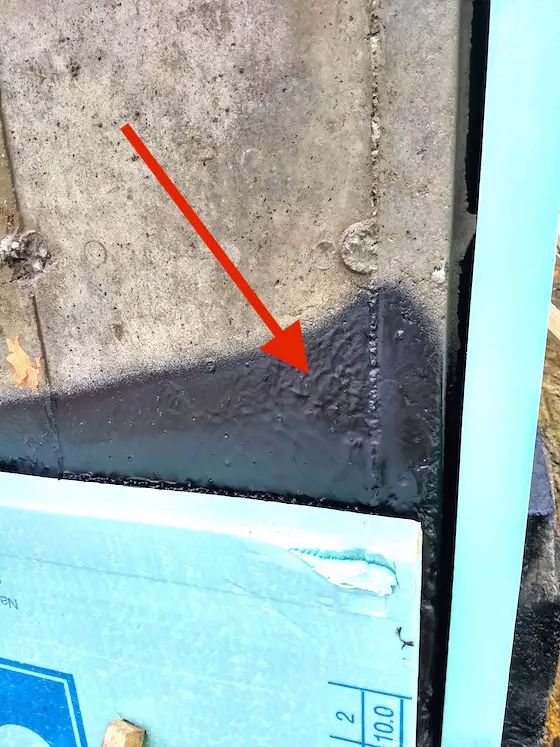
The black goo is foundation waterproofing. The red arrow points to the thick coating where it's sagged. Damproofing is much thinner like a simple coat of paint. Copyright 2018 Tim Carter

Exterior Foundation Waterproofing Compounds

Foundation waterproofing is probably one of the most confusing aspects of residential construction. Thousands of homeowners think they have a waterproofed foundation, when in fact they do not.

Waterproofing is generally not used by a majority of builders, due to its higher cost. In an effort to stay competitive, some builders will cut corners in areas where the homeowner cannot easily see the finished product.

Waterproofing is a prime example of this, due to the fact that it is generally covered early in the job by the dirt around the foundation. However, the higher initial cost of waterproofing is well worth it. Interior waterproofing methods used after a leak has developed are generally not as effective as a compound applied to the exterior surface of the foundation.

Related Links

Drain Tile Installation - 98% of Builders Do it WRONG

Drain Tile and Foundation Backfilling Tips

Damproofing - Not The Same as Foundation Waterproofing

Foundation waterproofing is often confused with "damp proofing." Damp proofing is a process which retards or slows water penetration into foundations. Damp proofing is usually performed by applying unmodified asphalt coatings to the foundation surfaces.

Free & Fast Bids

CLICK HERE to get FREE & FAST BIDS from local foundation waterproofing companies.

Most of these products become brittle when dry. Some of them can actually be dissolved by groundwater. Virtually none of them have the ability to bridge foundation cracks.

However, damp proofing compounds are generally very effective in stopping water vapor transmission. Untreated concrete or other masonry products readily absorb water from the soil around your house. This water travels through the concrete and evaporates from the inside surface of the basement wall.

Water Vapor Passes Through Concrete

Frequently the walls will appear dry, however, the water is still being transmitted into your basement. Unless a water vapor barrier was installed beneath your floor, this same thing is happening with your basement concrete slab. That is why older houses frequently have "damp" feeling basements. The widespread use of damp proofing methods did not begin until the 1950's.

Waterproofing, on the other hand, is very different from damp proofing. Waterproofing compounds are designed to stop water infiltration.

These compounds or membranes can be extremely effective when applied to the exterior of a foundation system. There are a wide variety of waterproofing products available to homeowners.

Wide Variety of Waterproofing Methods & Products

They are vastly different in their composition. Some of these products are urethane based, others are modified asphalts, some are clay based and some are rubber polymers.

If you’re interested in learning more about foundation waterproofing cost I have an article here.

Most of these compounds have the ability to bridge cracks that might later develop in a foundation. This is extremely important. Some compounds can bridge much bigger cracks than others. When installed properly, these waterproofing compounds can keep a basement dry for many, many years.

CLICK HERE to get FREE & FAST BIDS from local foundation waterproofing companies.

Column B15

Structural Alternatives for House Foundations & Footings

Foundation Alternatives

In the event that the site you choose to build upon has poor soil conditions, you have alternatives. There are several methods that you can employ. However, I highly recommend that you consult with a competent structural engineer to assist you. The calculations which are required to determine the proper structural alternative can generally be performed only by a trained professional. Do not attempt to do this by yourself!

One method to consider is the use of "piles." Piles are structural elements (steel columns, wooden timbers, etc.) which are mechanically driven into the soil. These elements act in soil much the same way as a nail acts when driven into wood. The piles attain a certain "skin" friction as they are driven into the soil. The deeper they are driven, the more friction they produce. You can illustrate this very easily. Drive a small finish nail 1/8" to 1/4" into a piece of pine. Generally, you can readily pull this nail out with your fingers. Reinsert this nail into the same hole, and now drive it 1" to 1 1/4" into the piece of pine. I think you get the picture. When the pile is driven sufficiently deep enough, it attains enough friction to hold the weight of your structure.

Another structural alternative is a pier. Piers are simply columns. They are created by drilling a shaft in the soil until you reach a layer of rock or soil which will be strong enough to support the weight of the structure. These shafts are then filled with concrete, usually reinforced with steel. Generally, a specialty contractor with very large drilling equipment is required to perform this work. It is risky and dangerous. The shafts can be very deep and the sidewalls can collapse without warning if unsupported. Drilling piers is not to be performed by an amateur.

Structural engineers can offer even more alternatives given your specific soil conditions. You will never regret hiring one. They can relieve your anxiety. In a difficult building situation, only a fool would proceed without the advice of a competent engineer.

Column B10

Forces Harmful to House Foundation & Footers

Gravity, soil swelling, soil collapse, frost heaving, hydrostatic pressure, etc. are forces of nature which can cause serious harm to footers and foundations. In the event that a footer or foundation has a structural failure, this failure usually transmits to the rest of the structure. Cracks or separations can begin to develop within your home or structure. These failures can be very serious and actually lead to the ultimate collapse of your home or structure.

Gravity & Your Foundation Walls

Gravity works against your foundation walls. In the case of a typical full basement foundation wall, the foundation wall not only acts as a beam to support the weight of the structure, but also acts as a retaining wall to keep the earth around your house from entering your basement. This can be a tall order to fill, in the event your house is built into a hillside. Think of all the soil that your foundation wall is holding back! Gravity is pushing the dirt or earth against your foundation constantly. During periods of heavy rainfall, the situation intensifies. Many soils absorb vast quantities of water and this added water, combined with the soil, pushes against your foundation wall. This force is commonly referred to as hydrostatic pressure.

Certain soils exist which expand and contract depending on whether they absorb or lose water. This property can be extremely harmful to footings and foundations. If a foundation is constructed on two different soils - and this is a very common occurrence - one soil may expand when saturated while the other soil remains stable. This situation can cause tension to build up within the footing and foundation. This tension, if great enough, can and will crack your footing and foundation. You can combat expansive and contractive soils quite easily. The key is to keep them in a state of dynamic equilibrium. That's a fancy word for tricking the soil. Simply put, if you keep the soil around your footing and foundation constantly moist, the soil will generally not expand and contract. It will not expand or contract because the soil reacts to changes in moisture content.

Frost Heaving

Frost heaving is a condition which occurs when the moisture in soil freezes and expands. Due to the fact that it takes extended cold weather for soil to freeze, this phenomena rarely occurs in warmer climates. Frost heaving in certain soils can cause a volume of soil to increase by as much as 25 percent. A volume change of this magnitude beneath a footer or against a foundation wall could be catastrophic. I personally have witnessed concrete slabs lift three to four inches due to frost heaving. For this reason, when you construct footings and foundations, you should always be sure that the bottom of the footing is below the "frost line" in your area. You can determine the "frost line" in your area by consulting your local building department officials. The frost line can vary widely. For example, in the southern United States, the frost line is measured in inches below the surface. In the northern Midwestern states, the frostline can extend to several feet below the surface.

Soil Collapse

Soil collapse can occur in soils which have very large voids within the soil. Loose sandy soil is an example. Footings and foundations placed upon these soils can "sink," which subjects them to tension. As we have discussed, this tension can lead to cracking and failure.

Cutting and filling activities can also act as an indirect force which can harm footings and foundations. These activities occur anytime you move undisturbed soil from one location to another. Many new home subdivisions are subjected to cut and fill earthmoving activities. When you cut a soil, its natural compaction is disturbed. It becomes "fluffed." It has large voids and requires compaction to make it suitable for construction purposes. If you place dirt or soil on a site without properly compacting it, you are inviting disaster. This "fill" dirt will eventually compact itself through the actions of gravity, vibration and water infiltration. Footings and foundations placed on uncompacted fill dirt or soil will, in all likelihood, crack and fail.

Column B10