Concrete and Flagstone Patio Tips

Concrete & Flagstone Tips

If you decide to try to build a brick patio like mine, you do not have to worry about the concrete finish. All that is important is that there are no high spots. Take your time and wiggle a board side to side across the forms you have built to create the shape of the patio. Low spots can easily be filled with more mortar. High spots will create a hump in the patio, unless you know how to sand a brick!

Flagstones are somewhat easy to lay. I prefer to install the border first. Remember to sort through the flagstones you have purchased. You are looking for the thickest pieces of flagstone. Ideally you should try to get a batch of flagstone that has fairly consistent thickness, but this is not always possible. The thickest piece of flagstone sets the tone for the amount of mortar that will be under each successive piece of flagstone that is installed. If you make a mistake and install a thinner piece of flagstone as your first piece, you will end up having a hump or a series of humps in your patio as you continue to install the stone.

Use a small torpedo level to make sure that the flagstones are not tilted. Lay out the stone to create the border. Do your cuts before you mix mortar. A rock hammer and chisel are used to score and cut flagstone. Have the manager at the stone yard demonstrate the easy way to cut and shape flagstone. It is not hard - it just requires a little practice. Chips that are generated from the cutting process can be used as filler in the mortar when you start to lay thinner pieces of flagstone. These thin pieces typically use up lots of mortar. The mortar for the brick laying is mixed as one part cement to three parts sand. When you place the flagstone into the mortar, tap the stone lightly to get it into position. If you have to tap more than three or four times, you have too much mortar under the stone. Too much mortar will also cause the mortar to ooze up in between the stones. This is not good as the intent is to grout the flagstone after they are all set. Once the border is complete, let the stones sit for 24 to 48 hours if possible. This will allow the mortar to get very hard. We need the stones to be set in place before we proceed.

Using a taut string line stretched between the border stone, you fill in the field. This is tons of fun. Just lay full stones that have been shaped to fit next to other stones. Use small stones to fill in gaps between large stones. You don't always have to try to chip a stone to make a huge jigsaw puzzle. If you want to fill in some of these larger "holes" between stones at the end of the project, that's OK. Don't forget to scrape out excess mortar that oozes out from under large stones from where the cuts go. If it dries and gets hard you will have problems.

Once the cut pieces are laid it is time to finish the grout. This is where you fill the spaces between the stones. This task is performed using a grout bag similar to what bakers use to decorate cakes. You mix up a soupy combination of one part sand to one part cement. The mixture should flow out of the bag with little or no squeezing.

It is important that no little rocks are in the mix. They will clog the nozzle. Over fill each joint by 1/4 inch. After a short period of time you will be able to scrape off the excess mortar without smearing the brick. Use a small triangular brick trowel for this job. The hard work will be worth it! It's best to do a small test pad to see if you are up to the task of doing an entire patio. Try it and see!

Column B409
Patio Sizing Tips

Tips on Sizing an Outdoor Patio

The Plan

Should I tell you how many times I have seen patios that are too small? I did not think you would be interested. Chances are you have seen the same thing. A patio with just enough room to fit a table and chairs or a cramped patio with a grill sitting off in the grass. The sad thing is that small, ineffective patios can be avoided with just a little bit of planning.

Use Your Existing Rooms

If you are thinking of building a patio, start your planning by walking into your living, dining or family room. Do those rooms currently seat the number of people that you plan to seat on the patio? Is there enough room between existing pieces of furniture in these rooms? If so, you are off to a good start. I hate to spend time reinventing the wheel!

Tape Measure and Graph Paper

A simple plan is better than no plan. You can make a simple plan by using standard 1/4 inch graph paper. This paper usually has light blue lines that are spaced at 1/4 inch intervals both horizontally and vertically on a piece of paper. Art supply stores sometimes carry this paper in large sheets (11 x 17 inches). The pre-drawn lines allow you to draw the plan more easily to scale. Make a quick drawing of what you think you want. Use a scale of 1/4 inch on paper equaling one real foot in your back yard.

Assuming you have chosen a patio size similar to one of the existing rooms in your house, measure the size of the room using your tape measure. Translate those measurements to the paper. You should remember to keep the drawing in scale. In addition, don't forget to add two to three feet behind furniture! This is a common mistake. Surely you do not want your patio furniture right at the edge of the brick!

Checking the Drawing for Fun & Function

Now we must check to see if the plan will work. Measure the size of your patio furniture or what you intend to buy. Make scale cut outs of these objects and color them. For example, most common chairs measure about two feet wide and deep. So, cut out a piece of paper that is 1/2 inch on each side. Do this for all the furniture. Place the colored cut outs on the patio plan. Do they fit? Is there plenty of space between the colored pieces of paper to walk? Are the pieces at the edge of the patio boundary? You say everything is fine? GREAT! I knew you could do it. Frank Lloyd Wright would be proud, that's for sure!

Read Steve C's question on sizing a new patio in this Concrete Patio column.

Column B409

Hepa Filter & Hepa Vacuum Manufacturers

HEPA Vacuum Manufacturers

I don't really advocate the use of vacuum cleaners to pick up lead dust, although I am told it is safe. Conventional filters are absolutely a no-no as the lead dust can pass right through those and be blasted back into the air via the vacuum exhaust port.

To stop lead dust inside a vacuum, you need a special filter known as a HEPA filter. HEPA is an acronym for high performance particulate air. These filters are expensive but they can trap very, very small particles that are invisible to the eye. Lead particles are trapped for sure by these filters.

Most of the ordinary wet / dry vacuum companies make a vacuum cleaner that can be equipped with such a filter. I own a Ridgid brand wet / dry vacuum that can handle such a HEPA filter. I am reasonably confident that the following vacuum manufacturers have certain models that can be equipped with a HEPA filter. Make sure the model you buy can accept such a filter before you complete your purchase. I would not do it based on literature claims. I would want to see the actual HEPA filter and see if indeed it fits the vacuum cleaner.

Here are the vacuum manufacturers:

  • Clarke Industries
    800-253-0367

  • Dayton Electric Mfg. Co.
    847-647-0124

  • Fein Power Tools
    800-441-9878

  • Ridgid Tool Co.
    888-4-RIDGID

  • Shop-Vac
    717-326-0502

Companion Articles:  Lead Paint Problems, Beware of Lead Paint, Lead Poisoning Danger - Lead Paint, Free Lead Poisoning Hazard Information

Column B278

Free Lead Poisoning Hazard Information

Do you want some helpful government literature? If so, there is a ton of it available for free. The following list is just a partial listing of some stuff you can get. I built this list from a helpful EPA web page . You can order 15 of the documents online right from there. If you don't have Web access, then order by mail. Call 800-424-LEAD for complete mailing instructions. Here is what they will tell you to do:

  • If you would like documents sent to you via U.S. Mail, please provide your name, address, and daytime phone number.
  • Make a list of what publications you want.
  • Please limit your document request to 15 individual documents.
  • Some NLIC documents may be available from the EPA Fax-on-Demand system. Call 1-800-424-LEAD for more information.

Partial Lead Hazard Document Listing:

  • 003 EPA Fact Sheet: Learn About Lead
  • 400 EPA Reducing Lead Hazard When Remodeling Your Home
  • 402 EPA Lead Exposure Associated With Renovation and Remodeling Activities
  • 418 EPA Testing Your Home for Lead in Paint, Dust, and Soil
  • 011 CDC/ATSDR Lead in Your Drinking Water
  • 017 EPA Lead in Your Home: A Parent's Reference Guide
  • 019 EPA Lead Poisoning and Your Children
  • 021 EPA Identifying Lead Hazards in Your Home
  • 024 EPA Report on the National Survey of Lead-Based Paint in Housing
  • 029 NLIC National Lead Information Center List of Documents available by FAX on Demand
  • 319 EPA Fact Sheet: Disclosure of Lead-Based Paint Hazards in Homes
  • 322 EPA EPA and HUD Notification and Disclosure Rule
  • 323 EPA/HUD Lead; Requirements for Disclosure of Known Lead-Based Paint
  • 325 EPA/HUD Real Estate Disclosure Forms (Sale / Lease)
  • 420 EPA A Field Test of Lead-Based Paint Testing Technologies: Summary
  • 426 AECLP EPA's National Guidelines for Lead Hazards in Dust and Soil
  • 440 EPA Residential Sampling for Lead; Protocols for Dust and Soil
  • 443 EPA Sampling House Dust for Lead; Basic Concepts and Literature Review
  • 471 EPA Summary and Assessment of Published Information on Determining Lead Exposures and Mitigating Lead Hazards Associated with Dust and Soil in Residential Carpets, Furniture, and Forced Air Ducts
  • 500 OSHA Lead Exposure in Construction - Interim Ruling
  • 601 HUD Guidelines for the Evaluation and Control of Lead Based Paint Hazards in Housing; Chapter 7 - Inspection

Companion Articles:  Lead Paint Problems, Beware of Lead Paint, Lead Poisoning Danger - Lead Paint, Hepa Filter & Hepa Vacuum Manufacturers

Column B278

Lead Poisoning Danger – Lead Paint

peeling paint on brick

Lead Paint Danger | This peeling paint might be a SERIOUS health hazard. If it's an older home, shed, or garage, it could contain LEAD! Copyright 2021 Tim Carter

A Dog Almost Dies - Chewing Painted Woodwork

One of the last jobs I did before I began my new media career was a large kitchen addition and remodeling job for my neighbor. They had a great dog that was kept in a basement room while we worked each day. The dog was fairly excitable and began to gnaw at the painted woodwork adjacent to the door of the room. Within a couple of weeks the dog was getting sick.

The neighbor mentioned the dog's illness to me and asked me what I thought. I immediately said, "I think the dog has lead poisoning." The neighbor thought I was nuts. I mentioned, "Look where the dog has been chewing on the woodwork. That is old paint that contains lead."

Well, it turns out I was right. They whisked the dog off to the vet and got blood work done. The dog's lead count was practically off the scale.

To this day, the dog has never been the same. That proves to me that lead absolutely can cause irreversible damage to the central nervous system.

CLICK or TAP HERE to get FREE BIDS from local LEAD-ABATEMENT CONTRACTORS.

Lead + Vinegar = Sweetness

For some reason, the USA was slow to outlaw or restrict the use of lead in consumer products. A very long time ago it was discovered that if you mixed lead with vinegar that it created lead acetate. This is actually a sweetener. So, lead was used as a sweetener in wine for many years. In 1427 the use of lead as an ingredient in wine was outlawed in France and Spain. That was almost 600 years ago!

Lead has been used in paint for over 200 years. But, France began to restrict the use of lead in paint in 1840. The Germans did the same in 1870 and they were followed by the Australians in 1922. It wasn't until 1978 that the USA decided to act.

How Great is Lead Poisoning Danger?

The current estimate of residential housing units in the USA that have a significant amount of lead-based paint either inside, outside or both is nearly 57 million houses or living units. That is a huge amount of lead paint! It also represents a significant danger to those who do not know about lead hazards.

Is Scraping, Sanding, or Chipping Lead Paint Dangerous?

Yes! Do NOT scrape, sand, or chip lead paint.

If you see someone sanding, chipping or scraping old paint, tell them to stop and read up on the dangers involved with working with this material. If you have relatives who live in old houses, be sure they clean dust around windows and doors with wet paper towels. Lead dust is a real hazard, especially to small children!

Companion Articles:  Lead Paint Problems, Beware of Lead Paint, Free Lead Poisoning Hazard Information, Hepa Filter & Hepa Vacuum Manufacturers, Peeling Exterior House Paint

Column B278

Beware of Lead Paint

If you are or know of a school teacher who is trying to get their Master's or Doctorate degree and they need a neat subject for their dissertation, I have one! Here is what they need to study. Let's look at the incidence of kids with learning disabilities. Let's compare the number of kids per thousand who have all sorts of disabilities and see the age of the houses they live in. Compare the number of kids with learning disabilities in suburban areas built prior to 1978 and inner city areas to those suburbs built in the 1980's and beyond.

I'll bet dollars to doughnuts that the statistics will shock all of us. In other words, I would be willing to bet that many of the learning disabilities are related to mild and severe cases of lead poisoning. My guess is that you will not find a statistically high number of kids with learning disabilities in houses built after 1978. This is the year that lead based paints were banned for residential use in the USA.

Exterior Hazard Too!

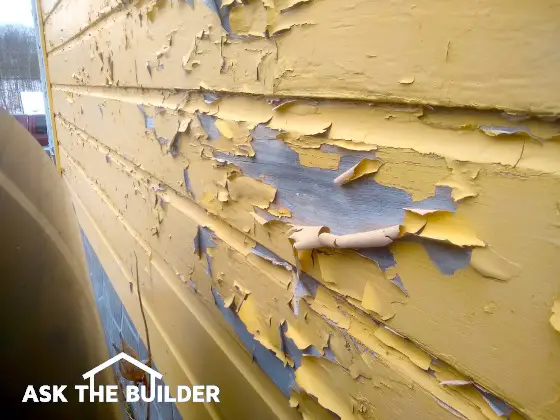
Don't forget that the exterior of many an old home is covered with paint. Much of this old paint contains vast amounts of lead. It is very risky to sand exterior painted surfaces as you prep an old house for a new paint job. Lead dust can enter an open window or drop down and poison the soil below. If a garden is nearby, the lead might be introduced to the garden soil by erosion or the wind.

If a painter is going to scrape old lead paint, make sure they spread drop cloths that capture all of the scrapings. Dispose of the paint chips off site. You really need to think before you work with any old painted surfaces.

Column B278

Sandpaper Facts

It seems there is some confusion out there about sandpapers and the properties of the different abrasives. After this column ran, I received two letters from people who said I had my information all backwards. Both of these people had worked with abrasives for years and thought they would set me straight.

Unfortunately, I had to send them the research materials I had from some of the top abrasive / sandpaper manufacturers in the world. I hate dishing up humble pie, but I had to in this case.

The reason I am bringing it up is to tell you that each and every day I find workers who unknowingly are either spreading inaccurate information or are possibly using the wrong tool for the job. This can impact you if you decide to hire a worker who thinks they know what they are doing simply because they have been doing it for 15 or 20 years. The sad fact may be that they have been doing it wrong for that length of time and never realized it!

Some Other Facts

Just after the column ran in a Kentucky newspaper I received a phone call from a reader who worked in a factory. She sanded fiberglass products each day and often saw the words "Open" and "Closed" on the back of the sanding sheets. She asked me what that meant. I told her it was an excellent question.

The abrasive particles in sandpaper can be distributed onto the paper in one of two ways. You can completely cover the paper with grit or you can apply it so that there is space between the grit particles.

Open coat sandpaper has space between the particles. The paper surface often only has 40 to 70 percent coverage of grit in open faced sandpapers. This property is really necessary when you work with raw wood as this space prevents the sandpaper from clogging with dust.

Closed coat papers have no place for the dust to go. For this reason, they are ideal when working with metals that produce an ultra-fine dust.

Backwards Labeling

When you go to buy grit, you might get confused. The coarse papers have small numbers like 40 or 60 and the fine sandpapers have large numbers like 180, 220 or 240. You can even get industrial papers that have numbers as high as 1,600!

The numbering system makes sense when you think of how the grit particles are separated to make the sandpaper. The numbers correspond to the number of holes per square inch in the mesh in the separating sieves used to filter the grit as it is crushed. If you want to get 220 holes per square inch, this means they have to be small. See how it works?

Companion Articles: Sandpaper Selection, Sandpaper Comparison, Foam Pads for Sanding, Abrasives & Specialty Sandpaper

Column B281

Abrasives & Specialty Sandpaper

Other Abrasives & Specialty Sandpaper

If you need specialty sandpapers or other abrasive tools, trust me, they are out there! You can purchase sandpapers in just about any type, size, shape and profile to meet just about every need.

Woodworkers know that they can buy waterstones and diamond stones for sharpening wood chisels, knives, and other cutting tools. Did you say waterstones? Yes, I did.

Waterstones are becoming the sweetheart of the sharpening industry rather than the oil stones used in the past. You simply soak the stones in water for about 10 minutes prior to using them and sprinkle water on the stone as you use it. The water acts as a swell lubricant and you don't have any oil residue on the blade once you are done.

The industrial diamond stones come in a wide range of grits that allows you to produce surgical sharp edges on knives and chisels. They are awesome.

Companion Articles: Sandpaper Selection, Sandpaper Comparison, Foam Pads for Sanding, Sandpaper Facts

Column B281

Foam Pads for Sanding – Sources

Sources of Foam Sanding Pads

How would you like to have a sanding tool that fits the shape of your hand or the object you are gripping, is waterproof, and is economical? This is not a problem if you happen to purchase a set of foam sanding pads.

There are many times in the past when I have had all sorts of trouble sanding round spindles or other curved objects. The foam pads are the answer. I also like them because they are reusable. When you finish a project, rinse them and they look like new.

I have found two companies that make the pads or sponge sanding tools. One of them sells their products on-line and the other one doesn't. In fact, the only company that sells their sponge pads on-line happens to have a very cool project kit that includes:

  • 4 sponge pads with grits ranging from coarse to extra fine
  • 4 different super glues
  • a glue remover
  • an all purpose abrasive file

You get all of this handy project stuff for just $19.99. It is a real deal! The company that has this great project kit is Surehold. Contact them at:

  • Surehold
    800-881-4495

The other company that sells foam sanding pads is:

  • Norton
    800-551-4415

In a 2012 review, it appears that Surehold might have dropped the foam sanding pads from their product. They seem to be selling adhesives only.

Companion Articles: Sandpaper Selection, Sandpaper Comparison, Abrasives & Specialty Sandpaper, Sandpaper Facts

Column B281

Sandpaper Comparison

Sandpaper Comparison Table
 

Type of Paper Color Properties Best Uses
Aluminum Oxide Light Brown / Tan Very durable,self-sharpens, inexpensive Excellent for raw wood or hard painted surfaces
.
Ceramic Reddish Brown / Ox Blood Really hard, not self-sharpening Best for use with power belt and pad sanders
.
Garnet Orange to light red Fairly soft grit, dulls rapidly Final sanding of wood to create a mirror like finish
.
Silicone Carbide Black Sharp grit, self sharpening, extremely durable Perfect for metal, plastics, fiberglass, & other synthetic materials

Companion Articles: Sandpaper Selection, Foam Pads for Sanding, Abrasives & Specialty Sandpaper, Sandpaper Facts

Column B281