Klein Wireless Speaker Review

klein wireless speaker

Klein wireless speaker | Don't let the size fool you. This smallish speaker puts out a BIG sound that's clear. CLICK or TAP HERE or the photo now to have one in your hands in a day or two. This column was shared with Tim's 31,000 subscribers who read his August 11, 2019 AsktheBuilder Newsletter.

Klein Wireless Speaker | AEPJS-1

I tested the Klein wireless speaker a week ago and I fell in love with it. Too many other job site speakers are too big or they just don't have the features that make them spectacular.

CLICK or TAP HERE for the full specifications and order form.

Does it Have a Rechargeable Battery?

Yes, the battery is internal and you charge it with a normal micro USB cord.

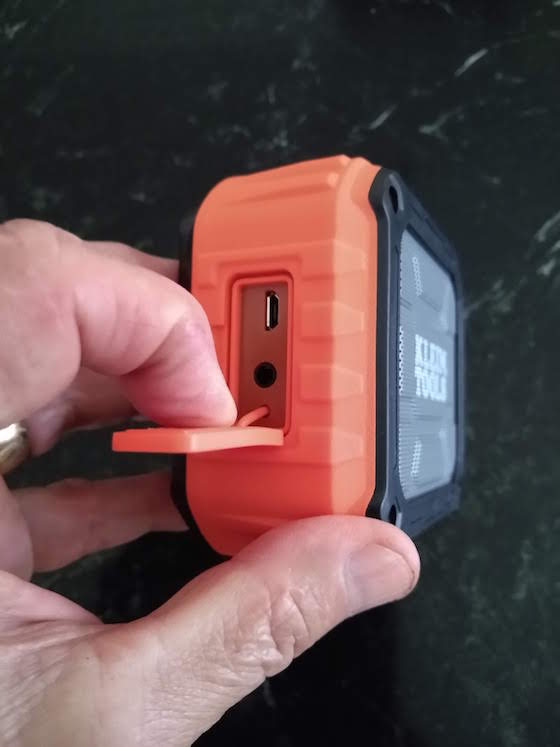
klein wireless speaker

This little door is on the side of the speaker. You charge the internal battery here and you can see the round 1/8-inch jack for auxiilary wired input from some other device that might not be Bluetooth. CLICK or TAP HERE or the photo to have this speaker playing at your home or job site.

Is it Easy to Bluetooth Pair the Klein Wireless Speaker?

You bet. As soon as you turn it on, it puts out the Bluetooth call. You'll see it on your device.

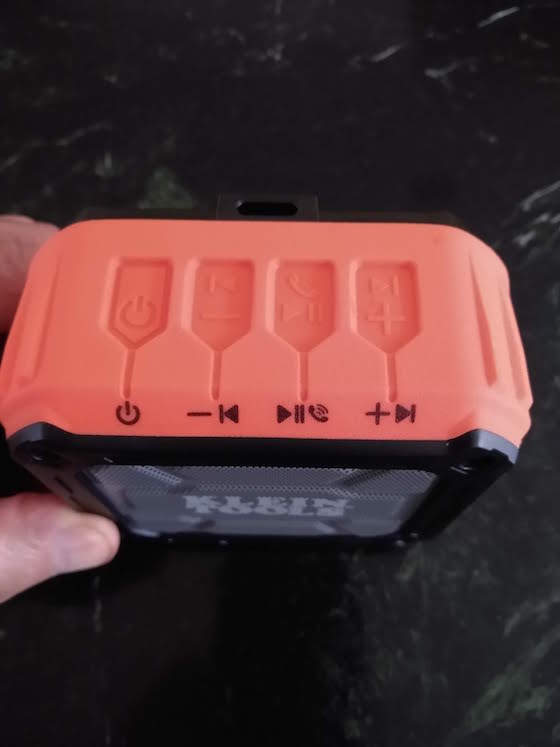
klein wireless speaker

These are the controls. The Bluetooth comes on with the on/off switch. You can take phone calls or reject them. The volume controls and back and forth are intuitive. CLICK or TAP HERE or the photo to own one now and be the cool gal or guy in your tribe.

Does the Speaker Have a Rear Magnet?

You bet it does! You can attach the speaker to an electric panel, steel garage door, steel door, or any other piece of steel so it's not on the ground.

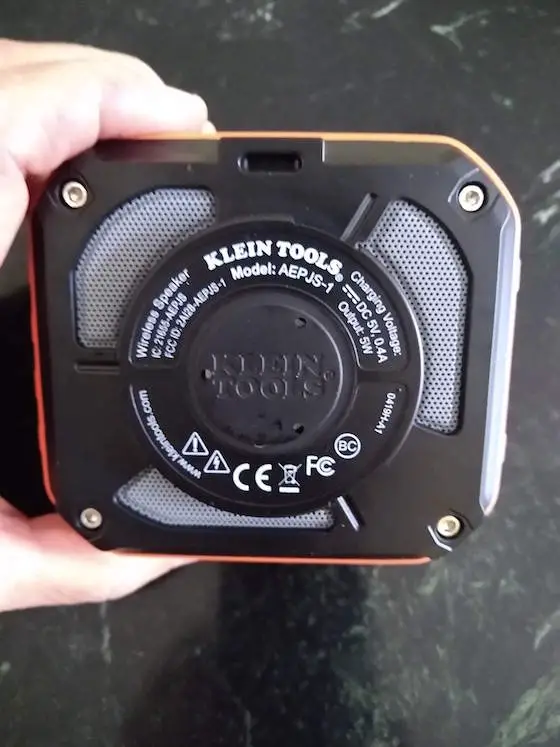
klein wireless speaker

The magnet is right there in the center. Sound also comes out through the holes in the back. It's like surround sound! CLICK or TAP HERE to get one before they're SOLD OUT! HURRY!


Flushable Wipes Testing Video

flushable wipes test

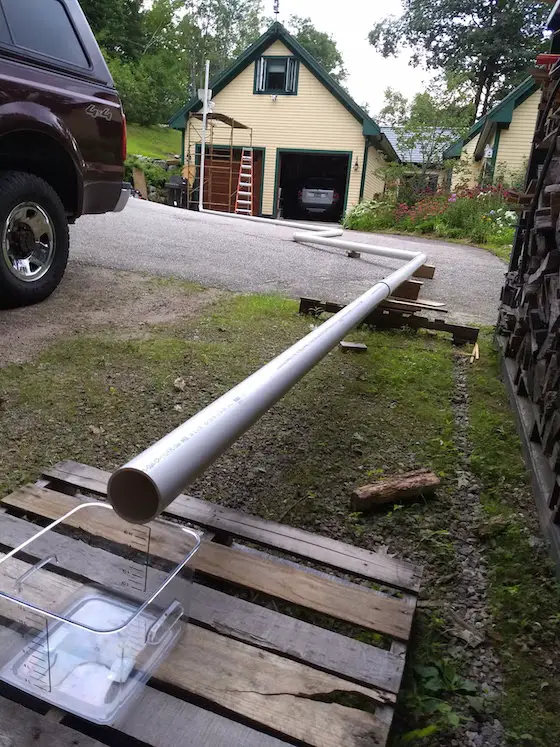
This is the testing setup I used when I accepted the challenge from the Responsible Flushing Alliance to update my May 2019 column about flushable wipes. (C) Copyright 2019 Tim Carter

"It’s important to realize I knew the Responsible Flushing Alliance would challenge my video findings...."

Flushable Wipes Test Video - The Truth is Out There at the End of the Pipe

You may have been one who responded to me three months ago. Remember the column I wrote about how flushable wipes clog sewers? I received hundreds of responses from readers who shared their expensive horror stories about how flushable wipes had caused clogs in their homes.

My favorite response was from a public relations hired gun representing the Responsible Flushing Alliance. They took umbrage with my column and said, “...we want to follow up with you to consider an update to your story...” I responded to them that I would gladly update my original story but would do it with a video, not words. You can read the letter they sent to me with all their counterclaims. Go here:

Responsible Flushing Alliance Letter

I wanted you, and millions of others, to see in real-world conditions what name-brand flushable wipes look like after you flush them down your toilet. I wanted you to see what condition they were in just before they enter your septic tank or drop down into your city sewer system where you pass ownership of the problem to all the other taxpayers of your community.

Here's the flushable wipes test video I did to respond to the letter I received from the manufacturers:

My original flushable wipes column was inspired by a man who lived in South Carolina. His sewage ejection pump was ruined to the tune of over $3,000 by “sewer and septic safe” flushable wipes. I’ve been a master plumber since age 29 and have seen the insides of decades-old building drain pipes under concrete slabs. I know how easy it is for drain lines to get clogged with things other than toilet paper.

It’s important to realize I knew the Responsible Flushing Alliance would challenge my video findings even though I know a thing or two or three about plumbing. I asked for their input on the testing protocol methods so they couldn’t cry foul.

They did provide me with some documents outlining how they test, but at least one thing in their method is against just about every plumbing code I know of. They said to install two 90-degree bends in the drain line. These fittings are the worst plumbing practice for buried lines for a host of reasons. If you need to turn 90 degrees, do it with two 45-degree fittings spaced 6 inches apart. I ignored that part of their protocol and installed my drain pipe as is called for in the Uniform Plumbing Code.

Last week, I spent several days getting ready for the test. Prior to this, I had purchased a special crystal-clear container so you could see what came out of the drainpipe after the toilet flushed. I erected my own pipe scaffolding with a platform 10 feet off the ground simulating a normal toilet height above a basement building drain. I went to the local home center to buy all the plumbing pipe and fittings. A new 1.6-gallons-per-flush toilet was used for the test. Finally, I prepared a script to follow so the video would be as professional as possible.

You can view my flushable wipes test video by going to:

Flushable Wipes Test Video

I didn’t want to have any preconceived ideas about what the results might be, but my decades of experience told me that normal toilet paper would start to degrade quickly as the paper is jostled around by the turbulence of the flowing water inside the drain line. Because flushable wipes are made similar to paper towels, I was fairly confident they’d not suffer too much from the flushing experience.

My local grocery store stocked three different brands of flushable wipes. I purchased a package of each one for the test. While there, I also bought a roll of cheap single-ply toilet paper as we use a more expensive and durable two-ply paper in our home.

The results of the video test were remarkable. One of the flushable wipes did start to degrade slightly after tumbling through 70 feet of the drain pipe. This is an average length of piping that you might have at your home before your sewage makes it to your septic tank or the city sewer.

The other two flushable wipes suffered no visible damage in the test. You can see in the video that the water from the toilet was crystal-clear in the container at the end of the pipe. The two flushable wipes appeared to be in the same condition as I dropped them into the toilet bowl.

The single-ply toilet paper turned to mush and broke apart into many small and medium-sized pieces. Surprisingly, the two-ply toilet paper didn’t fall apart too much. A large wad of it survived the journey through the piping.

I decided to flush a high-quality paper towel down the toilet. It survived the experience with no damage and the water in the container at the end of the line was also crystal clear. Trust me, never ever flush a paper towel down your toilet!

I urge you to watch my video of the test. This simple video might save you thousands of dollars. Share it with your friends, neighbors, and co-workers too. This is a rare opportunity to show exactly what happens beneath your concrete basement floor or under your lawn.

Finally, if you must use flushable wipes, please don’t flush them. Dispose of them in your home as you would a soiled baby’s diaper.

Column 1313

Flushable Wipes Test Video

Flushable Wipes Video | Watch this video to see what happens with name-brand flushable wipes when flushed in a normal household toilet. This was part of the March 17, 2020 AsktheBuilder Emergency Alert regarding COVID-19.

Flushable Wipes - Not Great for Septic Systems Not Terrible For Covered Bathroom Garbage Cans

Please read my original column about flushable wipes.

Read the complaint letter I received from the Responsible Flushing Alliance about my column.

IMPORTANT NOTE: When you watch the following video, pay very close attention to the end where Tim Carter is back on camera. He'll tell you exactly what you should flush down toilets. If you don't hear him mention a product you didn't see in the video demonstration, then that means DO NOT FLUSH it down your toilet.

Here's a photo of the test setup I used to create this video:

flushable wipes test

This is the testing setup for my video. It's a true test for what happens in your home. Copyright 2019 Tim Carter

Responsible Flushing Alliance Letter to AsktheBuilder.com

This is the actual text I received from the public relations person who represents the Responsible Flushing Alliance. This letter, in the form of an email, was in response to my Flushable Wipes Clog Sewers column that was published by many newspapers all across the USA.

Responsible Flushing Alliance - Letter Challenging AsktheBuilder.com Column

I've got screenshots of the actual email below the following text:

Hi Tim Carter,

I represent the Responsible Flushing Alliance, and we want to follow up with you to consider an update to your story from yesterday evening on, Flushable wipes are bad for plumbing.

We appreciate the issues faced by wastewater systems and your effort to educate consumers and agree there are products that should not be flushed – but we are concerned that blaming the problem on “flushable wipes” is missing the mark.  There are many types of wet wipes out there, such as baby wipes, disinfecting wipes, household cleaning wipes, facial wipes and more.  But there is a small but separate category of wipes designed, marketed and tested to be a “flushable wipe” for personal hygiene in a bathroom.  We know through extensive sewer collection studies that these “flushable wipes” are not the problem.

In those studies, 98 percent of materials contained in sewer systems were garbage, debris, and non-flushable wipes. Non-flushable wipes and paper products like paper towels were by far the biggest culprits, making up nearly 91 percent of problem-causing debris. Results of a New York City study can be seen here.

Additionally, we would like to clarify statements made in your article regarding the small portion of wipes that are marketed as “flushable” wipes.

“Flushable” wipes differ entirely from non-flushable wipes. It should be noted that the fibers used in flushable wipes are the same chemically as wood pulp, which is used to make toilet paper. And, like toilet paper, has been developed to biodegrade in wastewater treatment systems.

To be considered “flushable,” our industry has developed manufacturing guidelines that require wipes undergo a flushability assessment involving seven must-pass tests to ensure any wipes marketed as “flushable” are compatible with wastewater systems.

More specifically, flushable wipes must pass through the wastewater collection and treatment system with a minimal pump power increase and ultimately disintegrate in the treatment process.  In septic systems, flushable wipes sink, not float like non-flushable wipes, so they are exposed to the biological treatment process and, being cellulosic, are digested by that process.

Importantly for your readers, if you’re unsure how to dispose of a product, check the “How to Dispose” instructions.  If you see the “Do Not Flush” symbol on the packaging, that is a sure sign that a product should not be flushed.

As you update your story, you are welcome to attribute any of these comments to a spokesperson for the Responsible Flushing Alliance. And, if you’d like to speak with an RFA representative who can provide more detail for you, I would be happy to make someone available to you.

Kind regards,

Alfred Breuer

Hill+Knowlton Strategies

Austin, TX

responsible flushing alliance

responsible flushing alliance


August 4, 2019 AsktheBuilder Newsletter

Are you a new subscriber? Welcome, this is a pretty interesting newsletter for your first one if I don't say so myself!

Have you done the rodeo with me a few times being a seasoned subscriber? I think you'll agree this is a dandy newsletter edition.

This and That - Save $$$$$

I often share things that I've had a great experience with or that save me money.

I want to put out a great word for AAA. Yes, the American Automobile Association. I'm not getting anything from them for this mention.

I used to be an AAA member back 45 years ago. You'd get those crazy paper TripTiks to show you how to get to your vacation destination. You'd get the paperback books with all the lodging suggestions. There were other benefits too. I stopped being a member decades ago.

Anyway, fast forward to a year or two ago. If your auto insurance is like mine, your agent, or the company, tells you that you get "roadside assistance, free tows, blah blah blah" as part of your car insurance policy. It's all FREE FOR LIFE.

That's a crock of you-know-what. I had to have my truck towed twice two years ago because of a broken brake line. I had to call my agent about a piece of broken glass on my other car. I was paying for full glass coverage with no deductible and she said, "Oh, wait. You have two claims already this year. I wouldn't put in a claim for this glass if I were you."

You know about the well-hidden 'three strikes and you're OUT' rule in insurance, don't you??? CALL YOUR AGENT and ask about it.

"What? What CLAIMS???" I retorted.

"Well, I see here where WE had to PAY to have your truck towed twice."

"But that's FREE!"

"No it's not. Those are CLAIMS."

I was fuming. Yes, I know nothing in life is free, yadda yadda yadda.

I'm also against unethical business practices and the telling of half truths.

You know a half-truth is a whole lie, don't you?

That's why when you're sworn in on a witness stand you say, "I swear to tell the truth, the WHOLE truth and nothing but the truth." I've had to swear that countless times in my career as an expert witness.

Days later, I received in the mail a promotion - I wonder if AAA has my phone tapped????? - for AAA, I opened it, saw what the price was and immediately signed up.

Guess what? I had to have Kathy's car towed because we thought an idler pulley issue might have been a timing chain going bad, I had to have my truck towed again because of a minor issue and two weeks ago, I had to buy rear brake rotors, pads and one caliper for my truck for a grand total of $450.00.

The salesmen at my local NAPA store said, "Are you a AAA member?"

Heck yes I am!

BOOM, I saved $45 on that order!

The bottom line is I've already PAID for my membership in savings this year and MORE.

I'm sure there are other discounts I'm missing out on at other businesses.

CHECK OUT AAA for yourself. You don't even have to own a car to belong.

Flushable Wipes VIDEO!

Well, it took days to setup, record and edit. It's also got a very interesting ending for you!

But the video is done. I had some fun producing the video. I'm pretty certain you'll laugh at parts of this video. Do you have grandkids? You may not want them to see this as it will give them a few ideas!

Kathy helped me as I needed a second hand 70 feet away to hit the record button each time I flushed the toilet while I was up on the pipe scaffolding.

Suffice it to say the flushable wipes manufacturers are going to be none too happy!

Would you consider doing me a huge favor?

If you use social media at all, would you consider SHARING this video????

This video has the potential to go VIRAL because it can save millions of people BILLIONS of dollars in sewer-cleaning or septic-tank service calls.

All I ask you to do is post the following URL to Facebook, Twitter, Instagram, or whatever network you use. SHARE the following URL far and wide please.

Flushable Wipes Clog Sewer

Just say something about how you know me and let's see if we can't SAVE people LOTS of SWEET MOOLA as well as frustration from having their sewers clog up!!!

You'll see the video near the top of my column. See that clear plastic bin with my hand in it???? That's the video.

Flushable Wipes Clog Sewer

CLICK or TAP HERE to watch the video now.

How To Stay Cool

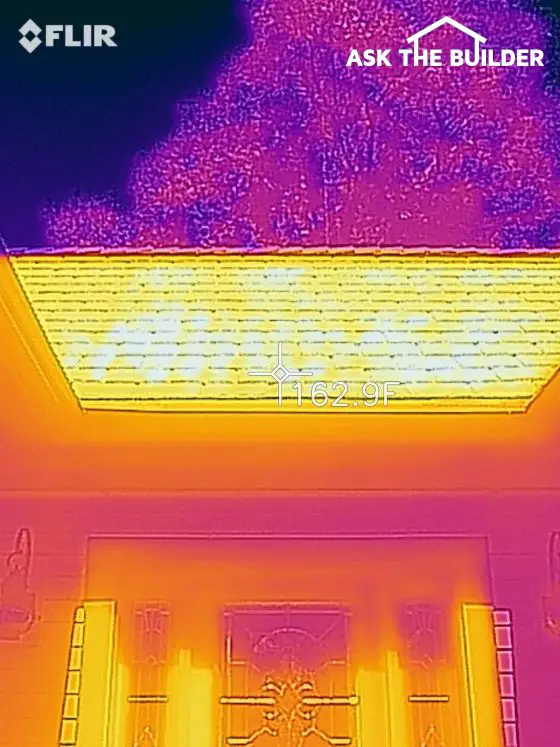
Look at the following thermal image of the roof above my front door. It faces due south. Can you see the white cross-hairs and the temperature reading???
roof temperature

It’s no wonder your attic is blistering hot. My roof temperature exceeds 162 F and that heat radiates into my attic and then into my home. (C) Copyright 2019 Tim Carter

Yes, your eyes are correct.

162.9 F

That's hot enough to cause second-degree burns on your skin in about two seconds. That's the voice of experience talkin'.

That's hot enough to get your roof framing (timbers, trusses, sheathing, etc.) hot enough to radiate heat like embers in a campfire.

That's hot enough to make sure your inside attic temperature is 140 F or so.

What's the best way to offset this wretched summer heat?

CLICK or TAP HERE for a list of things you can do to help lower your electric bills and to be more comfortable during HOT weather.

Heat Pump Research

Do you heat and cool your home with a heat pump? I need your help.

By any chance do you have a geothermal system that tricks the heat pump inside A coil into thinking it's 50-55 F outside?

If you use a heat pump I ask that you help me get some data for one of my national columns I'm about to write.

CLICK or TAP HERE please and fill out the very short survey. You'll need to know the AVERAGE amount you spend each month for electricity. I'm just talking about your entire bill, not the portion for your heat pump.

You will NOT have to enter your name or address. I don't need to know that, but it would be nice to know your postal code so I have an idea if you live on the frozen tundra!

THANKS in advance and I'll be SURE to share this column with you very soon.

Dvorak Typing

Last issue I left a tantalizing breadcrumb at the end of my newsletter about how I type. I use the Dvorak typing method.

Just about every computer known to woman or man has the Dvorak keyboard BUILT INTO it. Yes, you still look at and use the QWERTY keyboard on your machine, but when you press the different letters on the QWERTY keyboard, DIFFERENT letters appear on your screen.

I switched over about fifteen years ago to minimize fatigue from typing all day and to get MORE done FASTER. Dvorak typists can type so much faster than those who type the QWERTY way.

CLICK or TAP HERE to discover more about this unique way to type and to render your stolen laptop useless. Why? When the person starts to type on it, jibberish comes out! BWAHAHAHAHAHAHAHAHA

Discover how to turn this feature on and off if you work on your office computer so that your wretched spying office-mates can't hack into your computer while you're at lunch!

That's enough for a Sunday morning.

Tim Carter
Founder - www.AsktheBuilder.com
Clean up Cat Puke! - www.StainSolver.com
I'm Giving a Speech in Boxborough, MA 09/06/2019 - www.W3ATB.com

Do It Right, Not Over!

P.S. Is it faster to drive to New York or by train?

Burying Electrical Wire

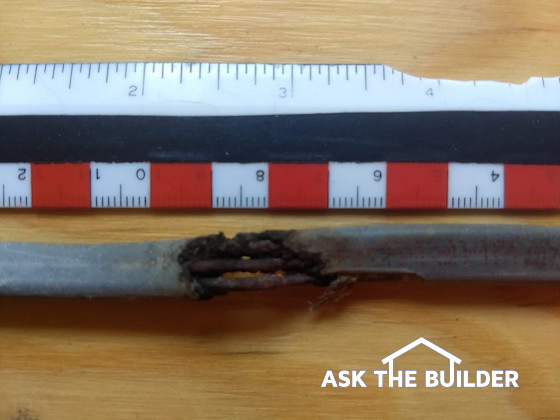
underground wire short burn

Burying Electrical Wire | Here’s a piece of shorted electrical cable pulled from the ground. It caused arcing house wiring in my yard. It was rated for direct burial and was damaged by frost movement in the soil. (C) Copyright 2021 Tim Carter

 Burying Electrical Wire - It's Allowed, But Use Conduit

QUESTION #1: Tim, can you settle a debate between me and my wife? We have to have electric cables buried in the ground for all sorts of things around our home. She insists on putting the cables in conduit and I say, after doing online research, that the use of code-approved cable for direct burial is good enough. I’ll add that we live in a colder climate where the ground does freeze all winter if that makes a difference. Brad P., Burlington, VT

I hate getting involved in these marital battles. More often than not, I tend to side with the wife because women seem to apply more critical thinking skills to the conundrums. Perhaps that’s why they live longer too!

Brad’s wife is on the right side of this issue in my opinion. I defer to a personal encounter I had at my own home with buried underground electrical cables. It’s very important to realize the house I currently live in was built by someone else, not me.

CLICK or TAP HERE to get FREE BIDS from local electricians who can bury electric wire.

Why Does My Post Lamp Not Work?

This past spring, I discovered that the post lamp at the end of our driveway no longer turned on. I checked and the circuit breaker had tripped. I went to reset the breaker and it immediately popped indicating a dead short in the circuit. Dead shorts are bad.

How Do You Discover the Broken Wire?

While not a master electrician, I’ve done lots of residential wiring to code and I knew how to quickly isolate the sections of the circuit to determine the location of the short. Within minutes I discovered the short was in a section of wire that was buried between the corner of the garage and an oak tree where an above-ground junction box was located.

Where Was the Short?

Fast forward and the short was at the end of a single piece of PVC conduit that the builder, or his electrician, had placed under our blacktop driveway. No conduit was used anywhere else, just under the driveway. The wire exited one end of the conduit and made a sharp turn. The up and down movement of the frost action here in New Hampshire had rubbed the plastic insulation off the cable where it contacted the sharp edge of the PVC conduit.

Do Rocks Move in Soil?

Sharp rocks are brought to the surface slowly by frost action. They can cut into unprotected wire and cable even though it’s rated for direct burial. Garden spades, shovels, and deep-cutting roto-tillers can chop into unprotected cables. Conduit prevents damage from almost all of these accidents.

I shared my woeful tale back in the spring about my shorted electric cable in my AsktheBuilder newsletter. One of my subscribers who lives in northern Maine shared how his electrician protects underground electrical cables.

Can Conduit Cause Problems?

This older master electrician discovered that conduits in deep cold climates can be problematic for a host of reasons. He experimented years ago digging a 2-foot-wide trench and putting in one foot of sand in the bottom. He’d then lay the wire in a zig-zag fashion on the sand to allow for movement. The cable would then be covered with another foot of sand. My subscriber claims the electrician has never had a failure putting in buried electric cable this way.

Should Conduit Be Used in Warm Climates?

Those who live in warmer climates where soil frost isn’t an issue should always bury cables in conduit in my opinion. Code-approved PVC conduit is affordable. It’s easy to install and comes with pre-bent fittings allowing you to go around tighter corners.

Should I Photograph and Video Conduit Before Covering It?

Should you decide to use conduit around your home always take photos of where it is before you cover the conduit with soil. If your digital photos are stored online, create a public album and place the URL to it on a piece of paper that you put in a zip-lock sandwich bag next to your circuit breaker panel. Mark on it: PHOTOS of BURIED EXTERIOR CONDUIT.

Believe me, a future homeowner, contractor, or electrician will thank you profusely for these photos showing where the wires snake about under your lawn, driveway, and gardens.

Should Large Blank Conduit Be Under Pavement?

While you’re at it, be sure to install sections of larger conduit, no less than 2 inches in diameter, under sidewalks, driveways or other paved surfaces. You may not need to run a cable now, but believe me, it’s so nice to know you can go under a paved surface with ease in the future. Make note of these conduit locations and put that drawing in the same sandwich bag next to the electrical panel.

Follow the NEC

Another key point is to follow the National Electrical Code with respect to all provisions dealing with conduit and the required depth of burial. Even though you bury the cables the recommended depth, they can be damaged by an inexperienced equipment operator. The key, in my opinion, is to have a clear record of exactly where all underground cables are buried on your land.

Column 1312

July 27, 2019 AsktheBuilder Newsletter

Are you a new subscriber? Welcome to the mayhem of AsktheBuilder.com. It's good mayhem, not bad.

Existing subscriber? Go ahead, tell one of the new subscribers how much sweet moola I've saved you over the past few months and years!

Remember My RANT About the Wire?

Less than a month ago, I was fuming about a shorted underground wire at my home. It's very important for you to realize I didn't build the home I live in at this time. Oh how I can't wait to build my next new home!

CLICK or TAP HERE to read what happened a month ago.

Now peer at this photo:
underground wire short burn

You're looking at the shorted wire I extracted from the rocky soil.

Do you want to know exactly what happened? I thought so.

CLICK or TAP HERE to read the autopsy report.

You absolutely want to read the report and look at the STUNNING PHOTOS. The other reason is Mike Cyr, a virtual friend from northern Maine, wrote to me with a time-tested method to PREVENT shorts in underground wires.

Wait until you read what Mike's electrician does.

Debba and the $300 Gift Card

Two months or so ago, I asked you to help provide some data about indoor portable dehumidifiers. You and hundreds of others responded!

I offered up a $300 Amazon gift card to help make it worth your while. You were assigned a unique number as your answers were recorded.

After the deadline passed, I went to random.org and used their random-number generator to pick the winner of the gift card.

It was Debba.

Here's what Debba sent me after she received it:

Dear Tim,

Your envelope just came in today's mail (we're last on the route). Thank you for all you sent along. I am happy to have the NEFR patch that you personally designed. It's quite handsome. I enjoy reading your ham radio columns, and now I have a patch.

And I am excited to have a piece of ancient mica. Because your degree was in Geology, I know you have considerable interest in this, so it makes the mica even more special.

I guess I don't have to describe the feeling of "winning" the gift card. What a wonderful timely surprise this is. My first grandchild arrived in February, and now Emma is needing a crib at home and one at Grammy's when she visits. This card will go nicely towards the two beds.

Thank you again, Tim. This all has been lots of fun, and I so appreciate it.

Sincerely,
Debba

Debba, I'm so glad the gift card will be put to such a great cause for Emma's slumber!

Prefabricated Wall Panels - Super Precise

It seems like eons ago that we were putting up the factory-built prefabricated wall panels at my daughter's new home.

The winter conditions made job-built walls very challenging. What might have taken a week or more in the field, was accomplished in hours.

CLICK or TAP HERE to WATCH a video I made about the wall panels.
prefabricated wall panels

What did you think? My guess is you'll be convinced you should use these on your next job - even a large room addition! With skilled labor as rare as a white moose, you'll want precise factory-built walls on your job.

CLICK or TAP HERE to discover more about HOW MUCH THEY COST and WHAT LUMBER COMPANY near you can supply these for you.

That's quite enough for the last weekend in July. Party time today and tomorrow!

Tim Carter
Founder - www.AsktheBuilder.com
Certified Organic Cleaner - www.StainSolver.com - look at baseball hat!!
Invisible Happiness - www.W3ATB.com

Do It Right, Not Over!

P.S. Isn't it weird that science has disproved the silly "i" before "e" except after "c" spelling rule?

P.P.S. I'm only responsible for what I blurt out of my mouth or what flows from my fingertips while typing the Dvorak method, not what you may understand.

Underground Wire Short

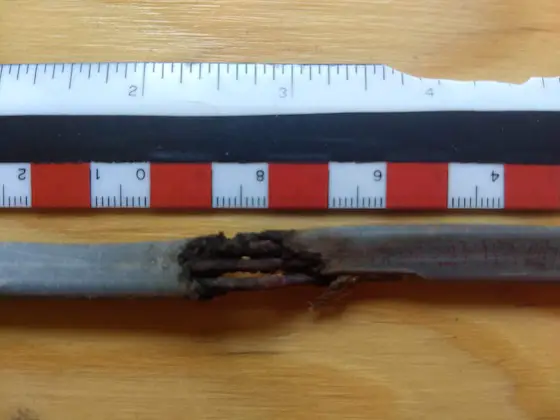
underground wire short

Underground Wire Short | Here's the section of wire that caused my problem. You can see how the dead short caused a small fire underground burning away the plastic wire insulation. Underground wire, in my opinion, should be placed in conduit. That said, read what Mike Cyr, one of my newsletter subscribers, sent to me below. Copyright 2019 Tim Carter

Underground Wire Short - Conduit and Sand Are the Answers

I didn't build the house I'm living in. Each month I discover something new where the builder and his subcontractors took a shortcut.

A few months ago I had an underground wire short. This wire extends from the corner of my house up to the base of an oak tree. From there it split off to a spotlight and then to a post lamp at the end of the driveway.

Was the Wire Rated For Underground Burial?

Yes, the wire was rated for direct burial.

Was the Wire Put in Conduit to Protect It?

There was one piece of 3/4-inch PVC conduit that ran under the blacktop driveway. On either side of the conduit, the wire was buried in the rocky soil without a conduit.

What Caused the Underground Wire Short?

Frost movement in my soil caused the wire short. It's important to realize I live in New Hampshire and the ground freezes each winter. It then thaws in the spring.

The freezing and thawing cause movement in the soil. Water in the soil expands by 9 percent in volume when it turns to ice. This movement wore away the insulation on the wire where it exited the end of a piece of PVC conduit.

Would the Short Have Happened if the Wire was in Conduit?

Maybe. In my case, you can see in the photo below what was the primary cause of the short. The wire exited the conduit and made a sharp 90-degree bend. That bend in the wire contributed the friction along the edge of the conduit.

underground wire short

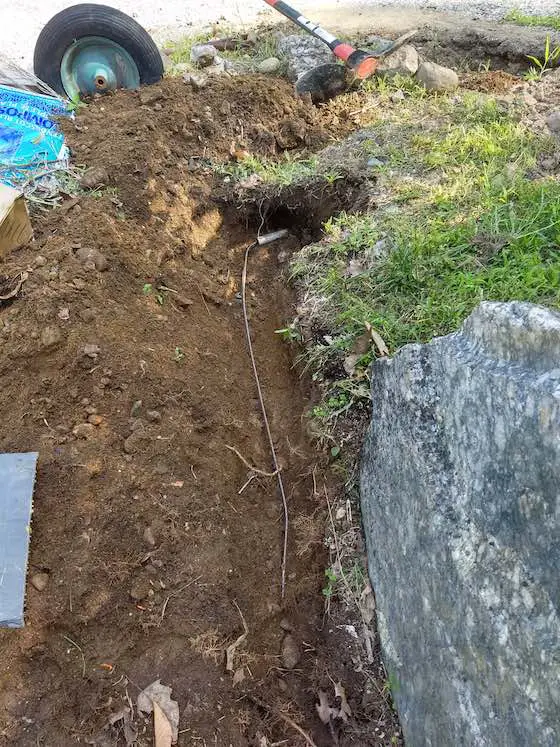
The conduit is at the top of the photo. You can see the original underground gray wire in the trench. Look at the closeup photo below to see the wire make the sharp 90-degree bend. Copyright 2019 Tim Carter

underground wire short

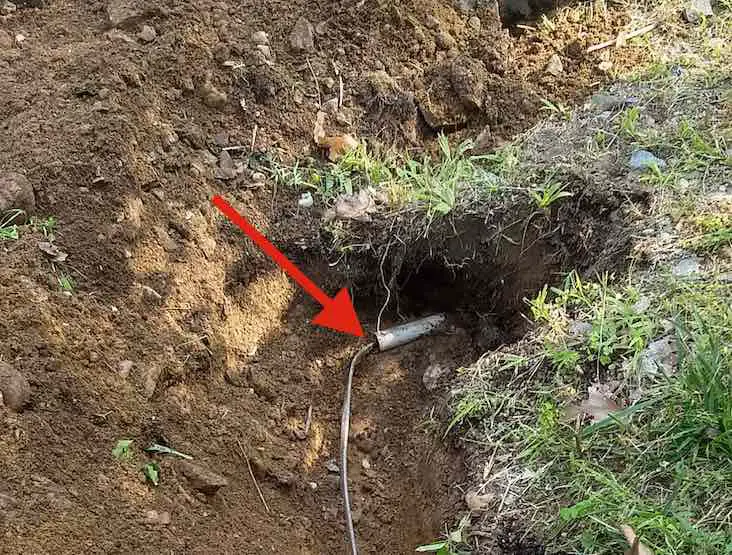
The red arrow points to the exact location of the underground wire short before I pulled the wire out of the ground. May the electrician who put in this wire have black flies around his face for months on end every year. Copyright 2019 Tim Carter

I feel conduit is a great idea because it protects underground wires from gardening shovels and spades.

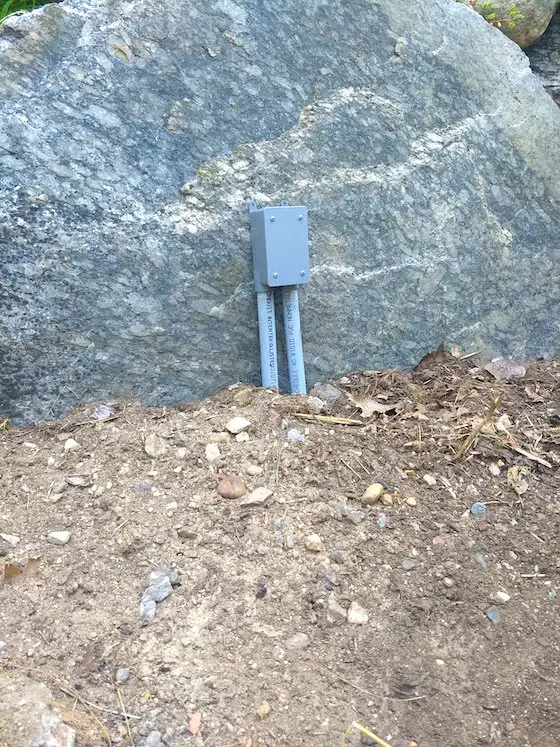
I cut the wire and made an above-ground splice in a waterproof code-approved junction box. I installed all new wire from this junction box to the oak tree on the other side of the driveway. This wire was placed inside new PVC NEC-approved conduit. I connected my new conduit to that which existed under the driveway.

waterproof electric junction box

Here's where I made the splice connecting a new underground cable to the old buried one. The conduit on the left travels up under the drive to the oak tree. The conduit on the right has the original wire that extends back to the corner of the garage. Copyright 2019 Tim Carter

Is There Another Way to Prevent an Underground Wire Short?

Mike Cyr is one of my newsletter subscribers. He's a great man that I hope to meet one day. He routinely responds to my comments in my newsletter and had this to say when I bemoaned my shorted wire in the spring of 2019:

"I have a friend who just retired as a master electrician and has done a lot of my work and we have buried some wires underground over the years.

He is against burying wire in conduit, and his reasoning is this: He claims that frost up here in northern Maine can go deep and can bring rocks up out of the ground and lift and stretch the conduit and actually break a joint or splice in the conduit, thus breaking the wire or opening a small gap in the conduit enough to fill with water and freeze the next freeze-thaw cycle and break the wire.
When he and I buried wire many times and many years ago, he would use direct burial wire which is designed for underground and we would put about 1-2 feet of sand under the wire and then make the trench 1 to 2 ft. wide and zig-zag the wire in the trench thus allowing the wire some slack to move with the frost.  We would then bury it with sand or crusher dust.
He told me he has never had a wire break doing it this way but has had many come apart in the conduits. This is just some food for thought."

Mike's electrician friend is right. Frost does push rocks up through the soil. Just ask any New England farmer! I don't dispute anything Mike's electrician said and protecting the wire with lots of sand is an excellent idea.

If you're going to bury your wire the way Mike's electrician does it and you're passing through a garden area, be sure to bury the wire quite deep so no shovel, spade, or roto-tiller can cut the wire.

What Does Wire Buried in Conduit Look Like?

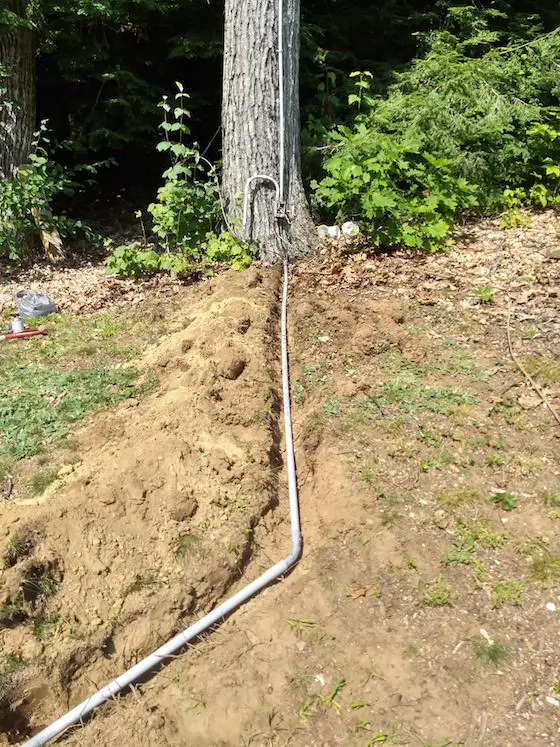
It looks like victory. Can you see how this would prevent the wire from rubbing against anything? Sure, in extreme conditions as described by Mike you could get a failure. But if you live where the soil doesn't freeze, the conduit is the only way to go.

underground wire short

This is 3/4-inch PVC electrical conduit. The 90-degree fitting at the tree will connect to an additional piece of conduit that extends up into a new 4x4 waterproof box. The conduit is in a shallow trench about 6 inches deep. Be sure to follow the National Electric Code when installing yours. Note that local inspectors can modify some codes. Copyright 2019 Tim Carter