Toro Power Clear 60V Snowthrower Snowblower
I recorded this video in late February, 2023 over two days. The snow was quite dry, but not Utah powder.
The machine exceeded my expectations! There was one drawback.
I recorded this video in late February, 2023 over two days. The snow was quite dry, but not Utah powder.
The machine exceeded my expectations! There was one drawback.

Artificial Intelligence and Home Improvement - This is what greets you when you go to the artificial intelligence ChatGPT website. Note the absence of any human face or photo. Copyright 2023 Tim Carter
I’m celebrating my thirtieth year of doing my best to protect you against home improvement scams, not-so-good products, and anything that’s a threat to you when it comes to building, remodeling, or maintaining your home. I’ve stood up to billion-dollar corporations to prevail on your behalf. But now I’m here to alert you of something far more sinister. I perceive it to be a grave threat to you, your relatives, your neighbors, and your co-workers.
This danger is much worse than the smarmiest high-pressure salesman that might ever cross your threshold. Have you been paying attention to the rise of artificial intelligence (AI)? In the past few months, it’s made a fairly big splash and it must be on your radar. AI, in my opinion, is going to make it extremely hard for you to discover the information you need to make smart and informed decisions when you're about to spend money on your home.
Years ago I was one of the founding charter members of a secret Internet mastermind group. Most of the people in the group were brilliant and collectively we helped each other’s online business grow and thrive. Several of us are still in touch and recently one of them assisted me in demonstrating the scary power of artificial intelligence.
You may remember a column I wrote just weeks ago about painting rusty metal. My friend asked the ChatGPT AI software to write a similar column and include an anecdote about my oldest daughter in the 500-word column.
I then decided to survey the subscribers of my weekly newsletter. I asked them to read the AI column and then read the one I had written. It’s important to realize I didn’t share with them who authored the two columns. I have a link at the end of this column to a page where you can read both columns.
When I asked my subscribers how authoritative each column was, the results shocked me. Just over 51 percent considered the ChatGPT column very authoritative. Slightly more than 54 percent thought that my column was very authoritative. When asked which column they trusted more, just over 75 percent voted for mine. Remember, at the time they made the above choices they had no idea who wrote either column.
In the last question of the survey, I asked, “If you discovered one of the two articles above was written by software that copied parts of other online articles not knowing what was good or bad information within the articles it copied, what would be your reaction?
Just over 77 percent of the respondents said they’d be upset and unhappy. Fourteen percent didn’t care as they just wanted to know how to paint rusty metal. The remainder of the respondents typed in their own responses. If I had to summarize all of these into one, here’s what it would be, "Aw! I'm shocked and my mouth is hanging open! They're both great articles, but No. 1 does seem more scientific and well-researched. No. 2 is folksy. I'm still shocked!”
Go here to see who wrote the more scientific and well-researched one and who wrote the folksy one.
The AI software has gone out onto the Internet and scraped content from millions of websites like a bulldozer collects and tumbles dirt in front of its blade. The software then studies the content for patterns. The deeply troubling thing is that the software can’t think like you and me. It has no idea if some of the content it scraped is filled with errors.
Perhaps the best comparison to content created by AI software is to think about what a genius kindergartener might write. But then realize how much life experience that 5-year-old has. How much confidence would you put in an AI column you were reading just before signing a contract for a $75,000 home improvement project?
Remember how ChatGPT was asked to create a story about my oldest daughter and me? It did write the short anecdote but it was all a lie. The story it created never happened. How will you be able to tell in the future what is the truth and what is a lie when the AI software starts to create false stories to ensnare you?
Quite a few of my subscribers, once I revealed they had been faked out by a computer, said that they’d invest the time online to get more opinions about what they should do when faced with a problem. Do you see the flaw here moving down the timeline? What percentage of the content in the future will have been created by AI software? How will you know what was created by a human like me who has forty years of field experience vs. a computer that’s just trying to guess what the correct answer is?
This AI plague is not just overtaking the written word. It’s also being used to create fake videos. The deep fakes possible today are so realistic that they fool many professionals. You can upload photos of people you know, or home improvement celebrities, and the AI software will create videos you think the actual person recorded. It can even get their voice right. Realize this is happening in 2023.
What is going to happen by 2025, or 2030? I think your best bet will be to try to find and stick close to humans like me that have decades of experience working in the homes of people like you. I guess within fifty years robots will be able to say they did that, but we’re not there just yet. Go here to read the ChatGPT content.
Column 1497
Below are two columns. One was written by the artificial intelligence software ChatGPT. The other was written by me, Tim Carter. I was an award-winning builder before I started my syndicated newspaper column Ask the Builder.
After reading each one, think about how authoritative each one is. Are you SURE you'd be able to tell in the future a column created by a non-human?
Start reading:
Column #1:
Painting rusty metal and steel is a common task for homeowners and professionals alike. The process of painting rusty metal requires careful preparation to ensure a long-lasting, attractive finish. In addition to improving the appearance of metal surfaces, painting can also help prevent gas line explosions.
Before painting, it is important to remove any loose or flaking rust from the surface of the metal. This can be done using a wire brush or sandpaper. After the rust has been removed, the surface should be cleaned thoroughly to remove any dirt, oil, or other contaminants that could interfere with the adhesion of the paint. A degreaser or a mixture of water and vinegar can be used to clean the surface.
Once the surface has been thoroughly cleaned, it is time to apply a rust-inhibiting primer. This type of primer contains zinc or another metal that will help prevent rust from forming in the future. The primer should be applied in thin, even coats using a brush or sprayer. It is important to allow the primer to dry completely before applying the topcoat.
When choosing a topcoat for painting rusty metal, it is important to select a paint that is specifically designed for use on metal surfaces. Some common types of paint for metal include alkyd enamels, epoxy enamels, and urethane enamels. These types of paint provide excellent durability and resistance to corrosion and abrasion. The topcoat should be applied in the same manner as the primer, with thin, even coats.
In addition to improving the appearance of metal surfaces, painting can also help prevent gas line explosions. Rust can weaken metal pipes and increase the risk of gas leaks. When metal pipes are painted, the paint creates a barrier that helps to protect the metal from rust and corrosion. This can help to prolong the life of the pipes and reduce the risk of gas leaks and explosions.
An interesting anecdote about painting metal is the story of Tim Carter and his daughter Meghan. Tim is a renowned home improvement expert and the founder of AsktheBuilder.com. One day, while working on a home improvement project, Tim's daughter Meghan noticed that the gas pipes in their basement were rusted and in poor condition. Tim knew that painting the pipes would help to prevent gas leaks and explosions, so he took the time to clean and paint the pipes. Meghan was fascinated by the process and helped her father every step of the way.
Today, Meghan is a successful contractor and home improvement expert in her own right. She often shares the story of her father's project and the importance of painting rusty metal to prevent gas line explosions. Meghan's passion for home improvement and safety has inspired many others to take an active role in maintaining and improving their homes.
In conclusion, painting rusty metal and steel is a simple but important task that can improve the appearance and safety of metal surfaces. By removing rust, applying a rust-inhibiting primer, and selecting the appropriate topcoat, you can create a long-lasting, attractive finish that will help prevent gas line explosions. Whether you're a professional contractor or a do-it-yourself homeowner, taking the time to paint rusty metal can have a significant impact on the appearance and safety of your home.
Column #2:
Did you see in the recent news the catastrophic gas explosion that killed nine people on the island of Jersey in the English Channel? It’s early in the investigation and the experts may not ever be able to pinpoint the cause, but I have my own idea based on something that happened to me two years ago.
I was hired by a small condominium association to do a thorough inspection of some outdoor covered decks that had leak issues and wood rot problems. This building was located just a mile or so from the Atlantic Ocean in New Hampshire. The flats on Jersey island were subject to the same marine environment.
My inspection started at the uppermost deck and I worked my way down to the ground-floor deck. When I was underneath the deck in a passageway that led to a basement door, I saw black iron gas lines that extended from the outdoor meters into the basement. These are connected to the water heaters and furnaces.
The iron pipes weren’t black. They were a crusty brown as they were completely coated in rust. I immediately informed the president of the condo association that these pipes must be painted with a special rust primer and then two coats of finish paint. I instructed her to make sure she read the instructions on the label of the special metal rust primer to prepare the pipes so the primer adhered well.
I was reminded of a quote from the captain of the Norwegian Dawn cruise ship. I had attended a talk of his five years ago while on a short cruise and he said, “The sea EATS iron and men.” If you remember some of your high school chemistry you know this to be true. Saltwater is extremely corrosive to unprotected steel and iron.
You may or may not know this but I’ve been a master plumber since 1981. I’ve installed miles of black iron gas lines in my lifetime. I’ve hand-threaded each and every pipe with cutting dies. You may have never thought about the threaded pipe, but where the grooves are the pipe wall thickness has been cut away and reduced to create the threads.
This means that the strength of the pipe is much less in these grooves. If rust has been working on the pipe eating away at the iron, then if something bumps the pipe or it becomes stressed or bent by accident, the metal at the base of the grooves can crack just like you bending a thin pop-top tab on a soft drink can. Gas now starts flowing from the pipe like air from a blown-up balloon.
You don’t need to live near the ocean for this to happen. Normal rain or humidity in the air will cause rust to form and grow on unprotected iron or steel. Your house has all sorts of structural steel elements that are rusting. Many ignore this rust at their peril.
What about your deck joist hangers? I know they were galvanized when they were installed, but has that zinc coating worn off and do you see rust?
What about the nails that attach the deck joist hangers and other structural connectors to the wood? Is the copper in the treated lumber leaching out with each rain event causing rust and corrosion?
What about those cheap electroplated roofing nails the roofer used to install your shingles? I’ve seen new roofing nails transform into rusty fasteners in as little as five to seven years. The best roofing nails are ones that are double-dipped hot galvanized. Period.
What about any steel support posts in your basement or crawlspace? Do you see rust on these? What happens if the rust eats through the post and someone bumps into it?
What about rust on any horizontal steel I-beams in your basement or crawlspace? Are you ignoring it? If so, you’re making a sad mistake.
The good news for you is that painting rusty black iron pipe or all the things I listed above is absolutely a simple DIY job. Most of the high-quality rust primers and special rust finish paints are available in spray cans should you not like to use a brush.
I recorded a video about five years ago showing the difference between two top rust-paint brands. The test panels in the ASTM scratch test were like night and day. I urge you to watch this video so you purchase a paint that will last for many years, even in a marine environment.
# # #
The first column was done by ChatGPT. The story about my daughter Meghan was a LIE. It never happened. The second column was written by me and you can see it here on my website.
In my opinion, you're DOOMED. Within a few years, thousands of websites will use ChatGPT or similar AI software to create MILLIONS of home improvement columns that probably will contain errors and fake stories to FOOL you. How much money will you LOSE because you followed erroneous advice? SUBSCRIBE NOW to my FREE newsletter so you get advice from a HUMAN.
Always go to the ABOUT page on a website. That page should have the photo of a human that created the content. If there's no mention of WHO wrote the content on the website or you don't see photos - even those can be FAKED - then automatically assume all the content was created by a computer.
Here's another author's opinion about the importance of checking the About Us page on a website.

Lead in Ceramic Coffee Mugs | These bright and cheerful coffee mugs might be invisible agents employed by the Grim Reaper. The glaze could have vast amounts of lead in it. Copyright 2023 Tim Carter ALL RIGHTS RESERVED
Do you have ceramic mugs as you see in the photo above?
Did you know the silica glaze and the pigments used in them often contain lead?
Did you know how little lead it makes to make you sick? I copied this from the past column I wrote about lead paint in the late 1990s:
"It takes very little lead to cause severe physical problems. Lead seeks out and attacks the central nervous system.
When health officials measure lead in a person's body, they deal in increments of micrograms (one microgram equals one-millionth of a gram). To put this in perspective consider a packet of artificial sweetener found on the average restaurant table. A single packet usually contains about one gram or 1,000,000 micrograms of artificial sweetener. Open a packet and pour the sweetener onto a colored piece of paper. Look at how small 1,000,000 micrograms actually is!
Imagine if you created a similar pile of pure lead dust. Since lead weighs far more than artificial sweetener, the pile would actually be smaller. If an adult male receives an acute intake of just 5,000 micrograms of lead - just 1/200th of this small pile of dust, he will most likely die in a very short period of time. It takes far less lead in a child or an adult to cause irreversible physical defects such as coordination problems, learning disabilities, seizures, kidney, and heart and reproductive problems."
Watch this video to see the CORRECT way to test for lead in your ceramic coffee mugs. After watching the video, go below it to read a story sent to me by one of my newsletter subscribers.
"We have practiced alternative medicine since 1984 when a gynecologist almost killed my wife. The doctor we were going to in the late 80's had tested us and found we both had lead poisoning. We didn't know the source, but one night a program like 20/20 came on, we never watched this program before.
They interviewed a pilot in the USAF and his wife. She was severely sick but no doctor could tell them what it was. The husband searched every article he could find on the
symptoms his wife had. After months, maybe years, he asked the doctor if he could test his wife for lead poisoning. Bingo, that was it.
This is the interesting part of the story. While in the Air Force, he was stationed in many countries each year. He would buy his wife stoneware coffee cups everywhere he went, she also traveled with him. The doctors had diagnosed her with a rare disease and had prescribed medicine that was taken with water. Each time she swallowed the pills/capsules, she downed it with one of the coffee cups. The cups were made with stoneware that had been fired with a glaze that contained lead.
My wife and I took our stoneware to our doctor and he tested us and sure enough, Bingo again. This was stoneware made in Mexico. We used it for years almost everyday.To detox we used a homeopathic liquid for maybe two months."

Lead in Pyrex Bowls - Do you own Pyrex bowls like this? The colored glaze you see might be contaminated with lead.
Do you have any old kitchen bowls like you see in the photo above? I grew up with bowls just like it.
In fact, each night for two years in the early 1970s I ate a pint of plain Skyline chili with onions and cheese in a red Prex bowl just like the one in the photo above.
Did you know these bowls might be contaminated with lead? Watch the video below.
Did you know there's NO SAFE exposure level to lead - especially with children? READ MY PAST COLUMN about Lead Poisoning.
You can do whatever you want, but the Lead Test kits you find in stores are meant to test PAINT, not ceramic glaze.
To do a PROPER TEST, you need a hand-held XRF scanner that tests for lead and other heavy metals.
Watch this video. Then you DECIDE if your old Pyrex bowls are safe to use:
Look at the chips and missing colored glaze on the outside of this bowl. How much of that might have transferred to my hands as I used the bowl?
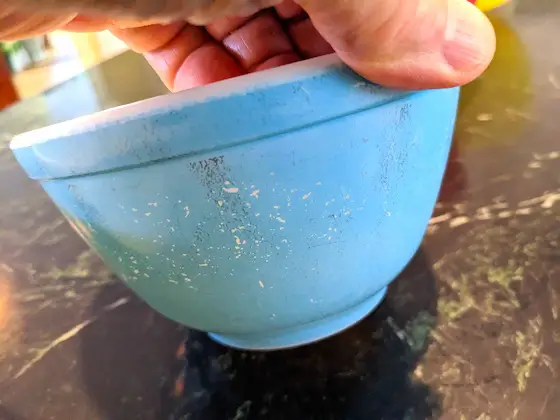
The blue paint or glaze probably contains lead. All those chips and scratches mean lead could have been on your hands, in your food, or in your dishwater. Scary.
You can read another article about lead in Pyrex bowls here.
Carl is a subscriber and he sent me a story about lead in coffee mugs. After doing additional testing, Carl and his wife sent me this photo. Read what he says below it.

These Pyrex bowls belong to Carl and Patricia.
Tim,
The article on lead poisoning was very enlightening, Especially the video with Lead Safe Mama. We didn't realize these bowls from Pat's parents were a lead problem. We tested them and sure enough, even an older set of Correl bowls tested bad.
Thank you,
Carl and Patricia
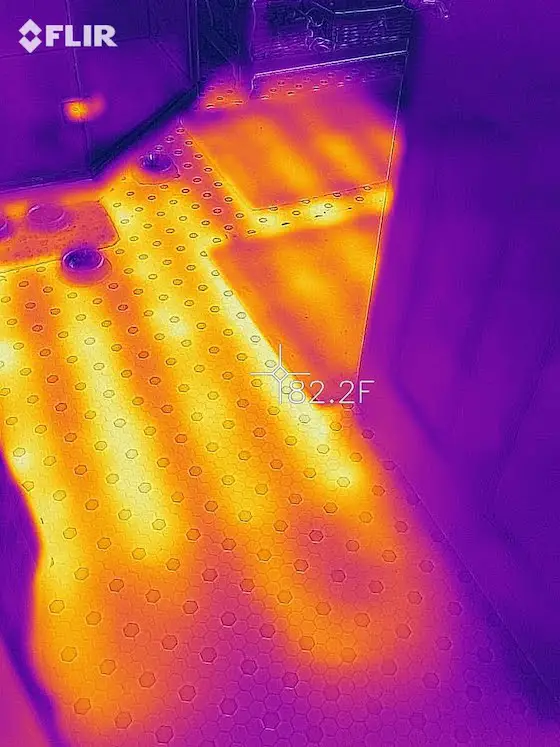
How to Make a Modern Hypocaust - This is an infrared photo showing the Uponor heat transfer plates and the Uponor hePEX tubing that keeps my feet toasty warm! Copyright 2023 Tim Carter ALL RIGHTS RESERVED
You may find this hard to believe, but I didn’t build the house I currently live in. It’s a long story but this current house in central New Hampshire was supposed to be a transition home while I did build a Queen Anne Victorian house for my family. Those plans were dashed by the horrible economic storm that affected millions in the autumn of 2008. It’s hard to believe that was fifteen years ago!
The builder who constructed my home took any number of shortcuts. I realize many of these may have been directed by the owner who could have been too cheap to invest in certain things. I do know the original owner and his wife only used it during the warmer summer months. That explains why each winter when my wife and I walk on our bathroom floor it feels like we were stepping onto the Athabasca Glacier.
New Hampshire winters can be brutal. The temperature can regularly dip to the single digits at night and never climb above 32 F for days at a time. Add to this a master bathroom that’s on the north end of the house with lots of windows and you have all the ingredients to create an extreme arctic-weather training simulator.
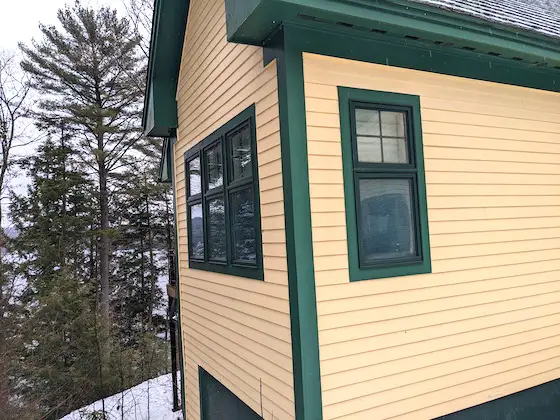
Just behind these two walls you'll discover my master bathroom. There's another window just around the corner making five windows in this tiny 10x10-foot room that faces north. Copyright 2023 Tim Carter
Several years ago I remodeled a basement bathroom part of which was under the master bathroom. Fortunately, the walk-out basement of my home has tall 11-foot 6-inch ceilings. I took advantage of this and created a lower ceiling over the basement shower and an adjacent closet. I now had easy access to the floor under the main part of the master bathroom.
My house has radiant hot-water heat and the current master bathroom only had two smaller wall-mounted radiators. These were not sized correctly and the bathroom would be icy cold on bitter days and nights. It would have taken the builder just three extra hours to install aluminum heat transfer plates under the wood subfloor in the bathroom. PEX radiant heating tubing could have been snapped into the transfer plates in less than 30 minutes. It’s not like radiant floor heating is a radically new concept. The Romans developed the hypocaust method of heating floors and walls thousands of years ago.
I ended up adding the heat transfer plates but it was a more involved project laying on my back in a cramped space above the basement bathroom. All the while I was mumbling about the lack of foresight of the original homeowner. Anyone who’s walked on a tile bathroom floor, even in a warmer climate, can tell you they’re always cold to the touch.

Above me are quite a few aluminum heat transfer plates and PEX radiant heating tubing. I installed this in my daughter's new home to heat a future Dad apartment over her garage. See the Uponor hePEX tubing in the Uponor radiant heat transfer plates? No wonder I'm so happy! Copyright 2023 Tim Carter
Once I completed the job the floor was instantly warm. I used an infrared thermal-imaging camera to capture the delicious warm heat transfer plates glowing in the photo.
You can create your own warm bathroom floor using hot water from a small water heater. You don’t need a big boiler as I have one that heats my entire home. A simple pump that’s connected to a thermostat sends hot water flowing through the tubing. You can even set up the pump to turn on and off with a timer or smart thermostat. This way you keep energy usage to a minimum.
You can also create a heated bathroom floor using a thin fiberglass mat that contains heating coils powered by electricity. These mats can be custom-made to fit your exact bathroom size. They can be made to only heat those portions of the floor you walk on saving you as much energy as possible.
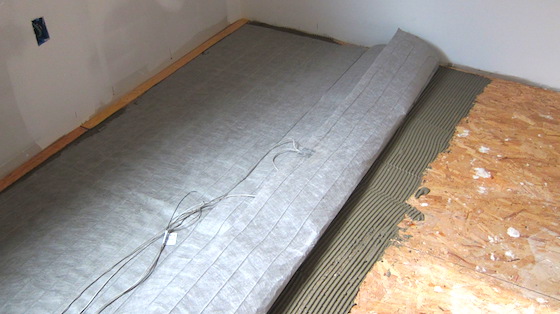
This is the electric radiant floor mat that's heating my man cave ham radio shack. It's a great DIY project. CLICK HERE or the IMAGE NOW to order your own NuHeat Electric Floor Heat Mat.
I installed a mat just like this to heat a small man cave I created for myself above my garage. The mat manufacturer works with you asking you how much heat you need so the mat provides the exact amount of comfort you require. In the case of my man cave, the mat had to create all the heat for the space. WATCH THE DIY VIDEOS BELOW.
If you’re remodeling a bathroom that already has a heat vent coming into it or an existing wall radiator, your mat will not need as much heating capacity to just make the floor warm. The mat is connected to a digital programmable thermostat or an app on your smartphone allowing you to easily control the temperature.
Installing the mat is not difficult. Most require that you embed the mat in a layer of cement thinset that you’d use to set ceramic tile. The manufacturer has step-by-step videos showing you how to do this. Once the thinset has dried, you then just cover the mat with a thin 1/4-inch layer of thinset.
Tile or laminate flooring can be installed directly on top of this second layer of the thinset. This layer of thinset acts as a heat sink and helps to ensure the temperature of the floor is distributed evenly so no matter where your bare foot steps, the floor is toasty warm. You can make it so warm that you may want to sleep on the floor in a sleeping bag!
Column 1496
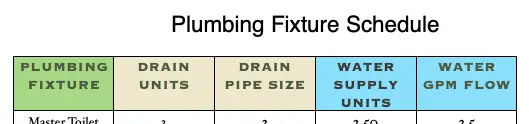
This is the header of a typical plumbing fixture schedule. You need to be an expert to fill in all the blanks correctly. Good luck if you try it yourself or CLICK HERE to have it done by a professional.
Your building department may require you to provide fixture unit calculations to obtain a plumbing permit.
These are very important as the calculations show to the department that the drain pipes you plan to use are sized properly.
Because of the physical laws on Earth and how gravity works, pipes of a certain inner diameter can only allow so much flow.
Allow Tim Carter, a master plumber, to do your fixture unit calculations. He has been doing them since 1989 and you can get a permit in a jiffy
Tim can also draw your plumbing isometric drawing or your required plumbing riser diagram. He provides 24-hour service as an option if you're in a hurry.
Go here to see all of the plumbing plans, isometric drawings, gas-line drawings, water-line drawings, etc. that Tim can do for you.

Tim Carter has been a master plumber since 1989. He knows all about plumbing fixture schedules.
Tim Carter has been a master plumber since 1989. He knows all about plumbing fixture schedules.
Some government entities require you to supply a plumbing fixture schedule to obtain a plumbing permit. These tables identify all the plumbing fixtures in a job. That's the easy part.
You also need to list the drain fixture units and the water-supply fixture units. That's the hard part.
Often you'll also be required to supply a three-dimensional plumbing isometric drawing showing all drain lines, vent lines, the building drain, and all pipe sizes. If you're not a plumber, you'll have a very hard time getting this isometric drawing or riser diagram produced correctly the first time.
This is the header of a typical plumbing fixture schedule. You need to be an expert to fill in all the blanks correctly. Good luck if you try it yourself or CLICK HERE to have it done by a professional.
Tim Carter has been a master plumber since 1989 and creates plumbing fixture schedules for architects, engineers, and homeowners like you. His schedules are never rejected by the building or plumbing departments.
It's important to realize that you need to understand the total capacity of the outgoing building drain pipe as well as the incoming water supply line.
Water supply calculations are harder because you need to take into consideration the length of the pipe as well as the pressure. The pressure within the pipe can vary depending how high or low the house is with respect to the water main at street level.
It's best to probably hire an expert like Tim Carter to create your plumbing fixture schedule. He can do it in just a few days. Go here to place your order for your fixture schedule or plumbing isometric drawing.
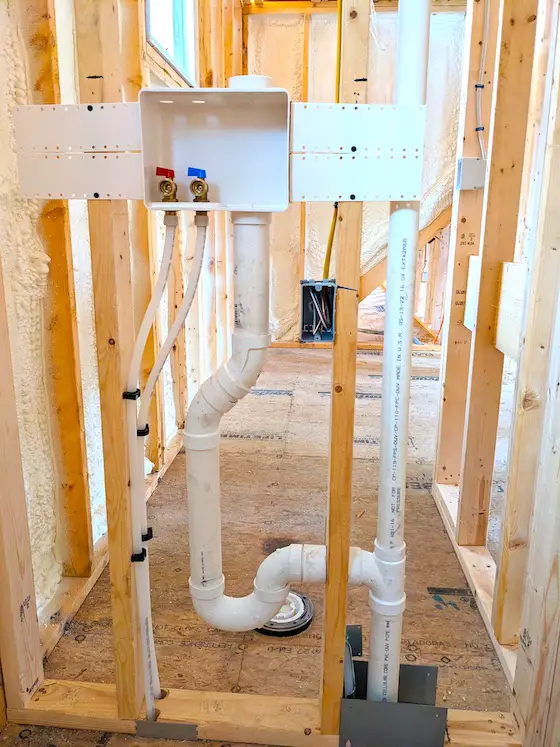
Plumbing Riser Diagrams - This is what the drain pipe for your washing machine might look like if you had x-ray vision and could see into your walls. The u-shaped pipe near the floor is a trap that holds water. It prevents sewer gas and vermin from entering your home. Copyright 2023 Tim Carter
Author's Note: I've been a master plumber since 1989. CALL ME NOW to talk about your riser diagram. 603-470-0508
I'd love to draw your plumbing riser diagram or isometric drawing. GO HERE to order one.

Yes, it's me, Tim Carter! I'm taking a break from installing a garage floor drain in my daughter's home on Mt. Desert Island in Downeast Maine. CALL ME NOW if you need a residential riser diagram for your project: 603-470-0508
You may wonder how I got my start as a builder and how I became interested in a plumbing riser diagram. The hook was set in Boy Scouts when I obtained my home repairs merit badge. I then helped pay my way through college working on the weekends and during the summer for a man who restored old homes that he bought out of foreclosure. After graduating from college with my geology degree, I decided to start my own construction business.
Within a year I had purchased an FHA-repossessed home in an auction for $8,500. The house needed lots of work including installing new drain pipes for the only bathroom in the house. I tackled this project myself and was instantly attracted to plumbing work. I found it fascinating how all the different-sized drain pipes connected to one another and more importantly how each fixture had a mysterious pipe that extended up from the drain pipe to the ceiling.

Tim Carter has been a master plumber since 1981 and can draw your residential riser diagram.
This extra pipe was a vent pipe. I didn’t understand how that vent pipe worked at the time but after a few trips to the local library, I discovered why the pipe was a vital part of the system and I was on my way to becoming a master plumber. I’d like to share some of what I discovered all those years ago so you don’t get sick from sewer gas. I also feel that once you understand how all the plumbing pipes in your house work together, you’ll have fewer clogs and you’ll save hundreds and thousands of dollars on plumbing repairs.
GO HERE to discover more about plumbing vent pipes.
It’s important to realize the plumbing drain and vent pipes in your home mimic what Mother Nature does with her drain water. Water that falls on mountains travels through ever larger streams and rivers until it eventually gets to the ocean. The rivers get bigger and deeper to handle all the water from thousands of square miles of surface area.
The same is true in your home. A vanity sink on the upper floor of your home only needs a small diameter pipe such as a 1 and 1/4 inch or a 1 and 1/2 inch. Toilets, because of the size of the solid waste they accept, require a 3-inch pipe. By the time all the fixtures in your home are connected, a 4-inch pipe transports all of the water and waste on its way to your septic tank or the city sewer. The pipe buried in your yard that connects to a city sewer is almost always 6 inches in diameter.
Have you ever seen a waterfall? You have them in your home at many fixtures. When the water leaves the p-trap under a sink, shower, tub, or washing machine drain, it almost always travels horizontally through a pipe just as a river flows across the land. When the horizontal pipe connects to a vertical one, you get a small waterfall within the pipes. Plumbers call these vertical pipes stacks. Typically the stack ends in a basement or under a slab connecting to a new horizontal pipe that leaves your home. The same is true with waterfalls as the water starts to flow horizontally at the base of the falls.
By now you’re probably wondering all about the vexing vent pipes. These pipes allow air from outside your home into the plumbing system. You may think that the pipe up on your roof acts like your fireplace chimney that sends smoke outdoors. It’s the exact opposite with plumbing pipes.
Before you turn the water on at a fixture or flush a toilet, the drain pipes beyond the water seal in your p-traps are filled with air. As soon as you flush your toilet and 1.6 gallons of water rushes into the pipes, it pushes the air in front of it. You’ve experienced this rush of air if you’ve ever stood next to a tall elevator in a high-rise building. As the elevator comes racing down the shaft, it rams the air in front of it and some of it blasts out of the closed doors you’re facing.
The vent pipe in your roof allows the air to enter the system to replace the air being pushed through the pipes by the drain water. Atmospheric pressure which is around 14 pounds per square inch, helps get the air into the vent pipes. The code calls out the minimum size for vent pipes, but they can work if smaller. You know this to be true because a tiny pin prick in a plastic water jug is all you need to get water to flow out of the spigot below. The enormous pressure of the atmosphere pushes plenty of air into the tiny pinprick hole.
One day I wanted to test this on a real plumbing system. I created a small bathroom with normal fixtures but instead of using the code-required vent pipe sizes, I vented the entire bathroom with just a 1/2-inch-diameter pipe. I filled all the fixtures with water to the brim, pulled the drain plugs and flushed the toilet at the same time. Everything worked perfectly because plenty of air could get through the small tubing. After satisfying my curiosity, I installed the correct-sized vent pipes!
Plumbing departments want to make sure all the drain pipes and vent pipes in your home are sized properly. This is why they require you to supply a riser diagram or isometric plumbing drawing to obtain a permit. I’ve always loved drawing these 3-dimensional drawings. I draw these each week for plumbers, architects, and plumbers who are too busy or who can’t figure out how to do the drawings to satisfy the inspectors.

Here's a riser isometric drawing showing the separation of gray water from black water in a home. CLICK or TAP HERE to have me draw your riser diagram.
You want the pipes to be sized correctly so that you minimize or eliminate the possibility of clogs in your system. Pipes that are sized too small can get clogged. You can also create clogs by using the wrong fittings in your system. You want the water flowing through the drain pipes to make gentle turns when the water is flowing horizontally.
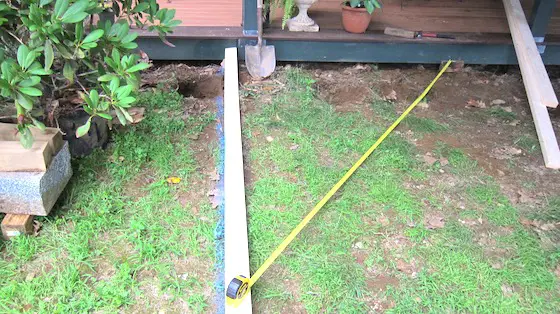
You can often square things up by yourself. In this case, I was able to get the flat 2x6 square with the front edge of the deck using a marker and a tape measure. It’s so easy to do! Copyright 2022 Tim Carter
Are you trying to save money in these harsh financial times? Have you given up trying to find a contractor and are starting to do more projects on your own? If so, you’re in fine company as my email inbox has exploded over the past months with requests for help.
Lately, I’ve had quite a few people ask for help who are going to build decks and patios outdoors. Some are building their own sheds and are using the plans I offer for a deluxe two-story shed. In each of these situations, the homeowner asks me how to get the object square. Or, they need to know how to make sure the edge of the patio or the deck is square with the side of the house.
Let’s talk first about the concept of square. You probably remember from your high school geometry class that a square is an object with four sides of equal length and each side is oriented at 90 degrees to the other. In the world of building, the concept of square means that a line extending out from some other straight surface is square when it extends out at a 90-degree angle.
You may also remember from your high school geometry class the math equation that Pythagoras discovered thousands of years ago that tells you when something is square. I’m talking about the equation that makes your brain hurt like your back does after carrying sacks of cement around all day. Yes, it was A squared times B squared equals C squared. Fortunately, there’s a much easier way.
The numbers 3, 4, and 5, or any multiples of them, are all you need to create a square line extending out from the side of your house or some other line. Here’s how to do it. Those three numbers represent the measurements of each of the three sides of a right triangle. Remember, a right triangle is one where two of the lines are at a 90-degree angle or square.
To create a short square line extending out from some other straight line here’s all you need to do. Take a scrap piece of wood and lay it on the ground. Put some weight on each end of the board so it’s hard to move it. Snap a straight chalk line down the center of the board. You always need to start with a straight line.
Drive an 8-penny sinker nail into the wood at one end of the line. Drive another one exactly 4 feet away down the chalk line. Using two tape measures, hook the ends on the heads of the nails. Tape measures that have a small slit in the hook make it easy to hold onto the nail head. The chalk line and two tape measures are about to create a triangle once you pull out the tapes.
The one tape measure is going to create the square line extending out from the chalk line. Pull it out about 39 inches. Pull the other tape measure out from the other nail. It represents the hypotenuse of the right triangle.
When you cross this second tape measure over the first one and the 60-inch mark on the second tape is crossing over the first tape at the 36-inch mark, the first tape measure is now square with the chalked line. Make sure you are aligning the tape lines taking the readings on the inside edges of each tape measure.
This method is close enough for patios and decks. If you want to be extremely accurate, you need to have the corner of the hook of each tape measure on the points of the 4-foot marks on the chalk line. Measuring from the center of the tape measure hook introduces a very very tiny margin of error.
One of the common questions I get is, “Tim, how in the world can a square up a 2x4 wall I’m building before I nail the OSB sheathing to it? Is it possible to do this without using a sophisticated calculator?” The answer is absolutely yes no matter how long the wall is or how tall it is.
When you build a wall of any length you should have the top and bottom plates the exact same length. You’ll then install all the wall studs in between the two plates. The king studs in this wall should also be the same length. You now have created the four sides of a rectangle with each opposing side the same length. Now we have to get it square since at this point it’s probably a parallelogram, not a right rectangle!
Chalk a line on the wood subfloor or concrete slab. Position the edge of the bottom plate on this chalk line along its entire edge. Tack the bottom plate down so it can’t move.
Take your tape measure and measure the diagonal distances from each corner of the bottom plate to the opposing corner of the top plate. If they are the exact same distance then by the luck of the stars the wall is already square. Go buy a lottery ticket! In almost all cases, the measurements will be different.
Let’s say one measurement is 170 inches and the other one is 172 inches. All you have to do to square up the wall is take a sledgehammer and tap the end of the top plate at the corner where it measures 172 inches. Tap it until it measures 171 inches. When you then measure the other diagonal that was previously 170 inches, it will now measure 171 inches. It’s sledgehammer magic I tell you! The wall is now square.
Keep in mind this method works no matter what the two diagonal measurements are. All you have to do is tap the top plate corner until such time as the two diagonal measurements are equal. There’s no need for one of those fancy calculators.
Column 1484
Subscribe to the FREE Ask the Builder newsletter to receive professional advice for your home. Complete the form below and each week you'll get:
Unsubscribe at any time. We respect your email privacy.