Linear French Drain Systems

! ! ! See Author's Notes at Bottom of Column ! ! !

Basement Water Seepage & Exterior Drainage

Gravity is a powerful force. It holds us against the surface of the earth so that we don't go flying off into outer space. Gravity is constantly pulling things down hill or closer to the center of the earth. There are many of these things. Some which immediately come to mind are boulders, balls and water. Yes, water!

Plumbers and people who build large dams have made lots of money knowing that water flows downhill. In fact, it (water) has the ability to do lots of work (create electricity, grind flour by turning a millstone, etc.) or do lots of damage (seep into basements, overturn retaining walls, cause mud slides, etc.) The point is, water responds very positively to the force of gravity (quite unlike helium!) and we can use this fact to our advantage.

Crash Course on Soils

OK, admit it, you don't know very much about the dirt you walk on each day in your yard. The only reason I know anything about it is because Dr. Lawrence Lattman, my geomorphology professor, hammered soil facts into my head three days a week in my junior year of college. You see, I thought that majoring in Geology would be neat. It turned out that it was.

Anyway, soil is pretty interesting stuff - just ask anyone who gardens. The only thing you need to know in my crash course is this: Most soils are made up of the following ingredients - small solid particles of rock, organic matter, weathered pieces of rock (clays), void spaces that hold air, and sometimes water.

hose void spaces are the thing that should be of great interest to you. Surely you have dumped a bucket of water or sprayed hose water onto your somewhat dry lawn. Depending upon your soil type, the water may disappear in seconds or minutes. Where did it go? Into the void spaces!
Underground Rivers

Now for the fun part. We now know that water goes into soil. We can thank the void spaces and gravity for this. Now where does it go? If just a little bit of water enters the soil, it just kind of hangs around that area. The vegetation or small organisms use it. Your trees and grass may be very thirsty. However, things change dramatically after four days of rain, or when two feet of snow melts rapidly.

Things get pretty dynamic at this point. The soil in your yard begins to act like an underground river. As the rain falls, it saturates the soil. The additional rainfall continues to add weight to the soil and pushes (gravity) the water in the soil down deeper AND sideways. The water in the soil is in motion. It, just like anything that is moving, takes the path of least resistance.

In many instances, this path of least resistance is sideways. The reason for this is simple. The deeper you go into most soils one of two things happens: you either hit solid rock (a barrier to the moving water) or the soil simply gets denser and has fewer void spaces to accept the water.

In fact, many of us know that so much water can enter soil that it does become completely saturated. This is why water wells work. Have you ever thought about how a well is built? You dig a hole, line the sides of the hole with rocks, and wait for the water to come in. Hmm, this isn't too much different from the way we build basements! The point I'm trying to make is that if you have a crack in your basement (ANY crack, such as in the wall, floor or where the walls meet the floor), this is a path of least resistance.

Think of it. A bunch of water droplets are in the soil and they are trying to push their way against other droplets, and one says, Hey, look over there! I see a crack and some light! Let's take a shortcut and get down a few feet closer to the center of the earth! I believe I saw this once in a Woody Allen movie.

This is what really happens. Water is constantly looking for a way to get to the center of the earth just as fast as it possibly can. Let's use this fact to our advantage.

Gravity and Gravel

OK, we know about gravity and void spaces. Let's put this knowledge to work. Since we know that water likes void spaces AND that it likes the path of least resistance, what can we use to maximize the quantity of water movement and the speed at which it moves? Of course, I knew you would know the answer. Large rounded washed gravel! Yes, stones that range in size from one inch or so to about one and a quarter inch in diameter!

Think of it, if we make a simulated soil of our own of this gravel, the water will go right for it. I can hear the water droplets yelling at each other now! "Hey guys (& gals), you're not gonna believe what I just found! Huge voids we can pass through. Hurry up, get over here as fast as you can!"

Replacement Soil

Replacement soil is easy. Nothing to it. Now, let's say you have one or more of the following problems: wet basement, soggy plant beds, soggy soil, wet spots in your yard, etc. Let's also say that your yard has some slope to it. Furthermore, let's say that your yard is at the bottom of a very long slope. Think of how much water is in the soil UP-SLOPE from your house! That water is moving and it is headed right for your basement, plant bed, whatever. It kind of reminds me of a medieval battle where an army is about to attack a castle... EUREKA, that's it! What we need is a moat!

Let's surround whatever we want to keep dry with a moat filled with replacement soil and a drainage pipe. Let's call this moat a linear French drain. Those old water droplets are going to come charging through the soil right towards (whatever) and fall through the gravel (gravity) to the bottom of the moat (drainage pipe) and be carried off (run downhill/gravity) away from whatever. Now that doesn't sound so hard, does it?

Traditional French Drains

Building sites that are relatively flat can still employ linear French drains. However, instead of the ends of the drainage pipe daylighting, they instead discharge into a traditional French drain. This structure is simply a large hole, excavated to as deep as you wish to dig, filled with a porous material such as the one inch washed rounded gravel. This structure is simply a large underground 'bucket' which accepts water. It works fine in most instances, unless the local water table is high, or if the water table has risen because of seasonal periods of high rain or snowfall.

If you decide to dig one of these holes, be sure you shore up the hole if you dig below five feet. Trench or sidewall collapse is a real hazard and you could be crushed by hundreds of pounds of falling dirt. BE CAREFUL!


Author's Notes:

You may wonder if my advice is worth anything. Well, read what Jim Sanders wrote to me when he was at the end of his rope:

"Hi, I just wanted to write to give you the results of my "Trench Drain". I have had a wet crawlspace for 15 years. Water would fill the crawlspace at times, so we actually had to drill weep holes at the base so that it would enter the basement and eventually, the sump pump.

I have tried everything. Several contractors said that the only thing we could do was to bring the water into the house via drainage tile and let it enter the sump pump. That would work, but because I live on a 6' elevation, there is no reason that I should have water problems. It became like clockwork...when it rained, we would rush home from the lake or wherever we were vacationing so that we could be prepared to start the backup generator, in case the power failed. We even had our alarm company put a sump alarm on our system, so they could notify us if we had a power failure. Battery backup was not an option, because sometimes we lose power for days and during any rain, our sump would run every 7 minutes...just like clockwork.

I found your site and read the article on the trench or French drain. At first, it sounded a bit like "holistic healing" to me. I failed to understand why a 2 ft. deep trench, 4 ft. away from the house would do any good. How could this simple thing correct an extreme water problem that has plagued me for years, cracked my foundation, settled my garage floor and ruined almost every vacation?
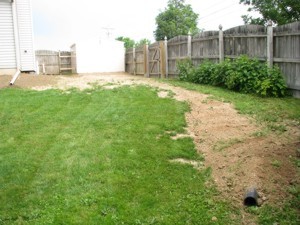
The Linear French Drain trench running from the house. PHOTO CREDIT: Jim Sanders

The Linear French Drain trench running from the house. PHOTO CREDIT: Jim Sanders

I decided "what the heck". I had to dig by hand using a trenching spade and a pick-ax, because the builder back-filled our property with brick and blacktop. It took quite a bit of time. Because the ground level varies so much on that side of the house, I was not able to achieve exactly 2 ft. deep. It varied from 18" to 30" in spots, but the slope was downhill. The trench is about 80 ft. long. At times, I thought about filling it all in, because I just didn’t believe that it would work.

I stoned it, put tile in, and filled it with #1 round stone. I socked the pipe just for safety measure and I also used geotextile fabric on top, so I could cover with dirt and grass. I also ordered some clay and pitched from the house to the drain.
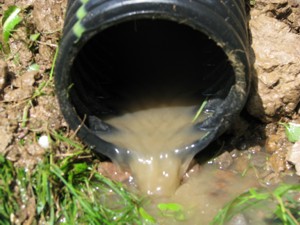
After a short rain, water is running away from the house. PHOTO CREDIT: Jim Sanders

After a short rain, water is running away from the house. PHOTO CREDIT: Jim Sanders

Result? For the last month, we have had 7 or 8 torrential rains, the worst of which was last night. It rained so hard, that our lawn washed out in spots because of the high clay content. Our sump pump, that normally ran every 7 minutes during and after rain, has not turned on for 4 weeks. The silt at the bottom of the sump well is now dry and cracking. Our crawlspace has not shown a trace of water or even moisture.

Since I couldn’t see correcting the foundation cracks or the garage floor settling and tilting until I corrected the problem's source, I waited to see if the trench drain worked first.

This week, I had a company come in and perform sort of a "mud-jacking" technique on the garage floor, which worked perfectly. Also, during the past few weeks, I parged the cracks in the foundation.
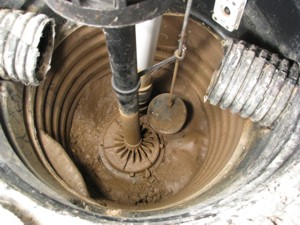
A dry sump pump. PHOTO CREDIT: Jim Sanders

A dry sump pump. PHOTO CREDIT: Jim Sanders

I just wanted you to know how this worked. I stressed for many years over this issue and the solution was nowhere near as difficult as I thought it would be.

As a side note, I went to the end of the drain tile during a hard rain to see what was happening. Water was running out of the drain tile in about the same exact volume that it previously ran out of the weep holes in my crawlspace. This winter will be interesting, because last year, the ground next to the house was so saturated that during a thaw, my sump would run constantly. I'm guessing that the ground between the trench and the house will probably be drier now going into this winter."

- Jim Sanders, Upstate area - New York

CLICK HERE to get FREE & FAST BIDS from local drainage expert contractors.

Column B70

Related Column: Curtain Drain Tips
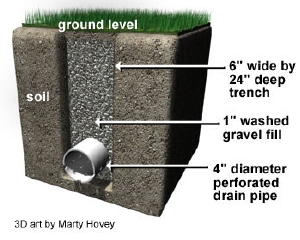
French Drain Design

! ! ! See Author's Notes at Bottom of Column ! ! !

French Drain Design

This sketch is a cutaway view of a linear French drain system. The view would be what you would see if you could stick your head in the ground and look down the trench. The key to understanding how the system works is knowing that there is a vast quantity of air in the upper horizons of soil. In addition, we know that gravity will pull water down slope. Furthermore, water will absolutely take the path of least resistance. It will flow down through the gravel and into the pipe much more readily than force its way past soil particles!

The French drain system will work wonderfully even if the pipe is installed dead level. It will not work if you install the pipe so that it slopes uphill. If your lot goes up and down, you will have to use a builders level or laser to set the pipe level or to set it with a slight down slope pitch. If you pitch the pipe, 1/8 inch per foot of fall is sufficient. Of course if you want it to slope more than 1/8 inch per foot, that would not pose a problem!

The trick to the whole system is providing a means for the end of the French drain system to "daylight" or expose itself on the lowest portion of your lot. This is where the collected water will discharge. You can often disguise this pipe exit point with decorative gravel, boulders or large rocks. You may also want to plant vegetation that likes to have its feet wet! Anything will look better than a simple pipe sticking out of the ground.


Author's Notes:

You may wonder if my advice is worth anything. Well, read what Jim Sanders wrote to me when he was at the end of his rope:

"Hi, I just wanted to write to give you the results of my "Trench Drain". I have had a wet crawlspace for 15 years. Water would fill the crawlspace at times, so we actually had to drill weep holes at the base so that it would enter the basement and eventually, the sump pump.

I have tried everything. Several contractors said that the only thing we could do was to bring the water into the house via drainage tile and let it enter the sump pump. That would work, but because I live on a 6' elevation, there is no reason that I should have water problems. It became like clockwork...when it rained, we would rush home from the lake or wherever we were vacationing so that we could be prepared to start the backup generator, in case the power failed. We even had our alarm company put a sump alarm on our system, so they could notify us if we had a power failure. Battery backup was not an option, because sometimes we lose power for days and during any rain, our sump would run every 7 minutes...just like clockwork.

I found your site and read the article on the trench or French drain. At first, it sounded a bit like "holistic healing" to me. I failed to understand why a 2 ft. deep trench, 4 ft. away from the house would do any good. How could this simple thing correct an extreme water problem that has plagued me for years, cracked my foundation, settled my garage floor and ruined almost every vacation?

The Linear French Drain trench running from the house. PHOTO CREDIT: Jim Sanders

The Linear French Drain trench running from the house. PHOTO CREDIT: Jim Sanders

I decided "what the heck". I had to dig by hand using a trenching spade and a pick-ax, because the builder back-filled our property with brick and blacktop. It took quite a bit of time. Because the ground level varies so much on that side of the house, I was not able to achieve exactly 2 ft. deep. It varied from 18" to 30" in spots, but the slope was downhill. The trench is about 80 ft. long. At times, I thought about filling it all in, because I just didn’t believe that it would work.

I stoned it, put tile in, and filled it with #1 round stone. I socked the pipe just for safety measure and I also used geotextile fabric on top, so I could cover with dirt and grass. I also ordered some clay and pitched from the house to the drain.

After a short rain, water is running away from the house. PHOTO CREDIT: Jim Sanders

After a short rain, water is running away from the house. PHOTO CREDIT: Jim Sanders

Result? For the last month, we have had 7 or 8 torrential rains, the worst of which was last night. It rained so hard, that our lawn washed out in spots because of the high clay content. Our sump pump, that normally ran every 7 minutes during and after rain, has not turned on for 4 weeks. The silt at the bottom of the sump well is now dry and cracking. Our crawlspace has not shown a trace of water or even moisture.

Since I couldn’t see correcting the foundation cracks or the garage floor settling and tilting until I corrected the problem's source, I waited to see if the trench drain worked first.

This week, I had a company come in and perform sort of a "mud-jacking" technique on the garage floor, which worked perfectly. Also, during the past few weeks, I parged the cracks in the foundation.

A dry sump pump. PHOTO CREDIT: Jim Sanders

A dry sump pump. PHOTO CREDIT: Jim Sanders

I just wanted you to know how this worked. I stressed for many years over this issue and the solution was nowhere near as difficult as I thought it would be.

As a side note, I went to the end of the drain tile during a hard rain to see what was happening. Water was running out of the drain tile in about the same exact volume that it previously ran out of the weep holes in my crawlspace. This winter will be interesting, because last year, the ground next to the house was so saturated that during a thaw, my sump would run constantly. I'm guessing that the ground between the trench and the house will probably be drier now going into this winter."

- Jim Sanders, Upstate area - New York

CLICK HERE to get FREE & FAST BIDS from local drainage expert contractors.

Column B70

Drain Tile & Shallow Foundations

Drain Tile & Shallow Foundations

Often, builders or contractors do not install drain tile systems on structures with shallow foundations (crawlspaces, no basements, or slabs). This can be a mistake. Shallow foundations are very susceptible to movement caused by soils that can expand or contract due to changes in moisture.

Many areas of the country have soils which fit this category. They are frequently called expansive clays. These soils are similar to synthetic sponges. When dry they shrink and when wet, they swell. Imagine what this kind of movement does to your structure. This movement is frequently referred to as settling. It often causes structural cracks in foundations, brickwork, plaster, doors and windows that stick, etc. A large majority of this damage can be avoided by simply installing a drain tile system in areas that have this type of soil. The only difference is one added pipe. However, instead of draining water the system will be used to add water.

These expansive clays can be stabilized. As long as the moisture content remains the same, the soils have a tendency not to shrink. Shallow foundation systems are more susceptible to droughts than deep foundations because the footings are closer to the surface. During dry spells or droughts, dry soil can extend 6-8' below the surface.

You can check with your county agricultural office to see if the soil in your area shrinks or swells in response to moisture changes.

The trick to stabilizing the soil is to keep it moist in periods of dry weather. The foundation drain system can easily accomplish this as long as you add a "T" fitting to the system at some point and extend a pipe to the surface. Place a removable cap on the end of this pipe. In dry weather, put a garden hose in the pipe and turn the faucet on low. Let the hose run over night once a week until the dry spell is over. This simple technique will stabilize your foundation for years to come.

Column B14

Termites and Mushrooms

Hello Tim,

A neighbor told me that mushrooms in my yard are a sign that I have termites. Can you tell me if there is any truth in this statement? Thank you,

James


James,

There is no truth whatsoever in this statement. It leads me to believe your neighbor might have eaten one of them and it is the type that produces hallucinations.

Mushrooms are fungal growth that often are based in decaying wood in your yard. The source could be an old branch or a twig.

The mushroom is actually the last hurrah of the fungal growth. The mature mushroom cap releases millions of spores so the fungus can continue to propagate.

Termites do eat wood, but they do not produce mushrooms.

Tim

Column EM

Termite Baiting Systems

Termite Baiting Systems

Every now and then in each industry there is a major breakthrough. The newer termite baiting systems shook up the pest control industry like no other discovery in the past. Prior to these systems termites were treated using barrier chemicals. Injecting chemicals into the soil works fine if you indeed treat all of the soil. It also is a good method if you can use a long lasting chemical that doesn't harm any other animals or plants.

Well, some barrier chemicals worked too well and several have been banned over the years, the most recent one being Dursban. Clordane was a powerful barrier chemical that I used when it was legal, but it was removed from the marketplace about 15 years ago. It simply didn't break down and was working its way through the food chain by migrating through soil and ground water. Keep in mind that the barrier chemicals didn't kill. They just made the termites move on to a different food source.

Baiting systems are different. Termites find a bait or poison in a monitoring system. The chemicals are designed to slowly kill the worker termites. The first system to hit the market was the Sentricon system made by Dow AgroSciences. It hit the market about seven years ago and made a huge splash.

Currently it is the only termite baiting system that has been independently tested and certified to eliminate termite colonies. In fact within the past few days it was announced that Sentricon is the only termite bait system now listed with the Southern Building Code Congress International (SBCCI) as a complete stand-alone alternative to liquid termiticide treatments. The other baiting systems may indeed work and over time they may also gain such status, but I have not been able to find evidence that they are equal to or better than Sentricon. Here are the major players in the termite baiting playing field:


Termite infestation? Pick the best exterminator using my Termite and Carpenter Ant Checklist. I offer a 100% Money Back Guarantee.


Sentricon Dow AgroSciences

On March 2, 1994 the EPA granted registration to Dow AgroSciences for hexaflumuron. This is the active ingredient in Sentricon. It is a slow acting growth regulator. It prevents termites from molting. Termites need to grow a new exterior skin on a regular basis. If they can't, they die. One of the keys of this chemical is that it is indeed slow acting. Termites are smart but they can't seem to figure out that the bait stations are killing them.

FirstLine and FirstLine GT FMC Corporation

Two years after Dow received their EPA registration, the FMC Corporation got one for a similar system. The FirstLine product is an above ground system and the FirstLine GT is a below ground system like Sentricon. The poison is different. FirstLine and FirstLine GT use sulfluramid which is a slow-acting stomach poison. This chemical prevents food from being turned into energy. Within a few weeks, the worker termites simply starve to death.

Subterfuge BASF

This product was introduced in 1997. Its active ingredient is hydramethylnon. It works just like the sulfluramid in FirstLine. Once ingested by termites, they seem to die within two to three weeks. The manufacturer claims that this bait/poison is preferred by termites. Don't ask me how they got them to talk!

Terminate Spectracide

This is a system that homeowners can buy at home centers. They look like fertilizer stakes. You simply hammer them into the ground and they supposedly work like all the others. There is another system like this out there called HomeChoice.

Scientists are very wary of these DIY systems. They feel that these baiting systems need periodic and ongoing monitoring to see if the termites have died and are indeed not attacking the structure. If you think you just hammer stakes into the ground and then walk away with nary a worry, you are mistaken!

Column B373

Termite Pest Control Research

Termite Damage

Talk about a horse race! Every year, there is well over a billion dollars in damage to U.S. homes and businesses that is directly related to termites. New Orleans alone suffers $300 million worth of damage a year! This means that a company or companies that can develop a product that delivers a knock out punch to those little subterranean devils stands to hit the jackpot. The race is on as we speak and it looks like one of the companies is several lengths ahead.

Termite Pest Control Research

Currently the rage in the pest control industry is the termite baiting systems commonly referred to as Colony Elimination Systems. They work to kill termites instead of simply repelling them. This is a good thing! But don't think for a moment that the chemical company scientists are resting on their laurels! Research is ongoing at any number of labs and it was recently announced that a mold has been discovered that kills termites. This would mean we might have a new bio-pesticide instead of synthetic chemicals. This new mold is so powerful that it killed 100 percent of the termites that contacted it within seven days! The point is that termites are getting the attention of many, many people including you!

Improving Existing Products

Many of the termite baiting products need to be installed by professionals. Those that do need regular and ongoing monitoring to see if the termites are present, have been killed and have possibly reappeared. Remember, new colonies can form each and every season! It is expensive to send out a person to look at each and every one of the little stations that is buried in the ground. Imagine if the stations would tell you if termites have arrived and were eating the bait within the station.

Well, at least two companies are working on such a device. One is a simple spring loaded gizmo that pops up once termites have chewed enough of the poisoned wood bait. The spring lets go and a rod or flag pops up to let you know dinner guests have arrived!


Termite infestation? Pick the best exterminator using my Termite and Carpenter Ant Checklist. I offer a 100% Money Back Guarantee.


The folks who make Sentricon are going much farther than this. They are developing a radio controlled system that detects termite activity and then actually sends a signal to the pest control company! They then send a technician out to confirm the presence of the little beasts. If these systems or other ones are developed, look for the price of the termite baiting systems to drop slightly over time.

Don't Give Up

Many pest control operators are switching over entirely to the new bait treatments. This is both good and bad. Keep in mind that not all of the new baiting systems are equal. Not all have been proven to be as effective as the other. If you hire a company that has a product that doesn't really perform that well, you may be in for a surprise. The traditional barrier systems are still a good choice for new homes that are being built. I always made sure that the soil beneath slabs I was pouring was chemically treated to do everything possible to repel termites. The barrier chemicals can also be injected in and around backfill soil very easily as a house is being built. It is expensive to do it on existing homes because of all of the drilling that is necessary.

If you are building a new home, absolutely insist on some form of pre-treatment program as the house is being built. Make SURE you talk with the pest control company yourself. Some of the chemicals are light sensitive and they degrade rapidly if they are not covered with concrete or soil in a hurry. You need to make sure this happens or the termites may move in with you!

Column B373

Repairing Termite Damage

Repairing Termite Damage

Termites will eat just about anything that contains cellulose. They can start in a post or a joist and then travel to any other wood that is nearby.

Structural wood components in a home are the most difficult to repair. Other wood or non-wood components are often attached to the damaged wood. This makes it very hard to remove and replace.

Stop the Invasion First

The first thing to do if you discover termite damage is to make sure the colony has been eliminated. There is no sense replacing wood if it is just going to be munched on in a few days or weeks. Once a professional has given you the green light, then start your repairs.

Think Demolition

Plumbing pipes and electric wires can interfere with reconstruction. I have seen hundreds of ruined floor joists that are adjacent to plumbing pipes or have wires passing through them. Installing a new floor joist(s) often means you have to disconnect the utilities to gain access. This can be a mind numbing experience...and a costly one if you hire someone to do it.

The Alternative

If you are lucky and there are no utilities near the damaged wood, you may not have to remove the termite infested structural members. You can add a new piece of wood next to the damaged wood. It is an accepted method of repair and the goal is achieved in most instances. Keep in mind that structural lumber does just that - it supports the structure. If your new added piece is shouldering the load, then you have accomplished your mission.

Keep in mind that as you remove lumber you need to temporarily support the structure. If you do not know how to do this, it is time to call a professional. Rookies often cause more damage than the termites!

Author's Note: We've received other emails with similar problems or questions. Here's one from Aaron S. of Los Angeles, CA, regarding termite fumigation.

"My house was fumigated for termites covered with a tent etc. After removing the tent two days later, we entered our house but there was no odor of gas at all.  A while later, we saw insects, spiders, roaches etc. moving around. The fumigation company claims that they mix a substance with the gas so that it will not have an odor. My question: Shouldn't there be a gas odor and dead insects? We can't see the termites inside the wall, but we feel that if all the insects are still alive, probably the termites are not dead either. Please, let us hear you opinion. Thank you very much!"

Doing a little online checking, the chemical used during termite fumigation is targeting only termites. It will not kill spiders, ants, bed bugs or cockroaches. So Aaron, you may still see other insects moving around.

Related Column: Termite

Column B373

Using Borate Chemicals

Using Borate Chemicals

Borates can be used on just about any wood. Use the borates on logs, all framing lumber, wood siding, plywood, and wood - foam composite components. Keep in mind that once treated with borates, you can sand, cut, saw, sand, glue, and finish lumber as if it had nothing in or on it. The borates will not cause problems.

If you do decide to treat some exterior lumber like siding, make sure you use a synthetic resin water repellent to treat the wood after the borates are applied. This sealer will stop the water from leaching the borates from the exposed lumber.

Watch Those Plants

The borate chemicals once mixed with water can harm plants and aquatic life. So you need to exercise caution when using them. Read the warnings on the labels!

Applying Borates

You can apply borate chemicals to wood in several different ways. You can dip the lumber, apply the borates under pressure (like CCA treating), spray it on, brush it on, immerse the lumber, or flood it with a borate solution.

If you choose the dip method, you need to make up a fairly large batch and have a large enough tank to handle the size of lumber you are dipping. You basically mix the borate chemical in hot water and keep the solution heated. You then dip the lumber and keep it in the tank for 2 to 5 minutes. After removal, if you stack the lumber under a tarp or plastic so it slowly dries, the borates will penetrate completely through the wood! Dipping is tough to do because you need the tank, a heat source, and a place to store the lumber.

You can get the borate chemicals to penetrate the wood to a depth of 3/4 inch by spraying, brushing, immersing and flooding the wood. Once the borates are applied it takes several weeks for them to disperse the full 3/4 inch depth into the wood.

Surface Preparation

As with any product, you need the wood to be clean, free of mold and mildew and free of wax. In other words you can't block the borates from getting into the wood.

Mixing

The two borate products you can buy are nearly identical. The Saver Systems product contains highly refined boron and is made so that you mix 1 pound of borate powder to one gallon of water.

Applying

One gallon of solution will usually treat 200 square feet of lumber. It is recommended that you then apply a second coat within 24 hours.

When I build my next home I will pre-treat all the ends of the joists and studs when they are delivered. You can do that when they are still in the bundles. Once the house is framed and under roof I will spray all other surfaces possibly three times.

Companion Articles:  Borate Chemicals for Wood PreservationTermites - Soak Wood with Safe Borates About Borate Chemicals

Column B272

Borate Treated Wood Stops Rot & Termites

borate wood treatment

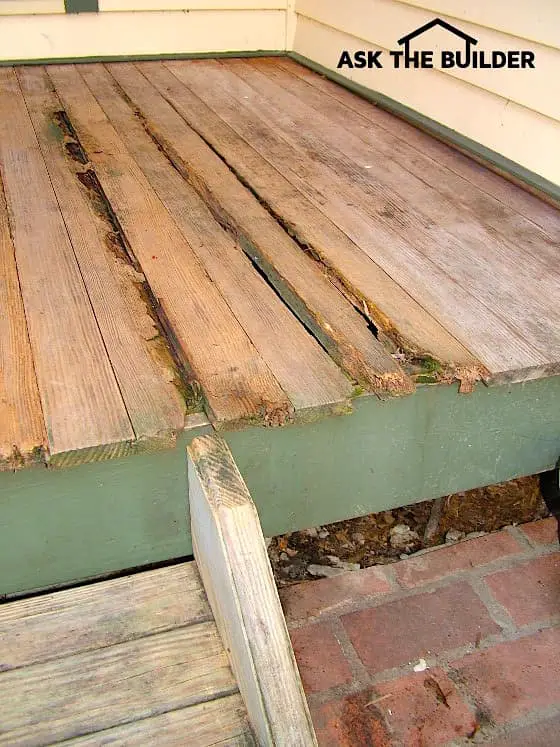
Borate wood treatment would have prevented this wood rot. This tongue and groove porch flooring is exposed to the weather. It suffered serious wood rot because it was not treated with a borate preservative. ©2018 Tim Carter

"The borate chemicals are a diffusible preservative. This means they can actually - and do - penetrate wood cell walls."

Borate Wood Treatment - An Effective DIY Wood Rot Trick


Related Links

Borate Chemicals for Wood Preservation

Termites - Soak Wood with Safe Borates

Using Borate Chemicals

Free & Fast Bids

Go HERE to get FREE & FAST BIDS from local pest control companies that use safe borate chemicals.

What is Borate Wood Treatment?

Borate wood treatment is a powder you mix with water. You then soak lumber in this solution to prevent wood rot and termite attack. Boron is the primary ingredient in the borate wood treatment. The fancy chemical name is disodium octaborate tetrahydrate.

Boron is found in glass fiber insulation, glass wool, high-temperature glass, enamels, detergents (remember the mule team stuff!), ceramics, flame retardants, magnets, fertilizers, and wood preservatives. It's also found in pesticides.

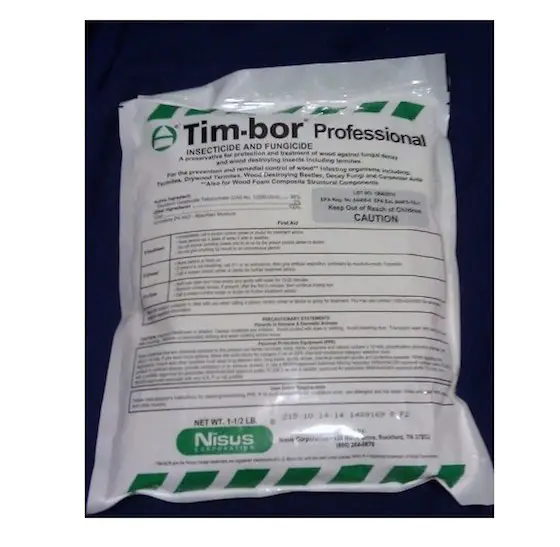
borate wood treatment bag

This bag of powder is but one of a few borate wood treatments. You mix the powder with water. CLICK ON THE IMAGE now to have it delivered to your home in a few days.

Is Boron Mined in the USA?

A major boron mine has been located in the United States since the 1800's. It's in California.

The positive properties of boron and borate wood have been known for some time, it just has never caught on. Borate treated wood is one of the best DIY termite treatments you can do, especially in new construction.

Is Borate Wood PreservativeWater Soluble?

Borate wood preservative is water soluble. The primary drawback is that the borate chemicals are water soluble. This means you dissolve it in water and use the water as the transport vehicle to get it into the wood.

This also means that water can extract the protection! Thus, if you pre-treat wood with borate chemicals at a factory and they get wet, there may be a loss of protection. Get the wood really wet, and the borates can completely leave the wood.

What is Borate Wood?

Borate wood is regular wood that has had borate solution sprayed on it or the wood has been put in a vat of the solution allowing it to soak deeply into the wood. The solution soaks up best in the ends of cut lumber or timber. Lumber mills sometimes paint or seal the ends of 2x material that can inhibit the borate treatment for wood to soak into the wood.

Are Treated Lumber Chemicals Water Soluble?

The old CCA (chromated copper arsenic), modern alkaline copper quaternary (ACQ), and LSOP (light organic solvent preservatives - i.e. creosote) methods of treating lumber are more popular because these chemicals are not water soluble.

This is why the CCA lumber - when it first came out - had a lifetime warranty. I clearly remember that back in the mid- 1970s.

You can get FREE & FAST BIDS from local pest control companies that use safe borate chemicals.

What are the Advantages of Borate Wood Preservative Products?

The borate wood preservative products are easy to work with. They're safe and have very low toxicity to mammals. That's you - you're a mammal in case no one told you. I wish I had known about them when I built my home! They protect wood against a broad range of insects and fungi - wood rot!

Can Borate Wood Rot?

Borate wood will not rot if you keep it dry. That's not hard to do if you build your house or rood addition correctly and keep water from getting to all the house framing.

The borates can disperse readily in wood. If the wood is kept dry after treatment, the borates persist indefinitely.

The wood properties stay the same after treatment. The borates are odorless, have a low volatility, and they don't corrode iron, galvanized metal or aluminum. The best part is that they are cost effective.

Does Borate Wood Treatment Stop Insects?

The borates are effective at controlling:

  • brown, white and red rots
  • powderpost beetles
  • furniture beetles
  • old house borers
  • subterranean termites (Reticulitermes, Coptotermes, Heterotermes)
  • damp wood termites
  • dry wood termites
  • carpenter ants!
  • cockroaches
  • ants
  • silverfish
  • earwings
  • crickets

The bad news is that they do not deter carpenter bees. Man, do I hate those devils! They have drilled hundreds of holes in my current house!

How Does Borate Wood Treatment Work?

The borate chemicals are a diffusible preservative. This means they can actually - and do - penetrate wood cell walls. Some other common preservatives are called envelope biocides (creosote, CCA, and pentachlorophenol) as they can produce an envelope of protection several inches from the wood surface.

The borates kill fungi and wood rot because they interfere with the enzyme systems in the microorganisms. When wood destroying insects eat wood that contains borates, it is a slow-acting stomach poison.

Worker termites transport wood back to the rest of the colony to eat. As such, the rest of the termites get sick over time, exhibit sluggish behavior, stop feeding and become moribund. In other words, the borate chemicals kick butt and take names!

If you decide to use the chemicals, be sure to follow all safety and handling guidelines!

CLICK HERE to get FREE & FAST BIDS from local pest control companies that use safe borate chemicals.

Column B272

Borate Chemicals for Wood Preservation

Borate Chemicals for Wood Preservation

I was only able to identify two companies that have the ability to sell wood preserving borate chemicals to you. The reason for this is based in EPA registration guidelines. These two companies chose to have their borate products registered as wood preservatives whereas the other companies registered theirs as pesticides.

The EPA says that if you want to buy powerful and effective pesticides you have to be a licensed pest control operator (PCO). But, in their infinite wisdom, you don't have to be licensed to buy the same product when it is a wood preservative. Go figure!

Just Mix With Water

The borate salt - disodium octaborate tetrahydrate - is simply mixed with water. The products from each company are quite similar and they are easy to work with.

The Companies

If you want literature and pricing information on the borate wood preservatives, call this company:

  • Sashco
    10300 E. 107th Place
    Brighton, Colorado 80601
    800-767-5656
    Ask for PeneTreat

Companion Articles:  Termites - Soak Wood with Safe BoratesAbout Borate Chemicals, Using Borate Chemicals

Column B272