Encapsulate Crawlspace
Tim Carter discusses why it's important to encapsulate a crawlspace. Encapsulation is the latest crawlspace technology.
Tim Carter shares news about a new easy-to-use glue he tried out. PC Universal Glue. It's strong like epoxy, but no messy mixing two parts together. It's as easy to use as the simple white glue you used in grade school. I LOVE the products made by the company that makes this glue.
CLICK HERE to BUY this amazing new glue. It's super strong. It dries CLEAR. Water washup!!
They paid me to make this video and when you see how well it works, you'll be glad they did.
DEAR TIM: I read your column each week in our paper and a few weeks ago you talked about building stairs for a deck. I can handle that but am worried about how to make all the complex cuts required for the deck stair railing. I realize you can’t provide step-by-step directions in the space you’re given, but can you point out the challenges and give me a few life-line tips so I don’t mess up my deck railing? Mandy C., Clemson, SC
DEAR MANDY: You’re correct that it’s impossible for me to offer you step-by-step directions on how to build stair railings in the limited space provided in this newspaper column. I could write a book about the process easily devoting one hundred pages or more with countless step-by-step photos.
What follows should be a decent quick-start guide you can use along with some common sense to get very good results. The first thing to realize is it doesn’t require complex math to make a great stair railing.
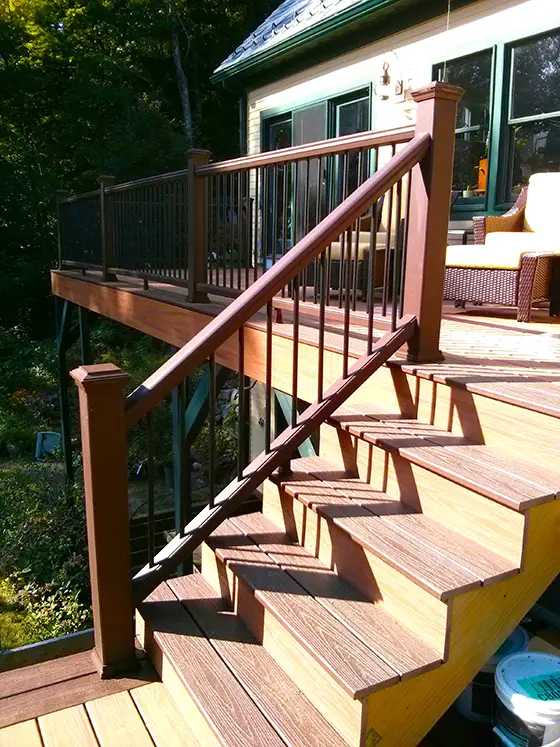
The angle of the stair railing is determined by the rise and run of the steps you’re working with. The bottom and top rails of the steps simply run parallel to the line created by the nose of each of the stair treads. To see this line, place a long straightedge on the steps. If you built the steps right with the same riser and tread combination and the needed one-inch overhang of the tread over the riser, then the straightedge will just touch the front tip of each tread all the way down to the bottom step.

This deck stair railing was made using great skill and modular parts designed to fit together. Photo Credit: Tim Carter
The posts that support the railing need to be very secure and they need to be in the same relative position on each tread. In other words, if the face of the top post on your deck is set back 3 inches from the tip of the decking board at the edge of the deck, then all the other posts on the steps going down must also have their face 3 inches from the tip of the stair riser they’re sitting on.
It’s vital to maintain this spacing and position for the posts so that the railings connect to the posts at the same height above each tread. This creates a uniform sight line and professional look. It also creates a safe railing. The building code is very specific about the height of the railing and you have some leeway.
Remember that line that’s created by the straightedge along the tips of the stair treads? If you extend a vertical line up from this sloped line, the top railing must be not less than 34 inches and no more than 38 inches above the line connecting the tips of the stair treads.
Calculating the angle of the cut for the railings is very simple. Once you have your railing posts in position and secure, you just clamp your bottom rail to the posts with the excess railing extending past the posts. Be sure the bottom railing is at least one inch above the tips of the stair nosing and that the railing is parallel with the sloped line created by the tips of the tread nosings.
Use a pencil to carefully mark the line where the vertical posts are touching the railing. These will be your cut lines. Be sure to cut on the correct side of the line with your miter saw.
Both the bottom and top railings need to be securely fastened to the vertical posts. Use screws that will not corrode and will penetrate deep into the posts. The last thing you want is a flimsy connection between the post and the railing. Pre-drill pilot holes so you don’t split the wood.
One trick some carpenters use to ensure the railings are in the correct position is to use a giant piece of plywood that has been cut to create the parallelogram that the railings and posts create when all the pieces are connected.
In other words, if you were to take a piece of plywood and rest the long edge on the stair tread nosing tips, the top long edge would be parallel to the stair nosings, but it would be too tall. Using a 4-foot level resting at the tip of the lower stair tread, you can make a mark up on the wood at the 34-inch level that meets the code requirement. If you make an identical mark using the level sitting on the top tread and then snap a line between those two marks, you’ve now created the top of your handrail. You can also trace where the sheet of wood contacts both posts.
Use a saw to cut along the three odd lines and now you should end up with a parallelogram that fits nicely between the two posts. If you did everything right, the top line is also parallel with the bottom edge of the plywood. Your top cut line represents where you hand will touch the top of the handrail as you go up and down the steps. As you stand back and look at this odd-shaped piece of wood, it should look good and uniform.
This template will help you to ensure your angled cuts are right and provide you with guidance as to where you need to place the top and bottom handrails so they’re in the correct positions allowing you to end up with a safe and sturdy stair railing.
Column 1161
DEAR TIM: How can I match the stucco finish on my eighty-year-old front porch? I tried using white Portland cement and buff sand, but as you can see in my photo, the results are atrocious. I added some dry cement pigment to try to get a match and it just didn’t work. I noticed the old stucco has dark sand in it. Is that important? What’s the best way to get a match, if it’s even possible? What can I do now to fix this so I don’t have to sleep on the couch? My wife is none too happy with me right now. Help me Tim, you’re my only hope! Brian McA., Whitehall, PA
DEAR BRIAN: What husband amongst us has not slept a night or two or three on the couch for a brazen misdeed around the home? It’s a right of passage, albeit an undistinguished one. Alas, I’ve got good news for you!
You’re going to soon be in your wife’s good graces because you’re going to make that front porch foundation wall stucco look stunning. But before we do that, let me tell you how difficult it is to match stucco. If you share this with your wife, you may get back into your own bedroom tonight and on a nice comfy mattress.

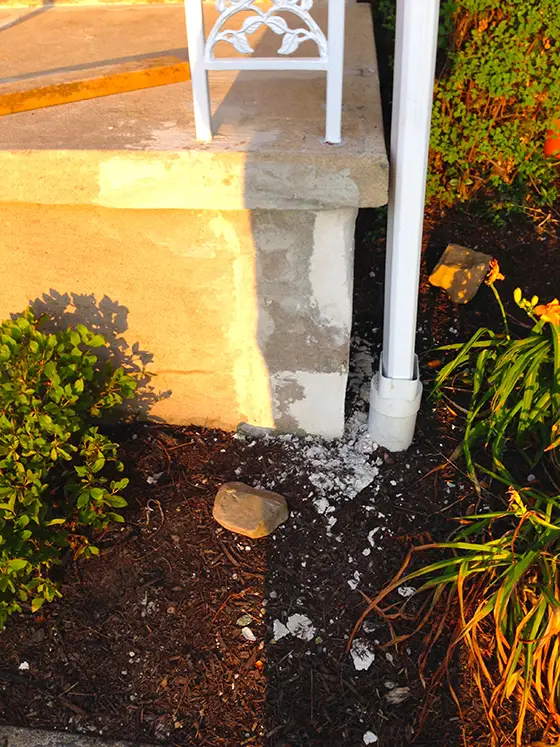
These patches don’t match at all. It requires some testing to get a perfect match when working with cement stucco. Photo Credit: Brian McAllister
I think the best way to describe how hard it is to match stucco is to imagine trying to repair a tear in just about any fabric. Even the best tailor or seamstress will have a nearly impossible time blending in the sewing needed to repair the slit or slash.
The most important thing to realize is that the stucco you see on your front porch does not look today like it looked eighty years ago. Mother Nature has changed the appearance of the stucco just like she does with anything left in her presence.
When the stucco was new, each piece of sand had a thin coating of cement paste over it. The color of the stucco was very uniform much like the patches you have in your photo. Note how you can’t see any color at all of the individual grains of sand in your fresh patches. Once you grasp this, you’ll understand how tough it is to match stucco.
Over time weathering works to remove the cement-paste film from the sand. This is why you now notice the dark grains of sand in your stucco. Your stucco can also get stained from rain splashing dirt against it. Soot from decades of diesel exhaust and who-knows-what can also settle into the stucco finish altering its appearance. Your new stucco patches have none of this.
The first thing to do when trying to match stucco, or brick mortar which is nearly identical to stucco, is to start with the sand. Look very closely at the sand grains in the existing stucco. Note the colors, the sand grain size and the blend of the colors.
The sand for the existing stucco probably came from a gravel and sand pit within fifteen miles or less. It was not easy eighty years ago to truck sand to a job site. Visit all the nearby sand and gravel pits and start to look at their different sands. Most gravel pits have different piles of sand. You need to find a sand that matches as close as possible what you have now.
Once you have the sand, now it’s time to clean your existing stucco. I’d use a solution of oxygen bleach to do this. It’s not harmful to your plants and it’s not aggressive like a pressure washer. A pressure washer could damage the stucco, so think twice before using one.
After the existing stucco is clean and dry, you can now try to get a match on the cement used to bond the sand together. You tried using white Portland cement adding pigment to it. I’d try to just go with a traditional gray Portland cement and see what happens. I’d also try to make different batches using hydrated lime in addition to the Portland cement. The lime will modify the color depending on the ratio of cement to lime in your mix.
Apply the different test batches to the face of some small concrete brick. Allow them to dry and cure for at least a week to see how you’re doing. Realize the grains of sand in the stucco make up probably ninety percent of the color matrix so you need to acid wash the new stucco samples after 30 days to see the real color of the new stucco you’re making.
See how hard this is? Most people don’t have the patience to undertake this job because it’s just so time consuming. Most people want instant gratification.
The easiest way to solve your problem is to just re-coat the entire foundation wall with new stucco that’s all made the same way. To get the new stucco to bond permanently to the old stucco you need to use cement paint. I’m assuming you’ve cleaned the old stucco of all dirt, grease, etc. before you start.
Cement paint is just a mixture of Portland cement and water. You add water to Portland cement stirring until it’s the consistency of a thin latex paint. Slightly dampen the existing stucco with water, brush on the cement paint and immediately cover it with the fresh stucco. Do not allow the cement paint to dry. Work in the shade or on an overcast day with no wind.
Column 1160
I'm getting ready to leave for church in about 30 minutes and wanted to give you some great information to SAVE YOU MONEY.
I just finished writing a column that's going to appear in Newsday, the newspaper many on Long Island, NY get. But you get a SNEAK PEEK at it first. Why? Because I own the copyright, not Newsday.
The column dispels the MYTH about SAVING MONEY when you buy replacement windows.
CLICK HERE to read it and then get out your utility bills. If you have something to add, be SURE TO COMMENT at the bottom of the column.
Can't See Photos or Images
You may be one that tells me that something is wrong with my newsletter because you can't see any of my photos or images that are in it. Look to the right of this, you should be able to see a photo of my daughter Meghan and all sorts of other photos / images.
If you can't, the issue is at your end. You need to have images *turned on* in your email or browser software. Just use a search engine to figure out how to do it if you're having trouble.
Wood Rot Video Series
If you need a great product to repair wood rot at your home, you should watch these four videos.
CLICK THESE FOUR LINKS to see the videos:
CLICK HERE if you just want the link to buy the AMAZING product I used in the video series.
Time to go!
Tim Carter
Founder - www.AsktheBuilder.com
Do It Right, Not Over!
I did two exciting things in the last few days.
First, I did some Fall cleaning of the subscribers to this AsktheBuilder.com newsletter. If you're reading this and seeing it, that means you didn't get put into the rubbish bin (RB).
To ensure you get the newsletter when it comes out, it's important for me to remove inactive subscribers. The postmaster that delivers your email to you wants to make sure my newsletter is not SPAM.
This is why I asked you a few days ago to:
When you do both of those things, this shows your incoming email provider that you *want* my newsletter.
Clicking any link in any issue of my newsletter tells my newsletter software that you're engaged still and that you want to continue to get it.
Bottom Line: Open each issue and always click at least one link in each issue. Do that and you'll make everybody happy!
The second fun thing I did was play Bingo with several of my very good friends from the scenic railroad. Here we are before the first ping pong ball appeared on the TV screen.

From left to right in the above photo: Theresa Drury, yours truly, Cleora Ohar, Janey Miller, and James Nigzus.
You can see me holding my blue daubber that I had to buy. It matches my eyes.
I quickly discovered that Bingo requires quite a bit of skill. You need to be sure to get just the right amount of daubber ink on each number and it needs to be centered within the lines.
You need to know that fifteen years ago, I was a Bingo caller at my kids church / school. But I hadn't played the game in perhaps fifty years!
Bottom Line: It's not all about home improvement - it's about having fun with friends to help balance yourself.
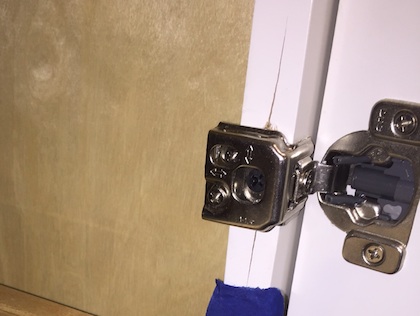
Tipping Dishwasher
Jackie has a problem with her dishwasher. It's actually quite common.
CLICK HERE do discover what is going on and how to FIX it without damaging the dishwasher or any surrounding cabinets or countertops!!
Marty and His Nail Gun
Overnight I received an email from Marty Hess who lives in Florence, OR. Here's what he sent:
"I'm going to fasten a 2x6 to a cement foundation. I'm on the coast. I would like to know if stainless nails can be used in a .22-caliber nail gun."
I get questions like this all the time from people asking if you can do this or that with a product or tool.
For example, I got one the other day asking if vinegar should be used to clean a concrete floor prior to putting down an epoxy coating.
I answer all these questions the same exact way. Here's what I sent back to Marty an hour ago:
"When you contacted the nail-gun manufacturer, what did they tell you?"
I feel this is a VERY VALUABLE teaching moment.
Marty (and you) should not trust my answer or that from any other website, a store clerk, a contractor, etc.
He should trust ONLY the manufacturer because putting in the wrong nail could cause the gun to malfunction or VOID THE WARRANTY.
In the case of the vinegar, there could be an adverse chemical reaction that causes the epoxy to not bond well to the concrete.
I believe you get the point.
Speech at University of Cincinnati
I've been asked to give a speech at my Alma Mater - UC on Friday, September 30th.
It's at 3:30 pm in room 201 of Braunstein Hall. This building is just south of the Geology - Physics building which happens to be at the northern border of the UC campus.
You're invited to attend and there's a reception following the speech.
In other words, if you live in or near Cincinnati, OH here's a chance at a meet up!
The topic of the speech is how I used my geology degree, as well as other knowledge I gained while at UC, to help people like you with my building skills, syndicated newspaper column, AsktheBuilder.com and my videos.
The speech is going to be laced with many different stories, some that will make you laugh quite loud I believe.
Wait until you hear what Dr. Caster used to say to us before each test!!!! If you're a teacher, you'd NEVER get away with this today.
If you're thinking of attending, I NEED TO KNOW so they have plenty of food and drink at the reception.
REPLY to me now and I'll start to create a list of who's coming.
I'll also be able to provide a great map and directions for you. We may go out for ice cream afterwards or a cheese coney if not satisfied with what's at the reception.
New Videos
I'm going to be taping two very interesting videos in the next two days.
One is about a fantastic new glue that's just about as stong as epoxy, but requires NO MIXING!
The second video is about the importance of a great dehumidifier - they're not all the same! - when coupled with encapsulation of damp crawlspaces.
I'll share the videos with you just as soon as I have them on the website.
If you have a YouTube account, you might want to consider subscribing to my AsktheBuilder YouTube channel! CLICK HERE to do that.
I'm pretty amazed that my videos have been watched nearly 45,000,000 times. That's hard to believe.
New Columns for You
Here are two new columns I've added to the website:
Matching Mortar
I've added a few very high-resolution photos to an older column. If you're thinking of tuck-pointing mortar or need to MATCH MORTAR in brick or stonework, you MUST READ THIS COLUMN:
That's enough for a Friday.
Have a fantastic weekend.
Tim Carter
Founder - www.AsktheBuilder.com
Do It Right, Not Over!
Tim Carter here, founder of AsktheBuilder.com.
Can you please help me? I just need you to do two simple things.
Step One: If you're reading this in a PREVIEW window of some email software, *PLEASE* open this email and read it normally. Don't read it in the Preview mode.
Step Two: I need you to PLEASE click the following link to reset the Click Counter in my AWeber email software that tells me what links in each newsletter are the most popular.
NOTHING BAD OR EVIL when you click it. You'll be taken to my most recent column that was uploaded on Monday morning.
CLICK this link:
THANKS for doing both things and I'll have a REGULAR newsletter for you on Friday.
Tim Carter
Founder - www.AsktheBuilder.com
Do It Right, Not Over!
Jackie wrote to me:
"I have a dishwasher that is not secure in its spot. If I pull both trays out at the same time it almost tips over. While I had a plumber here for something else I had him look at it and he said it needed to be secured with screws into the granite and he wouldn't touch it. Apparently that was never done when it was installed. I'm afraid to fix it myself for fear I will use the wrong size screw and crack the granite. Will I need to have a professional granite company come out and take care of it or will someone who installs appliances be able to handle it?"
Jackie, yes, the original installer goofed up. There are normally two small tabs with holes in them at the front top edge of the dishwasher chassis.
Screws need to be placed through the tabs into the underside of the countertop.
To ensure the granite top is not damaged, it's best to hire a company that builds and fabricates granite tops to install the tiny pieces of hardware that will accept the screws. They need to be placed with epoxy into the granite.
Back in 2010, there was a major dishwasher recall. Check and see if you have on the recalled washers.

DIY Deck Stairs | These are custom-cut stair stringers. It requires some thought and math to make them work. Photo Credit: Tim Carter
DEAR TIM: I need to build some simple outdoor steps to replace ones that fell apart and rotted, even though they were made with treated lumber. I’m fairly handy and have a decent grasp of the math but would love some tips to get professional results. I’d also like to prevent the new steps from falling apart so what can be done to ensure that doesn’t happen. Blondie C., Raleigh, NC
DEAR BLONDIE: Most weekend warriors shudder at the thought of having to build steps because it appears to be fairly complex. In reality, you just need some simple grade school math skills to master the process. As for the rot issue, there’s good news as to how to prevent or eliminate it.
Over the years, different companies have developed all sorts of products that allow you to take regular lumber and add metal brackets and connectors to simplify the construction of stairs. These are not as easy to install as they seem, but some of them are perfect for the average person. Just realize there are many many options when it comes to DIY deck stairs.

The treated lumber 2x4 bolted to the massive concrete landing pad prevents the stairs from sliding forward once you notch the base of the stringer like I did. Copyright 2017 Tim Carter ALL RIGHTS RESERVED
You can even purchase precut stringers from some lumberyards and home centers. Some old-fashioned lumberyards may even make custom-cut stair stringers for you if you provide them with certain measurements. You then assemble the parts at your home.
If you have the ability to modify the landing area where the bottom of the stairs will rest, then you can take advantage of my most valuable tip. I’ve discovered over the years, and some of this was from input from master stair builders and architects with decades of experience, that the most comfortable stairs to go up and down are ones that have 7 and 1/2-inch risers and 10-inch treads. These are also some of the safest steps to travel.
Decades ago, the building code had a very common-sense approach to the formula used to build code-compliant stairs. Because there’s an infinite amount of possible riser / tread combinations the code said something like, “The combination of any two risers and one tread must not be less than 24 inches and not exceed 26 inches.” You’ll note that the 7.5-inch riser and 10-inch tread produces the sweet spot between the two extremes coming in at 25 inches.
Realize that the wood stringers used to support the flat treads and vertical risers are the beams that support the weight of the steps and anything that travels them. Think about hauling a heavy refrigerator or piano up a set of steps. To ensure the stairs don’t collapse, it’s wise to have the stringers spaced around 12 inches on center.
This is vital if you take giant 2 x 12’s and notch them to create the flat tread area and vertical riser. When you cut away lumber to create these 90-degree cuts or notches, you transform the 2 x 12 into a 2 x 6 or less! Long sets of steps may need support mid span so they don’t feel spongy as you go up and down them.
The rot issue has perplexed many a homeowner because you’re not the first person to ask for help about this. When you take regular dimensional lumber like 2 x 12’s and cut notches into them for the treads and risers, you expose, at an angle, the tiny vertical tubes that make up the average tree.
If you were to use a microscope and look at the end of a log, you’d see thousands of tiny tubes. Imagine taking a handful of drinking straws and holding them in your hand. That’s what a tree looks like on end.
If you glued the straws together and then put them in a miter saw set at a 37-degree angle and cut them, you’d end up with enlarged openings for water to enter. This is exactly what you have on each flat space you cut for a stair tread after you cut the lumber with your saw. Water that gets under the stair tread then easily flows down the open tubes in the lumber.
Even though the lumber was treated, the treatment process may not have reached deep into all the tubes and now you’re allowing water to seep into the wood. This water promotes the growth of fungi that eat the wood fibers.
One way to stop the water from entering the wood is to cover the flat and vertical cuts with a continuous piece of joist protection tape that stops water from getting into the wood. This tape is readily available and I prefer the ones that use butyl adhesive rather than asphalt. You can purchase this tape at most traditional lumber yards and online at Amazon.com. CLICK HERE to purchase the tape I used on my own deck stairs.
If you can’t locate this tape, then you may want to apply two coats of paint to the notched cuts of your stair stringers. This paint will plug up the tiny tubes and prevent much of the water from entering the wood. Three coats of paint is better than two.
Finally, be sure to use screws instead of nails when fastening all the lumber. Nails tend to lose their holding power over time because most exterior lumber expands and contracts from the endless cycles of getting wet from rain and then drying out. This causes cracks to develop in the lumber and the cracks get wider and wider with each successive wetting.
If you did as I asked in my August 31, 2016 AsktheBuilder Announcement, this is where you landed. Thanks for clicking on the link.
Column 1159
Months ago, I decided that this was going to be the Summer of Fun. I had grandiose plans about working less, spending more time kayaking, doing outdoor amateur radio, etc.
Instead, it's become the Summer of Deck.
I've been working on rebuilding two huge decks at my house as well as completing a new deck that extends out from both of the existing decks.
I did NOT build the house I'm in and the existing decks needed lots of help.
The good news is I'm about three weeks away from finishing the project. You just can't believe how many hundreds of hours have been involved in this job.
Fortunately, I've received some help from a young man named James Nigzus. I met James two years ago working on the scenic train.
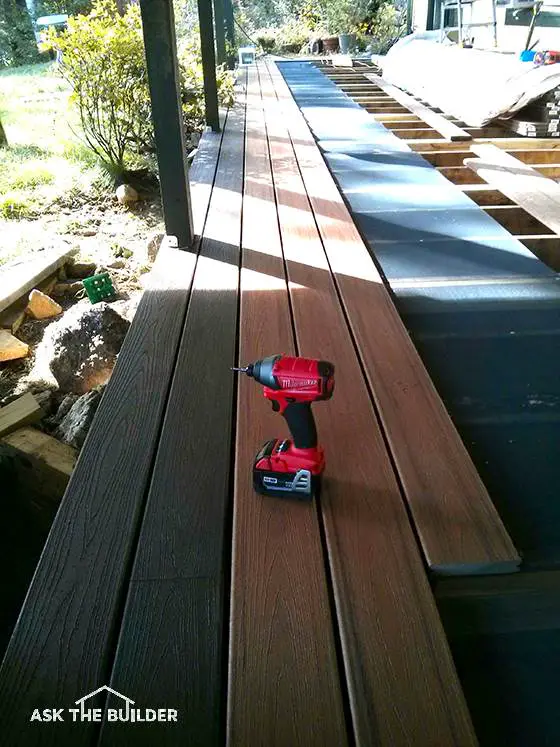
He's helped carry the old decking up from the lower yard and carry the new decking down. Last night, I had him helping me install the decorative Trex Transcend facia boards.
I have had great luck selling all my old deck material, plus the old railing, on Craigslist. Before you throw anything away, try to sell it on Craigslist or to a local building materials resale / recycle center.
You can just barely see the gorgeous fascia board covering the 2x10 joists on the lower deck in this photo I took moments ago.

Yes, we put the new furniture out on the upper deck before it's finished because we just couldn't wait.
Today I'll be finishing all the railing except for the few sections next to the staircases.
CLICK HERE if you want to see WHY I chose to use Trex Transcend - as if the photo above doesn't tell you!!!
Prepare for the STORM Survey
In the last issue of the newsletter, I asked you to take a simple survey about Storm Preparedness.
I GOOFED up and made the second question required when it should not have been. Oh well, no one was injured as a result so I dodged the bullet.
The results of the survey were pretty telling. Here they are. So far 1,251 responses have been logged.

Fifty-one percent are NOT ready.
The biggest reason is because you don't know how to get ready.
Why is this important? Here's a recent example.
Last week, my good friend Veronica Hill was working in Riverside, CA. Mid morning a forest fire started up near the Cajon Pass on I-15. Within hours her home in Wrightwood, CA was under the gun. It was named the Blue Cut fire.
I don't know if she ever was able to get back home BEFORE the authorities did a mandatory evacuation. She and her family were some of the 82,000 people displaced by the natural disaster.
Fortunately, the brave and diligent firefighters saved the town of Wrightwood. Veronica and her family dodged the bullet.
But she could have lost EVERYTHING.
Are you going to be a statistic or are you going to be one who had the foresight and gumption to Be Prepared?
My Roofing Book Status
Six months ago, I was deep into writing an expose' book about how asphalt shingles are failing much earlier than they should.
The book is finished, but NOT PUBLISHED.
The reason is simple. I have to have a company in place to sell and ship an invention I discovered while writing the book.
This SIMPLE invention will allow you to SLOW the damage happening on an asphalt shingle roof that's five or less years old.
The invention will allow you to arrest the deterioration of a NEW asphalt shingle roof.
In my book, I also tell you the asphalt shingles I'd buy if they were my only choice.
I'm HOPING to have the book ready for you to purchase by the end of October.
If you just need the NAMES of the shingles in case you can't wait until then, then CLICK HERE to get that information. If you buy this, be sure to IMMEDIATELY EMAIL me that you placed your order.
If you buy the information, I'll send you a .pdf version of the book once it's done. You'll just have to remind me of your purchase of the Best Shingle Advice.
DIY Termite and Wood ROT Protection
Yesterday, just as I was finishing lunch sitting on the edge of the deck, I got an email from Larry in Iowa. He had just purchased one of my affordable 15-Minute Phone Consults.
He was in a bind and needed an answer FAST.
I pulled my phone out of my pocket and called him. His issue was about how to protect new vertical-grained Douglas Fir tongue and groove porch decking.
He found a column on my website I had written years ago that contained secret information about a long-lost method used to treat wood to prevent wood ROT and termite infestation.
The bottom line, along with all the other advice I gave him about the BEST PAINT to use and how to apply it, is that he should soak all the lumber in a borate solution BEFORE he installs it.
The borate chemicals are SAFE for humans but wood rot fungi, termites, carpenter ants and other bad things that eat wood HATE them.
CLICK HERE to buy some of the best borate powder I know of. It's EASY to use.
That's enough for today.
I'm going out now to finish all of the railings for the deck. I'll tape a video today showing how simple it is to install the TREX Transcend Railing system. CLICK HERE to get more information about it.
Tim Carter
Founder - AsktheBuilder.com
Do It Right, Not Over!
Subscribe to the FREE Ask the Builder newsletter to receive professional advice for your home. Complete the form below and each week you'll get:
Unsubscribe at any time. We respect your email privacy.