December 14, 2008 AsktheBuilder Special News

What's in This Issue?

ICE STORM NEWS
REAL FRIENDS AND HAPPINESS
FINAL CALL FOR STAIN SOLVER AND EBOOK SPECIAL


I have a few quick things I want to share with you today. Look for a beefier newsletter packed with home-improvement tips in  a few days. Check out my new slogan when you get to the end of this newsletter.


ICE STORM NEWS

I've received several emails asking if I'm a victim of the savage ice storm that has paralyzed the Northeast for the past three days. The answer is yes. I was without electricity for about 19 seconds and the Internet was down for five hours.

The reason the electricity was only out for 19 seconds is because it takes about 10 seconds for my new Kohler 17kw standby generator to automatically switch on. We lost power here at the house twice early Friday, once at 3 a.m. and the second time at 6 a.m. The first time the power was out for about 90 minutes. The second outage cut power and the cable connection to the Internet for five hours.

My Kohler generator, powered by propane, ran like the Energizer Bunny. I just read on USA Today a story about the storm and how three NH residents already have died from carbon monoxide created by portable generators. You have to be so very careful when you use portable generators to help you limp through a storm such as this.


REAL FRIENDS AND HAPPINESS

First, you need to know how satisfying it is to both write this newsletter, and then hear back from you. Two days ago, several things happened to me, and they were all related to you.

Within the past three weeks, I asked if you could help by sending me actual tear sheets of my column from your newspaper. In my post office box two days ago, there were two letters, one was from R. Grubb of Delaware, OH, and it had a tear sheet. Thanks! The other letter was from Roger Hamel of Cedarville, MI. Roger had sent fantastic diagrams of how to wire a 3 and 4-way switch. Way to go Roger!

Getting physical pieces of mail, other than bills and junk mail, in this day and age is almost like Christmas morning. Sending a hand-addressed letter with a personal note is becoming a lost art. Receiving one is a true delight, just like listening to the song Christmas Canon as I type this.

Then, a few hours after getting back from the post office, I got an email from a colleague. Mike Kegley, is a custom-home builder in Northern Kentucky. I had the distinct pleasure to meet Mike years ago when I was doing my weekly radio show. Mike, and his family members, own BOLD Homes. Suffice it to say they build really fine houses. He was lamenting my exodus from Cincinnati to New Hampshire. He was both kidding and serious at the same time. But what prompted him to contact me was he had just read my most recent newsletter and decided to respond.

The point to all of this is I feel you're my friend, even if you don't email me or send me things in the mail. I get many replies from subscribers, often within minutes of blasting out the newsletter to you. Almost every one is a thank you, has a story in it how the newsletter helped or just a personal question. It's a pleasure to read each one.

Several issues ago, I told you I would share with you what I wanted for Christmas. It's really easy. Could you forward this newsletter to all of your friends, relatives, co-workers, etc. and mention why you enjoy it? If you can share how a past issue of my newsletter has helped you and suggest they subscribe, that would be ideal. It would mean the world to me if you could do this. Here is the direct link to the sign up page


FINAL CALL FOR STAIN SOLVER AND EBOOK SPECIAL

Four days ago, I sent you a newsletter telling you about my end-of-season Stain Solver sale, as well as the special on the newest eBook.  I had a crazy typo in that story saying the sale would extend until 7 a.m. December 15, 2009. Sorry about that!

It was supposed to say 2008. And December 15th is tomorrow with 7 a.m. less than 24 hours away as I compose this sentence.

I'm offering huge savings on the 16 and 50-pound sizes of Stain Solver. Go see for yourself - nearly $40 alone on the 50-pound size. That's crazy insane discounting. There are only a few of each size left. We will not have any of this size until January 2, 2009, and when we restock the prices will be bumped back up to the original price.

As for the new eBook, if you order today you get a huge reduction in price, plus I throw in at no charge the newest eGuide about how to double the life of your three-tab asphalt shingle roof.

Watch for more juicy home-improvement tips in a few days.

Tim Carter Founder - AsktheBuilder.com

Do it Right, not Over

Index of past newsletters.


December 11, 2008 AsktheBuilder News

What’s in This Issue?

CHRISTMAS TWO WEEKS AWAY!
MARK YOUR CALENDAR
NEW SHOWER IN AN EXISTING BATH
SEVERAL BOOK GIFT IDEAS
GASOLINE ENGINES
MASSIVE STAIN SOLVER NEWS
SEARS CATALOGUE
MY LATEST EBOOK AND FIRST EGUIDE!
VERY COOL WIRELESS VIDEO CAMERA


CHRISTMAS TWO WEEKS AWAY!

Yikes, Christmas is two weeks from today. So much to do and so little time. I remember not too many years back when I would get all stressed out at this time of year and not really enjoy it. Well, now I just go with the flow. I can tell you that I'm much happier. Try it yourself this year and let me know how it works out for you. Because we are now so close to the Holidays, this issue of the newsletter is going to have lots of suggestions of gifts to buy, some being things I have that may be of great interest to you as you jump into projects just after the holidays. One in particular is a new eGuide that can show you how to extend the life of your asphalt-shingle roof.

In the next newsletter I'll get you caught up on past columns as well as some interesting questions I've been getting from people just like you.


MARK YOUR CALENDAR

I'm going to be in Boston again for one day on January 24th. I'll be at the Greater Boston Home Show talking about standby generators AND anything you want me to discuss. If you have problems at your house, bring photos and let's talk about how to fix them. I'll be at the Kraft Power booth from 2 until 4 p.m. However, I'm willing to meet with you before that time and have lunch with you or several subscribers if we just coordinate ahead of time. I'll even do dinner with you and then head back up I-93 to New Hampshire. In three weeks I'll have more information about this. But if you live near or in Boston, this would be a great opportunity for you and I to meet face to face. I would love to meet you.


NEW SHOWER IN AN EXISTING BATH

Heather Cumpston from Highlands Ranch, Colorado emailed me asking, "Hey Tim, We would like to install a shower in an existing ½ bath on the main floor. The basement is finished below. We would need to knock out part of a wall to extend into a room that would become a new bedroom if we're able to put in a shower. From a plumbing aspect is this possible without being real difficult and costly? We would use a prebuilt shower with an inside diameter of 36x36."

Heather, it depends. There are lots of unknowns. For example, what's inside that wall you need to move? Is it a bearing wall? How hard will it be to connect the new shower drain and its vent to the existing plumbing system? I can think of ten other mission-critical questions.

I'm a licensed master plumber, and can tell you that since you have a toilet in this half bath, the drain line has to be at least a 3-inch-diameter stack servicing the toilet. This is a good thing, as the code will allow you to add a shower drain to this stack. How hard is it to make this connection? I can't tell you unless I come out to look at it. But suffice it to say that since it's only 5 feet away and in a ceiling you can access, it's far less expensive than having to break into a slab and make a connection about 30 feet away. I've done that on more occasions than I'd like to remember!


SEVERAL BOOK GIFT IDEAS

Are you looking for three book ideas for gifts? These are totally unrelated, so it gives you lots of latitude for that tough person to buy for. The first one is more a business book, but it also has a strong personal message if you want to succeed at anything. It's called The Success Effect by John Eckberg. I know John, he's a business columnist for the Cincinnati Enquirer. His book is a collection of interviews with some superstars in business. Read each of these interviews, and you're sure to walk away with some inspiration that will help you in your work or personal life.

Are you thinking of building a new home in a few years? Now is the time to start planning the house. Designing Your Perfect House -
Lessons from an Architect
is a really swell read. Bill Hirsch is a seasoned architect who has plenty of experience designing custom homes. Wait until you see some of the tips and color photos in this book!

Finally, how about a non-fiction tale of real treasure? Perhaps the richest gold treasure ever brought up from the ocean depths? Ship
of Gold in a Deep Blue Sea
is perhaps one of the best books I've read in years. Not only is the story fascinating, but the internal passion of Tommy Thompson to reach his goal is also unbelievable. If you've ever wanted to do something, but think it's too tough, wait until you read this book. WARNING: Rarely do I discover a book I can't put down. This was one of them. It's as if there is a brain magnet inside the pages. This is a fantastic adventure book you may want for yourself to curl up with on a winter's weekend.

If you don't want to buy these, all of them are probably available at your local library or can be had via an inter-library loan.


GASOLINE ENGINES

Yesterday I took delivery of a new John Deere Dual Stage Snow Blower.

It looks like it will munch through the deep snows that are common here in New Hampshire. But I'll report more on that as winter progresses. What I wanted to tell you is the discussion I had with the great mechanic who brought it to me. We were talking about the care of the engine both during the winter and next year when the blower is stored. I thought that what he said would apply to many engines I have that sit idle part of the year.

His advice is for any gasoline engine that you have in your garage or storage shed. I thought it made perfect sense. First, you absolutely must use a gasoline stabilizer when gasoline is stored in the tanks of the engines. The chemistry of the gasoline can change without the stabilizers in as little as 30 days. If this happens, deposits can clog up the carburetors. Also, the mechanic said they have had problems when engines have been run dry of gasoline when stored. Some manuals say to do this. He said it's better to fill the tank, and have gasoline in the carburetor.

Another friend of mine, Mike Mangan - whom you will hear about in a moment - suggested that's it's a great idea to only store one gallon of gas at home at a time. This way you have great odds of having fresh gasoline on hand. Try to manage your inventory so the gasoline you have when you really use the engine is enough to last you just two or three weeks, not two or three months.

But the best advice I thought, was to start the engine every two or three weeks, even in the off season. Allow the engine to run maybe three or five minutes so it's exercised. This is exactly the same thing that is happening with the new standby generator I had installed. It starts up each week so the engine runs on a regular basis.

If you decide to do this, make sure you don't let the engines run in an enclosed space like your garage or a shed. You don't want to be overcome with carbon-monoxide fumes.


MASSIVE STAIN SOLVER NEWS

This will all make sense, so bear with me. I'm a small business. When I testified in front of Congress three times this past summer, I discovered that small businesses make up the lion's share of employment in our nation. I had never really thought about that. Add to this the fact I served over ten years as an appointed government official and as an elected one for two terms of office. What in the world does this have to do with the magical oxygen bleach Stain Solver you ask?

Well, in the county where the Stain Solver warehouse is located, there is an end-of-year inventory tax. As a small business owner, this tax frosts me as it's just another layered cost government adds on to our already stiff tax burden. We small businesses have to pass on that tax on to you. It's hard enough to run a small business and having to raise prices to please the government is hogwash. Well, guess what? We don't have to raise prices - not if we have no product in the warehouse to tax. So I'm doing a true inventory-reduction event.

I want to take my inventory in the warehouse to zero over the next few days with your help. Yes, sell out. That way I can give you the tax money I was otherwise going to give the government. You need the savings now more than the government. I've seen far too much waste in government spending, so I always want to give them less. As an elected councilman, I could tell you stories that would make your blood boil. But I digress.

We did a count at the warehouse. There is only so much material there. I'll not have pricing like this for a while, so you don't want to miss out. I'm only offering the special price on my two largest sizes, as I want to move massive amounts of the product. I want to sell out now and then restock on January 2, 2009 so I can avoid the tax.

I've told Ellen and Roger to slash the price 30 percent on the 16 and 50-pound sizes of Stain Solver.  The other sizes are NOT on sale. With this pricing, I guarantee you we will sell out in days. There are only 135 of the 50 pounders in the warehouse and 150 of the 16 pounders. If you don't react fast enough, you will see an Out-of-Stock message at the shopping cart. Come back on January 2, 2009, and we will be selling those sizes again, but not at the reduced price. I urge you to take advantage of this sale. I will not be offering this discount to those that show up late to the sale. Hurry please so you're not disappointed.


SEARS CATALOGUE

Years ago, I met a great friend. His name is Mike Mangan. Mike has done public relations for Sears for years. He's a real pro. If you're looking for some really great Christmas gifts for your loved ones, Sears might have some specials for you in the Sears Christmas Holiday Tool Gift Guide. Go and act quickly.


MY LATEST EBOOK AND FIRST EGUIDE!

I finished my latest eBook a few days ago. If you want to discover how I install and grout a ceramic-tile floor or a slate floor, this is what you need. To be honest, I feel it's my best eBook ever. It's loaded with detailed color step-by-step photos, and is by far, the longest eBook I've ever written. The photos in the actual eBook are links to high-resolution photos so you can really see what's going on.

To get an idea for yourself of its quality and depth of information, you can download a free chapter of the eBook. That way you can see what goes into these neat documents. Years ago I made a pledge that when I introduced a new eBook, I would give you a discounted price when it was first rolled out. The regular price is going to be $19.97, but you can get this new eBook for just $14.97 until Monday morning December 15, 2008.

But stop, it gets better, I also finished my first eGuide this week. These are new shorter publications that will help you conserve money in these times of hardship. This first eGuide is for anyone who has a standard three-tab asphalt shingle roof. You'll be able to see a photo of what that is in a moment. Both the eBook and the eGuide are instant download PDF documents. I don't mail you a hard-copy book. You download these things and decide yourself if you just want to view it on your computer or print off your own copy. Within a minute or two of placing the order, you get an email with links you click to get your documents. This is a very green thing to do. It saves lots of energy, and you get the information almost instantly.

Right now, you may be one of the tens of thousands of people who can't afford a new roof. What if I told you there was a simple thing you could do to extend the life of your existing three-tab shingle roof by ten or even fifteen years? That way when money comes available, you can install the new roof. This eGuide, with its own step-by-step color photos, shows you how to do that. The cost of the Roofing eGuide is just $4.97.

But if you purchase the Slate eBook at the discounted price of just $14.97 on or before 7:00 a.m. December 15, 2008, I'll give you the Roofing Guide at no cost to you. So you get both documents as Instant Downloads for just $14.97. But you need to act now.

If you do this, remember that you get TWO emails from the shopping cart. The one will say STAINSOLVER and ASKTHEBUILDER. Ignore that one. The second one will have the links that allow you to download both documents.

I guarantee you'll be satisfied. Remember, the eBook says it's for a Slate floor because at the time, that's what I was installing. But the techniques are the SAME for ceramic tile. All of the step-by-step information in the eBook applies if you're going to do a tile floor. The price is so attractive I guarantee you'll discover tips you've never heard before. Oh, I almost forgot!!!!! In the Forward of the eBook there is a photo of me from 38 years ago with my hair down to my shoulders. That alone may be worth the purchase price to you. Ha Ha!!!


VERY COOL WIRELESS VIDEO CAMERA

This past weekend I tested a really cool Lorex LNE3003 wireless, network ready, day/night webcam that's very easy to set up out of the box. I say that if you use a PC instead of a Mac or Apple computer. I use a Mac, so I had to switch to a PC to get the software to run.

This little dandy camera allows you to remote view while you are in the house or remote view if you are away from the property. If you have an iPhone, you can even view the camera in real time with your phone. The camera can be operated wired into your network or beam its signal wirelessly.

The camera has some amazing features that you may find interesting. I urge you to go look at this product. It would make a cool gift for someone, even yourself.  

Index of past newsletters.


Radiant Floor Heating

radiant floor heating

Radiant Floor Heating | Here's a peek at some of the 6,000 feet of Uponor hePex that's going to keep the floors in my daughter's new house toasty warm. The PEX tubing snaps into aluminum heat-transfer plates. You bet I'm happy as this was a complex job that we completed using the three Ds: diligence, discipline, and determination. (C) 2021 Tim Carter

DEAR TIM: I have a unique opportunity to convert to radiant floor heating in my home. A complete renovation is in progress, and I'm convinced radiant floor heat will be the best for me. Is installing radiant floor heat a task that the average homeowner can do successfully? What do I need to know to ensure my radiant floor heat system is installed correctly? Is one radiant floor heater better than the other? Victoria B., Holderness, NH

DEAR VICTORIA: Radiant floor heating is heavenly. If you've never had it before, you'll not sacrifice it in any future homes. The house I'm living in now is the first one I've ever had that has radiant floor heat. I've known for years that it's perhaps the most comfortable but never experiencing it, I couldn't stand witness. Well, now I can. I'm smitten with it.

CLICK HERE to get FREE BIDS from local contractors who will install radiant floor heating.

Can Radiant Heating Be in Concrete or Under Wood?

Radiant heating can be installed in concrete or wood floors. You can use hot water or electric-resistance heating pads.

Hot water radiant floor heat is an amazing system, whether the flooring system is wood or masonry. The floor itself, once heated, sends out low-level infrared rays through the air to heat your body and any other solid object in the room.

radiant floor heating

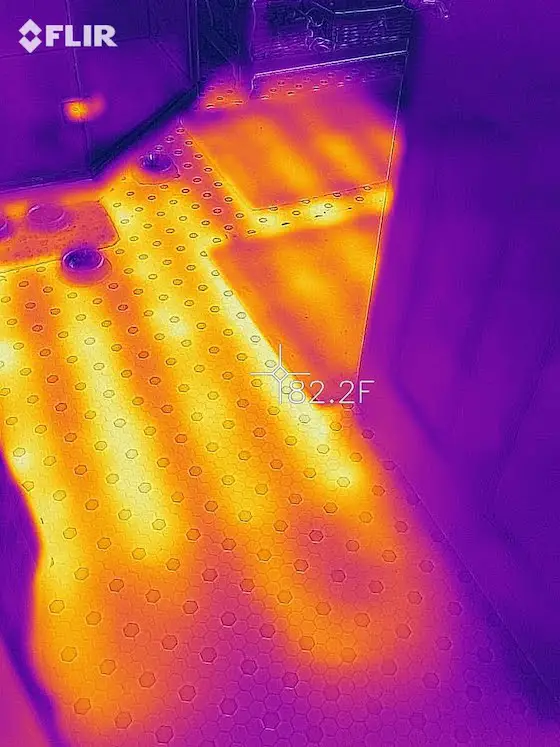
This is an infrared photo showing radiant heat in my bathroom floor. The aluminum Uponor heat transfer plates and the Uponor hePEX tubing work together to keep my feet, and those of She Who Must Be Obeyed, toasty warm!

No heat is wasted in the air. Forced-air heating systems don't really do that. The water vapor in the air is warmed, and as these microscopic molecules are blown through the air they inefficiently transmit their warmth to you as the warm air hits you. It's just not the same feeling.

Is it Easy to Install Radiant Floor Heat?

No, it's not easy to install radiant floor heat. You may rise to the challenge if you're a DIYr, but the odds are you might make a costly design error or two.

CLICK HERE to get FREE BIDS from local contractors who will install radiant floor heating.

You can forget about installing radiant floor heat yourself. It's an extremely complex task requiring enormous skill and talent. You want a seasoned installer that can prove to you he's installed countless systems. The calculations, flow rates, Btu heat-loss calculations, and engineering required to get a residential system to work flawlessly are difficult. Installing the actual equipment and piping is another skill set entirely. Focus your energies on interviewing several pros, talk to past customers and decide which pro will do the best job for you. Going with the low bid in this situation could be an enormous mistake.

How Does the Floor get Warm?

Radiant floor heat starts its life in a boiler. Modern radiant-floor heaters, or boilers, are highly efficient, and they are amazingly compact. I recommend getting a combi boiler. This provides the heat for the home and gives you unlimited hot domestic water too.

combi boiler

This is a Noritz combi boiler in my daughter's home. It's about the size of a piece of luggage! (C) 2021 Tim Carter

You will be stunned at how small yours will probably be. Don't restrict your budget here. You want a superb boiler, so ask the different installers who makes the best one and why they feel that way. Invest time in searching for reviews on the Internet.

How Does the Boiler Heat the Floors?

Water is heated in the boiler and sent into a piping system that recirculates this water through any number of interconnected loops. One of the magical things you can have with radiant floor heating are individual zones.

radiant floor heat manifold

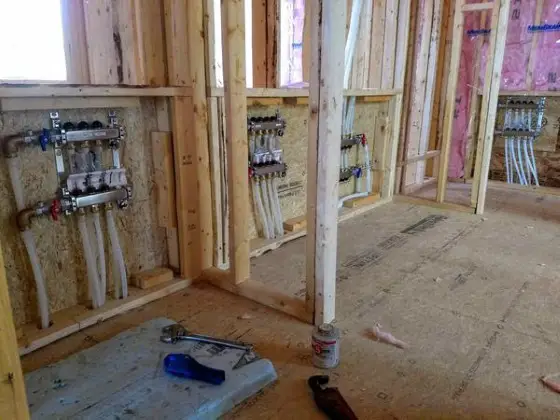
Here are four different zones. A manifold sends water to the heating pipes in each zone.

My current house has seven separate zones, each one controlled by its own thermostat. I can control the heat level in each zone. A zone typically is a grouping of two or three rooms that are almost always connected to one another. For example, in my basement, a bedroom, large closet and a bathroom are on one zone. The other four rooms in the basement are on another zone.

radiant floor heating

Infrared Photos | These are the heating supply pipes in my daughter's new home. Can you tell how many zones of the seven are calling for heat? Can you see which are the outgoing supply pipes with hotter water than the return pipes coming back to get reheated? Can you see why having one of these infrared cameras is such a good idea?

Do You Need Pumps to Move the Hot Water?

The water is pumped to each zone by separate recirculating pumps. These workhorses are one of the few moving parts in a common radiant-floor-heating system. High-quality recirculating water pumps can last many years.

What Should I Ask the Installers?

To make sure your radiant-floor-heating system is installed correctly, you need to ask lots of questions as you interview installers. Talk to them about the necessary calculations as to how they know there will be enough heat on the coldest possible winter days. Discuss which plastic radiant-heat piping will provide years of service. Ask about how the piping will be protected so it will never get punctured. Inquire about insulating concrete slabs so you don't bleed heat to the outdoors. Many radiant-floor-heat boiler manufacturers have some good tips as well on their websites.

CLICK HERE to get FREE BIDS from local contractors who will install radiant floor heating.

Make sure that all the promises made by your installer are put in writing in the contract. Take many photos of each step of the installation, especially those parts of the piping that will be covered and never seen again. Inspect the work to the best of your ability as you take the photos. Make sure your installer gets a permit and that the inspector gives the job her/his seal of approval.

How Warm Are the Floors?

One of the superb characteristics of radiant floor heating is the warmth of the floor. You can lay on the floor and be amazingly comfortable. Other floors are cold or uncomfortable. A floor that's heated is a dream to walk on with bare feet or just in socks. You'll not believe it until you try it.

Does Concrete Work Well?

Concrete slabs that contain the radiant-floor-heat piping become massive radiators. Once the concrete gets heated, the thermal mass radiates the heat into the room for hours. You can get the slab up to temperature and then turn back the thermostat. I've actually had my basement floor radiate bone-warming heat for up to 12 hours after the thermostat was turned back.

Column 756

December 2, 2008 AsktheBuilder News

What’s in This Issue?

HOLIDAY TO-DO LIST
DO YOU SEE MY COLUMN IN YOUR NEWSPAPER?
A KITCHEN FLOOR DILEMMA
QUICK-HELP GUIDES
THANKSGIVING AT THE CARTER’S
MY CHRISTMAS LIST
REPLACE-MY-MIRROR SALE
LATEST COLUMN


HOLIDAY TO-DO LIST

Can you believe the holidays are just three weeks away? Stress builds for so many reasons not the least of which is a small nagging project that you or your better half wants you to complete. How can I help? If you are stuck on a small project, send me an email and I'll try to give you a quick tip so you can get it done.

If you're entertaining a group, having a party, relatives are coming for dinner, etc. realize this amount of activity can stress a plumbing drainage system. If your drain lines have chronic backups due to tree roots or some other blockage, twenty guests using the toilet  or you washing all the dishes from the meal can cause a backup at the worst possible time. Now is the time - before the party - to get the sewer line cleaned out. The same is true for water heaters. If you know your heater is ready to give up the ghost, replace it now before all the guests arrive.


DO YOU SEE MY COLUMN IN YOUR NEWSPAPER?

My syndicated Ask the Builder column still runs in about 100 newspapers across the land. That number is decreasing because the newspaper industry is on life support. I wrote a blog post about how the newspapers can save themselves, but many don't seem to want to reinvent what they do.

However, I need your help right now if you do get the paper and my column runs in it. Can you please do one of two things for me:

Clip a recent column, scan it and send me the image in an email. Or clip the recent column and mail it to me.

My postal address is:  100 Swain Rd., Meredith, NH 03252-0887

Thanks in advance.


A KITCHEN FLOOR DILEMMA

Andy Winford of Fresno, CA wrote to me:

"Tim, we are moving into a home that has aggregate flooring in the kitchen but we do not like that look. What is the best way to remove aggregate? It's been suggested that we tile over it but I'm afraid it will make the floor too high."

My response was,

"Well Tony, if that aggregate flooring is terrazzo, I just can't believe you want to remove or cover that. If the existing floor is smooth and in great shape, I would consider commercial vinyl tile. It's only one-eighth-inch thick. Some of the modern vinyl tiles are stunningly gorgeous.

You can also cover the floor with a thinner ceramic tile. Some tiles are available that are only one-quarter-inch thick. That's not much of an offset to deal with where the kitchen floor transitions to another room."

Imagine getting advice like this when you have an issue with your home. Very soon my new website is going to be live. You or Tony could have gotten that answer from me over the phone or through a live video chat. I've decided to make myself more accessible to you through this new website. You never know when you're going to be in a bind and need help or an opinion from someone who doesn't have a skin in the game. I'll be able to sort out your problem or give you help if you're trying to decipher bids from contractors.

One thing is for sure. You must start opening all my future newsletters. Just before this new site goes live, I'm going to share with you and every other newsletter subscriber something you simply will not believe. So be on the lookout for that!


QUICK-HELP GUIDES

I'm days away from publishing three different projects. One is an extensive eBook that is long overdue. It's about how to install and grout Slate Flooring. Kathy and I love slate, and have had it in our home for years. It's nearly indestructible, and it's drop-dead gorgeous. Wait until you see the photos in this eBook of the red slate I installed in our Sun Room. This eBook has many detailed step-by-step color photos.

The other two are new products. I haven't picked a name, but I'm leaning towards eGuides. These are shorter publications that will show you how to conserve enormous amounts of money on things around your home. These harsh economic times are making it so all of us have to get more useful life out of things we already own.

The first help guide is a step-by-step guide that shows you how to double or triple the life of your water heater. The second one shows you how to double the life - or at least get 5 or 10 more years of life - from your asphalt-shingle roof.

But once again I need your input. Please tell me what small help guides you would like to see me write for you. Put that thinking cap on. Here are some hints. Tell me what you would like to replace at your home, but can't because money is tight and you can't afford to get a new "fill-in-the-blank". Or perhaps you used to hire a pro to do something and can't afford this person. What task are you willing to tackle? Tell me and I'll try to get the guide you need completed as soon as possible.


THANKSGIVING AT THE CARTER'S

It was so great to go back to Cincinnati for Thanksgiving. I hadn't seen Kathy or Kelly since September 8th! It was wonderful to have all the kids together in the same house for a week. I hope your holiday was as good. You may not celebrate Thanksgiving where you live, but it is one of my favorite holidays. It's indeed my favorite meal of the year. Kathy cooks an amazing turkey breast that I help her brine the night before. The dressing with raisins is to die for. Then the pumpkin and pecan pies. Oh my gosh, I get dreamy eyed thinking about it again!

I was doing a number of projects for Kathy while I was home. One was putting up the Christmas lights. Years ago, I painted my house with Sears Weatherbeater ULTRA paint. It has urethane resins in it, and is the best paint I've ever used. The semi-gloss finish allows me to wash the house every two years and the paint looks nearly as good as the day I finished applying it to the house. My Cincinnati house is in the city. I'm only 1.5 miles east of busy Interstate 75 and two miles west of Interstate 71.

As I was installing the lights, I noticed it was time to wash the house again. It was covered with this blackish dust. Then I stopped and thought, "Wait a minute. The house I'm in up in New Hampshire doesn't have any black dust on it and it's six-years old. In fact, it has no dirt on the siding." I'm convinced the previous owner didn't wash the house based upon other things I've discovered in the past few months.

So that got me to thinking. What is the black dust? How much of that have I breathed in the past 50+ years? I'm thinking of having it tested. My initial thoughts are that it's primarily rubber from the tens of thousands of car and truck tires that get worn as they pass my house on those two highways.

We still have some manufacturing going on, but I don't think any of the companies are burning coal. We do have coal-fired power plants to the west of my house, so maybe it's coal dust. Do you have similar experiences? Meaning, if you live in a city do you get the same dust and if you live out in the country your siding is pretty much dust-free? I realize if you live in a desert area your house will be dusty. I'm talking about if you live in an area with lots of vegetation and few dirt roads and deserts.

Oh, and the drive home. Yikes! I've NEVER had to travel for the holidays since all my family was in Cincinnati. It took me nearly 20 hours to drive back to New Hampshire. It rained from Cleveland all the way to New Hampshire. Interstate 90 east of Buffalo to Syracuse was bumper to bumper. That's a long way ...... and it cost us hours of time. I've developed a new level of sympathy for you if you have to routinely travel to get to a loved one during the holidays. We left Cincinnati at 7:15 am and got into the driveway in New Hampshire at 1:38 the next morning. It was brutal.


MY CHRISTMAS LIST

Next week, I'll share one thing with you a couple of things that I would love for Christmas. You can do them easily. It will only cost you a little time and no money.


REPLACE-MY-MIRROR SALE

As I was getting the car packed to come back to New Hampshire, I ripped the passenger side mirror off my Volvo station wagon. What an idiot I was. That's what happens when you're in a rush. Kathy, of course, had no sympathy for me and just laughed. She said, "If that had happened to one of the kids, you'd ream them a new orifice in the back of their body." I replied that I've mellowed over the years, but she wasn't buying what I was selling.

Today, I went to get the estimate for this mirror. To put it mildly, I was stunned. If I get reincarnated, I'm coming back to work in the auto-parts business. My mistake is going to cost me $600, $472 of it in parts!

Since Kathy isn't buying what I'm selling, I need you to do it. Every year around the holidays, I see the sales of my crown-molding eBook really go up. I'm convinced that people are in a mad rush to get their houses ready for the holidays. If this is you and you're still procrastinating, then I have a deal for you. I'm selling my crown-molding eBook for just $9.97, that's over a 50 percent price reduction off the normal price of $19.97. I've set the inventory counter to stop the sale as soon as I raise the $600.00. This means you better go get your copy NOW, even if you don't plan to install crown molding in the next few weeks.


LATEST COLUMN

I've had it with power outages. If you need electric, think about a standby generator. Don't confuse these with the portable ones you fill with gasoline.

Index of past newsletters.


Wood Fencing

DEAR TIM: Wood fencing is my next project. My wife loves wood fences and I feel they are attractive. What are the top things I need to know to ensure this project is a success? What is a good wood fence post? Should I prebuild wood fence panels or construct the fence in place? Is it necessary to embed the fence posts in concrete? Barry L., Columbia, SC

DEAR BARRY: My wife and I are suckers for a wood fence as well. I've had wood fencing at every house I've ever owned, and the fence at my existing home still gets compliments to this day. This fence has a gentle convex curve between each of the fence posts. Each wood fence panel is made from two horizontal treated-pine 2x4s and vertical pickets made from rough-sawn cedar. Each picket has an arrow point to match the distinctive points on each of the treated-pine 4x4 fence posts.

There are many things you need to consider as you start this project, not the least of which is are you even allowed to build the fence in the first place? Many cities and towns have strict zoning laws that control wood fencing, it's location, height, design, etc. just to name a few. I used to live in a village that prohibited fences in front yards and strictly controlled the height of fences so that the vista across multiple properties was not blocked.

wood fence

This wood fence is made from durable cedar lumber and treated pine posts. PHOTO CREDIT: Tim Carter

If you get the approval and necessary permits to build your wood fence, then you need to be concerned with underground utilities. Electric, gas, water, phone, cable television lines can be lurking just below the surface of the soil where you intend to ram your post-hole digger. Call 811 from your phone to schedule an appointment from the service that marks the location of underground utilities.

To conserve natural resources, your time and money, I would recommend wood-fence designs that allow you to build your fence in a modular fashion. This means using wood materials in such a way that you have minimal or no waste. I did this with my own wood fence many years ago.

I've had fantastic success over the years with treated pine fence posts. My current fence has treated-pine 4x4 posts that are six-feet long. I was able to get two posts from each 12-foot-long 4x4 that I purchased. These posts are buried 2 feet in the ground so that the top of the fence is 4 feet out of the ground. This 2:1 above/below ground ratio is a good one to adopt to ensure your fence withstands strong wind gusts.

It's not a bad idea to pre-build your wood fence panels, but keep in mind the total weight of each panel and how you will connect each panel to your wood posts. If you intend to stain or paint your wood fence, you'll get the best long-term results if you pre-paint or stain each individual piece on all surfaces and cut edges before you assemble the parts. Paint that peels from wood fences often starts at locations where one piece of unpainted or unstained wood overlaps another one. Rain gets into this confined space and soaks into the wood.

There are two schools of thought on placing fence posts in concrete. Each argument is strong and has good points. In my own personal experience, I've never placed a fence post in concrete. I couldn't see any advantages, just disadvantages. The primary issue is that if the fence post needs to be replaced because of damage or rot, it's a major ordeal. With no concrete to deal with, the old post comes out in a jiffy.

An alternative to concrete is crushed gravel. The sharp edges of the stone interlock and the stone mass mimics that of concrete, especially if the crushed stone comes with rock dust that fills all of the voids in between the stone.

Clay soil does a magnificent job of holding fence posts. That's what I have had at my past homes, and the dense clay provides plenty of lateral support to my wood fences. My father-in-law grew up on a farm with livestock that used to bump the fences and he said that they never used concrete to set fence posts.

If you do feel the need to surround your fence posts with concrete and live in a cold climate where the soil freezes, you must dig your fence-post hole carefully. To prevent the frost from heaving the fence post and concrete out of the ground, you must ensure that the hole you dig is similar to an upside down ice-cream cone. The bottom of the hole needs to be larger than the top of the hole.

The final piece of advice is to pay for a site survey if you intend to build your fence on your property line. Many a homeowner has had to pay twice for a wood fence installation because the fence was erected on a neighbor's property. Wood fences make for great neighbors, but only if the fence is on the right parcel of land.

Dan sent Tim an email about the materials to be used in a wood fence. Read the column by CLICKING HERE.

Column 755

How to Clean Paint Brushes Video

How to Clean Paint Brushes

Cleaning paint brushes is a chore for most people. At the end of a job, you are tired and the last thing on your mind is the paint brush. But guess what, if you follow some techniques and few of Tim's tricks, you can extend the life of that paint brush for many, many years.

Most of you don't realize that the cleaning process begins before you start painting. If you are using latex paint, get the paint brush wet with a little bit of water. If you are using oil-based paint, use a little mineral spirits or paint thinner. Those fluids will keep the bristles wet up near the handle. Without that fluid contact, the paint will dry very quickly and at the end of the day, it is almost impossible to get that paint off the brush.

Once you are ready to clean the brush, remove as much paint as you can on a scrap piece of lumber or cardboard. Use soapy, warm water to clean latex paint from brushes. Mineral spirits or paint thinner is required for oil-based paints.

The trick is to submerge the brush in the cleaning solution and use rapid side-to-side motions to rinse the paint from the brush. You will need to change your cleaning solution frequently until your solution remains clear as you move the brush around.

Now if you want to ruin your expensive paint brush, here are some common mistakes. Never hold a brush upside down in a stream of water. Don't jam your brush down on the bottom of the sink or bucket to rinse it and the paint from the bristles. This will weaken and crush the bristles.

Once you have finished the cleaning process, use a comb to comb out as much water as possible. Treat your brush just as you do your hair after getting out of the shower.

Use the hole in the brush handle to hang it up on a nail after using and cleaning it. If you take care of your paint brush, it will last for many years.

November 25, 2008 AsktheBuilder News

What in This Issue?

THANKSGIVING
MORE CHRISTMAS GIFT IDEAS
SLOW HOT WATER
STAIN SOLVER NEWS


THANKSGIVING

Another year is nearly over. It's time to look back and survey the results. I want to thank you for subscribing to this newsletter. Over the past six months, it's been a true joy to publish on a regular schedule and hear from you. Within minutes of sending this newsletter, I get emails from subscribers just like you. Your support, advice, stories all make publishing this newsletter worthwhile. I get enormous amounts of pleasure reading your emails, especially when you set me straight or tell a story about how something I wrote jogged a memory hidden in the corner of your mind.

I hope you get to spend time with your loved ones over the holiday. A few days ago, Meghan, Tristan, Brent and I drove back from New Hampshire to Cincinnati to be with Kathy and Kelly. We had to take an indirect route through central Pennsylvania because of lake-effect snow warnings along I-90. I had to drive about 80 miles along I-70/76 (the old Pennsylvania Turnpike) after already driving about eight hours.

It was dark, slushy and the space between the median wall and the never-ending stream of semi-tractor trailers in the right lane was about 13 feet. I was towing a trailer and fortunately I was in the zone. I can't remember ever seeing high-speed lanes that are so narrow. The margin for error either drifting left or right was no more than two feet.

Let me simply say that if you want a thrill and were thinking of playing a video game about fast driving and risk-taking, just go do the real thing. Wait for a rainy night and have yourself a blast on this road. Suffice it to say I will do everything possible to never drive this expressway again. I'm thankful my kids and I are still alive!


MORE CHRISTMAS GIFT IDEAS

Here are some other Christmas gift ideas for you. These are all products I've tested recently.

I'm a sucker for maps with my college degree in geology. Mapping and geology are like butter and bread. National Geographic has, in the opinion of many, some of the best maps in the world, so it stands to reason they would have some neat mapping software.  If a hiker, explorer or anyone who likes maps as I do is on  your Christmas gift list, they will really appreciate Topo! Explorer. Get the deluxe version.

Do you want a germ-free 2009 and beyond and hate the odor of chlorine bleach? Perhaps the Germ Guardian UV-C Light Wand is what you need. This tool allows you to illuminate surfaces with powerful ultraviolet light. This kills tons of bacteria if done for 20 seconds while holding the device two inches away from what you are trying to sanitize. Don't use this wand as a personal tanning device.

Here is a stocking stuffer for that person on your list who has no fear of electricity. Every now and then fatigue or mistakes happen, so fully insulated tools make all the difference. Klein Tools makes a full line of insulated hand tools for serious DIY'rs or professional electricians. The insulated screwdrivers have a thick coating on the shaft of the tool so if the tip is in contact with hot electricity and the shaft touches metal or you that might ground the tool, nothing happens. I also had good luck with the insulated diagonal-cutting pliers.


SLOW HOT WATER

Cynthia from Forest Lake, MN wrote to me saying,

"I live in a 58 ft long walk-out on a lake that has a septic system. The water heater is in the lower level at the opposite end of the house as the kitchen and laundry on the main level. I have to run the hot water for a long time to get the hot water to the kitchen. I want to spare the septic system of all that wasted water. What's the best way to provide hot water to the kitchen and laundry? I'm thinking a small water heater in the laundry that feeds the kitchen, too."

This is a great example of what I was talking about in the last newsletter about existing columns at my website. The good news is that within seconds, Cynthia could have had her answer. What's more, very soon Cynthia could have scheduled a ten-minute phone call with me or a video chat to walk her through the steps. The phone call and video chat are going to be part of the new website I'm building.

The bottom line is that Cynthia just has to install a recirculating pump near her water heater that will send hot water to the kitchen at key times when she needs it most. These pumps have cool timers that you can set to turn on and off at preset times of the day and night. If you have a pretty regular schedule, you can have hot water waiting for you right as you get to the sink. Read these columns and watch the video. I prefer the Grundfos pump, but have also heard that there are other systems that work just as well.

The pump in this column is fantastic. Cynthia would have to install the diverter under her sink to make it work. You'll see the diverter in the photo. It's black.

Here's the column where I talk about the Grundfos pump.

Watch this video! I show you the exact pump that Cynthia should use. You can see the little cogs that allow you to precisely tell the pump when to send hot water to your sink or shower.


STAIN SOLVER NEWS

In a couple of weeks, I'm going to do a blowout sale on the 16 and 50-pound sizes of Stain Solver. I'll explain more when this happens, but it will be a true Inventory Reduction Sale. The local government has a tax they levy on inventory in the warehouse at the close of business at the end of the year. My goal is to have little or no product on hand the last week of the year. I'd rather let you benefit.

This is going to be an enormous sale as there are literally TONS of material I need you to buy. I urge you to talk with friends, coworkers, neighbors, relatives, etc. to see who you can share this product with. You may want to think about buying multiple buckets as the deal is going to be unbelievable.

Be sure you pay attention to upcoming newsletters for this announcement.

Index of past newsletters.


Floor Grout Repair

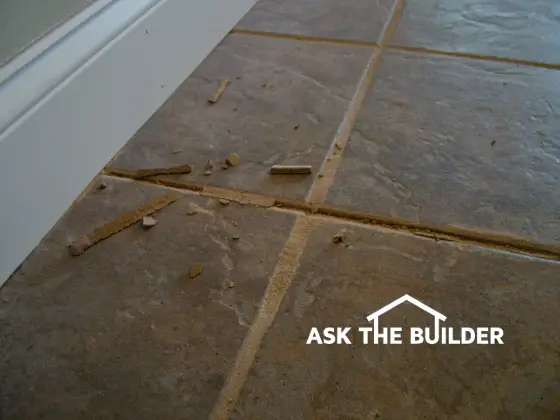
DEAR TIM: The grout in one joint of my floor tile has come out. Do you know why this happened? Upon close inspection, I can see that the previous homeowner repaired it. What's the best way to work with floor grout in this situation? How do I ensure I match the existing floor grout color perfectly? What type of grout do I install? Valerie P., Tampa, FL

DEAR VALERIE: Floor grout failure can happen for a host of reasons. Some of them have nothing to do with the original installation and others have everything to do with the installer or bad grout. Let's just hope that your failure is limited to this one area, and that all the remaining grout stays put for quite a while.

Here are but a few reasons why the grout could have failed. I could devote the entire column to just this topic, so I'll be brief. First, a structural failure where the floor moved can be the culprit. Seasonal movement of a wood-floor system can cause this as well. The installer could have mixed too much water in with the grout or used too much water at this spot in the floor when dressing the joint. The grout itself could have been bad.

To increase your chances of a repair that lasts, I suggest that you carefully chisel out as much of the grout as possible. Doing this ensures that the good grout you will install will not rest on top of poor-quality grout. I liken this to building a house on top of a poor foundation.

Floor Grout Repair

This floor grout was repaired once but failed. The joint needs to be clean and dust free before the next repair is done. PHOTO CREDIT: Tim Carter

You can use a small motorized rotary tool that has a grinding wheel for this task. You can also do it with a light hammer and a narrow chisel or old worn-out flat-head screwdriver. Always chip away from where the grout is still solid. This puts less stress on the tiles on either side of the grout joint. You have to be really careful that you don't strike the tile or aim the chipping tool towards the tile.

Vacuum all powdered grout and grout chunks from the joint. Use an old paint brush to dust out the joint. The bottom of the joint and sides of the tile need to be dust-free to get the best bond between the new grout and the tile.

Matching the grout color is not hard, but many tile installers and homeowners make a mission-critical mistake here. You must restore the existing grout to it original color and allow it to dry before you attempt to select a color. Remember, there are different shades of white and gray grouts. Don't underestimate how hard it is to match the color.

The easiest way I have cleaned floor tile grout is to use oxygen bleach. This non-toxic powder mixes with water making a solution that attacks all dirt and organic food stains without harming the tile, the grout or the pigments in the grout. Oxygen bleach has no odor, and if the solution is allowed to sit on the grout for 30 minutes, minimal scrubbing is needed to make the grout look like the day it was installed. You can readily purchase oxygen bleach online.

Visit a store that sells just ceramic tile or tile and stone products. They almost always have a massive selection of grout colors. You will probably be using sanded grout if the joints between your tile are wider than one-eighth inch. Look closely at you existing grout. If it has a rough texture similar to medium-grit sandpaper, you have sanded floor grout.

You must allow the existing grout to dry completely after cleaning to start to match its color. You can get color charts or sample grout sticks from the specialty tile store. Bring those home and compare them under good light to get a match.

Mix some new grout, about a cupful, to a consistency that matches thick mashed potatoes. Spread it out on a piece of aluminum foil so it's one-quarter-inch thick. Allow this to dry naturally in the air for two days. Crack off small pieces and set them next to the existing grout or in the empty grout joint to see how the color looks. Do this until you get a match. You may have to blend different grouts to get a perfect match.

When you finally have the grout color matched, you can begin to install the new grout. Check again to make sure the joint is dust free. Mix a new batch of grout and get a rubber float as well as a grout sponge and a bucket of warm water.

Push the grout into the joint using the float. Hold the float at a 45-degree angle and wipe away excess grout so the grout is flush with the top of the tile. Don't worry about a film on top of the tile. Wait 15 or 20 minutes until the grout in the joint is pretty firm and stiff. Take the sponge and get it wet but squeeze all the water out of it you can. Lightly stroke the sponge over the tile applying minimal pressure. Do this until the film is completely removed from the tile and the grout joint has the same appearance as the existing grout around adjacent tiles. The new grout will appear darker than the existing grout. Don't worry about that as it should dry to the correct color in two or three days.

Check the grout an hour or two after this and be sure the film is completely gone from the tile. Use the sponge rinsing it frequently. Dry the wet tile with an old rag to polish it and ensure all grout is off the tile.

Column 754

Chainsaw

Craftsman Chain Saw

This lightweight chainsaw is really amazing. You would think it's a toy when you pick it up, but it chews through oak logs like they were butter. PHOTO CREDIT: Brent Walter

DEAR TIM: I need a chainsaw and am flummoxed as to which type to purchase. I'm certain that I want a gas chainsaw, but wonder whether to get an 18-inch chainsaw or a 14-inch model. I've never used chainsaws before and am concerned about my safety. Can an average person use one with little fear? What tips can you offer about buying and working with these amazing tools? Laurel S., Lusby, MD

DEAR LAUREL: I can sure see why you are overwhelmed when faced with purchasing a chainsaw. Wow! There are so many brands, models and features, it's tough to separate what is really needed to do a particular job. But the good news is that I can help you as I just went through this myself. However, it's impossible to share all the knowledge you need to know in this short column.

Many moons ago, 414 to be precise, I used to operate a chainsaw regularly. My father-in-law owned a large tract of forested land that we harvested wild cherry trees for both woodworking and firewood. I used a durable chainsaw that had an 18-inch bar. This saw was fairly heavy, and it cut through hardwood trees with little or no effort.

I was never injured by the chainsaw, but my father-in-law was seriously hurt one day. He slipped while using it and proceeded to make a deep cut in one of his legs. Accidents happen, but this one may have been prevented had he been wearing chainsaw chaps. Chaps are special protective clothing that is an absolute must to have. Furthermore you need heavy gloves, safety glasses and a helmet with a cutting shield.

You can work with these magnificent and powerful tools safely. I urge you to inquire about training classes or demonstrations that might be offered at local stores that sell the chainsaws. There are also some excellent video and DVD products that many of the chainsaw manufacturers have produced that take you through a safety course. These mission-critical safety lessons must not be skipped.

I now own a fantastic 2.4 cubic inch, 40/cc two-cycle gasoline chainsaw that has an 18-inch bar. It's a Sears Craftsman, but as with all things Sears, it's made by some other manufacturer. Sears doesn't own a factory. They sell things made by other companies. I believe this saw was made by Husqvarna, but I'm not certain.

When I first took the saw out of the box I was disappointed. The saw was so light that I thought it was a toy. As soon as I started it and began to use it, I changed my mind. This saw is a beauty. The saw I used over 30 years ago was much heavier, and it would create arm fatigue before the rest of my body was tired. Pay attention to weight as well as any features on the saws that lessen vibrations.

When selecting a chainsaw, think long and hard about what you will really be cutting. In my opinion, you want a chainsaw that has a bar that's longer than the diameter of the wood you will be cutting. You absolutely can cut logs that have a diameter larger than the bar is long, but you take risks doing this.

Price is also a great indicator of quality. Chainsaws that cost more tend to have better parts and components, and they usually are more rugged. The extra money you spend will almost always give you a saw that will not let you down, and it can last generations if cared for. If you want recommendations about great chainsaws, talk to the owners of tree-trimming companies. They use the saws each workday and know what brands are dependable.

Cutting logs is a science. Be aware that a freshly cut tree has enormous amounts of tension in it as it lays on the ground. You can easily get the chainsaw bound up in a cut as the tree pinches the blade. Large portions of the tree can start to roll and trap you as you cut. You must always be aware of these dangers.

Be sure to read the owner's manual several times. Never take shortcuts with respect to the gas and oil that must be used. The bar needs oil to lubricate the moving chain. Use high-quality gas and oil for top performance.

Never let a chainsaw blade touch the ground or dirt. This will dull the blade very quickly. Cutting with a dull blade is both dangerous and puts lots of stress on the engine. Watch for dirt that gets trapped in the bark of older logs that you might find in the woods.

Sharpening a chainsaw blade is an art. The teeth of the blade must be ground to a precise angle to ensure the chainsaw cuts straight. Many tool-rental businesses will do a great job of sharpening chains. Don't underestimate this aspect of chainsaw maintenance.

Follow the instructions in the owner's manual for long-term storage if you want the saw to start after months of sitting idle. If you ignore these steps, you will be taking your saw in to get service.

Read about getting this chainsaw in the October 28, 2008 Newsletter.

Column 753

November 16, 2008 AsktheBuilder News

What’s in This Issue

ANOTHER APOLOGY
VIDEO CHAT
SWANN ADW300 WIRELESS VIDEO CAMERA
SEARCH TIPS
PAINTING PLASTIC
RECIPES
SPACE SHUTTLE INSULATION
GUTTER GUARDS
SPRAY SPACKLING


ANOTHER APOLOGY

The last issue of this newsletter was published on Veteran's Day. I forgot to honor all of our veterans. I'm deeply sorry for that oversight. The sacrifices of our veterans are what make this newsletter possible. I've had the distinct honor to meet several distinguished veterans who subscribe to my newsletter. One of them is Dick Daniels, a former Captain in the US Navy who is a tailhooker. He was a pilot who landed on aircraft carriers and put his life on the line each day for us. There are hundreds of thousands, actually millions, of Dick Daniels out there. You know them. Another one is my best friend Richard Anderson. Both served in Vietnam, Richard volunteering for two tours of duty in the Marine Corps.

Do me a huge favor and call or contact any veteran you know. Thank them. Reach out and do them a favor if you can. The freedom we enjoy here in the USA is because of them. The same can be said no matter where you live. Just about every country has been involved in a conflict. If you're free, you owe that to the sacrifice of many. If you're a veteran, my family and I are deeply indebted to you for your sacrifice. Thank you so very much.


VIDEO CHAT

Several days ago, I installed the new video chat feature in Gmail. I'm a big fan of Gmail, the free web-based email provided by Google. I use Gmail each day for all of my email needs. It's amazing. The download of the video-chat software was painless and within minutes it was up and working. I use a MacBookPro laptop, so I have a camera built into my computer. If you don't have a built-in camera, after-market video cameras that connect to a computer are now very affordable.

I tested the video connection with a friend of mine who lives in Los Angeles, 3,000 miles away from me in New Hampshire. It was like we were in the same room. The video quality was fantastic, and the audio was just as good. Video chat is not new by any means. It's been around for a while with different providers. What I like about this is that the video chat seamlessly integrates with my email. Oh, and it's free. I can talk and see my friends and soon possibly you for free. Once again, I'm sure there are similar video chat systems out there, some attached to email. But there's a reason why I'm excited about this. Here's why.

If you're a new subscriber in the past month or so, you have no idea of the new website I'm working on. In the early part of 2009, this new website will be live. This video chat feature will be part of it. I plan to set aside two hours per week in this new website to do something akin to the talk radio show I did for over 12 years. On that radio show I would get calls from someone just like you that had a problem with their house. In ten minutes or less, I almost always solved the problem. But it was all done with voice only and me having to visualize what the situation looked like. That can be hard to do if the person on the other end of the phone can't describe things well.

Part of my plan for this new website is that you'll be able to sign up for time slots each week where I either call you on the phone or video chat with you about your problem. We'll talk for ten minutes or less so that I'll be able to help at least 12 people in two hours.

If you decide to do the video chat with me and can set your camera up near the problem, you'll have the ability to show me what's wrong while we talk about it! That will allow me to give you the best advice possible.

If this is of any interest to you, I suggest that you sign up now for a free Gmail account and start to use it. You can still keep your existing email address and use that as you do now. This new Gmail account can be used when you and I video chat or you decide to video chat with other friends and relatives. But I'll warn you now. When you see all the features of Gmail, you may start using it as I do. When I use Gmail, my emails show that the email came from my @askthebuilder.com address, not my @gmail.com address. That allows you to keep your current address but use a different email platform.

You can go here now to read about the Video Chat and get the account activated. If you have a Gmail account now, download the software and start practicing. I can't wait to see you!


SWANN ADW300 WIRELESS VIDEO CAMERA

While we are on the subject of video cameras, you may be interested in a wireless video camera that allows you to monitor remotely a room in your house, an exterior door or some other thing you want to watch. In the past, these video cameras almost always required a cable to be extended to a monitor, digital video recorder or a hard drive that stored the video footage.

I just started testing the Swann ADW-300 and it's pretty slick. One of the neatest things about this camera is that it has a remote control that allows you to zoom the camera in and out and make the camera pan left, right, up and down. This wireless camera boasts a 160-foot wireless range, so you can have considerable distance between the camera and the receiver. It's rated for outdoor use and has infrared sensors so things that come close to the camera in the dark are visible.

I just started to test this camera and am really impressed with it. In the past, I always felt that running the cable was tough, especially in a finished home. With this device you can be up and running in about five minutes or less - the time it takes you to screw the camera mounting base to the wall.


SEARCH TIPS

Earlier this week, I got an email from a CEO of a company that wanted to know about how to install a toilet and especially about plumbing vents. I was a little flummoxed by his email as that information is at my website. I get similar emails within minutes each time I send out a newsletter.

Six weeks ago when I asked for input about the new website, one of the most-important things you told me you wanted was a superb search engine. Well, unless I'm mistaken, I think I have the best now on my AsktheBuilder.com website. If there's a better one, I sure would love to know about it.

Here are some tips that may really help you discover what you're looking for when you come to my website. Let's say you were that CEO. If he would have typed "toilet installation" and then done a separate search for "plumbing vent", he would have had, in seconds, exactly what he was looking for.

The trick is to use common keywords and just one or two. Let's say you want to know what I've written about ventilation. Well, I have a category named that. If you type in "ventilation", that category page pops right up to the top in the search results. All my columns about ventilation are listed on that category page.

I urge you to really play with the search engine when you need help. Oh, here's a really cool tip. Let's say you want to see if I have a video about a topic. Always include the word video in the search phrase. Examples would be crown molding video, gutter guard video, etc. If I have a video, it will show up right at the top of the search results. Try it and see!


PAINTING PLASTIC

Katrina Demilo from Massachusetts emailed me and asked: "We are going to paint recycling bins as a project for a school auction. What kind of paint/sealer should we use? We want them to last as long as possible."

My response was pretty simple. Plastic is somewhat challenging because it often has a slick surface. I suggested that she try liquid deglossing solvent on the bins followed with a bonding primer that says on the label it adheres to plastic. Traditional oil paints usually have fantastic adhesives in them that allow them to stick to just about anything. But they can be difficult to work with. The oil paints tend to cure faster getting harder quicker than great latex paints.


RECIPES

I want to thank you for sending me your recipe. I got some that made my mouth water as I read them. Right after Thanksgiving I intend to try all of them. By the way, the pork chops and wild rice came out great. I simmered the chops in some pork gravy for about 35 minutes and they were so tender I couldn't believe it. Oh, and I made another apple pie yesterday! My next dessert is banana bread followed by avocado cream pie. That was one of the recipes sent in by Sharon.


SPACE SHUTTLE INSULATION

Several newsletters ago, I made reference to the technology in the protective heat tiles on the Space Shuttles. As always happens, I get emails from subscribers like you who share inside information or fill in the blanks. I really appreciate that feedback. Dana was so interested, she told me she was going to try to locate that past issue of National Geographic magazine that had the article I referenced. Well, that motivated me to go to the Meredith Public Library after I went online to discover the exact issue of the magazine. My library had a copy and it was fascinating to read the article that was published in March 1981 - over 27 years ago! You have to read it if you can get it. You can't believe the reference the author made about cell phones. It was hilarious.

I decided to scan the two pages of the magazine that had the photo I remembered as well as a page I forgot about. Those tiles are 90 percent air! Can you believe that? The only thing I couldn't verify was the R-value of the tiles. One thing's for sure - it's incredibly high as it takes an enormous amount of time for the heat to move into or out of the tiles.

If you want to be the next billionaire and do the planet a huge favor, figure out a way to copy that technology and make sheets of the product that are one-half-inch thick. If we had that material, we could heat our homes for 1/100th of what we spend now. You just need ultra-pure silica. Silica is the most abundant element on the planet. Here's the link to those two pages I scanned.


GUTTER GUARDS

Months ago, I announced that I had completed ten years of testing of gutter guards. Since then there are literally thousands and thousands of new subscribers who get the same newsletter you're reading now. In many areas of the nation we just got through another leaf season. So I thought I would share the link to the page where I have posted the two videos and the story behind which one I finally decided to have installed on my house.

The important thing to realize is that there appears to be a subtle reason why the one gutter guard - the one I chose to use - performed better. The manufacturer determined themselves long ago that the guard must be installed so it's at the same slope as the roof. Of all the gutter guards I had installed over time or had professionally installed by the manufacturer, this is the ONLY one that required that.

You need to understand that making sure the gutter guard is sloped with the roof requires additional work that might be more than the average do-it-yourselfer can handle. Lowering the actual gutter so its front top surface is in the same plane as the roof is what needs to be done. If you have long gutters, this might be problematic and is a good reason to have it done by a professional.

The company that installed my gutter guards was MasterShield. If you contact them, make sure you tell them I said Hello. It's always nice that they know where you heard all about them.

Go watch the videos at this page and remember that in my testing, gutter guards fail miserably in the Spring. Well, just about all of them except MasterShield!

Several Months Into the Test

The video below is what my garage roof looked like after months of testing. It's very obvious that the way the gutter guard is installed makes a very big difference:

The one gutter guard performed better than the other. You can clearly see that.

You can't dispute the findings in the above video.


SPRAY SPACKLING

As you might imagine, I get a constant stream of products to test. One of them arrived about three weeks ago. It's a spray can of spackling compound. Yes, spray spackling. I was as inquisitive as you might be right now. It's called Jig-a-Patch.

I tested it today, and it's very unusual. By that I mean it's as unique as the delivery system. Spackling compounds have come a long way in the past few years, and this may be the one product that pushes the envelope.

My first impression moments after I pushed the tip on the aerosol can is why did I spray shaving cream on the wall? The spackling was as fluffy as that! It spread easily and readily filled the hole. I think you should try it and tell me what you think. The manufacturer has a 100 percent rebate offer open for the next three weeks. Check out their web site for the details and get your free spray spackle.

Index of past newsletters.