Lazy Toilet

DEAR TIM: I have a toilet that flushes very slow. It seems to just swirl around and whatever is in the bowl takes two, sometimes three flushes to go down. Any suggestions? Terry R. Minor New Eagle, PA

DEAR TERRY: The first thing I would do is pour a 5 gallon bucket of water down the toilet as fast as possible. If the toilet and drain line are free of clogs, the level of the water in the bowl will not rise as you rapidly pour the water into the bowl. The water from the bucket will leave the bowl faster than a speeding bullet.

Once you are certain there are no clogs, take the tank lid off the toilet and lift up the flapper valve in the tank with your hand. Open it fully and keep it open until all the water leaves the tank. If you get a good flush, then this tells me the flapper valve is not opening fully and/or it is closing too quickly before all water leaves the tank.

If the toilet still flushes slow, then you may have a lime buildup in the holes under the bowl rim or the siphon jet hole in the base of the bowl.

Column QA

Specific Building Plans Help Avoid Delays

Tips for Minimizing Project Delays

Project delays can occur for many reasons. Some are avoidable and some are not. You should focus on the avoidable reasons when you are getting ready for your next project. Include in your scheduling some type of contingency for unavoidable delays.

Excellent plans and specifications are a necessity. Generally speaking, if you have an excellent set of plans you will avoid surprises and change orders. Both of these can create havoc in scheduling, especially change orders. Change orders usually can be traced back to poor planning, because you or the architect did not explore or think out all possibilities. Most contractors hate change orders.

In the bidding stage, quiz all of the contractors about the length of time your project will take. Ask them to produce, along with their price quotation, a simple project time line chart. Tell them it does not have to be fancy. Compare the charts and make your judgment. If a submitted chart is incomplete or inaccurate, how well do you think that contractor will perform?????

You have a responsibility to make timely material selections. Look ahead on the time line chart and give yourself plenty of time to make decisions. Don't underestimate this process, especially if your project is large and you have many things to select. Believe me, you can spend 3-4 hours just looking at sinks, faucets, and countertops. Selecting cabinets can take days.

Chart the progress of your project. Quiz your contractor as to whether or not things are on schedule. If a problem develops, ask what is being done. Ask if there is a way to get back on schedule. Openly communicate with your contractor. If he has a problem, try to be understanding. Remember, he is already under pressure. If you turn up the heat, it probably will only make things worse. However, delays caused by inaction by the contractor should be dealt with immediately. Tell him you're HOT!

Related Column: New Building Blues

Column B3

Construction Project Timeline

Simple Project Time Lines

One way to help minimize or eliminate project delays is to create an accurate and realistic project time line. This timeline lists all major aspects of your project. These aspects include both tasks and key materials needed to complete your project. It is vitally important to ensure that all tasks and materials are listed. The Checklists that I market list these aspects in great detail.

The successful creation of the project timeline depends upon accurate information from your contractor, his sub-contractors and material suppliers. Professional contractors must create a time line so as to accurately calculate the length of a project. You can create a time line yourself by just asking your contractor some simple questions. Some of these questions are as follows:

  • How many work days will each task take to complete?
  • What is the order in which tasks will occur?
  • What tasks must be completed in order for other tasks to begin?
  • What tasks can take place at the same time?
  • What materials must be special ordered?
  • How long does it take for specific special order items to arrive?
  • What is a realistic time frame to select materials?

When you have the answers to these questions, you can begin to create your project time line. If you have not done this before, you will need the assistance of your contractor. His input will be necessary with respect to those tasks which can take place at the same time. This aspect of a job is probably the most important, because it is here where you can compress your schedule and get the most amount of work done in the least amount of time. The number of tasks that can take place at the same time depend on many things. Scope of job, weather conditions, type of tasks to be completed, etc. all play a part.

The creation of the time line begins by using a large piece of graph paper. List the project tasks, in the order in which they occur from beginning of project to the end of the project, on the left side of your graph paper in a column starting at the top and proceeding to the bottom. Before you proceed any farther, you should have a general idea as to how many total days your project will last. This total should include days off and holidays. make sure that your graph paper from left to right has enough spaces or boxes equal to or greater than the amount of days you have calculated. Tape on an extra piece of graph paper if you need more spaces. You are now ready to begin your timeline. The tasks are listed on the left side of the paper vertically. The days of the week are listed across the top of the paper.

It is important to determine whether or not your contractor intends to work on weekends. You need to know this for a simple reason. If the workmen do not work on the weekends remember not to include these days as a part of your calculation. For example, let's say your contractor tells you that the demolition phase will take '7 workdays' and that his employees do not work on weekends. If the job begins on the first Monday on the chart, you would put a small circle in the 'Monday (M)' square of the first week and draw a line to the 'Tuesday(T)' square of the second week. It's that simple.

If your project is more complex, your chart simply gets bigger. You just have to list all of the tasks and the proper amount of days and/or weeks. If your project will take more than 2 months, you may choose to list weeks in place of days on the chart. When you do this, however, you tend to loose some detail in your planning. Beware, this will come back to haunt you.

One important aspect that many people forget to include on such a timeline chart is notation of when certain special order items must be ordered. This error is responsible for many project delays. You can overcome this error very easily. As I mentioned earlier, you must know the 'lead' time for special order items. That is, how long does it take to get the item.When you know this lead time and you know when the item must be on the jobsite from the completed time line chart, simply count back the number of days or weeks it takes to get that item and make a note in red on that day or week. For example,on our chart above, let's say that it takes 3 weeks for the particular carpet you selected to be delivered. That means that you must place the order for the carpet on the first Friday in the project while the demolition is occurring. What's more, your contractor should have informed you of this prior to the start of the project, so that you had enough time to go to several carpet stores. Can you imagine how you would react if the contractor came to you that Friday morning and said, "Oh, by the way, you need to select your carpet today so that I can stay on schedule." I'm sure that you now see the value in having one of these charts filled out at the beginning of a project!!

There are several ways to compress your job schedule so that you can finish your project in the minimum amount of time.The primary factor to consider is that of task overlap. This is where the professional contractor really shines. On any given project, certain tasks can occur at the same time. The ability of a contractor is measured by his or her ability to make this happen in a coordinated and timely fashion. For example, in a room addition project, the roof can be installed while the plumber and heating man are installing pipes and ducts below. These tradespeople generally won't be in each other's way. Also, just as soon as the roofer is completed working overhead, the brickwork or exterior siding can be applied as the electrician is working inside. I'm sure you get the picture.

Once you are convinced that you have an accurate time line chart, you must use it. You put it to use by printing enough copies for all sub-contractors and material suppliers. Highlight in color when each particular sub or special order item is needed. Give the appropriate copy to each person. This simple act puts them on notice as to when they are expected to arrive and work on your job.

In the event something goes wrong and you must adjust the schedule, you must inform all parties and 'push' all dates forward.If you do not do this, tradespeople and materials will arrive before you need them. This is very important to remember.

Although it may seem like a lot of work to make up a time line chart, it really is not. Believe me, when you have a realistic chart and people see that they are expected to be on your job on a certain day, they usually make it a point to be there. That's why they disappear from the other jobs!!! Make a timeline chart for your next project to make sure that your tradespeople don't disappear!!!

Column B3

Use 3 Ring Binders – Get Organized

Creating A Jobsite Organizational Binder

Did you know that many construction projects finish on schedule? Have you ever wondered what they do to make this possible? Usually, the key to this type of success is good planning and subsequent jobsite organization. Jobsite organization on residential projects can be accomplished very simply and easily. It is just a simple matter of assembling all of the information concerning the project and keeping this information handy for all people who are involved in the job. A method that has worked very well for me over the past few years uses a simple 8 1/2 " x 11" loose leaf 3 ring binder.

Delays and problems often occur on projects when a question cannot be readily answered. For example, imagine the electrician shows up to the job to install rough wiring. Let's say that the plan calls for wall sconce light fixtures on either side of the bathroom medicine cabinet. The electrician asks the contractor what type of medicine cabinet and lights will be installed. Will the medicine cabinet require electricity for a self-contained light? How large are the wall sconce fixtures? I could easily list three more questions. The point is, if the items have not been pre-selected and all information concerning these items, including dimensions and catalogue photographs, is not readily available, the builder or the homeowner will not be able to definitively answer the questions. This same scenario can occur with every sub-contractor. It can become a nightmare.

The Solution

I have always encouraged clients to make selections of items either before the project begins, or as soon after the start as possible. When clients make their selections at the various supply houses, the salespeople mail to me the next day all technical information and photographs, if possible, of every selected item. I then begin to assemble this information in a binder which stays at the jobsite at all times. This binder becomes almost as important as the plan.

The creation of the binder is very simple to do. Purchase a 3 ring binder, some loose leaf paper, a set or two of dividers with colored tabs, and a simple 3 hole punch apparatus. The 3 ring hole punch will come in very handy. There will be copies of many things that have to go into the binder which do not have holes in them.

The first step in assembling the binder is to try to determine how many categories or areas you wish to create divisions for. This is not extremely critical, because you can always easily add a divider or a section. For example, a common set of categories for a project might be the following:

  • Contract
  • Specifications
  • Change Orders
  • Electric Fixtures
  • Plumbing Fixtures
  • Kitchen Cabinets
  • Counter Tops
  • Appliances
  • Hardware Selections
  • Notes of Meetings
  • Sketches

Depending upon the scope of the project, you could easily have more categories or fewer categories.

Once you have decided upon your categories, begin to label the colored dividers and arrange them in a logical fashion, if at all possible.

Now for the fun part. Simply begin to assemble copies of all information concerning all of the items you have selected. Use a colored highlighter to draw attention to various items on any given page. Often, technical data sheets have information for many models. Find the specifications or dimensions for your model and highlight them. This will help to minimize any confusion. Be sure to obtain catalogue photographs of fixtures.

The more information you gather prior to the start of your project, the better. The reason for this is very simple. For example, would you think it important to select a medicine cabinet while the foundation is being poured? Many of my clients could not understand the urgency. They did not realize that in just a matter of days, the carpenters would be framing the bathroom walls. They need to have the proper dimensions of the cabinet so that they can create the correct rough opening. The same thing goes every item.

Binder Benefits

If you decide to create a binder for your next project, your efforts will be rewarded. The job is guaranteed to go smoother. Clear lines of responsibility will have been created. Virtually nothing will be left to speculation. All information will be in writing in black and white. You, as the homeowner, will minimize or eliminate the possibility of a dispute concerning material selections. This should be important to you. Disputes take all of the fun out of jobs. They can almost always be avoided. Often, disputes arise out of poor planning or reliance on verbal agreements. A jobsite organizational binder takes care of problems like these.

Because these binders can be assembled usually for less than $10 each, I suggest that 3 identical copies be made. One should be the homeowners, one the contractor's and the third one should be left in a safe, secure and dry place on the jobsite.

Many projects do not have a full-time superintendent. Sub-contractors can arrive on a job and work unsupervised. If they know that a binder is on the jobsite, they can refer to it to obtain answers to questions they may have. They will not have to call the contractor. This can save valuable time.

A binder which has all contract and change order information is invaluable. Imagine a jobsite meeting between you and the contractor. In the course of discussion, you fail to agree with the contractor on a particular point. If you have a binder with all contract documentation, the disagreement can be settled on the spot, not the next day. It is a good practice to 'white out' all financial information on the contracts and change orders. This is personal information and the jobsite binder could easily be reviewed by many individuals. Financial information such as this is none of their business.

Smooth-running projects do not occur by chance. They are usually the result of organization and attention to detail. A jobsite organizational binder can achieve this goal. Try one on your next project!

Column B18

Avoid Change Orders

Change Order Tips

The best advice concerning change orders is to avoid them if at all possible. Try to think out all possibilities prior to the start of your project. Try to preselect as many items as possible before you start construction. If you inform a contractor as to exactly what he will be installing, he or she cannot attempt to charge you extra money.

Always get the change order in writing before the work begins. Make sure that the paperwork clearly spells out what you want changed and how much it will cost. Indicate on the change order if the completion date will remain the same or be extended. Do the mathematics on the change order to show what the new contract price will be. Don't assume anything!! Get everything in writing!!!!!

Column B18

Construction Bid Tips

Obtaining Bids

This is a tough thing to do sometimes. However, the first thing you need is a complete set of drawings and specifications. This will virtually ensure that each builder or remodeler will be bidding on the same thing.

Try to make as many selections of finished materials as possible. this will eliminate allowances. Allowances in bids can easily create confusion. Sometimes a builder will slip an artificially low allowance in his/her bid to give a lower grand total number. This can cause big problems later when you find out that you need more money to purchase that particular item.

Insist on itemized quotations for large projects. These line item breakouts enable you to see whether or not an item has been forgotten. They also allow you to set up benchmarks for payments to your contractor. As always, insist on copies of the bidder's Workers Compensation and general liability insurance policies. These are a must!

Column B88

Finding a Good Architect

Hiring Architects

Most people don't realize that architects receive very little training in school concerning residential construction. Architects learn this themselves, for the most part, once they get out into the working world. You need to find a seasoned residential architect for your job.

Here are a few ways to do just this. Call the major lumber companies in your town. Most of them have people who prepare estimates for builders and remodelers from blueprints. These individuals see a full range of plans. As such, they tend to know who draws a complete, well thought-out plan.

Ask the architects themselves what percentage of their work is residential. Talk to past clients. Ask if the plans were accurate. Look for details on the blueprints. These are little side drawings showing exploded views of things in your job. Look for door, window and room finish schedules. These are necessary for a complete set of drawings.

Column B88

Getting Construction Estimates and Bids

Webster's Seventh New Collegiate Dictionary defines the word estimate as follows: "to produce a statement of the approximate cost of." Based on this definition you can understand why the bids you receive from different contractors rarely match. Estimating is not an exact science. There are too many variables.

However, using historical data indicating how long it takes to do specific job tasks, and using accurate up-to-date cost figures for materials, a person can get pretty darn close to the actual cost of a remodeling job. Heck, I used to do this every day for 20 years. There are thousands of builders and remodelers who also do this every day as well.

Thus, if you are planning to build or remodel, accurate cost figures can be developed. The problem is, jobs often experience cost overruns or they run over budget before they even start.

Why?

That question has been asked a million times by homeowners. There are hundreds of reasons. Here are just a few: poor plans, poor soil conditions, hidden damage, change orders, etc. But one of the most aggravating experiences a homeowner faces is receiving quotations for a planned job that far exceed his or her budget. The heartache this causes is immense. Months worth of planning, hopes, and dreams are shattered when the bids are delivered.

This frustration is avoidable. All you need to do is assemble a written description using plans, photos from magazines, or a simple verbal description outlining exactly what you want. Based on this preliminary description, builders or remodelers can sometimes offer preliminary square foot job costs. They can do this by comparing your description to recently completed jobs. If your job is unique, this may be a difficult thing to estimate.

You can also refer to cost estimating guides. These are detailed books and tables that break down each aspect of a construction project. They have cost figures for many cities throughout the USA.

Remodeling Magazine used these types of books to prepare the cost estimates for their 2003 Cost vs. Value Report. You must use these figures with caution when calculating your project cost. Modifying a project just a little bit can add thousands of dollars to a job. Difficult or tight building spots can also add money.

Column B88

AsktheBuilder mp3 Radio Show Aug 6 2005

Each title below is a direct link to a downloadable mp3 file. Just click the title if you want to listen. Right click if you want to download into your computer to save and play at a later date.

The Copyright to all radio segments is owned by Tim Carter. I would love to know what you think of these radio segments.  Do you like them? Do they help you? Have they saved you money and/or time?  Let me know by sending me an email: [email protected]


Show Open - Radio Show mp3 Files are Up for All

Tim Talks about Dry Soil and Watering Foundations

Email Concerning Sewer Department Suction Problems

Jeff - Exterior Spackling Compounds

Price - Dry Rot in Wood Siding

Bill - Wood Flooring Alternative in Bathroom

Ruined Brazilian Cherry Flooring

Ian - Settle Husband/Wife Debate About Air Conditioning

Tips to Install Vinyl Floor Tiles

vinyl Tile flooringThe first thing to realize about vinyl tile is that the floor surface it is attached to must be very smooth. This means you need to fill any holes, cracks or depressions. The floor needs to be free of grit and bumps as well. Particles of sand or any other hard object will eventually telegraph through the tile. The best way to check for imperfections is at night. Use an automotive trouble lamp and lay it on the floor and aim the bulb so it shines sideways across the floor. Trust me, you will see imperfections!
Follow Adhesive Instructions

First, make sure you buy the specified adhesive for the tile. DO NOT use an off-brand adhesive. If you do, tile can come loose, colors may bleed, etc. Don't try to save money by buying a non-name brand adhesive.

Read the label instructions - twice. Follow them to the letter. Pay attention to instructions that deal with moisture content of concrete floors. If the floor is fresh or damp, you could have bonding problems.

Square the Floor

Vinyl floor tiles or vinyl plank flooring are manufactured square. The first tile or line of tile you lay must be perfect or your error will carry through on each successive row. Look at your room. What is the primary sight line where people stand and look down or across the floor? Use this as a guideline for creating your layout. Align the first row of tile so that when you get to the sight line, it is straight or parallel with a nearby wall. If you chalk your initial layout line, snap the chalk line in the air first so when it snaps on the floor it is a crisp line, not a blurred line.

Cutting Tile

Vinyl tile can be cut with a razor knife, but that is hard work. It is best to use a vinyl tile cutter. These devices can be rented at tool centers. They are hand operated and make very crisp cuts. If you work with plank vinyl, keep in mind that the cut-off piece from the row you are working on is used to start the next row. In other words, with plank vinyl, there is zero waste!

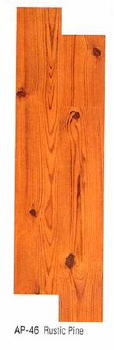
Rustic Pine Vinyl Tile

Rolling the Floor

The instructions for your vinyl flooring may require that the tiles be rolled with a heavy floor roller within so many minutes of being installed. Do not overlook this step! The rollers can be rented where you get the cutter. Clean the roller wheels well before you place it on your new tile!

Vinyl Floor Care Guidelines

The biggest enemy of any flooring is tracked in dirt and grit. Small sand and dirt particles will scratch virtually any surface, even hard ceramic tile. If you want your floors to look as good as this sample of Congoleum vinyl planking, then you need to regularly vacuum or dust mop the floor. Place door mats to catch most debris or tell family and friends to take off their shoes.

If you have an asphalt driveway, you should really get in the habit of removing your shoes. Your shoes pick up the asphalt oils, and they will eventually stain vinyl tile floors, especially light colored ones.

Believe it or not, certain vinyl floors can be sunburned. If sunlight streams in through a large glass door or window, shade the tile in the most intense part of the day. The glass can actually magnify the sun's rays.

When you purchase your vinyl flooring, see if the store also carries the recommended cleaners and polishing compounds. They may cost one or two dollars more per bottle than off brands you see at the grocery, but they are well worth it. If you use these products, save the labels from the empty bottles. In the event you have a future problem, the manufacturer of the tile will usually go the extra mile to make you happy. They recognize immediately that you DID probably follow all of their guidelines!

Column B307