Tub Valve Location

Harold Meehan lives pretty close to me over in North Bennington, Vermont.

He's got a good question about the location of his tub valve.

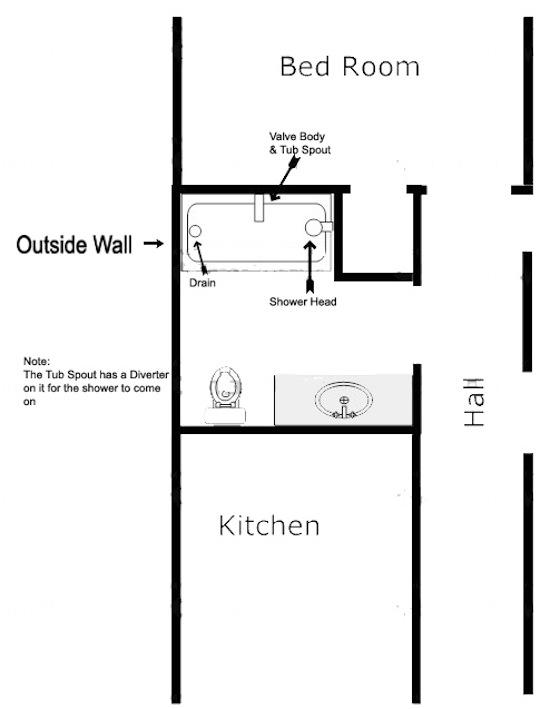
I am going to do a bathroom remodel the tub is going to be a whirlpool type tub. The drain end will be against an outside wall, the other end will be against an interior wall (a closet) that will allow me access to the pump and heater.

Bath Room
My question is:

Can I install the Valve body and Tub spout on the side wall (the 5ft side) and the shower head on the pump side of the tub?

The tub spout has a diverter on it for the shower head. I do not want to install water lines on an outside wall. Are there an restrictions on the distance the shower head can be installed?

Harold,

You're good to go. You can install the tub and shower valve on that other wall with no issues. 

It's smart to keep that valve out of an exterior wall. Remember, water lines can FREEZE on inside walls too!

Make sure there are no air leaks from the attic that can fall down any of the wall cavities where you have water lines.

Copper Sink Care

Ross Moran and his wife Kate live in Leeds, England (UK).

They purchased two copper pans they want to convert to sinks.

Ross wants to know about copper sink care and preparation.

Hi Tim,

You have a fantastic website - some really helpful information on here and people are reading all the way over here in the UK.

Quick question. We have purchased 2x antique Victorian copper jam pans from a sale here in the UK and as I browsed the web I found you already have an article that states you yourself once converted a very similar pan to a basin.
copper pans

I've read this article and it's great - we would like to do similar, set up both pans as his and her sinks on a timber unit (not the one pictured actually).

The only question I have before we do this is in regards to the inside of this pan. You may be able to see from the image that both pans are quite worn and weathered on the inside and I wonder if you would advise that we would need to clean/scrub/treat or condition this inside surface before using it as a basin sink? Mainly thinking from a sanitation perspective as the water within will obviously be used for washing hands and faces!

Look forward to hearing back with any hints, tips or recommendations and then we will be sure to send you a picture of the finished product!

Kind Regards
Ross and Kate Moran

Ross and Kate, hello from the USA!

The clue to giving you the correct answer lies in the word "sanitation". 

I would give the pans a good scrubbing to make sure there's no regular dirt or ???? in them. You don't know what was in them before you got them.

Here's the good news. Copper is a natural biocide. It does, on it's own, an amazing job of killing bacteria and germs of all sorts. This is why the hulls of some ships have copper plating to prevent barnacle growth. This is why roofs that have a copper strip at the top are free of roof algae and moss.

I would never apply any clear finish to the inside of the pans. Let them transform themselves to a natural brown or even green oxidized copper.

Your sinks will be the most germ-free ones in the UK!

Send that photo once you have them installed so I can post it here.

Santa Fe Advance 2 Dehumidifier

The Santa Fe Advance 2 is a great dehumidifier.

How do you judge such things?

Easy.

The first thing to look at is how much water will it remove from the air in a 24-hour period.

The Advance 2 by Santa Fe is rated at 90 pints of water. 

If you remember your grade school math, that's 11.25 gallons.

That's over two five-gallon buckets of water. WOW!

The second thing to realize is the Santa-Fe dehumidifier will typically cost LESS to operate.

Why?

Since it removes so much water from the air FASTER, it won't stay on as long as cheaper brands with small tiny coils that might ice up on you!

The Santa Fe Advance 2 dehumidifier also costs more than most other brands. You might recoil from that.

The reason the price is higher is simple:

  • it contains better parts
  • it has better engineering
  • it has more robust coils and compressors
  • it has commercial-grade components
  • it can last much longer than the cheaper home-center units
  • it can be adapted to connect to flexible piping so the dry air is delivered to your home through decorative wall registers

CLICK HERE to get more information about Santa Fe dehumidifiers.

CLICK HERE to watch my video review of this dehumidifier.

Voltage Tester Pen

DEAR TIM: I've always been afraid of electricity. I know I can't be alone. I'm trying to overcome this fear and wonder if you can help me. What would you do if you were me? Are there simple tools I can use to help tell me when I'm close to a wire or cable that has electricity in it? How effective are they? Are they safe and easy to use? I've seen something that looks like an oversized pen that says it can detect a live electrical circuit without touching the actual wire or cable. Would you use one of these? Carla P., Albany, NY

DEAR CARLA: Your fear of electricity is fairly common based on the number of emails I receive about it. My gut tells me the fear is based on the fact you can't see electricity in most instances and it's a known killer. Even though I don't really fear electricity in my home, I have a keen and healthy respect for it.

You may never get over your fear of it, but I congratulate you for facing the fear and giving it a try. The first step, in my opinion, is to read about electricity and have a good understanding of how it works and why it would want to pass into and through your body. You may want to look into classes offered at local vocational schools to gain some formal training as well.

Voltage testers and meters have been around for years, but most of them had two probes or tips that require you to be in contact with the electrical wire to check it's voltage. These require a certain level of skill to operate and for a person with a fear of touching a live electrical circuit, using one of these would no doubt be a deal breaker. I'm sure you'd never, at this point, put one of these tools in your hands.

Fortunately, tool manufacturers have responded to this niche and have developed non-contact proximity voltage testers. These testers are made for folks like you that just want to get a tool close to a wire to see what's going on.
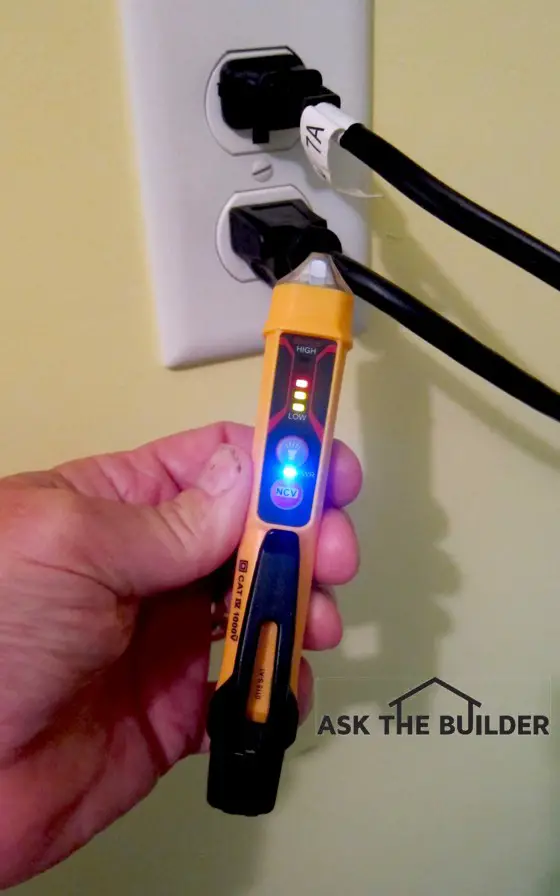
voltage tester pen

I've had the opportunity to test several of these magical and safe tools. The latest one to market intrigues me for a number of reasons. I recently had the opportunity to test the rugged NCVT-3 made by Klein Tools. The acronym, NCVT, stands for non-contact voltage tester. You'd think they made the tool for you!

This little tester is about the size of a large felt-tipped marker pen and comes with a clip to fit into a shirt pocket. It operates on two AAA batteries. A handy small LED flashlight is also built into the tool so you can operate it in a low-light environment safely.

This tool is perfect for a homeowner because it can sense voltages between 12 and 1000 in alternating current (AC). The electricity you have in your home is almost always AC, as I've never yet in my life seen a home that uses direct current (DC) to power everything. The common voltages in a residential home in the USA are 120 and 240 volts so this new tool will tell you all you need to know around your home.

The tool has five vibrant LED light bars as well as an audible tone beeper that alerts you when the tool senses the presence of electricity in the 12-1000-volt AC range. The more voltage present the more bars light up and the faster the tool beeps at you.

One of the things you'll love about this tool is how it works as you get closer to a live wire. I tested it extensively and it seems to start to sense live electricity about 2 inches away from the wire.

Here in my office, I tested the 120-volt power cord that feeds my inkjet printer. When I got within 2 inches of the cord, one of the yellow LEDs came on and the beeper slowly beeped at me. As I got the tip closer and closer to the power cord, a second LED lit up and the beeping increased. When I finally touched the tip of the tester to the safe power cord, a third red LED light came on and the beeping turned into a constant audible tone.

I went around my house and started putting the tool on the drywall near light switches that were in the on position. Sure enough the tool was able to sense voltage through the drywall. The wires must have been close to the other side of the drywall for this to happen as Klein Tools says the effective range of the tool is 2 inches.

This NCVT-3 has an automatic power off function to save the batteries in the tool. This is a very handy feature. The tool can survive a drop of up to 6.6 feet. If you plan to use it up working on a step ladder, I'd tie a string to the pocket clip and then tie the other end to a belt loop. Accidents can happen and there's no need for the tool to fall to the ground if you just use some common sense.

Dust and water will not harm the tool. I can tell you this is a tool that can last generations if you just treat it with moderate care. It's that durable.

If you decide to invest in this tool, be sure you always test it on a live circuit so you know it's working properly. I'd suggest doing what I did by testing it on a power cord that's plugged in and the appliance or electronic device is drawing a small amount of power. My inkjet printer has a tiny blue LED light that sucks power as the printer is on standby so I know that there's power flowing through the power cord from the wall outlet to the printer.

CLICK HERE to purchase this great tool NOW.

You can test it on a toaster power cord as you're browning up your bread for breakfast. When you turn the toaster on and see the orange glow of the heating elements, turn on your NCVT-3 and start to get it close to the power cord. I'll bet you have a grin on your face in about two seconds as you safely see the presence of the electric in the power cord! Have fun and be safe!

CLICK HERE to watch my video tool review of this voltage pen tester.

Column 1094
May 31, 2015 AsktheBuilder Sunday Newsletter

I started a new feature last week and FORGOT to tell you about it! I'm blaming it on the heat and humidity down in Antigua.

Just above your name - look up above (appeared in the email newsletter only, not online) - you should see the name of my website displayed as a hyperlink. I see it in blue.

From now on, that's going to be a MYSTERY link to an older column at my website that's pure gold. Today's link is AsktheBuilder.com.

The photo in this issue's mystery column was taken in the family room in the Queen Anne Victorian house I built for Kathy and the family back in Cincinnati. Oh how I miss what you'll see in that photo!!!

If you like what you see in that photo, there should be LINKS on that page that take you to companies that sell what you'll see. If you have an interest in that product, then by all means CLICK the ads. That's why the ads are there!

Roof Progress

I've now got five days in on the roof. It's slow going because I've got a great friend who's been able to help me for a total of eight hours.

Then my son had a past knee injury slow him as my ground support. In other words, lots of the work has been happening solo.

Here's my initial report. The DaVinci Roofscapes Single-Width Slate is a DREAM product to work with.

I love it. It's the most distinctive roof I've ever installed on any of my homes or on any of my jobs in my life. Believe me, that says it all.

I'm starting to tape the videos I promised in the DVD series next week as I start to work on one of the ten valleys in the job.

Wait until you see the one FREE video I'll be taping early next week about plumbing vent pipe flashings. You probably have one of those POC aluminum flashings with the thin rubber boot that cracks and goes bad in about ten years.

When you see the flashing I'm installing and the condition of my existing POC one, you'll FOR SURE INSIST that your roofer use the flashing I'm putting on. Wait for the video!

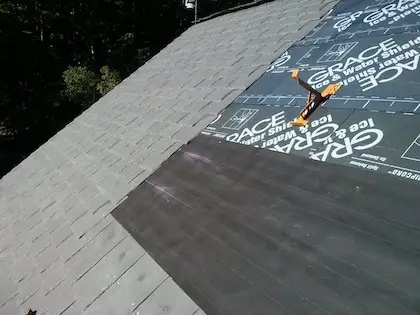
Here's a quick photo of the roof in progress. I'll share a closeup photo of the actual synthetic slate next issue so you can see how rich the product is.

In the meantime, CLICK the photo just below to see some closeup photos taken by pros. Surf the DaVinci website to see all they have.

roof davinci shingles

Upcoming Videos

Here's a list of videos I'm getting ready to tape this week for you:

Santa Fe DELUXE Dehumidifier - Do NOT buy a dehumidifier until you see this video!

WiFi Garage Door Opener - Very, very cool product

Paslode Compact Nail Gun

Hot Dipped Galvanized Nails - Fun Fact video

Wheelbarrow chairs - Silly video

.
CLICK HERE for Amazing Algae Remover PHOTOS
.


Old Great Columns for You!

CLICK HERE for Secret Formula to determine cost of your new home!

CLICK HERE for my Top 25 Tips on how to pick the PERFECT LOT.

PREVENT Foundation CRACKS in Drought Video!!!

I need to go get ready to work the train today. I'm a fireman and it's going to be a WET ONE.

It's raining now and rain is forecast all day.

Tim Carter
Founder - www.AsktheBuilder.com

Do It Right, Not Over!

May 27, 2015 AsktheBuilder Newsletter

I'm back from Antigua. I was there as an expert witness in a high-profile case concerning construction defects at the home of the Brazilian Ambassador.

Here are my observations about Antigua after visiting it twice - I was there three years ago for the initial inspection of the property to see all the defects:

  • It's a third-world country
  • It's dangerous
  • Daily power outages can be counted on
  • If you have water coming to your home from the municipal system, you don't dare put it inside your body unless you like to drink orange water
  • It's BLAZING HOT in the daytime sun
  • Piracy is still thriving in the Caribbean

So ask me if I had a good time?

The bottom line is I never made it into the courtroom.

I was working for the owner of the home of the Brazilian Ambassador. They held back the last payment of the home because of serious defects. The builder was suing the owner for non-payment.

The builder's attorney filed a bunch of motions the first day of the trial to get three of the four top witnesses for the homeowner thrown out. I was one of the three.

The judge kicked two of them out and limited my testimony to only one SMALL aspect of the defects.

The reason was, "Mr. Carter can't show he has any formal training on roof construction so he's not an expert."

ARE YOU KIDDING ME?

My CV clearly listed me as a Master Roof Cutter, Master Builder and Roofer. I've built more roofs than the judge has probably read law books cover to cover.

The home owners fired their attorney and the next morning hired an aggressive one that immediately filed an appeal.

We shall see what happens.

On a positive note, I did make three new friends, Keri, her able fisherman husband Tyler, and Vivyan from Toronto.

.
CLICK HERE NOW for Certified Organic Stain Solver! It cleans anything water washable and Kathy and I own Stain Solver. You can TRUST US and Stain Solver!
.


My Roof Job

I started the massive re-roof job on my house yesterday.

I'm DONE with asphalt shingles.

I've got IKO shingles on my home that were supposed to last 40 years. They FAILED after 12 years.

CLICK HERE to see an UNBELIEVABLE PHOTO of what 40-year shingles can look like after just 12 years.

I'm putting on DaVinci Roofscapes Single-Width Synthetic Slate Roof Tiles on my house so I NEVER HAVE TO WORRY again about my roof.

The photo below is looking up at the roof from my front porch. It's going to be a fun job!

roof

New Q & As for You

Here are some new columns and questions and answers.

Are you THINKING of SUING a builder or remodeler?

Better read this NEW COLUMN of mine:

Construction Defect Litigation

CD Backsplash

Foundation Corner Crack Repair - MUST SEE THIS PHOTO!!

Trash Chute Noise

Oil on Driveway

That's enough.

I need to get up on the roof.

Tim Carter
Founder - www.AsktheBuilder.com

Do It Right, Not Over!

Construction Defect Litigation

DEAR TIM: My new house is full of defects. The builder will not fix them. Fortunately, I was able to hold back lots of money and now he's suing me. I've never had to hire an attorney nor have I ever been involved in any litigation, much less one about construction defects. The defects are obvious and some are very serious. This seems like a no brainer and I'll win hands down. What advice can you offer and have you ever been involved in any construction defect lawsuits in any capacity? Jennifer S., Birmingham, AL

DEAR JENNIFER: I'm very sorry to hear about your dilemma. The sad thing is that houses with construction defects seem to be far more plentiful than those without them. High quality workmanship in the marketplace seems to be more of a recommendation than a common practice.

I'm very proud to say that in all my years of business as a custom home builder and a remodeler, I was never sued by a homeowner. I strived to always deliver the best quality that I could on every job.

My only brush up with the law was with a customer from Hades late in my building career. The American Institute of Architects contract I signed with her stipulated binding arbitration and she requested it because she felt the stain color on the solid poplar woodwork and doors on her job were not the exact perfect shade to match the existing woodwork in her home. She was either color-blind, wicked or both. Early in the job she and I crossed swords, and I'm convinced she decided to make my life miserable. Believe me, she did.

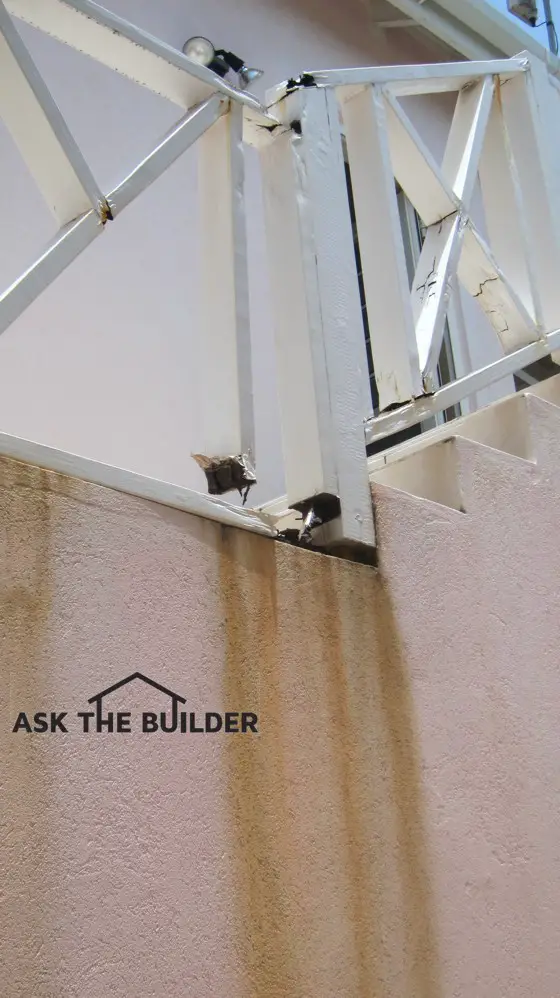
This wood railing rotted out in less than eight years. It’s just one of many construction defects in this new home. Photo credit: Tim Carter

This wood railing rotted out in less than eight years. It’s just one of many construction defects in this new home. Photo credit: Tim Carter

Once I started writing my syndicated newspaper column and publishing columns and videos at my AsktheBuilder.com website, I started to get contacted by attorneys to perform expert witness work in construction defect cases. I still do that type of work and just recently arrived home from a court date in Antigua involving a lawsuit about defects in the home of the Brazilian Ambassador.

I'd say I've got lots of experience with respect to how the legal system works and what you're facing. If I had to tell you in fifty words what's in your future I'd say: The only winners will be the attorneys and no matter how strong your facts and case may be, there's no guarantee you'll win. I realize that's not encouraging.

The legal process involving construction defects is different in each state of the USA. The attorneys in each state have to follow a set of rules about how lawsuits are processed and litigated. There's usually a very distinct timeline and pathway with deadlines that must be followed and met. It's imperative that you discover through work on your own exactly what the steps are, what the timeline is and what can happen if your attorney misses a deadline or fails to get permission from the court if it's required when a deadline is missed.

The raw emotion that's driving you right now because you feel assaulted having to pay hard-earned after-tax money for shoddy workmanship can cloud your decision-making process. What's more almost every homeowner I ever represented as an expert witness placed all their trust and hope in their attorney.

Guess what? If you think there are bad contractors out there, wait until you hire an attorney. In every profession there are players that have poor skills, lack of attention to detail, and a poor understanding of the science and facts about your case. It's your job to hire the best attorney that can prove to you she or he has a proven track record of winning construction defect lawsuits. The last thing you want to be is a lab rat for some attorney that's never really worked a case similar to yours.

In my experience, lawsuits like this are won and lost on the expert witnesses. The judge and juries use the reports and testimony of these people to try to determine who's at fault in a lawsuit. What's more, only a small percentage of lawsuits actually make it to a bench trial. The expert witness reports and findings are like playing cards in an expensive game of poker.

If you hire a fantastic expert witness that produces an iron-clad report listing all of the defects in your job connecting them back to building code violations and/or failures to install products as stipulated by the written instructions from manufacturers, you're usually holding a royal flush in your hand. That's a hard hand to beat. You do not want a report that is a summary of subjective findings about the quality of workmanship. That's useless information that will not help you win.

Once each side files all the expert witness reports, then it's time to bargain. Your attorney and the builder's attorney start to haggle just as you might at a yard sale over that marble paperweight with a picture of the Old Man of the Mountains NH state symbol on it. Your attorney must have the attitude of a bear that just woke up from five months of hibernation. Her or his motto should be: Take No Prisoners.

Here's the most important question you need to ask the attorney you're thinking of hiring: "If we lose the lawsuit, what does the builder get?" The answer, in most states, is a judgement. The builder will then have to do even more expensive legal maneuvering to eventually get you to pay.

The same is true, in most states, if you're trying to sue anyone for money. Don't think for a minute that when the judge's gavel hits the wood block that the person holding the money in a case is immediately forced to write the winner a check. Always ask the attorney you're hiring in the first ten minutes of the meeting how you know the money you're after exists. Why go through months of litigation to only discover after you win there's no pot of gold at the end of the rainbow.

Column 1093

CD Backsplash

Julie might have used a valuable Beatles or Rolling Stones CD or two or three to make a backsplash in her home in Essex, UK.

Here's what she want to know:

"I have made a kitchen backsplash out of old CDs.

How can I remove the tile grout without scratching the CDs?

Are cup brushes any good?"

Here's my answer.

Julie, I'm assuming you're talking about the actual CD and not the plastic case. In either case, this advice should work.

I'd get a one-liter can of water-based CLEAR urethane and coat the CDs with three coats before you grout them. The urethane will protect the soft plastic.

You know urethane is durable because you can walk on it.

If the grouting process creates minor scratches, a final coat of urethane will make them disappear.

I would never use a cup brush for this project. It's too aggressive.