Build A Porch Video Part 3 of 6

Hi, I'm Tim Carter and this is the third installment of the Build a Porch Video series. I want to show you this ingenious way we are going to support the porch. Previously the band boards were nailed directly to the house. We want to get them away from the house about 3-inches. This will allow us to extend the siding down over the foundation, and provide us with a nice air-space between the edge of the porch and the siding.

So far, we have installed three(4" x 6" x 5/16") steel supports that will be bolted with wedge anchors into the foundation. Also to help hold them in place, we are going to use a two-part epoxy that needs to be mixed. The ends of the anchor bolts will be coated with the epoxy as they are driven into the foundation.

To install the wedge anchors, you drill a half-inch hole in the foundation. Place the washer and the nut on the anchor, apply the epoxy and then using a hammer drive the anchor into the hole. Then as the nut is tightened, the end of the wedge anchor starts to expand holding the anchor tight.

As a secondary defense due to the weight of the deck and a limited number of supports, a treated-lumber block will be placed on the ground under the support and a 4"x4" treated-lumber block will be placed between the angle iron support and the block on the ground. This support will help keep the angle iron from trying to tip downwards under the weight of the porch.

This will all come together in the next few videos. Click here for the other three videos.

Build A Porch Video Part 2 of 6

Hi, I'm Tim Carter and this is the second part of the porch reconstruction videos. All the decking has been removed and it revealed some more issues.

The first issue deals with the original builder placing the Trex decking right up against the house and then installed the siding right down on top of the decking. This caused the fiber-cement siding to rot. Because the house is located in a cold climate, water was being soaked up into the underside of the fiber-cement siding and freezing, expanding and falling apart. It got so bad that the siding is just flaking apart.

Here's a big problem. The builder an carpenters thought they were going to do a good job by putting on the flashing on top of the band board. The band board is nailed directly to the sill plate, that is on top of the foundation. Since they didn't want to get water behind the band board, they installed a piece of aluminum for the flashing. But they goofed-up.

The flashing is a piece of tin with a 90-degree up bend on one side and a 90-degree down bend on the opposite side. The down bend should have a slight outward curve to it. The tin-flashing should have been placed on top of the band board. The upturned part of the flashing would go well up behind the siding. Maybe 3" or 4".

When the porch was build, they ended the flashing even with the edge of the band board. There was no down-turned part. The correct flashing should go over the edge of the band board and end with a little kick-out bend. This kick-out allows the water to form into a drop and drip down away from the band board. Without the kick-out, when the water forms the droplet, it runs back underneath the siding due to capillary action. Bad idea!

Finally where they lapped the pieces of aluminum, they just did a lap joint. There is no sealant or caulk. (I don't like caulk. I prefer tin flashing so all the seems can be soldered.)

One more problem is the floor joists are just toenailed into the band board. They should have used structural joint hangers. That was a big mistake.

To correct this problem, we will completely disconnect the framing from the house. We will make the siding go down over the foundation. The deck will be supported off the foundation using structural steel angle iron that will be bolted to the foundation. That is coming up in the next video.

Build A Porch Video Series

Build A Porch Video Series

The videos 1 through 3 of this six-part series are shown below. Videos 4 through 6 will be available for sale after the first of the year. Check back then for the link.

Part 1 of this series shows the various problems with the porch that are visible before tearing the porch completely apart.

To view a transcription of this video, CLICK HERE.
The second video has the porch or deck flooring completely removed. Problems are discovered with an improperly shaped flashing.

To view a transcription of this video, CLICK HERE.
In the third video, Tim installs angle iron supports attached to the foundation to hold up the porch.

To view a transcription of this video, CLICK HERE.
 

Build A Porch Video Part 1 of 6

Hi, I'm Tim Carter and I'm here at a house that has a big problem with the front porch. This porch could be the same as your deck. Check some of the problems on this porch. But first, I am going to tape a series of videos on rebuilding this porch to eliminate water problems.

The first problem is a base board that was not painted when the house was recently painted. The reason is this board is falling apart. It's fiber cement siding and the reason is fell apart is because the siding was installed too close and right on top of the deck.

Secondly, we discovered as the porch was taken apart that there are flashing problems. The porch/deck was not flashed properly.

One of the biggest problems was when the porch was built, the boards were placed too close together. The previous owner of the home actually took a drill and a circular saw to try and create holes and grooves in-between the boards so water could drain.

One last problem at the front door is a lack of flashing. No flashing is visible. In a future video, I will show you how to fix that, as well as the other problems. Be sure to watch the entire video series to see how the porch is rebuilt to eliminate all the water issues.

Milwaukee Fluorescent Light Bulb Tester Video

Hi, I'm Tim Carter and I have a game changing tool I want to show you. This device is a fluorescent light bulb tester. It can test to see if the bulb is out, the ballast is bad and tests the filaments in the fluorescent bulb.

In normal garages, you can just extend the testing antenna. If your garage ceiling is 8-feet high, you can test the bulbs while standing on the ground. In my case, the ceiling is 11-feet high so I need a short ladder.

The first step in the testing is to turn off the light fixtures. To test the bulbs, turn the dial to Lamp. Now extend the antenna and place the cradle on the end of the antenna on the fluorescent tube. Then press the Test button. If the bulb flickers, it is good. If there is no flickering, the bulb is bad. This way you know exactly which bulb to replace.

If both bulbs tested okay, the problem might be in the ballast. Change the dial to Ballast to start the test. Note that this only works on T8 Electronic Ballasts.

You can also check tubes even when they are not installed in a fixture. Just check the bulb without installing it. If it flickers, it is good.

To check the filament, just insert the pins on the bulb in the socket located on the bottom of the tester. Turn the dial to Pin and press the Test button. If the test beeps, the filament is good. Be sure to test each end of the fluorescent tube.

This test will be a huge time saver for locations with hundreds of fluorescent bulbs.

The above is an affiliate link. I get a tiny commission if you purchase this item from Amazon.

December 6, 2011 AsktheBuilder Newsletter And Tips

What's in This Newsletter?

Latest News
Tool & Product Reviews
New Feature - Your Project!
Cheryl & the South Africa Hardware Store
Tub or Tile First?
Wet-Dry Vac Guide
Winter Fireplace & CO Danger
Touch Not This Wall
Facebook News

Yesterday I was up on my land in New Hampshire burning some brush piles before the rain and snow hit.Once the fires were started, I was doing some clean up. There are any number of traditional stacked rock walls on the land, and some of the rocks have tumbled to the ground.

I was trying to lift a few and pulled a muscle in my back. That's when the light bulb went off in my head about Wally.

I came across Wally Wallington about four or five years ago. I can't remember how I found him, but by gosh if you've not seen him, you NEED to.

Faced with a situation on a construction site where he was working, Wally figured out on his own a method that early people could have used to build The Great Pyramids and Stonehenge.  He calls it The Forgotten Technology.

The best part is he's actually created full-size stones and moved them by himself to prove this.

Wally has a DVD that shows you exactly how to move 10 ton blocks of stone sideways or up as high as you want - totally by yourself.

You're insane if you don't order this. It makes the perfect stocking stuffer for this Christmas.

If you mention my name when you order, he'll give you a $2 discount.

Be sure to go to the bottom to see the latest book I read.


Tool and Product Reviews and Ads

I try to feature new tools and products as often as possible in this newsletter.

A month ago, I was talking with Dan, a close friend of mine,  and he told me that I keep forgetting to mention to you that I don't feature things that FAIL my testing.

DUH! My policy had been to not say a word because I didn't want to harm the company. I also may expose myself to some liability. A company may say my testing was flawed and that I caused them millions of dollars of lost sales.

Suffice it to say that when I mention something in this newsletter, it's a product I would use in or on my home.

New Feature - Your Project!

I'm starting a new feature in the newsletter. I want to feature your home improvement victories!

While it can be anything, it would be great if you have done a project using some of my advice. For example, I regularly get photos and emails from people who have grouted a tile floor using my four-part series.

All you have to do is send photos to me, a description of the project, what you discovered, etc. and a note saying I have permission to post the content on my website and in the newsletter.

If you have a video and have uploaded it to YouTube or some other sharing website, I'll use the embed code as well. Send me the link to the video.

Let's see your sweet skills and magic! Send me stuff! Show off your work!


Cheryl and the South Africa Hardware Store

Cheryl wrote to me after I published the tip about using emery boards to sand with.

"I thought I would share a lighter moment of sanding with you. I have a little sanding machine made by Black and Decker called a "Mouse". I'm not sure if you get them in the States.

In South Africa, it's fairly unusual to have women doing woodwork. I went down to our little local hardware store where I was approached by one of the sales assistants with the usual condescending attitude. I asked him to point me to the sandpaper as I needed sand paper for the mouse.

With absolute pity in his voice, he replied that I should rather try the pet shop next door. No amount of explaining could convince him that I was sane."

Cheryl, let's hope the sexist store clerk also subscribes to this newsletter and the next time you see him, he has well-deserved egg all over his face!


Tub or Tile First?

Gordon Berry wrote to me:

"I really appreciate all the information your newsletters. I'm replacing a bath tub and tiling the bathroom floor. Is it better to tile the whole floor and then install the tub on the tile, or is it better to install the tub on the floor then tile up to the tub?"

Gordon, I absolutely put the tub in first if it's one that just has the front apron. If it's a decorative tub like a claws foot or soaking tub that is finished on all sides, then I do put the tile floor in first.

You install heavy tubs with an apron first because there's too great a danger you'll damage the tile moving the tub into place.

In the past, I've done some crazy things to minimize the chance of wood rot when I place a tub on a wood sub-flooring system.

I like to apply two coats of urethane to the wood floor system before the tub install. I then lay down 30-pound felt paper on the floor under the tub and under the tile underlayment. I lap the felt paper up on the walls about an inch and a half.

The tile needs to be installed after the drywall is complete and you've possibly even painted. I do install the tile under the toilet and absolutely under vanity or other cabinets in the room.


Wet-Dry Vac Guide - Unique Uses

Oh my, you know the saying, "Be careful what you wish for."

You may have been one of the well over 100 subscribers that sent an email to me about a cool way you use your wet-dry vacuum.

Well, the guide is almost finished. Each day several new uses dribble in. I'm going to have it all ready for you next Tuesday.

Wait till you see how Anne plans to use hers in a few years. Oh my!


Winter Fireplace and CO Danger

Bill Hannigan  of North Ft. Myers, FL wrote to me after the last newsletter:

"Your recent newsletter reminded me of an incident a friend experienced some time ago that could have led to loss of life and home.

He had mounted a pretty powerful whole house ceiling fan in his upstairs ceiling. The on/off switch was installed on the wall by the stairs. That winter he was coming down the stairs and, without thinking, switched the fan on to check to see if it was working OK.

This pulled embers from the downstairs fireplace onto the living room carpet and smoked up the house. Fortunately the screams from downstairs told him that he had done something wrong, and they were able to save the house but not the carpet. Luckily there were no injuries."

Bill, guess what? I did the same thing about 30 years ago at my sister's house at a family gathering. What a young idiot I was.

This is why I tell people to put whole house fans on a separate circuit and to TURN OFF that breaker once the heating season arrives and fireplaces, furnaces and water heaters are in use.

Whole house fans can be a serious carbon monoxide hazard as these powerful fans will suck massive amounts of air down exhaust vents for boilers, furnaces and water heaters in order to satisfy their voracious appetite for air.


Touch Not This Wall

Touch Not This WallAbout a week ago, I finished reading a very powerful book called Touch Not This Wall by Harley Melton.

Harley is a Vietnam veteran that used his combat experiences overseas to help guide the storyline. It's a book centered around the very special friendships warriors forge when faced with death or severe injury as each hour ticks by.

But the book also dives deeply into what happened with virtually every Vietnam veteran when he/she came back to the World. You start to understand how it can take decades to readjust to a place that had changed oh so dramatically in just a few short years.

I couldn't put this book down. On more than one occasion I was crying. It held a special meaning for me as I found it to be a touchstone about my dad's WW II experiences.

You see, I had to send my dad back to Heaven when I was just 24.  I never got the chance to talk to him about his war experiences, so Harley helped me part way across that bridge.

I urge you to order this book if you're a war veteran, know one, are married to one or are the son or daughter of one. It will absolutely help you grasp a better understanding of what war does to the minds and bodies of young men and women.

You can only get the book by mailing cash or a check to Harley.

Send $13 - cash is better - to:

Harley Melton
5480 Laurie Lane
Memphis, TN  38120

For gosh sakes, be sure to include your name and address so Harley knows where to send your book.


Facebook News!

AsktheBuilder on FacebookDo you use Facebook? I've got a Facebook Fan Page that really sees some action during the week.

We have lots of fun there each week. Go look for yourself..

Please go there now and LIKE me so you can start to get FREE tips from me when you login to your Facebook page.
How To Do Insulation For Basement

DEAR TIM: I'm going to be remodeling my basement and want it to be toasty warm. How would you do insulation for a basement remodel like this? Would you use basement foam insulation or just the old standby fiberglass?

What's the worst thing that can happen if you do the job wrong, and how do you avoid problems down the road? Is the insulation for basement wall in new construction any different than a remodel job? Kimberly C., East Hanover, NJ

DEAR KIMBERLY: Your questions are ones that could generate probably four or five correct answers. Any number of insulation experts would probably tell you their method is the best. The good news is that I know of at least two methods that work well.

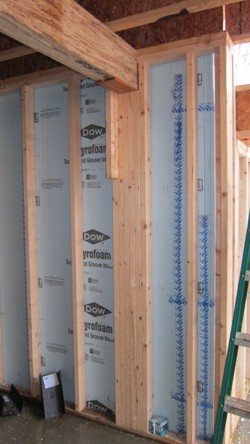
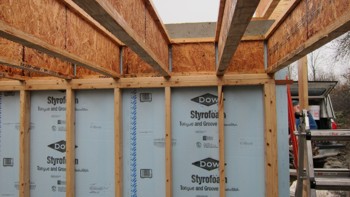
The rigid foam insulation is placed between the stud wall and the foundation wall. The butt seams of the insulation must be taped. Photo Credit: Tim Carter

The rigid foam insulation is placed between the stud wall and the foundation wall. The butt seams of the insulation must be taped. Photo Credit: Tim Carter

I find it interesting that you have thought ahead as to what is an unintended consequence of doing the job incorrectly. This is absolutely a concern because once you finish the walls, you hide the work and can't see problems until they get so bad they work their way through the walls.

I feel the biggest problem you can face in a basement remodel in a climate where the basement walls can be cool or cold is mold or mildew. Most basements, especially ones in houses built before the 1960's, have an issue with high or excessive water vapor. Water leakage into finished basements is also a huge issue. More on that in a moment.

This water vapor comes from two primary sources, water that's working its way through the foundation walls or the concrete floor. Prior to the 1960's, it was not a common practice to install a vapor barrier under the concrete floor, and not all houses had the minimum damp-proofing sprayed on the outside of the foundation walls before they were backfilled. Water vapor readily works its way through solid concrete.

The water vapor that concentrates and builds up inside a basement will readily condense on cool or cold masonry foundation walls. It may never get so bad that you see the beads of water. In most instances, it's just an invisible fog on the walls much like the mirrors in a bathroom fog up after you shower. You see the fog on a mirror because it obscures reflections. A water vapor fog on a concrete wall is absolutely invisible.

This water on the walls is the needed fuel for mold and mildew growth. When you insulate a basement in order to finish it, you need to account for this water issue.

There are two ways to insulate a basement that do a superb job. The first one works well if you're on a tight budget. The key is to create an air space between the foundation wall and the backside of the stud wall that you'll construct for your wiring and fiberglass insulation.

The air space can be as little as one-half inch and still be effective. This air space allows for minimum air circulation should water vapor get to the cold wall. You just make sure the fiberglass batts in the wall don't contact the foundation wall.

The rigid foam insulation is placed between the stud wall and the foundation wall. Photo Credit: Tim Carter

The rigid foam insulation is placed between the stud wall and the foundation wall. Photo Credit: Tim Carter

What's more, it's mandatory that you install a vapor barrier on the warm side of the stud walls before they're covered with drywall or paneling. This vapor barrier can't guarantee that water vapor will not find it's way to the foundation walls, but it surely helps funnel the water vapor to rise higher into your home eventually exhausting through great roof ventilation.

Perhaps the most effective way to install basement insulation is to use both rigid foam insulation in conjunction with stud walls that also contain fiberglass batts.

The rigid closed-cell foam is installed in large sheets, usually no less than one and one-half-inches thick, over the entire surface of the foundation wall. You want the foam to cover the foundation wall from the top of the floor slab all the way to the very top of the foundation wall.

The closed cell foam insulation is an exceptional vapor barrier, and when the seams at all butt joints and the corners are taped, it will be very hard for water vapor to get to the cold walls. The stud walls are built tightly against the foam pressing it to the foundation. Fill the stud cavities with un-faced fiberglass batts for a toasty warm basement.

The foam insulation method works best if the foundation walls are smooth. If the basement is an old stone foundation, spray foam insulation companies can spray expanding foam directly on the rough masonry. It'll be expensive, but it can be done and it will do a fantastic job.

If there are any issues whatsoever with leakage into the basement, this MUST be solved before you begin to remodel. The best method I have seen over the years is to control this water on the outside of the foundation before it comes into the house.

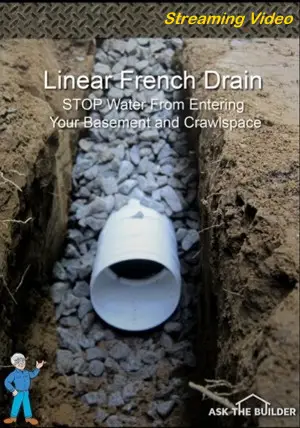
You can capture and divert subsurface water in a yard by using a linear french drain. I explain these in great detail at my AsktheBuilder.com website. Just type Linear French Drain in the search engine once there.

Click HERE to see a much larger graphic and a complete description of Linear French Drains in just one of my columns dealing with French Drains.

Column 912

December 4, 2011 AsktheBuilder Newsletter And Tips

What's in This Newsletter?

Latest News
Checklist Sale Ends Soon
My Christmas Gift Guide
Meghan's Gift Guide
Facebook News

Three VERY Quick things. A regular newsletter is queued up for Tuesday if you just happened to subscribe. I rarely send something out on a Sunday.The Tuesday newsletter is packed with great stuff.

Cheryl's visit to the South Africa hardware store, the Wet-Dry Vac FREE Use Tips Gude, Moving HEAVY things, etc.


Checklist Sale ENDS in 12 Hours

The insane flash sale is almost over. It ends at midnight tonight Eastern Time (December 4, 2011).

As you can tell, I'm still alive. My buddy Chuck threatened to email Kathy telling her what I did. But I told him I would gather all the local wizards here in central New Hampshire and cast a hex on him. He knew I was serious.

Bottom Line: Save over $400 now. If you were to buy all my 31 checklists one at a time as you need them, you'd spend over $500.

You can have ALL of them NOW for $79. When you go to the cart, it will say "Five Category Checklist Bundle". Believe me, that's the product. You get ALL of the checklists when you buy this item.

If you're an old-time subscriber, you know that sales like this happen about as often as a blue moon.

Just go buy them now and you'll be set for ALL of the projects around your home.


My Christmas Gift Guide

My Christmas Gift GuideI can really use your help, seriously.

My Christmas Gift Guide has now been out a little over three weeks. It's filled with great ideas in case you need tools for that special someone.

Your support by using the Gift Guide to shop at Amazon.com allows me to continue to offer the thousands of columns and hundreds of videos at AsktheBuilder.com and this newsletter at no cost.

I'm trying my best to expand AsktheBuilder.com in an effort to give you more of what you want and need. Using my Gift Guide allows me to do just that.


Meghan's Gift Guide

Meghan's Gift GuideAre you in need of gift ideas that are not tool related? If so, I believe you'll love my daughter Meghan's gift guide.

It's got 300 suggestions that will fit everyone's budget. This guide has gifts for people of all ages.

It's going to WOW you when you visit it. There's no need to download it, as you can just view it at her website as if you were flipping through a catalog. Once you're there, just click the "Expand" button to make it work.

Click here to get access to this FREE Holiday Gift Guide.


Facebook News!

AsktheBuilder on FacebookDo you use Facebook? I've got a Facebook Fan Page that really sees some action during the week.

We have lots of fun there each week. Go look for yourself..

Please go there now and LIKE me so you can start to get FREE tips from me when you login to your Facebook page.
Chip Seal Video

Chip Seal Video Transcript

Oh, you know the two most common driveway materials here in the tri-state area are blacktop and even concrete. You see them all the time but to me, they're kind of plain vanilla.

If you want a driveway that is drop-dead gorgeous, durable and built the way roadways we're done 70 years ago, you want a driveway like mine. A tar and chip driveway.

The way you install a tar and chip driveway is really simple. You just need to bring liquid asphalt cement to the job site. It's pretty hot. It's about 350 degrees so you have to be careful. You can get burned by it and they spray it onto your driveway and it's about 3/8 to a quarter of an inch thick. And into that hot tar, they dump gravel chips. It can be brown gravel that's beautiful. You can also get gray gravel and if you come up with any different color that you can think of they'll put it into the tar.

The tar really doesn't care what goes into it. It's very important that they put just enough tar down. If you put too much the tar can actually ooze through the surface and cause a problem on hot summer days. But I've never seen it happen with the different companies that I use to install my tar and chip surfaces.

You probably want to know what the tar and chip surface looks like up close and personal. That's a good point. I have a light loose coating of these brown stones on my drive. But look here. This is exactly what it looks like if I brush them away. These brown stones are firmly locked into the tar and it basically looks not much different than a standard blacktop roadway or driveway.

And it provides excellent traction in the wintertime and if you do want to plow the tar and chip driveway, it’s not a problem. Just tell your snowplow operator to hold that blade up about one-inch and he won't push any of the stones off of your driveway.

If you want a tar and chip driveway go ahead and open up your yellow pages (this video was recorded before the Internet search engines were popular), start calling around the different blacktop contractors. if you're really lucky you just might find one that still knows how to do a tar and chip surface. I'm Tim Carter, Ask the Builder. If you want to discover more home improvement tips, go to AsktheBuilder.com

Related Links

Tar and Chip Drives Support Giant Truck!

Step-by-Step Tar and Chip Installation Method

CLICK HERE to get FREE QUOTES from local companies that can do chip seal and tar and chip.

December 1, 2011 AsktheBuilder Newsletter And Tips

What's in This Newsletter?

Latest News
Wet-Dry Vac Top Tips
Insane Checklist Sale
My Christmas Gift Guide
Facebook News

I've got just TWO quick things for you - well actually three.A monster REGULAR newsletter comes out next Tuesday.

I'm going to share with you a fantastic book I just read about the Vietnam War. It was sent to me by a Veteran. It was POWERFUL.

And wait till you read about Cheryl's trip to the hardware store in South Africa!


Wet-Dry Vac Top Tips

Who would have ever thought that's Bob's email to me about how he used his wet-dry vac to unclog a tub drain would snowball!

I continue to get other great tips sent to me.

A light bulb went off.

How about YOU and I create the world's largest collection of CRAZY UNIQUE things you can do with a wet - dry vac? You send in a great tip and your name will appear right there with the tip. You'll be famous!

This is going to be a FREE guide I give away to anyone who comes to the AsktheBuilder.com website.

Maybe it's a tip where you use one in reverse - the blower aspect.

Whatever your unique and most helpful uses are, SEND them to me now. Please change the Subject Line to VAC.

Please put in your name, city, state, country, whatever so I can CREDIT you. If you want to be anonymous, just say so.

If this turns out well, we'll do it with countless other topics. What do you think?


INSANE Checklist Sale Ends in 72 +/- Hours

Want ALL 31 of my checklists that usually sell for $17 EACH for just $79?

You now have only about three days left (sale ends December 4, 2011 at Midnight ET) to take advantage of this. Do the math.

$17 X 31 = $527. You SAVE well over $400.

Kathy has been distracted and luckily no one has forwarded her a copy of the last newsletter. You better hurry before she finds out.


My Christmas Gift GuideMy Christmas Gift Guide

Have you downloaded and looked through my Christmas Gift Guide? You should!

Just go here and CLICK the giant cover of the gift guide.


Facebook News!

AsktheBuilder on FacebookDo you use Facebook? I've got a Facebook Fan Page that really sees some action during the week.

We have lots of fun there each week. Go look for yourself..

Please go there now and LIKE me so you can start to get FREE tips from me when you login to your Facebook page.