How To Install Ceramic Tile

DEAR TIM: I've decided to install new ceramic tile in my bathroom. I'll be doing the floors and the walls. Should I do the floors first and then the walls? What tools do I need? How do you start a wall tile job? Do you have any nifty design suggestions? Jaclyn E., Sherman Oaks, CA

DEAR JACLYN: You've selected one of my favorite jobs - ceramic tile.

Fun & A Challenge

I find it to be fun and challenging. It requires preplanning, patience, and plenty of time.

The layout, cutting, and fitting of tiles will make or break the appearance of your tile installation. If you assemble the necessary and affordable tools, you can complete this job to your satisfaction and the amazement of your friends and neighbors.

Full Tile Tool List

Here's a list of tools that I've used for years to successfully install thousands of square feet of ceramic tile.

  • tape measure
  • pencil
  • tile cutter
  • nippers
  • 1/4 by 1/4 inch v-notched trowel
  • a hammer
  • some 6d finish nails
  • 8 lineal feet of straight 1/4 inch wood lattice strip
  • putty knife
  • 3-inch wide-bladed scraper
  • grout sponge
  • rubber grout float
  • several buckets
  • accurate 4 foot level

Click the image below to BUY all, or some, of the tools in the above list.

Ceramic Tool List

CLICK THIS IMAGE NOW TO ORDER ALL THE TOOLS YOU NEED TO DO CERAMIC TILE.

Plumb & Level

Your tile installation is going to look superb if the carpenters who framed the walls and floors installed them plumb and level. High-quality ceramic tile is often manufactured to extremely tight tolerances.

Each piece of wall tile is basically an exact copy of the one before. If a wall or corner is out of plumb then each row of tile will get smaller or larger than the one below. If you have the ability to correct framing defects, do so before you add the waterproof backerboard.

CLICK HERE to get FREE & FAST BIDS from local ceramic tile contractors.

Walls First

I like to install most of my wall tile first. Installing floor tile early in the job makes it susceptible to scratches, chips or other damage as you work on the wall tile above.

Accidents happen and you don't want to do superb work only to have it damaged by working on top of it.

Sanitary Base

You begin the wall tile installation by selecting your base tile. Many wall tiles come with an accessory piece called sanitary base.

The bottom of this tile resembles - to a degree - wood toe strip that you might see on wood baseboards.

Some base tiles are meant to sit on the floor substrate and the floor tile butt into them. Other base tile are designed to sit on top of the finished floor tile.

Calculate Heights

This extra relief built into the tile provides a great finishing touch. The height of this base tile, the thickness of the floor tile, and your first row of wall "adjustment" tile need to be calculated before you begin to install your first piece of tile.

Level Is A Must

Most floors are not level. Ceramic wall tile must be installed perfectly level.

The sanitary base tile may rest on top of the floor tile producing a professional look. If the floor is out of level then wall tile stacked directly on top of the base tile will be out of level.

Adjustment Row

You correct this problem by installing the second row of wall tile above the base tile as your first full sized row. The row of tile between the base tile and the second row is your "adjustment" row. This row is generally only two thirds the height of a standard tile. This usually gives you plenty of room to adjust as the floor rises and falls.

Lattice Ledge

When you start to do a wall, always start at the middle and work both ways. I like to nail a one-quarter-inch-thick piece of lattice molding to the wall. It creates a small ledge my first row of tile rests upon.

This simple support strip prevents the first row of tile from succumbing to the forces of gravity while the adhesive dries. After several hours you can remove this piece of wood.

CLICK HERE to get FREE & FAST BIDS from local ceramic tile contractors.

Spacing Lugs

If your tile has tiny little lugs or spacing bumps on each edge of the tile be sure you push the tiles firmly against one another. The spacing lugs are very normal for most wall tile and you rarely see them for floor tile. Small plastic crosses or plastic discs are often used to create uniform grout lines for floor tile.

Fifteen Minutes

Only spread as much adhesive as you can cover with tile in 15 minutes. Don't worry if the horizontal and vertical cracks between the tile seem a little off.

When the tile is grouted these imperfections disappear.

Once you've installed all of the wall tile above the wood strip on all walls you can then install the floor tile. I say this assuming you're going to use a sanitary base tile that rests on top of the floor tile.

Grout Walls

If there's lots of wall tile, I'd go ahead and grout it before installing the floor tile. Don't allow grout to get under the lower edge of the first row of tile. It will mess you up when you install the adjustment row.

Floor Then Back To The Walls

Once the wall tile is completed and grouted you then can move ahead with the floor tile installation.

After you have that complete and grouted, the last step is to come back and install the sanitary base tile and finally the "adjustment" row of wall tile.

Accent Tiles & Accessories

You can purchase accent tiles that are very attractive. These tiles come in different sizes or sometimes match exactly the size of the tile you are working with.

Consider using marble corner shelves in your shower for shampoo and other items. These same shelves work great near a toilet for plants or other decorative items. Use a white colored inexpensive marble that goes with just about any tile color. The marble company will cut these shelves for you with a special diamond wet saw.

Now, thanks to new materials and techniques, it's easier for anyone to get professional-looking results every time. Master tilesetter Michael Byrne's fully updated book explains everything anyone needs to know about tiling in an easy-to-read format. 

Setting Tile delivers all the basics tilesetters rely on - plus all the fresh ideas and innovative methods they need to do the job right. This book demonstrates floor, wall, countertop and bathroom tile installation techniques.

It covers the many types of tile--including natural stone, explains tools, setting materials, preparation and layout. The traditional mortar-bed method is still covered, but easy-to-use backerboard and waterproofing membranes now get special attention. Michael did a great job in this book.

Related Articles:   Ceramic Wall Tile TipsCutting Ceramic Tile

CLICK HERE to get FREE & FAST BIDS from local ceramic tile contractors.

Column 226
Wood I Joists

DEAR TIM: My wife and I are building a new home soon. Our builder wants to use modern wood I joists instead of regular solid wood floor joists. He says they are stronger than solid wood. Will these products save the builder money and leave my wife and I with a flimsy floor? Do wood I joists offer other advantages? Is it safe to drill holes in the joists? Is there any other alternative floor joist material? Tony P., Wahoo, NE

DEAR TONY: Congratulate your builder for catching the wave. Wood I joists made from engineered lumber are an excellent building material. 627 million linear feet of these key structural members were made in 1997 for the North American construction market. That number represents 33 percent of the total lineal footage of floor joists used in North America in that same time period. By the year 2005, it is expected that engineered wood I-joists will be used in over 50 percent of the residential homes built in the USA and Canada.

Engineered lumber is very environmentally friendly. The lumber used to make the wood I joists probably came from a tree that grew somewhere on the 241 million acres of forest land that is suitable for repeated planting of trees and commercially logged. Currently, 27 percent more timber is planted and grown each year than is harvested. To insure that future generations have plenty of wood for their houses, the forest products industry replants about 3 million trees a day!

Wood I joists resemble traditional steel I beams. After all, a floor joist is simply a beam. The wood I-joist consists of a top and bottom flange that can be made from structural composite lumber (glued lumber veneer) or regular sawn lumber. These flanges are grooved to accept a 3/8 inch thick vertical web that is made from structural plywood or oriented strand board. All of the adhesives used to make these products are designed for exterior exposure until such time as the house can be protected from the weather. It is important that your builder keeps the wood I joists as dry as possible.

If your architect and builder work together you can minimize and sometimes eliminate bearing walls, beams, and support columns. You can purchase wood I joists in depths up to 16 inches. Using 16 inch deep wood I joists spaced at 16 inches on center, you can span 26 feet 1 inch and still meet virtually every modern building code. Just about every wood I joist is stronger inch for inch than standard solid floor joists. In many instances, the use of wood I joists can lower construction costs.

Wood I joists that are made in conformance to the PRI-400 Performance Standard as written and enforced by the APA / Engineered Wood Association are your guarantee of a quality product. This standard has made life easier for designers and builders by providing uniformity within the wood I joist industry. Companies that decide to meet the stringent testing and quality control can place the PRI trademarked stamp on the web of their products. Look for this on your wood I joists.

Your builder and all sub contractors can drill holes in wood I joists. However, most of them come with knockouts or prescored holes approximately every two feet on center for small water supply pipes and electrical wiring. Make sure your builder uses these whenever possible. Large holes for plumbing drain lines and heating and cooling ducts can be cut as long as the mechanics follow easy-to-follow guidelines provided by the manufacturers. Absolutely make sure that no one drills through, cuts or notches a top or bottom wood flange. Avoid rectangular holes with sharp 90 degree corners. The inside corners of the rectangular cuts should be rounded to minimize stress on the wood I joist.

You can also use wood floor trusses instead of traditional joists and engineered lumber wood I joists. These structural members remind me of the sides of many bridges that cross rivers. Floor trusses are very open and you can readily snake pipes, wires, ducts, etc. through them. These floor joists can be built to meet just about any need. If your carpenter leaves the sheathing off the end of the floor trusses the mechanical sub contractors will be able to install pipes and ducts much easier. Once these utilities are installed, the carpenter can button up the ends of your house.

Author's Notes - August, 1998:

Three weeks after this column ran in the Staten Island Advance, I received a letter from an Assistant Fire Chief of the New York City Fire Department. This individual - speaking on behalf of the department - felt that you and I should know that wood I-joists, "...may demonstrate excellent structural characteristics under non-fire conditions, it (wood I-joist construction) has proven to be disastrous under fire conditions with early collapse in under five minutes."

The Assistant Chief's point is right on target. Typical solid-wood floor joists take much longer to burn through in a fire. This means that a fireman charging into a burning building built with regular solid-wood joists can attempt to rescue you or a loved one with a degree of confidence. Firefighters die and are seriously and permanently injured every year when they are trapped in burning building collapses. This is a serious issue. The growth in usage of engineered wood products threatens the lives of firefighters all across the nation.

I responded to the individual and promised that I would post these notes. Furthermore, I urged him to continue to push code writing officials to mandate residential fire sprinklers in certain high probability fire locations in the typical residential home. I urge you to consider installing a simplistic, yet effective, fire sprinkler system in your home if you decide to use wood I-joists or floor trusses. Read my past column about nearly-invisible residential sprinklers. Fire sprinklers not only can save property but they can save the lives of you, your family and firefighters who are constantly on guard to serve, protect, and save you.

Tim Carter

Clothes Dryer Vents

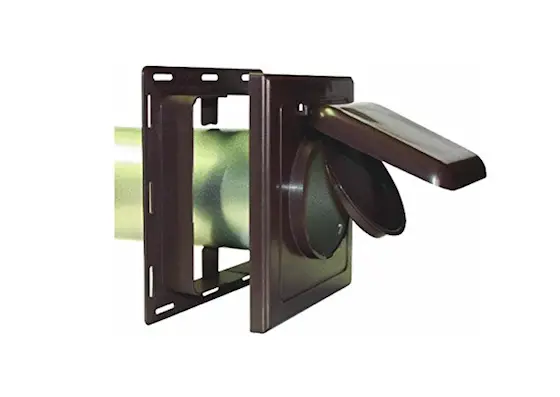
clothes dryer vent double door

Look at the double doors. This keeps pests out and prevents cold air from backdrafting into your home. CLICK THE IMAGE to order it now.

DEAR TIM: I just discovered that my clothes dryer exhaust in my new home dumps into my attic near a roof vent. There is a large collection of lint in the attic. When asked, the builder states that this is perfectly acceptable. Is he correct? Is the solid vent piping better than the flexible piping? Can you vent a dryer through a roof or a soffit with minimal problems? What about those interior vent kits that claim energy savings? Is that an option? Bob E., Troy, MI

DEAR BOB: I see inferior dryer vent installations like yours on a monthly basis. Dryers that exhaust into garages and crawl spaces are also potential problems. Ask your builder if your local building inspector finds his installation "acceptable". Virtually every model building code addresses clothes dryer exhausting. The codes mandate that dryer exhaust needs to be ducted outdoors. Terminating the exhaust pipe near an attic vent does not meet this requirement, plain and simple.

Clothes dryer exhaust can cause major problems within a house. In your case you have two imminent hazards. One is a fire hazard with respect to the massive quantities of exposed fabric lint dust. An open flame could turn your attic into an inferno within seconds. I also suspect that you will have mildew growing in short order. The dryer pumps a large amount of humid air into the attic with each load of laundry that is dried. This warm, moist air is exactly the tropical climate that mildew thrives upon.


roof flashing for bathroom
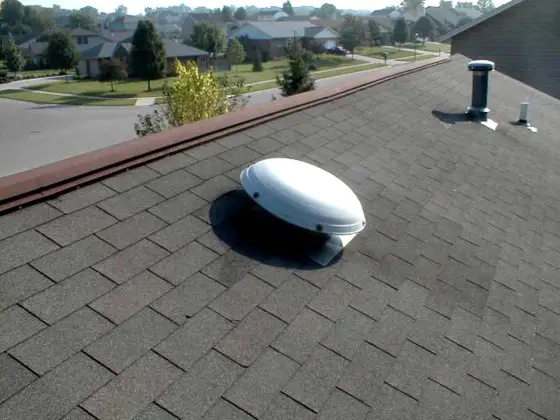
I have found that it is often best to vent fans and dryers through the roof. I urge you to watch this video of mine to see how easy it is to install the correct vent-cap flashing on a roof. Have no fear - if done right you will have no leaks.


Interior vent kits do not meet most model building codes and they inject vast quantities of humid air into your home. Condensation on windows, within exterior walls, and in attics can result from this method of dryer venting. This trapped moisture can cause wood rot and mildew problems.

Dryer venting is not as simple as it seems. The blower motor within a dryer can only push the moist air so far. If you exceed this limit, the dryer will not dry clothes properly and the vent piping can clog easily with lint. The exhaust hood design, the type of exhaust pipe used (smooth metal vent vs. corrugated/flexible metal pipe), and the number of bends in the exhaust piping create friction that slows the air leaving your dryer.

Smooth metal vent pipe and exterior exhaust hoods that have openings of sixteen square inches or more offer the least resistance to air flow. If you have no bends or turns in the exhaust piping, you can place the dryer up to 64 feet away from the exhaust hood. The addition of four 90 degree bends allows you to have only 27 feet of straight pipe in between the dryer, the bends and the exhaust hood. Exhaust hoods with narrow mouths often have only ten to twelve square inch openings. If you use one of these with flexible piping that has four bends in it you can only have fifteen feet of straight piping between the bends, dryer, and exhaust hood!

Author's Note:  Since this article was written, the Code has changed.  Mark D. of  Laconia, NH, emailed me and stated that "Since the International Residential Code states "Max length of 25' (less for elbows)", why do you say 64'?"  Be sure to check the most recent Code for the correct lengths. Codes can be updated at any time.

You can vent a dryer through a roof if you use the correct exhaust hood. The best hoods are one piece and contain wide flanges that permit a leak proof installation under common asphalt shingles. The hoods include insect screening and a built-in damper that stops outside air and bumble bees from blowing or flying back into your dryer. Venting dryers through soffits is not a good idea. Humid air can often find its way into your attic through soffit vents.

Because you live in a cold climate you need to make sure your builder insulates the metal dryer pipe when he connects it to the new special roof exhaust hood. Without this insulation, the metal pipe will chill the moist air within the pipe creating condensation. This liquid water will run down the pipe and possibly leak from the pipe joints or show up as a leak under your dryer. High quality reinforced foil duct tape found at heating and cooling supply houses is the best material to use to secure the insulation to the metal piping and the insulation backing. Standard duct tape can fail in the extreme temperatures found in many attic spaces.

Check to see how your dryer vent pipe was fastened together. If your builder used screws, it was a mistake. The screw shafts inside the piping collect lint and cause additional friction. Manufacturers and building code officials prefer that you use the reinforced foil duct tape in conjunction with special large diameter clamps that squeeze the pipes together.

Natural Stone Pathway

flagstone patio

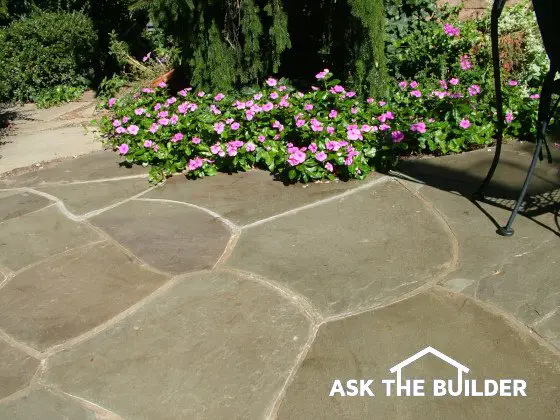
This is a flagstone patio I installed. You can't see the hydrated lime in the mortar, but it's there. Copyright 2023 Tim Carter

DEAR TIM: I would like to build a simple garden pathway using natural stone. Are there natural stones that I can use that are both durable and affordable? How would you create a natural-looking pathway using stones? Sarah T., Gastonia, NC

DEAR SARAH: I knew my college geology degree would come in handy! There are numerous natural stone products that can be used to create colorful and durable pathways in your garden or in any other part of your yard. Several products can also be used to build low, mortar-less retaining walls. I have seen quite a few highly durable and colorful natural stone products on my many geologic field trips.

Some parts of the nation are blessed with local outcroppings of natural stone that you can mine yourself. We have these in my own hometown. Southwestern Ohio happens to have an abundant supply of layered gray and buff-colored limestone. Limestone is calcium carbonate - a durable natural stone. Limestone deposits often appear in thin layers that make it easy to quarry.

Other parts of the nation have natural stones like slate, sandstone, flagstone, and granite. I was taught in college that stones that contain the highest amount of the mineral quartz tend to be extremely durable. Sandstone and quartzite are wonderful natural stone products that contain nearly 100 percent quartz. Some quartzites are available in a series of buff and brown tones while others can be found that are a rich medium green in color. The quartz particles within the rock shimmer when the sun strikes them just right.

The biggest problem in obtaining natural stone is usually the cost to ship the heavy material from the source to the point of use. For your garden path, you should consider a stone that is thin yet strong. By doing this you will get more surface area covered per ton of material delivered. Quartzite, slate, flagstone, and some limestones can be found that meet these requirements. Many large home center stores across the nation are beginning to stock natural stone products that are perfect for your project. Quartzite is available at many home center stores for just $2.50 per square foot. You can also locate natural stones by checking your Yellow Pages under the "Stone Products" heading. AUTHOR'S NOTE: You can tell this column was written before Google existed. The Yellow Pages and Classified Ads in newspapers were the search engines before the Internet existed.

To build the appealing path in your garden you will need minimal tools. A round-point shovel, a square point spade, rake, mason's hammer, level, string, small wood stakes, and a wheelbarrow will enable you to complete this project. Layout your path using the string and stakes. An 18 to 24-inch wide meandering path is usually suitable for one person to walk along. If you intend to have two people walk side by side down the path, plan for it to be 42 to 48 inches wide. Once the path is planned, you can calculate the square footage of stone material you will need.

I prefer to use crushed stone under and around the natural stone products. A 4-inch thick layer of crushed stone will provide plenty of support for foot traffic. You can purchase this crushed stone at gravel pits or quarries that sell this material to contractors who install blacktop or asphalt driveways. Be sure to get the grade of crushed stone that contains rock dust and stone chips that range in size from 3/4 inch down to the size of a pencil eraser. The rock dust and small stone chips will eventually interlock and resemble hardened concrete.

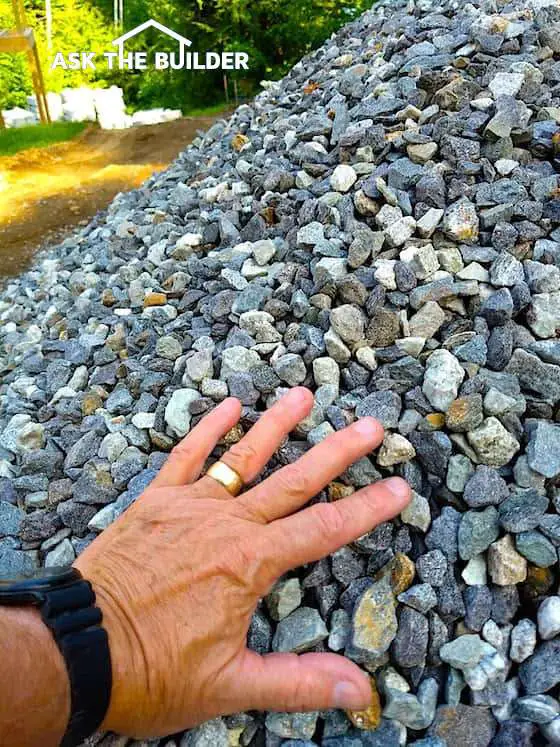
crushed washed gravel linear french drain

This is an example of crushed stone. It's best to use some that does contain different sizes of stone chips as well as some sand. Copyright 2018 Tim Carter

Use the round point shovel to do your initial excavation. The square spade can be used to cut a smooth surface in the soil to accept the crushed stone. Install the gravel and smooth it with your rake so that the center of the path is slightly higher than the edges. A slope of 1/8 inch per foot is acceptable, however, a one-quarter-inch slope per foot will work even better. This slope prevents the puddling of rainwater.

Trim the stones with the mason's hammer so that you have approximately one inch of space between the stones. If the stones wobble after you lay them in place, use hand fulls of fine stone chips and dust to fill in the void spaces beneath the stones. Once you are satisfied with the layout, sweep fine stone chips and rock dust into the joints around the stones. Water the pathway using a garden hose and enjoy the stroll through your garden!

Related Articles:  Natural Stone Path, Suppliers of Natural Stone, Building a Path of Natural Stone

Air Conditioning Sizing Problems

air conditioning

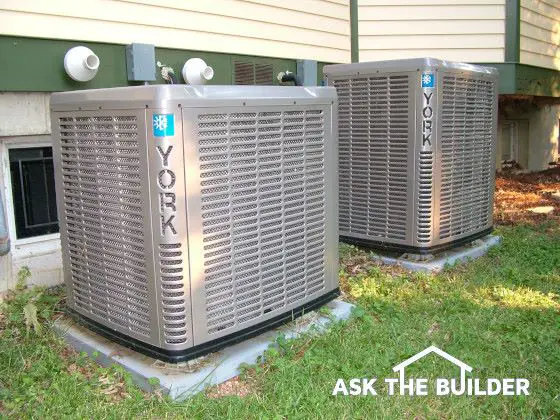
These are two AC units outside my own home. I have two separate systems in my home, one for the first floor and one for the second floor. Copyright 2018 Tim Carter

DEAR TIM: I have never been satisfied with the performance of our central air conditioner. Even though the unit runs 45 minutes or more each hour, the house never seems really cool. All of the rooms that face west become unbearably hot in the late afternoon. A neighbor's house across the street has an identical floor plan and their house seems very comfortable. Periodic checks of our system indicate that the refrigerant level is fine. Why am I so hot? Ron W., San Marcos, TX

DEAR RON: Your discomfort can be caused by any number of problems. However, I suspect that a mistake was made when you house was built. It is a distinct possibility that the outdoor air conditioner and the coil inside your air handler or furnace is too small.

I think that the cooling contractor either made an error in his sizing calculations or simply guessed at the size air conditioner needed to cool you home. Air conditioners are like shoes. Ones that don't fit are simply uncomfortable!

All houses attract and create heat. The infrared energy contained in natural sunlight is the heat energy that comes through windows, doors, air leaks, and through insulated walls and ceilings. Appliances, light fixtures, even our own bodies create heat within houses.

CLICK HERE to get FREE & FAST BIDS from local AC Technicians who can install the right sized AC Unit for your home.

All of this heat can be easily measured. Air conditioning contractors and manufacturers refer to the accumulated heat as heat gain. It is measured in British Thermal Units (Btus).

Air conditioning equipment comes in different sizes. The cooling capacity of a particular system is measured in tons. One ton of cooling equals 12,000 Btus or the amount of heat it takes to melt one ton of ice in a 24 hour period. Typical residential air conditioners can be purchased in sizes that range from 1 ton to 7 tons often in one-half ton increments.

My guess is that you and your neighbor have the same sized air conditioners.  Their house is comfortable because they have much less glass surface pointing west.  West or southwest facing glass allows enormous amounts of heat into your home.  This explains why your west facing rooms are so hot.

Air conditioning engineers have developed straight forward step-by-step procedures that allow just about anyone to calculate with considerable accuracy just how much heat accumulates in their house.

To calculate your house's heat gain, you simply need a measuring tape, notepad and pencil, a simple calculator, a compass, cooling load calculation tables, and several hours of your free time.

You first need to obtain a copy of the cooling load calculation tables. Cooling contractors and those in the industry commonly refer to this publication as Manual J. The tables are published by the Air Conditioning Contractors of America.

You may be able to find a copy of Manual J at your local library or from an air conditioning contractor of distributor in your city. The booklet looks intimidating but if you can follow step by step instructions, you can do the calculations quickly and accurately.  If your final total of Btus is in the tens of thousands (20,000 - 55,000 or more Btus), then you have done well!

Once you have completed your calculations and checked your math for accuracy, you need to look at your outdoor air conditioning unit.  Often you will readily see a plate that contains a model number, serial number and other numbers. 

The tonnage capacity of your unit is contained within the numbers on this plate. Your air conditioning service person can quickly tell you how many tons of cooling your air conditioner will produce after reviewing these numbers.  Divide your final total Btus by 12,000 and see if the two numbers match!

CLICK HERE to get FREE & FAST BIDS from local AC Technicians who can install the right sized AC Unit for your home.

Column 231

A Saw Horse Substitute – Tim’s Carpenter’s Bench

Years ago, a carpenter buddy of mine, Chuck Sallee, made some dandy carpenter's benches at a job we were working on. I liked them so much, I ended up making countless numbers for myself and friends. I even made a set on TV one day! You will love these strong benches.

Carpenter's Bench

DEAR TIM: I have never liked working with saw horses. I'm looking for a simple work platform or bench that I can use for various purposes around the house. My guess is that you were also frustrated with saw horses. What did you use in the on your jobs? Is it easy to find one in a store? If not, how do you build one? Melinda B., Cardwell, MT

DEAR MELINDA: Saw horses are okay for certain tasks but I only use them as a last resort. My weapon of choice around the jobsite is a wonderful multi-purpose carpenter's bench that I make from scrap lumber. The environmentally friendly benches are usually made by lunch of the first day. I use the scrap lumber that is generated during the construction of the wooden sub-floor or wall assemblies. The benches are far stronger than traditional saw horses and they also serve as a tool caddy, emergency stepladder, and a great place to sit down and eat lunch.

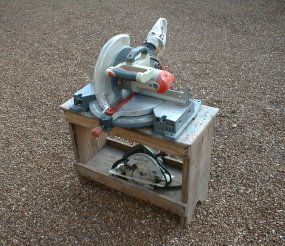
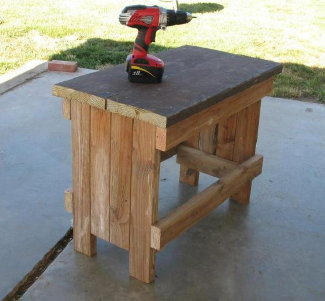
This bench has seen years of service. I use it as a painting platform as well as a tool bench.


You can see how well the bench supports a large miter saw. The lower shelf is handy for other tools or supplies.


You will not find my bench in a store, however you can build one in less than a half hour using some simple tools and minimal lumber. If your friends, neighbors and relatives are like my past customers, I guarantee you that you will be building quite a few of these great tools. I commonly left my benches behind for my customers as a gift. Trust me, your friends and neighbors are going to borrow your bench for extended periods of time and "forget" to return it.

To start this project you are going to need a circular saw, a drill with a one half inch spade bit, a jig saw, a level, a framing square, tape measure, pencil, a screw driver, and some 2.5 inch long galvanized coarse threaded screws. If you want a fancy bench you will need a router as well. Your lumber requirements are simple. All you need is a four foot length of 2 x 12 and a four foot by three foot piece of scrap 3/4 inch plywood or oriented strand board (OSB).

The completed bench measures 14 and 3/4 inches wide at the top, 32 inches long and it is 24 inches high. I always like to cut all of my lumber before I start to assemble the bench. The legs of the bench are made from two pieces of 2 x 12 that measure 11 and 1/4 inches wide and are 23 and 1/4 inches long. A V notch is cut in the bottom of each leg so that just a 2 inch long portion of the 2 x 12 contacts the ground at each corner.

All of the other bench parts are made with the plywood or OSB board. Six pieces need to be cut in order to begin assembly. If you are using plywood, be sure that all pieces are laid out so that the longest dimension is parallel with the grain of the wood. OSB layout is not as critical. The top measures 14 and 3/4 inches wide by 32 inches long. Cut out the top and bottom stabilizer braces next. The braces measure 3 inches wide by 30 inches long. The last piece to be cut is the bench's bottom shelf. It measures 11 and 1/4 inches wide by 27 inches long.

This is an adaptation of my workbench. It was built by Mike Radcow. As you can see, Mike used all 2x material to enhance the strength. But you also need to be strong to lift his model. It is a beautiful modification to my simplistic bench. Good job Mike!! PHOTO BY: Mike Radcow

This is an adaptation of my workbench. It was built by Mike Radcow. As you can see, Mike used all 2x material to enhance the strength. But you also need to be strong to lift his model. It is a beautiful modification to my simplistic bench. Good job Mike!! PHOTO BY: Mike Radcow

The bench assembly begins by attaching the top braces to the top outside 1 and one half inch wide corner of the 2 x 12's. Once attached, the top of each brace should be flush with the top of each leg. Use two screws at each connection point. The bottom braces are attached in the same manner. However, the bottom of the lower braces should be held up 4 inches from the bottom of the legs. The shelf can now be installed. If you cut your lumber correctly, it will fit snugly in between the legs and the bottom braces. The underside of the shelf should be flush with the bottom edge of the lower braces. Install 3 screws through each brace to secure the shelf. The braces act as shelf sides and form a convenient storage area within the bench. You will find this to be a perfect place to store nails, shims, paint brushes or other items for different tasks.

The final piece to be attached is the top. Once again, if all cuts are accurate you will find that the top overhangs the legs and top braces one inch on all sides. Attach the top by driving at least 3 screws into each leg and 2 screws into each top brace. Use the drill and jig saw to cut out a 2 inch by 4 inch rectangle in the center of the top. This cutout acts as a hand hold that allows you to easily lift and transport the bench using one hand. Equip the router with a profiled bit to give the top's outside edge and the interior edge of the hand hold a finished touch.

If you decide to stand on the finished workbench for any reason, be aware that it is unstable. If you shift your weight or change your center of gravity, the bench can tip without any warning (the voice of experience screaming!). You can fall and seriously injure yourself. Only use the workbench as a step stool as an absolute last choice. It is worth the trip to the garage or truck to get a stable step ladder.

Related Articles:  Work & Storage Bench Assembly, Carpenter Workbench with Tool Storage

Exterior Painting

DEAR TIM: I intend to paint the exterior of my wood house soon. I am confused about using primers. Is it a good idea to use a pressure washer on my house? Do I have to prime the entire house before I apply the finish paint? What can I do to maximize the life of this new paint job? Stephanie S., Athens, OH

DEAR STEPHANIE: I am not surprised that you are confused about primers. It seems like I get a different answer to each primer, paint and surface preparation question that I ask when I talk with paint salespeople. Fortunately the entire exterior painting process is fairly straightforward.

The largest obstacle you face is the one of instant gratification. I find that most homeowners and painters want to get the finish paint on the surface as quickly as possible so that they can "see" results. If you succumb to this temptation you can rob yourself of possibly 50 percent of the life span of your paint job. Surface preparation and the correct use of primers is essential to the performance of an exterior paint job. They also consume the most time.

The first thing I want you to do is to read the label on the can of your finish paint. I'll bet that you will find a sentence that contains the following sentence or phrase, "Apply paint to a clean, dry surface." How do you wash yourself each day? Do you just stand in the shower and let the water run over your body? My guess is that you use soap and rub it into your skin and then rinse it off. This is exactly what you are going to do with your house.

Pressure washing a house, in my opinion, is not a good idea. This method does not completely clean the surface. You can demonstrate this by using a pressure washer at a drive-in car wash. After using one there will still be a fine film of deep-set dirt on your car's finish. The same is true on a house. What's more, pressure washers used in the hands of a rookie can cause significant damage to wood. It can erode wood fibers and drive water deep into exposed soft woods. Water sprayed up under siding or into cracks between siding and trim can actually saturate the back side of the wood on your house and promote rapid peeling of the fresh paint.


Is the exterior of your house looking drab? Find the professional painters by using my Exterior Painting & Staining Checklist. I offer a 100% Money Back Guarantee.


Oil based primers are superb products. These products penetrate deeper into wood fibers. Oil primers also do a great job of sealing woods like cedar and redwood that can produce bleed stains when coated with water based products. Primers are a must on bare wood and previously painted surfaces that have bad alligatoring, blisters, or the paint film is eroded. If your existing paint job is fairly smooth and sound, you do not need to use a primer over the entire surface.

To get the most from you upcoming paint job the first thing to do is to remove all loose paint. Wash your house just like you wash yourself or your car. In other words, use soap and rub the entire surface with a sponge or scrub brush to remove all dirt. Rinse with clear water from a standard hose. Let the house dry for a minimum of two days before you continue.

Apply a rust inhibitive primer to any rusty nails. Countersink these and fill the holes with exterior spackling compound. Prime all bare wood spots and areas on the wood that require a primer. Apply a 100 percent acrylic latex top coat finish paint to all primed areas within 48 hours. This insures that the primer and finish coat will completely bond to one another. The acrylic paint also will not promote the growth of mildew on the paint. Oil based finish paints can support mildew growth.

Be sure to apply a sufficient amount of finish paint to the surface. It is not uncommon for a rookie to overspread the finish paint. Look at the label for the recommended coverage rate. If the label says a gallon of paint should cover 400 square feet, you better have used one half gallon of paint after you have brushed a 10 foot by 20 foot area!

Finally, try to paint when air temperatures are in the 70 F range and the relative humidity is in 50 percent range. Always paint a surface after the sun has passed and it is in the shade. Sunlight that strikes a freshly painted surface can dry a wet paint film too quickly and actually create blisters.

Related Articles:  Understand Paint & Painting Tips, Exterior Home Painting & Weather

Cutting Crown Molding – Upside Down and Backwards!

DEAR TIM: I have tried for the last 2 hours to properly cut the miters for crown molding that I am installing in my dining room. My cuts are not even close. What am I doing wrong? How do you cut crown molding correctly? What is the trick to getting tight fitting joints in corners? Dan K., Greensburg, IN

DEAR DAN: Been there, done that. I remember my first time trying to install crown molding. I struggled just like you did. After wasting three hours and countless feet of beautiful white pine crown molding, the lady politely showed me to the door of her house. I was really humiliated. After I finished beating myself up, I immediately went to the library and borrowed an illustrated book on crown molding.

It only took one illustration to show me what I had been doing wrong. It was so simple that I could scream. You probably were making the same mistake that I did. I'll bet that you were holding the back side of the crown molding up against the rear fence of your miter box saw, weren't you? After that didn't work you held the molding on the bottom of the miter saw frame. You then tried setting the saw at different angles didn't you? Those are all common mistakes.


Would you like step-by-step photos and instructions that show you how I install crown molding anywhere in a home?  If so, you might want my Instant Download Crown Molding eBook.

But, if you want to actually see me install crown molding in all the same places while watching an action-packed interactive DVD that was filmed in High Definition, then you may want my Crown Molding DVD.


Crown molding differs from wall baseboards and door and window trim. Baseboard, window and door trim moldings are basically rectangular in shape and fit flat on a wall once cut. Crown molding is actually a triangular shaped molding and the finished face sits at an angle to the wall and ceiling. Back when lumber was plentiful the moldings were actually triangular in shape. Modern moldings look similar to door and window casings because of the removal of the large mass of wood behind the molding face. This saves our precious natural resources but it causes lots of confusion when trying to miter it.

To get accurate corner cuts you have to hold the crown molding in the miter box at the same angle as it will be once on the wall. High quality miter box frames or power miter boxes can help you do this. The bottom and rear fence of the miter box actually mimic the 90 degree intersection of your wall and ceiling.


Remember,my Crown Molding eBook has complete step-by-step instructions with tons of color photographs that show you exactly how to cut crown molding. 100% Satisfaction Guarantee!


The first step in achieving professional crown molding cuts is to determine how far the molding projects away from the wall and how far down from the ceiling the molding sits when it is installed. Cut a 2 inch long piece of crown molding to accomplish this task. Place the small piece of molding into the inside corner of a framing square. Note how there is a small foot on the bottom back of the molding. You will also find a shoulder at the top of the molding. These two surfaces should contact the edge of the framing square squarely. Note the measurements where the molding ends in each direction and write them down.

Click here to watch a video on cutting crown molding the easy way.


Place the small cut piece of crown molding upside down in your miter box frame. Imagine that it is up on your wall. Adjust the molding in the miter box frame until the measurements match what you determined when it was in the square. Make reference marks on the saw frame so that you can hold the molding accurately as you saw it.

To accurately cut inside miter joints you simply need to remember that only the small bottom shoe of the molding will fit into the wall corner. The intersection of the finished face of two moldings meets out in space away from the actual corner. This means that the longest point of your molding once it is cut must be at the actual bottom of the molding.

I always first cut a one foot long left and right mitered corner. I check these for fit in each corner to see how they look. These pieces also serve as templates back at the saw to help me correctly visualize the molding as it sits upside down and backwards in the miter saw!


Remember, my Crown Molding eBook has complete step-by-step instructions with tons of color photographs that show you exactly how to cut crown molding. 100% Satisfaction Guarantee!


Powered Attic Fans – Attic Insulation Facts

powered attic ventilation fan

This is a powered attic ventilation fan. If it doesn't have excellent intake air around the soffits, it can actually vacuum air from inside your home.

DEAR TIM: I am trying to make my house more comfortable and lower my air conditioning bills at the same time. It seems to me that a powered attic ventilation fan will help. Will such a fan exhaust enough air to lower my attic temperature significantly? If not, what is the best way to exhaust hot air from an attic and lower cooling costs? Amy V., Magnolia Park, FL

DEAR AMY: This is a classic example of where common sense does not always prevail. I used to think like you that powered attic ventilators (PAVs) are a great way to get hot air out of attic spaces. It turns out that these rooftop and sidewall mounted attics fans can actually suck air conditioned air from your house into your attic space. What's more - in extreme cases - they can actually create serious life safety problems by back-drafting combustion gases into a house living space. I used to recommend PAVs for houses, but I don't anymore.

When a PAV is turned on to exhaust hot attic air, it begins to move massive quantities of air. Smaller fans can easily move 1,000 cubic feet of air per minute (cfm). More powerful or multiple fans can extract thousands of cfms of air.

This movement of air creates a natural low pressure inside your attic space. To equalize this pressure difference, air begins to rush into the attic space from multiple points. If you have many passive roof vents, large side gable vents, and/or excellent unobstructed soffit vents, then there is a good chance that most of the makeup air will originate from outside your home. If you have few passive attic ventilation inlets, then most of the replacement air will come from the inside of your home.

If you have your air conditioner running at the same time your PAV is operating, you are sending expensive cool air from your living space into your attic. This air seeps into your attic through the attic access panel and hidden holes in the interior wall top plates where plumbing vent pipes and electrical wires enter the attic. Air also can easily slip between the space between bowed wall plates and drywall. To complete the circle, hot and humid exterior air enters your living space. Your air conditioner now has to work harder and longer to keep you cool while that PAV is merrily spinning away up in the attic!

Recently, completed studies by the Florida Solar Energy Center have proven that as the sun heats up the wood roof sheathing and framing members in your attic they quickly and invisibly send this heat directly to the top layer of your attic insulation. The insulation in turn re-radiates this heat into the attic airspace. PAVs can lower the overall attic temperature to a slight degree but the secondary effects of sucking cool air from your house and possibly combustion gases into your living spaces offset this benefit.

The danger of sucking combustion gases from hot water heaters and any other combustion appliance is real. This is especially true in tighter, newer homes. To feed the voracious appetite of the PAVs, air will enter your home at the point of least resistance. This point is often a chimney or hot water heater metal B-vent pipe.

Your desire to lower energy costs and keep cool should begin by boosting the amount of attic insulation to offset high attic temperatures. Not only will the added attic insulation help you in the summer, it will also help you to lower winter heating costs. Remember that you must maintain at least 2 inches of air space between insulation and the roof sheathing. At the same time, you must be sure that air can easily enter the attic space through the lower portions of your roof or soffits and travel unimpeded into the attic space. Once there it can be gently vacuumed from your attic through continuous roof ridge ventilation systems every time Mother Nature exhales across your roof.

Related Articles:  Continuous Ridge & Soffit Vent Manufacturers, Insulation Values, Ventilation - Keeping Home & Attic Cool

Metal Roofing – Good Looking and Durable

DEAR TIM: I am in the market for a new roof. Asphalt shingles - even the fancy dimensional ones - do nothing for me. I really like the old fashioned look of the tin metal roofs. I see painted replicas on some commercial buildings. Can you install metal roofing on residential houses? Will painted metal roof colors fade? What kinds of metal roofs are available? Sally P., Simi Valley, CA

DEAR SALLY: Tin metal roofing was immensely popular in the late 1800's and early 1900's. Labor was inexpensive at that time and there was an abundance of craftsmen who could easily install the material. Metal roofing systems are still available and great strides have been taken to simplify their installation. Metal roofing also has a history of proven performance. Simple flat seam metal roofs have been found in buildings dated to 3,000 B.C.

Metal roofing is a superb material for residential buildings. If you choose the right system, you can get a roof that will easily last your lifetime and quite possible an additional 50 years or so. Expect to pay for this performance, however. Metal roofing is pricey. A metal roof can cost at least three to four times what you might expect to pay for a high quality asphalt shingle installation.

There are numerous advantages to using metal roofing. First of all, it is totally fireproof. If you live in an area that experiences wildfires, a metal roof just might save your home from a devastating roof fire caused by a wind blown ember. Metal roofs are made with environmentally friendly recyclable metals, such as steel, tin, aluminum and copper. A house with a metal roof can be extremely distinctive. When installed correctly, metal roofs are extremely wind resistant. A light colored metal roof can actually reflect a portion of the sun's radiant energy, thus lowering your cooling costs.

Aside from the traditional standing seam look, you can also install flat lock metal roofs and ones that look like traditional overlapping shingle type or Spanish clay tile roofs. Certain manufacturers have gone so far as to coat the metal roofing shingles with colored ceramic granules to simulate the look of asphalt shingles!

Don't hesitate to select a painted metal roof product. This is especially true if the paint has been treated with a clear fluoropolymer resin. This coating was originally used to inhibit corrosion on the inside of steel piping used in chemical plants. Fortunately someone decided to try it on top of paint to stop ultraviolet (UV) degradation and fading of colored paints. It works so well that painted roofs can retain 85 percent of their original color after 20 years of exposure.

If you decide to purchase a metal roof system, make sure that the installer uses all matching components during the installation. In other words, all assembly parts must come from the same metal roof manufacturer. Pay particular attention to instructions with respect to ventilation. Metal roof failures can happen and often the corrosion begins on the underside of the roofing. Condensation can form under some metal roofs. You need to make sure that the underside of your metal roof can breathe readily and dissipate the condensate water and water vapor.

Be sure your roofer follows written installation instructions to the letter. If you live in a high wind area, pay attention that the bottom and top edges of the roof are installed correctly. These areas of the roof receive the highest loads during sustained wind storms. Most metal roofs need to expand and contract readily. Special metal clips and fastening techniques are employed that allow the roof to move yet remain watertight. Be sure you hire a roofer that understands this vital concept.

Related Articles:  Metal  Roofing Cost ExamplesMetal Roofing ProductsResidential Metal Roofing