John Wilkes Detector Lock 1680 - True Craftmanship
This is a lock that will rock your socks off.

It's got a very fancy skeleton key.
This is a lock that will rock your socks off.
It's got a very fancy skeleton key.

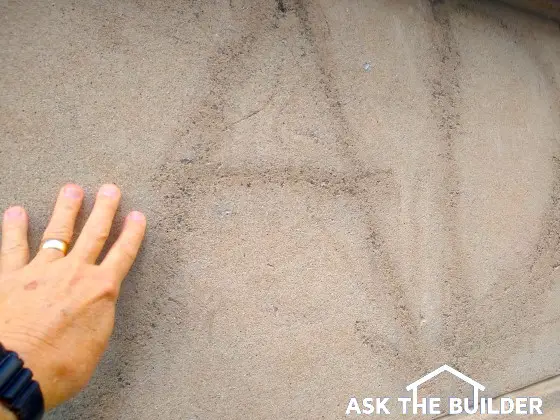
Pressure Washer Dangers | A pressure washer caused this irreparable damage to dense hard limestone. The operator used it to remove spray paint protesting the governor of Puerto Rico but now has permanently etched the slogan into the stone surface. Copyright 2021 Tim Carter
Do you own a pressure washer? I’ve had no less than five of them in my lifetime. I must say they’re amazing machines when you use them correctly and on surfaces that won’t be harmed by the powerful blast exiting the nozzle at the end of the cleaning wand. If you want to know how to use a pressure washer, I can help you.
My college degree is in geology. A month after my 20th birthday, I found myself walking down the Kaibab Trail into the maw of the Grand Canyon on my first out-West geology field trip. It took about four or five hours to get down to the Colorado River.
I don’t know if the professor told us at the time, but the National Park Service says the Colorado River gobbled up all that missing rock transporting it to the ocean in just 6,000,000 years. It did this with just 14.2 pounds of normal atmospheric pressure pushing down on the water flowing over the rock, not 2,400 pounds as many pressure washers produce.
In other words, water just normally flowing over dense hard rock will erode it. Think of how much destructive force is created when you plug in your pressure washer or pull the start cord on its gasoline engine. I witnessed an agonizing example of this destructive force on a trip to Old San Juan, Puerto Rico in October of 2019. Months before anti-government protestors had spray-painted slogans on many of the buildings.
The governor dispatched workers to remove the paint and they decided to use a pressure washer. One of the buildings was built using hard oolitic limestone. The operator of the machine removed the paint, but he also eroded the actual stone permanently etching into the building facade that had been spray painted. It was hard to stomach because one would think within a few minutes the operator could see he was damaging the stone itself.
Think of the things around your home that are far softer than hard limestone the likes of which many of the buildings in Washington DC are made, including the Washington Monument! That oolitic limestone was chosen for a reason because it’s so long-lasting and it’s gorgeous.
In other words, if you don’t know how to use a pressure washer and aim that cleaning wand at your wood deck, your wood deck railing, or the wood steps, in a matter of seconds you’ll transform smooth treated lumber into a weathered fishing pier where the soft springwood in between the darker bands of summerwood has been worn away.
Do you use your pressure washer to clean your brick paver driveway, sidewalk, or patio? I’m talking about the interlocking bricks made from concrete that have dry pigments added to them. These brick can be had in an assortment of earthy colors and tones.
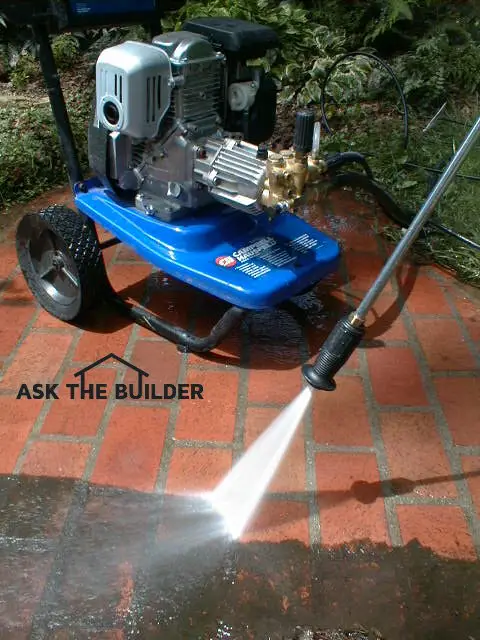
That color you see at the surface is just an ultra-thin coating of cement paste that has the dry pigments in it. It’s child’s play for your pressure washer to blast away this thin film of color exposing the actual color of the small stones used to make the concrete brick. Put the spray wand too close to the brick and you’ll actually blast away some of the small fine sand used to make the brick.
I see professionals improperly use pressure washers all the time. Many are painters who use them to wash the outside of a house before applying a fresh coat of paint. All too often I see the operator aiming the cleaning wand up to clean things above his head or shoulders. This is a huge mistake.
We builders construct homes thinking about how rain falls. Rain falls down, and in rare instances, it can hit a structure sideways during a powerful storm, nor’easter, or hurricane. But Mother Nature rarely has rain blowing up to the sky.
Builders lap siding, trim, flashings, etc. so that the falling water doesn’t get behind the outer skin of your house. An operator aiming a pressure washer up can drive water behind the outer skin of your home in short order. Never ever aim a pressure washer wand up on the outside of your home.
Is your house covered with vinyl siding? Have you ever paid attention to how the pieces of siding overlap at a joint along a long wall? Don’t ever aim a pressure washer wand so the water lifts the overlapping siding and gets behind the vinyl. The same is true for where the vinyl trim is up against windows and doors. There’s a seam there and the pressure washer can drive lots of water behind the siding that otherwise shouldn’t be going there.
First and foremost you should read cover to cover any manual that comes with your pressure washer. The manufacturer may have all sorts of warnings about how to use the machine with different materials.
At the very least, use your own critical-thinking skills. Do experiments. Instead of aiming the pressure wand at a 90-degree angle to the surface you’re cleaning, try 45 degrees or even 10 degrees! If you’re using a high-pressure stream of water to remove flaking paint, it’s best to hold the wand almost parallel with the painted surface. The stream of water will burrow between the paint and the surface and blast it away usually doing little harm to the siding or trim.
Column 1421
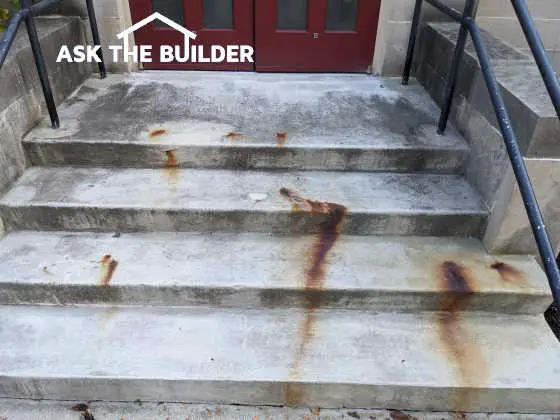
Concrete Rust Remover | What a sad situation to see rust stains on these concrete steps! The rust could have been prevented with a small amount of paint and a few extra minutes. Copyright 2021 Tim Carter
You may be like me and notice things about who knows what. For example, you may pay attention to decorating things and color coordination. Or, you may focus on landscaping and outdoor furniture arrangements. The list of things to look at in and around homes is almost endless. My eye is attracted to any and all defects that I see. It almost ranks as a disease because instead of enjoying looking at a home, I tend to feel like I’m inspecting it.
Recently, I had to travel from my home in central New Hampshire to Cincinnati, Ohio. Cincinnati is my hometown and in some ways, it was great to be back. But I quickly discovered there are more traffic lights, potholes, and low manhole covers in a 2-square-mile area in the east side of town than we have in all of Belknap County in NH! If you want to make a good living, open up a shock-absorber and wheel-alignment shop in Cincinnati.
One of my stops was the church I got married in. I had a few extra days to wander around taking photos of the places that mean lots to me. Once at the church, I was saddened to go up a flight of concrete steps that had horrible rust stains. I shook my head thinking, “What a shame! If only the contractor had taken the time to spray paint the reinforcing steel, there would be no stains.”
My first thought was, "I wish I had some oxalic acid with me. That rust would disappear in minutes." All you have to do is mix the oxalic acid crystals with water, dissolve them, and apply the solution to the rust stains. Scrub and magic will happen. Pay attention to the safety instructions on the label of the oxalic acid! Rinse well with clear water.
My second thought was how the rusting steel was expanding. That’s what happens to reinforcing steel when it starts to rust. Within a few years, these wonderful concrete steps that should have lasted seventy years, or more, will be cracked and falling apart.
Have you taken the time to get any bids lately for work? Are you shocked by the prices and how inflation is raging in home building, remodeling, and repair? I know I’m stunned. It’s a good thing I can do just about all repairs to my own home.
The issue is it’s going to be thousands and thousands of dollars to replace these concrete steps in a few years when they start to fail. The expenditure could have been avoided if the concrete contractor who installed the steps had taken a few extra minutes to roll on or spray on some metal primer and then add a coat of finish paint to the steel rebar.
This is so easy to do and the paint might have cost just $50. The reasons are plenty as to why it wasn’t done. It most likely is the Building Committee members who advise the parish priest just don’t know to do this. If a young architect did plans years ago for the steps, he might not have put in the written specifications telling the contractor to paint the rebar.
I tend to do autopsies on failures like this and then try to share what happens so I can help you avoid the same problem. This is an easy one only from the standpoint that it’s so simple to stop the rust.
What’s the biggest takeaway from this simple rust stain situation? I know you’re not going to like this, but you should be thinking about taking on a more active role in sharing with contractors what you want to be done at your home and more importantly, how it should be done. You may think this is confrontational, but it’s not if you make it clear what you want in the plans and written instructions contractors use to bid your work.
My guess is you’re like most people, including me! You don’t know what you don’t know. And to add to that, you may not know the lexicon of building terms. In some respects, it can be similar to a different language.
But the Internet has made your job so much easier. You can easily get great advice from a plethora of associations that publish easy-to-understand documents about how products should be installed. The same is true for manufacturers. A smart and wise homeowner selects all the things they intend to use on the job long before the contractors arrive to look at things.
That same homeowner then reads all the installation instructions and notes the really important parts about what needs to be done. Here’s an example. Let’s say you want a few very expensive french doors installed that lead out to a deck. Manufacturers now have very detailed information about how to flash the doors, how to install them, and exactly what needs to be done to make sure they operate like a Swiss watch. Often they have great videos you can watch.
Absorb all this information. Put in your contracts that products must be installed according to the written manufacturer’s instructions. If you’re not able to see the work happen, put it in writing that the contractor has to take photos of important steps before they get covered up. Have him email those photos to you daily.
Technology has made it so very easy to do all of this. Make use of it so your investment doesn’t fall apart like the concrete steps 20 or 30 years before it’s supposed to happen.
Column 1425
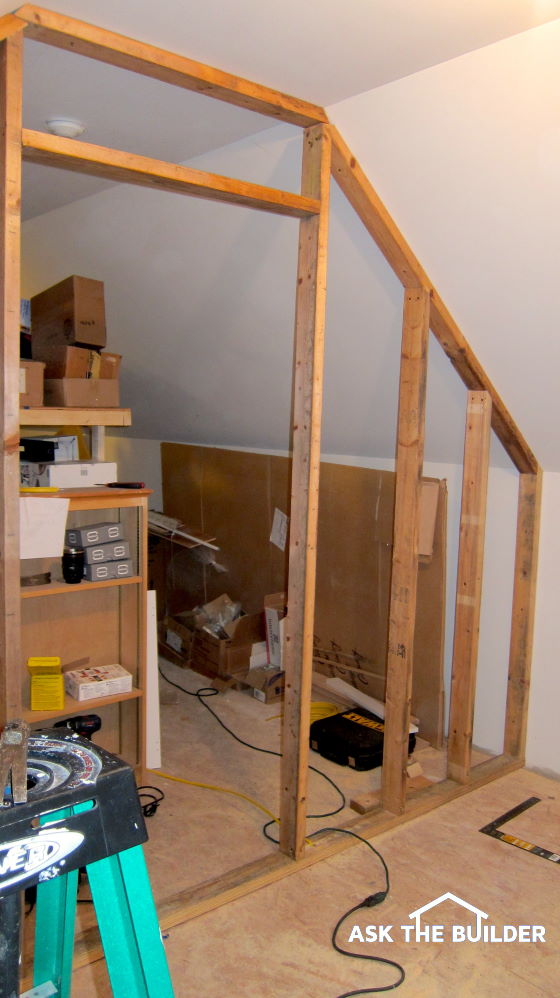
Build a New Interior Wall | This is a new interior wall in an existing home. The angled ceiling makes the job a bit more difficult. Copyright 2021 Tim Carter
Do you want to build a new interior wall inside your home? Perhaps you’re trying to create a new small space for a home office, hobby room, or you have a bigger appetite and are transforming a dank basement into a cozy finished living space. But you have no idea where to start. I’ve been there. I’ve experienced your anxiety.
Every now and then, it’s quite interesting to go back in time. I clearly remember having to build my first partition wall inside a house. I was a soaking wet-behind-the-ears carpenter working for a small remodeling company. One of my college professors, Dr. Larsen, had asked me to install a half bathroom in his home. I had no idea what to do so I told him that my boss could do the job.
Once the simple plans were drawn and the contract signed, I was sent to my professor’s house to start the job. I had previously painted the outside of the home three years before and Dr. Larsen and his wife trusted me. Little did they know, I had no clue how to efficiently build the three simple walls needed for the small new bathroom.
I survived with the help of a few phone calls to my boss. It was a humbling experience as I discovered you don’t know what you don’t know. Keep in mind this was decades before the Internet and YouTube. You have no idea how much of an advantage you now have when it comes to all things about how to repair and build things around your home. Count your blessings!
Building a new interior wall in an existing house can be much different than doing it on a new home job site. When we carpenters build a wall for a new home, we typically build it flat on the floor. Once all the studs are nailed to the bottom and top plates, we tilt the wall up and secure it so it doesn’t fall over.

See that angled board nailed to the vertical wall studs? It extends from the top right corner of the wall to the lower-left corner bottom plate. It’s a temporary diagonal wall brace used to stabilize the framing while the house is built. © 2021 Tim Carter Builder
You can’t always do this in an existing home, especially if the ceilings in the room are finished with drywall or plaster. As you tilt the wall up, it binds against the ceiling. If you’re challenged by a finished ceiling, you’ll most likely have to install your top and bottom plates making sure the plates are plumb in the same plane. You’ll then cut each wall stud to fit snugly between the plates and toenail them in place. Drill angled pilot holes in the ends of the wall studs for the nails. Use no less than 3-inch-long 16d sinker nails to connect the wall studs to the plates.
If there is no ceiling, you can tilt the wall up so long as you orient the wall in the same direction as the floor joists above. You simply make sure the top of the wall rises up in between two parallel floor joists. Once the wall is vertical, you can then slide it into position under the floor joists assuming you didn’t make the wall too tall!
It’s important for you to consider stacked framing. If your new wall is going to be perpendicular to the way the floor joists below or above run, you should make every attempt possible to layout your wall so the wall studs are located directly above or below the joists. This alignment allows plumbers and HVAC contractors to route their pipes and ducts with ease.
You may discover the carpenters that built your home didn’t go to the trouble to stack all their framing. The floor joists for each floor may not line up. If this is your case, then you need to decide if it’s better to align your new wall studs with the floor joists below or above the wall. This really only comes into play if you have plumbing pipes and heating or air-conditioning ducts in your new wall. Electrical cables are so small and flexible they can easily navigate unstacked framing.
It’s vital that your wall studs are spaced so your drywall ends in the center of a wall stud. Your goal is to minimize cutting thin slivers of drywall off the end of a long piece so you can butt two pieces together. Sixteen inches on center is the gold standard for spacing wall studs.
Don’t fret about how to create the opening for a door. It’s not that hard and you just need to do a little math. My recommendation is to purchase your new prehung door and have it at your home. You’ll create the rough opening in the wall by taking measurements off the door jamb.
Measure the total overall width of the door jamb up at the top where the horizontal door jamb is attached to the two side jambs of the door. Add one-half inch to your measurement. This will be the width of your rough opening. Note how much the side jambs of the door frame hang below the bottom of the door. In almost all cases, you’ll be trimming some of this length off when you install the door. Ideally, you want just one-half inch of space between the bottom of the door and the top of your finished flooring.
You can usually safely make the height of the door rough opening just one-quarter inch longer than the factory length of the door jambs. Trust me, the finished molding you install over the door on top of the drywall will cover even a one-inch gap between the top of the door jamb and the bottom of the rough opening.
If you’re attaching your bottom wall plate to a concrete floor, see how easy it is to secure the plate using just two regular 16d nails! Watch my video!


Home Inspectors Near Me - You Have to Hire Ones -Are you sure your new home will be inspected? If not, how would you know if this framing was correct? Copyright 2021 Tim Carter
A few years back, I used to do a two-hour home improvement radio call-in show in Cincinnati, Ohio. It was loads of fun to be on the spot on live radio answering your questions. I miss those mornings, but now I do the same thing via an email interface via my AsktheBuilder.com website.
A few years ago, one of my clients that publishes this column in Kenosha, Wisconsin, invited me onto a live radio show he does each Monday-Friday with his wife on WLIP in Kenosha. Frank and Kim invite me back at least once a month and we cover lots of topics some of which have nothing to do with home improvement. It’s so much fun to be back on live radio!
Several months ago on one show, it came up in a discussion that some places across the USA have no building inspections for new homes. Frank thought this was unbelievable. Last week he brought up this topic again and we spent lots of time discussing it. Frank wanted to know more about home inspectors near me in New Hampshire and other parts of the USA.
You may think it’s hard to believe too as you might think that building inspections are universal and mandatory. That’s not the case in every city and hamlet across the great fruited plain. For years, I’ve done expert witness work in residential legal cases. I clearly remember a case in northern Ohio where a prominent orthopedic surgeon and his wife built a stunning house on a lake. It turns out there were no inspections required and as you might suspect, problems started cropping up.
You can discover lots more about what goes on in a new home inspection here.
I moved to New Hampshire from Cincinnati in 2008. Not too long after this, I discovered at least one small town in New Hampshire that also has no building inspections. Just a few days ago, a woman hired me to draw her plumbing riser isometric drawing for her new home. I’ve been a master plumber since 1981 and draw many of these plans. It turns out where she’s building in the state of Mississippi, there are no inspections of any type, including a plumbing inspection. This woman asked me, "How can I locate home inspectors near me?"

This is a house foundation that’s being built with insulated concrete forms in central New Hampshire. It was done by the homeowner. Who knows if it was inspected? (C) Copyright 2021 Tim Carter
What does this mean to you? First and foremost, let’s briefly discuss the building code. This written document is generated with the input of many experts. That said, most inspectors I’ve talked with in my 45-plus years in the industry will readily admit the building code is a set of minimum standards. This means if your home passes a building inspection using the code it might be similar to achieving a 70-percent grade on a test. Every aspect of building your home can always be done better than what the code mandates.
You should never assume your home will be inspected, especially if you’re building in a rural setting. It’s in your best interests to call your local government office where building permits are issued and discover what inspections happen as your home is built.
Some new houses get quite a few separate inspections. It’s not unusual in larger towns and cities to have inspectors look at the soil before footings are poured, the framing after all the utilities are installed, the insulation, rough plumbing, rough electric, and final inspections for all these things before a certificate of occupancy is granted.
However, even with all these inspections don’t think they’re all done with a magnifying glass. Inspectors may only be able to spend a few minutes at your house as they have lots of jobs to look at on that given day. I clearly remember one of my plumbing inspectors that never got out his car to inspect my work. He had seen my work, knew it was first-class, and trusted me. He’d chit chat with me, fill out the sticker, and hand it to me. I’ve had just the opposite with certain electrical inspectors. Some were so thorough they discovered a wall outlet hidden by an open door that had no cover plate!
What should you do if you want to ensure your new home is built as best as it can be? This is a whopper of a question. First, it starts with excellent plans and written specifications.
CLICK or TAP HERE to see what a fantastic set of plans looks like. You can DOWNLOAD a PDF copy.
CLICK or TAP HERE to download a sample set of great specifications for a new home.
CLICK or TAP HERE to download a spreadsheet that helps you calculate the cost of your new home.
These two things are the north star for your builder. They should be referenced in your contract with the builder. Simply state that your house must be built in accordance with the plans and specifications that become an exhibit to the contract. You and the contractor should sign the cover page of the plans and specifications as well as the contract. Keep your copy of these documents in a very safe place.
You can hire your own inspectors that can look over the shoulder of the builder. This should be referenced in your contract and there needs to be language that your builder must satisfy this inspector as well as any that your local government provides. If you don’t include this clause in the contract, your builder might say, “I don’t care what he says. That’s not the way I do things.”
It’s entirely possible you might hire separate inspectors for different aspects of the job. I wouldn’t hesitate to hire a residential structural engineer to look at the footings before they’re poured to make sure the soil is good and to make sure the reinforcing steel is correct. I’d have her/him also look at every aspect of the structure as the house is built.
CLICK or TAP HERE to get FREE QUOTES from local Structural Engineers.
You might also look into hiring a home inspector that is certified by the American Society of Home Inspectors (ASHI). If you do this, be sure to ask her/him about how much new construction experience they have. Many of these inspectors have deep experience and that’s the one you want.
Column 1427
It makes perfect sense why you'd be mingling with Lisa, Norm, Mac, Jane, Denise and about 94 others out on the terrace looking at the leaves! This is your first real newsletter issue. Let's celebrate! Thanks for your trust.
Autumn is my favorite season. It's all about vibrant color here in the great Northeast Kingdom. Drive the back roads of New Hampshire in October and you can expect to see trees like you see below. I captured that image just south of Laconia, NH. Those are the original Boston & Maine RR tracks along the east shore of Lake Winnisquam. CLICK or TAP HERE to see the high-resolution version.

CLICK or TAP HERE to see some other fall photos. It's a magical time of year for me. Leaf peepers (tourists) come visit and clog all the roads around here for three weeks. But alas, I don't blame them. The color this year is spectacular!
Peak color arrived late this year. I think it's because we've not had any cold nights as of yet. By now, we normally would have had one or two frosty nights. A killing frost is not even in the immediate future looking at my WX app!
Do you own a website that gets a fair amount of traffic? If it's a content site similar to mine where folks come to get help, I think I can put more sweet moola in your pocket each day. Ping me saying, "Tim, show me the money!".
You may be a new or newer subscriber in the past few months. It's time I ply my STAIN SOLVER wares on you.
Allow me to pose this riddle to you ladies and lords. What's the real color of this baseball cap?
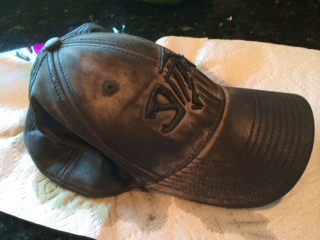
If you answered brown or beige, you're wrong. Do you think it's possible I could get you to say "NO WAY! THAT'S IMPOSSIBLE!" out loud in the next ten seconds?
Let's try!
CLICK or TAP HERE to discover the actual color of the baseball cap. Be sure to scroll down and read Georgia's short tale.
My lovely wife Kathy and I own the STAIN SOLVER company. We've been helping folks like you save hundreds of thousands of dollars cleaning countless things for over 25 years.
STAIN SOLVER is the BEST certified organic cleaner on our Earth Ball (planet). STAIN SOLVER will clean ANYTHING that's water washable.
Thousands of other Ask the Builder subscribers are happy STAIN SOLVER customers. It's time for YOU to become one too.
CLICK or TAP HERE to watch a few videos of how I use it.
SIDEBAR: Can you see how warehouse got its name? It's where you find/store wares.
Several days ago, I did a short consult call with Jeff. He had some troublesome corrosion on his copper water lines. To make a long story short, I shared how he could cut out the bad sections of tubing and put NEW in with NO SOLDERING!
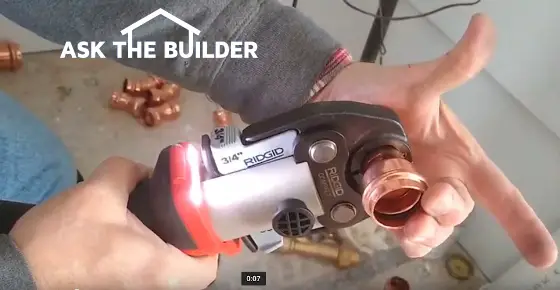
I said, "What if I told you that you could create a leakproof joint in about five seconds with NO THREAT of burning your house down? You just use the modern press fittings."
CLICK or TAP HERE and see how you can create joints using press fittings like a pro.
BTW, working with Uponor PEX water lines is just as easy. CLICK or TAP HERE and be sure to watch the video of me creating a PEX joint in seconds.
Moments ago, I just unloaded our dishwasher. I thought, "Jeeez, these glasses look like they weren't washed."
I decided to inspect the washer arm that's responsible for washing the glasses. It's under the top slide-out tray. You can easily detach it from the tray by rotating a ring on the center of it.
Sure enough two of the ports where water's supposed to squirt out were BLOCKED by pieces of pasta. I know what you're thinking, "Tim, don't you rinse off your dishes before putting them in the machine?"
Well, I'm not the only one that loads the machine and believe it or not the companies that make the soap that's used in dishwashers advise you to put the dishes in the machine with some food scraps on them! Read the label on your soap if you don't believe me.
I then mumbled, "Hmmmm, I've not cleaned the filter recently."
When was the last time you deep-cleaned your filter?
What? NEVER? Are you serious? Do you know where it is? It's at the bottom of the dishwasher pan. You can see it when you slide out the bottom tray.
This filter is there to protect the pump that circulates the water within the machine. But it collects GREASE and all the water used to RINSE your dishes passes through this filter multiple times in the rinse cycle.
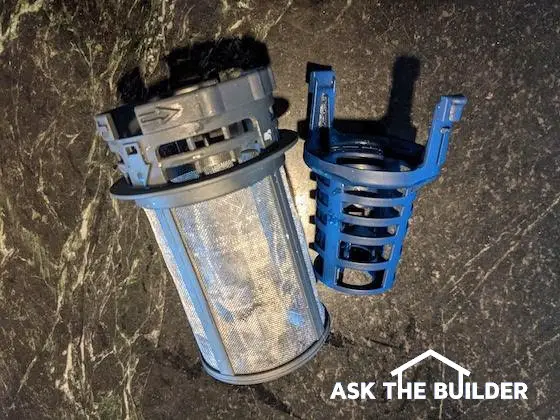
My filter was a mess. It had all sorts of grease clogging the fine screening. Right now it's soaking in a solution of, what else, STAIN SOLVER!
After a few hours, it looked like new. I just touched it up with a brush and some dish soap to make it look new. See for yourself:
CLICK or TAP HERE now to ORDER some STAIN SOLVER.
That's enough for a Sunday.
Tim Carter
Founder - www.AsktheBuilder.com
Super Clean - www.StainSolver.com
Telegrapher Tim - www.W3ATB.com
Do It Right, Not Over!
P.S. Infrared photos can show you where you're losing heat. They can even show you water leaks you don't know about. Now's the time to consider getting an infrared camera that attaches to your smart phone. Look at this photo.
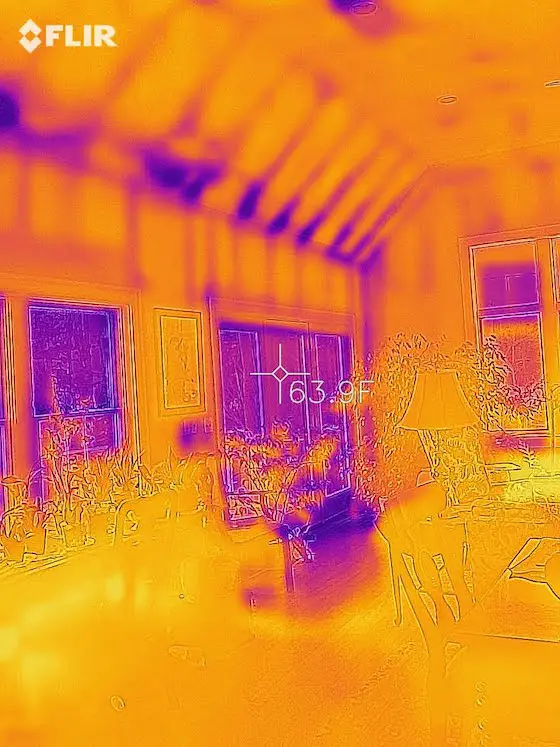
HOLY TOMATO! Look at the COLD spots in the sloped ceiling!!!!
CLICK or TAP HERE to see even MORE disturbing infrared photos and for a link to the infrared camera I use.
This is a very rare request for help. Are you a car rental warrior?
I need to rent a car in Phoenix for two weeks from November 6 until the 20th. The car rental company prices are absurd. Perhaps you know a secret car rental company I don't know about and can get a price down near $30 a day.
Anyway, I found out about Turo.com which is much like AirBnB. Private owners rent their cars. They usually have limited mileage, but my total mileage is well within the allowance.
Have you rented a car using Turo? How was the experience? Are you aware of other ways to get a superb deal on a safe rental car?
When I get your response, I'm going to curate all of them and share with the rest of the folks on this list so we can all benefit from your knowledge.
Time is of the essence. PSE respond ASAP.
Thanks!
Tim Carter
Founder - www.AsktheBuilder.com
Hold on a minute. Are you mingling with Kyoko, Martin, Jill, Dave, Marilyn, Gregg, and Andre' because you subscribed in the past week? My goodness, you're in good company as you're one of over 100 new subscribers that have joined my virtual family in the past seven days. Thanks for your trust!
This is an unusual newsletter as I just returned from a long trip and have some interesting information to share about it.
Three days ago, I got back from ten days of solo travel. Thirteen days ago, I jumped in my Ford F-250 4x4 and headed west from central New Hampshire towards Cincinnati, Ohio. The primary reason for the trip was my 51st high school reunion. CLICK or TAP HERE to see all those photos. Keep in mind my high school is almost 100 years old. Note the remarkable condition of the building.
About a month before leaving, I took possession of a new cell phone - the Google Pixel 5a. The camera inside this phone is remarkable. It has a special night mode as many modern cell phone cameras now sport. Look at this photo I took from the outdoor eating deck of the Incline House on the western flank of Cincinnati.

CLICK or TAP HERE to see the original high-resolution version. I can't say enough good things about the Pixel 5a. I'm only paying $15 per month for it over a two-year contract and that includes the damage/lose-it insurance! BTW, I use Google Fi as my cell phone provider. I immediately shaved 50% off my phone bill switching to Fi. If you want to know more about Google Fi, just ping me.
In just a bit, you're going to see about 130+ other incredible high-resolution photos and videos shot by the Pixel.
I want to give a huge shout out to Steve Flannery who manages the Ace Hardware store in the Dillonvale shopping center on E. Galbraith Road in Cincinnati. I was in desperate need of three moving blankets and Steve made sure I got what I needed! Thanks, Steve!
The secondary reason I was in Cincinnati was a very important business meeting. It was with two brothers I've known for 45 years!
We had lunch and as we were chit chatting, one of them asked me if I knew anything about these small black dots on his home. Look:
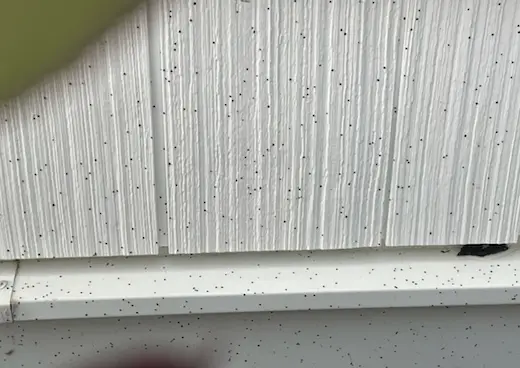
Do you have this problem on your home? He wanted to know if Stain Solver would clean them off. I said, "Of course it will, but it's going to take a little work."
It turns out the cause of the black dots is the wretched mulch he placed around his house. For years, he always used pine needle straw and never had an issue. This year he switched to mulch and now he's got a mess.
What causes the dots? Artillery fungus. These tiny organisms in the mulch can shoot very small blobs of spores and goop almost 20 feet up from the ground. Once the goop sticks to the house, it forms a hardened shell, the black dot, that's tough to remove.
When you compare that feat - shooting a tiny blob of goop up 15 feet - to what an Iowa-class battleship can do, it's a pretty good scaled comparison. The nine 16-inch artillery battleship guns could hurl a 2,000-pound shell about 20 miles.
Oh, you want to know more about battleships? I thought you'd never ask!
Each day I was gone on my trip, I had lots of things planned. One was a photography assignment. I took countless photos of the neighborhood where I grew up. You'll see those photos another time after I add captions. But in the meantime, here's one of the Esquire, my neighborhood theater that's been saved from the wrecking ball.

The last day of my trip I took care of a bucket-list item shooting over 130 photographs and a few videos. Many, I think, will make you say "WOW!" out loud.
I had always wanted to board and tour an Iowa-class battleship. It turns out the USS New Jersey is docked across the river from Philadelphia in Camden, NJ. I had to drive through Pennsylvania to get back to New Hampshire, so why not make a slight detour?

Two months before, by chance, I made radio contact with a ham operator on the ship. The New Jersey radio club has the vanity call sign: NJ2BB. I was so excited I went to their website and discovered they have a guest-operator opportunity. I immediately reached out and Dave set up the time to meet him when I boarded the ship.
How cool would it be to operate in the radio room of a battleship? To actually use the antennas on the ship! Let me tell you, it was thrilling!
I like to think of the New Jersey when it was active on the high seas as 45,000 tons of steel that did a fantastic job of preserving freedom and liberty. If you're a pacifist, you may look at her as a highly efficient killing machine that prevents you from kneeling by a large open trench. It was both.
President Theodore Roosevelt said, "Walk softly, but carry a big stick." Trust me, the USS New Jersey is one heck of a big stick. I URGE YOU TO DO ALL POSSIBLE to go visit the ship and tour it. It's a day you'll never forget.
You simply have no idea as to how BIG this ship is. In wartime, it had a crew of nearly 2,700 men. It was a small city.
CLICK or TAP HERE to see all my photos and videos of my tour experience. You'll see quite a few photos of signs that explain what you're looking at. Be sure to read all that information.
Would you like to see some videos that will entice you to make the trip to the ship? I thought so.
CLICK or TAP HERE to see the USS New Jersey's YouTube channel.
I think you've got plenty to do now looking at all the links above. I'll be back next Sunday with a more-normal newsletter.
Tim Carter
Founder - www.AsktheBuilder.com
Organic Cleaner - www.StainSolver.com
Radio-Room Man - www.W3ATB.com
Do It Right, Not Over!
P.S. What's the biggest flaw in your garage? CLICK or TAP HERE to see if it matches what I think it is.
This is a very very short and unusual newsletter. I've been on the road all week. I'm in Cincinnati, Ohio and attended my 51st high school reunion last night.

I've been far too busy visiting friends, not being able to have time to see enough of them I might add, and conducting a little business to pen a normal newsletter.
I thought you'd like to see a few photos of my high school. I've included captions explaining what the photo is all about. It turns out I should have taken at least 20 or 30 more!
I've already TESTED the following link. It works.
If it doesn't work for you, as the old message said on your Sony TV: "The trouble is in your set."
CLICK or TAP HERE for the photos.
I'll be back with a normal newsletter next Sunday morning.
Tim Carter
Founder - www.AsktheBuilder.com
P.S. In just a few hours on this Sunday morning, I'll be putting on a new right-front brake caliper on my truck. It malfunctioned on Tuesday driving through Columbus, Ohio. One of my good friends from grade school has a wonderful garage with all the tools we need. Otherwise, I'd have done it myself at home with my own tools.

Septic System Design and Pumping | This is the leach field for a septic system. Septic designers have all sorts of options and can make a septic system work on just about any lot. Copyright 2021 Tim Carter
Do you wonder how septic systems work? I never gave it much thought in all the years I lived in Cincinnati, Ohio. Every house I lived in was connected to a municipal sewer line. Just about every house I built I connected to a sewer line. There were a few houses I built that did have septic systems.
One, in particular, was very unique. The lot wasn’t big enough to support a traditional leach field. I’ll share what a leach field does in a moment. In essence, the system was a miniature sewage treatment plant! There was a propeller on a shaft that extend down into the septic tank. It was attached to a motor that was protected from the weather. For ten minutes an hour, this motor would spin working much like the blender in your kitchen. The only difference is when the propeller spun around, fresh air from outdoors was also injected into the swirling mass of water and waste inside the septic tank.
Visit a medium or large-sized sewage treatment plant and that’s what you’ll discover. Before they send the sewage back into the closest river, they aerate the wastewater. Introducing oxygen to sewage is a fantastic way to get rid of all the harmful things that one might find in wastewater.
If you’re a city dweller as I was for five decades, here’s how septic systems work for the most part. When you flush your toilet or water drains from a tub, shower, vanity, or kitchen sink, the wastewater flows through a 4-inch pipe that connects to a large precast concrete tank. The capacity of the tank can range from 500 to 1,000-gallons or more. They’re sized by septic designers based on the amount of projected waste that might be created within the house each day. Typically the designer goes by the number of bedrooms in the house.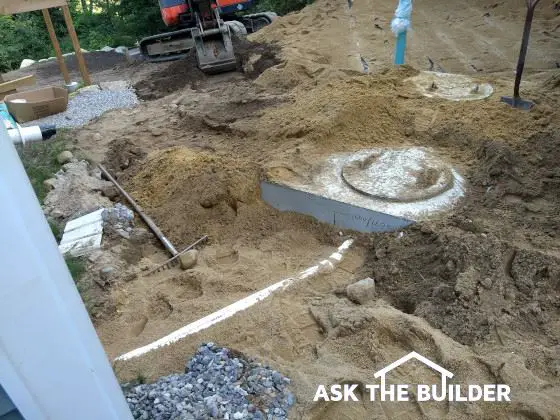
Some tanks have different partial suspended walls and baffles within the tank. These baffles isolate grease and other floating debris trying to ensure it doesn't make it to the leach field.
One of the biggest issues with septic tank installation is installing the tank BACKWARDS! It happens. A plumber might put the inlet pipe where the outlet pipe is supposed to be. You can get a diagram from the company that builds the precast concrete tanks. You can see clearly what's the inlet and what's the outlet opening.
The waste from your body, foodstuffs, and oils from your skin all contain bacteria. This bacteria starts to work in the tank to break down the waste. At the other end of the tank opposite the inlet pipe is an outlet pipe. For each gallon of water that enters the septic tank, a gallon of water flows out of it. This partially treated water that leaves the tank has lots of microscopic bacteria and pathogens in it.
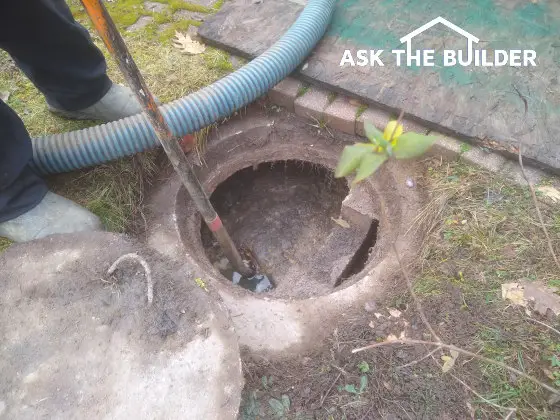
You simply can't believe how nasty the liquid is inside a septic tank. Countless bacteria and pathogens. This is a septic tank about to be pumped. It’s a best practice to do this every two or three years. Copyright 2021 Tim Carter
It flows from the tank, or is pumped up a hill, to the leach field. The wastewater enters a maze of pipes that have perforations in them. The pipes typically are set upon a thick layer of washed sand. The wastewater is distributed into multiple pipes where it then slowly enters the sand.
There’s lots of oxygen in the sand and other organisms. These work in tandem to purify the wastewater that drips out of the leach field pipes. It’s a simplistic system that’s time-tested and best of all it works very well if you watch what you put in your septic tank.
Years ago when I lived in Cincinnati, I would put anything I could down my drainpipes. Heck, as long as it made it out to the sewer line, foolishly I felt it wasn’t my problem. That was a bad attitude and municipal sewer plant operators wish more people would care. For example, I’d clean my paintbrushes in a sink thinking nothing of it. I’d emulsify grease from kitchen pots and pans and it no doubt congealed farther down in the sewer.
You never ever want to put any of these things, chlorine bleach, or any chemicals into a septic tank. The only thing that should go into the tank is waste from your body and toilet paper. The cheaper the toilet paper the better. Never ever put flushable wipes in a septic tank or a city sewer system. Why? Watch my Flushable Wipes video!
If you plan to build in a rural area where a septic tank is in your future, put in a utility sink in the laundry room or garage that drains directly outdoors. In other words, don’t connect the sink to the septic tank. Many inspectors allow this gray water to flow onto the ground away from your home because they don’t want you to put paint, grease, or who-knows-what into your septic tank. Wash all the bad things in this sink, not the other sinks in your home.

Here's a riser isometric drawing showing the separation of gray water from black water in a home. CLICK or TAP HERE to have me draw your riser diagram.
It’s vital that you pump your septic tank at least every three years. It’s affordable and it ensures that you won’t ruin your leach field. It’s very expensive to replace a leach field with costs running in the thousands of dollars. I only pay, in 2021 dollars, $285 to pump out my 1,000-gallon septic tank. You can see why it really pays to do this. The average cost per year is less than $100.00.
Column 1424
Subscribe to the FREE Ask the Builder newsletter to receive professional advice for your home. Complete the form below and each week you'll get:
Unsubscribe at any time. We respect your email privacy.