How to Fix Cracked Grout on Tile Floor

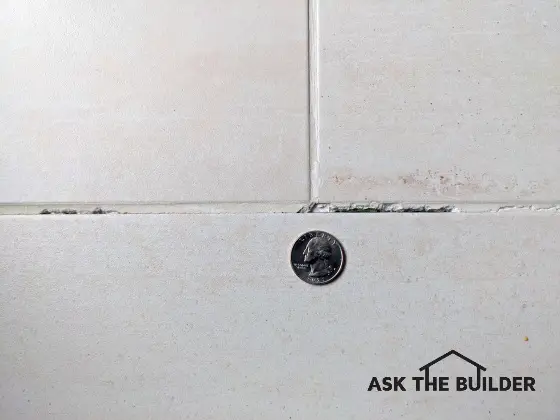
bad grout with quarter for sizing

How To Fix Cracked Grout on Tile Floor | This grout is less than two years old. It started to degrade less than six months after being installed. Copyright 2022 Tim Carter

Cracked Grout on Tile Floor

A few days ago, I was singing Happy Birthday for the third time to my granddaughter in the kitchen of her parent’s newer home. It was a festive morning and cake was served before lunch. After taking the first bite of the delicious cake my daughter made, I’m thinking this is a brilliant new trend many should consider!

Right behind and below my granddaughter was a section of grout in the tile floor that was defective. A significant amount of grout was missing from the joint. There are no less than ten or twenty other random places on the tile floor throughout the house where this exact same thing is happening.

When Was the House Built?

Days after my granddaughter was born, I was installing the cast-iron drain pipes in the house. Eighteen months later, it was move-in day. I was not the builder on the project but I did install all the plumbing, electric, and radiant heat in the home. Unfortunately, the builder lacked the skill set of how to order products in advance and schedule other subcontractors so there was activity on the job site every day. In my day, a simple rectangle custom house like my daughter’s would have taken me less than seven months to build from start to finish.

You can probably do the math, but the floor grout that failed is less than two years old. It started to fail within a month after my daughter moved in. There are quite a few reasons floor grout can fail, and based on where it’s failing in the house I’ve come to the conclusion it’s a simple workmanship error.

Do Wood Subfloors Cause Grout and Tile Cracks?

Your floor grout can crack if the floor itself flexes. Ceramic tile can be installed over a wood-floor system but it’s imperative the floor be as stiff as a granite countertop. In your lifetime you may have walked across a somewhat bouncy floor that felt a bit like a trampoline. These floor systems do meet minimum building-code requirements, but they’re death on a stick for ceramic tile flooring and grout.

My daughter’s home has a stiff floor. I made sure of this in the design. The two-story house is constructed using engineered floor trusses. In fact, the trusses under my granddaughter’s stool, while she was eating cake, were special extra-stiff ones made to compensate for the massive 10-foot by the 5-foot center island in the kitchen. There is absolutely no flex whatsoever in my daughter’s floors.
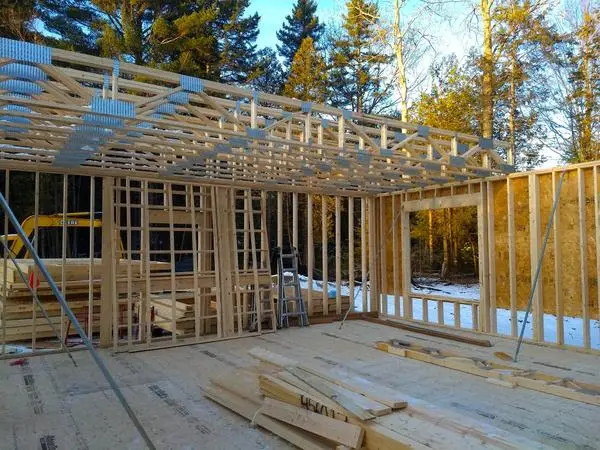
second-floor wood floor trusses

These are the floor trusses in my daughter's home. The floor I'm standing on to take the photo is also made from floor trusses. Copyright 2022 Tim Carter ALL RIGHTS RESERVED

Was the Actual Grout Defective?

Eliminating this possibility points the finger at the installer and possibly the actual grout itself. It’s easy to eliminate defective grout because a vast majority of the grout in the tile is fine with no defects. The floor was grouted over a period of a few days in the late spring of 2020.

How Does One Determine the Cause?

The random locations of the defects provide the insight to help determine the cause of the failure. Some are adjacent to bearing points of the floor trusses and others can be found mid-span of a few trusses. If the grout were failing just at mid-span you might make a compelling argument that the floor trusses have just enough flex to crack the grout.

But there’s a difference between when the grout just cracks and when it turns to powder and giant gaps and holes in the grout are present. This is the issue my daughter faces. The smoking gun, in my opinion, points to small amounts of grout that had already started to harden in the bucket and were applied by the tile setter. He may have even added a tiny amount of water to the stiff grout to make it workable.

How Do You Fix the Cracked and Missing Grout?

About ten years ago, I recorded with the help of my future son-in-law four in-depth videos showing exactly how to mix, install, and finish sanded floor tile grout so it can last for hundreds of years. Realize that floor grout is simply a miniature version of concrete and I can show you concrete in different parts of the USA that’s over 100 years old and has withstood decades of harsh weather. Your floor grout never has to experience this since it’s inside! You can watch the four videos at the bottom of this column. Keep reading, though!

The key to creating floor grout that lasts is controlling the water that’s used to mix it and the amount that’s used when you strike the joints with a sponge to make them look perfect. Keep in mind the instant you mix water with the dried grout you start an irreversible chemical reaction called hydration. Tiny crystals in the Portland cement in the grout start to grow. As more and more crystals grow, the grout gets stiff and eventually, it gets as hard as a rock. After all, all the components in standard sanded floor grout are all rock except for the water.

If the mixed grout in the bucket starts to get stiff because it wasn’t installed fast enough, there aren’t enough crystals left to bond to the sides of the tile in the actual grout joint. What’s more, if the installer decides to add a little water to make the grout workable, he breaks apart many of the crystal bonds that have already formed. These are not self-healing.

You can also ruin floor grout when you’re finishing the joints. The sponge that’s used to strike the joints must be just damp with all the excess water squeezed out before you slide the sponge across the floor tile and the grout lines. If excess water gets on the wet floor grout, it can dilute the amount of the Portland cement in the grout in those random areas where the water soaks into or puddles on the wet grout.

Column 1444


Best Heating System for House?

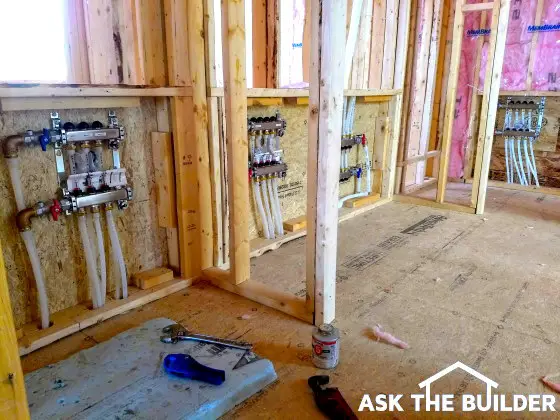
radiant heating distribution manifolds

Best Heating System for House | These are radiant heating distribution manifolds. Hot water enters the manifold and it’s sent through the smaller tubing to heat the floors in this house. It then returns to the boiler to get reheated. Copyright 2022 Tim Carter

What is the Best Heating System for House? - Well...

You might overhear several pickup truck owners bragging about how their Ford or Chevy truck is better than all the rest. It might even be a Ram or Toyota owner. The odds of any of them convincing the other to change brands is more remote than rainfall in the Atacama Desert. This same debate has raged for years with HVAC contractors about what is the best heating system.

I don’t know that there’s a definitive answer, but fortunately I’ve had enough experience with several systems that I can weigh in and give you some food for thought should you be in a position to build a new home or be involved in a massive remodeling job where you just might have the budget and ability to transform the way your home might be heated.

I grew up in Cincinnati, Ohio. The homes built in the late 1800s in the Queen City almost all were heated with hot water or steam radiators. These houses were built long before air conditioning had been invented. Radiant heat is luxurious as I currently have it in my New Hampshire home. I’ll share more about this in a moment.

Gravity Furnaces

Some older homes had monster furnaces that worked on gravity. They’d heat up the air inside a giant round furnace and it would float up through metal ducts into the house. Cold air is heavier and it would drop back down into the basement to be reheated by the wasteful burner. More modern houses transitioned to forced hot air with a blower pushing air up into the rooms. This same air handler would deliver cool air in the summer if you had an air conditioning system too.

Forced-Air Systems

Forced-air systems offer lots of advantages for purifying the air in your home and adding humidity should it be needed. For these systems to work best, the supply and return ductwork needs to be carefully sized and installed so all rooms are comfortable.

Coal Stoves

I have a very good friend here in New Hampshire that heats with anthracite coal. He has two coal stoves and only uses the one when the temperature drops below 0 F for an extended time. One advantage to using coal is he knows when it’s all delivered in the fall, he’ll never be cold at all in the winter. He has all his required fuel. If you’ve ever lost power and been cold, you know how well my friend sleeps at night.

Propane - Natural Gas Systems

You can’t say that about me as I depend on three propane deliveries per winter season to keep my tank full. You may depend on natural gas to flow to your home each day. What happens if there’s some national shortage of gas? How will you keep warm? The disadvantage to my friend’s archaic coal stove is it’s a little dusty in the house and he needs to feed it twice a day.

floor truss framing

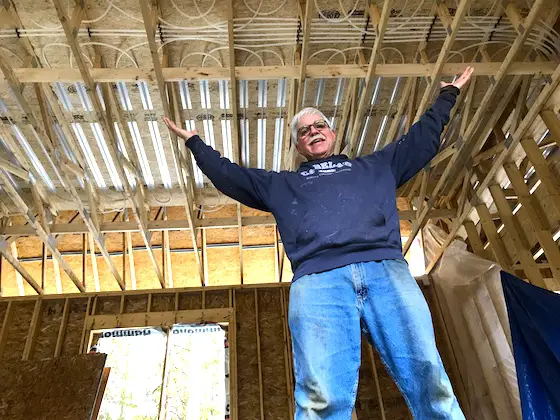
Above me are floor trusses. See the Uponor hePEX tubing in the Uponor radiant heat transfer plates? No wonder I'm so happy! Copyright 2022 Tim Carter

Radiant Floor Heat

What about radiant floor heat? I have it in my home and it’s quite possibly the best form of heating I’ve ever experienced. The entire floor of my basement is toasty warm. It’s magical to step out of a shower onto a warm tile floor. I have six different zones in my system so I can save on fuel by using programmable thermostats to keep rooms in several zones cooler when I’m not in them.

You can also install radiant heat using sleek baseboard radiators if you can’t afford to put the heating tubes under each floor in your home. My house has both radiant floor heating and these baseboard heaters. The plastic tubes that supply the heat to the radiators install just like electric cables. In just a few hours, two workers can easily run all the tubing for baseboard radiators in a modest home.

Modern boilers and forced-air furnaces have modulating technology. This means the burner works like the one on your gas or electric stove. When you cook, you can adjust the amount of heat so you can boil water on high heat or just apply enough heat to simmer a tasty gravy. The same thing happens when a part of your house calls for heat. The boiler or furnace only produces enough heat to satisfy that demand no matter what it is. This saves energy as less heat is sent outdoors with the exhaust gas when the burner is on low.

baseboard heater radiant heat

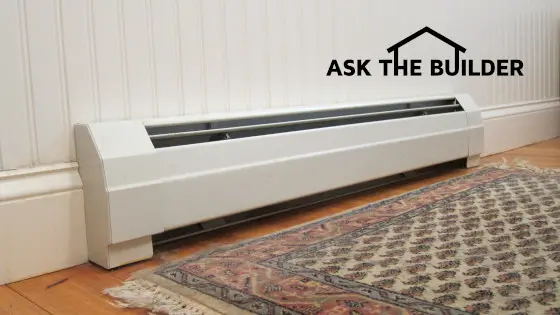
This is a sleek baseboard heater. Hot water enters the heater at one end flowing through a large tube to which radiating aluminum fins are attached. Air is heated and floats up softly into the room. These are very effective.

Electric Heat

Perhaps the most basic heating system you can install is one that just uses electricity. Simple baseboard radiators or portable ones can be used for heating. There are no moving parts to speak of but the downside is electricity costs may be quite high where you live.

Heat Pumps

Heat pumps are electric heating systems, but they’re very complex machines. They do double duty as air conditioners in the summer. Modern heat pumps are quite efficient but once again, electricity may be pricey where you live. What’s more, electricity is quite possibly the least reliable heating fuel that you can choose. The news is littered with stories any time of year about hundreds of thousands of people without power when large storms damage power lines.

What am I going to do when I build my next home? I’m going to install radiant floor heating in the entire house and have a wood stove backup heating system. I’ll stock in enough dried oak firewood to provide a few months of heat should propane become scarce.

Column 1443

February 20, 2022 AsktheBuilder Newsletter

Newsletter Issue #1170

Guess what? This could be your first issue! I sure hope I exceed your expectations. Since you're new around these parts, be sure to check out the special offer below on my entire Digital Library.

You, though, may have hitched your wagon to my mastodon with issue #1003. If so, you undoubtedly remember the video about how easy it is to create a PEX connection.

The Owl Moon

I'm fortunate to be able to share with you each week what's going on in my life even though I have no clue what's happening with you. You can get a dose of me six days a week if you read this newsletter and watch my new LIVE stream videos.

If you can't catch them live, you can watch them after the fact. During a LIVE stream, I always share what's going on in my world. This new venture of mine has allowed me to create a wonderful group of new friends.

I remember many times talking with my kids about how to cultivate and care for a friendship. It's like watering a plant. If you stop watering plants, they tend to die. You need to water the friendships that mean something to you on a very regular basis. I'm sure you've seen them wither when you don't. I suggest you reach out today to some friend of yours that needs a gulp of water! You'll feel refreshed too.

I also remember reading books to my kids when it was time for bed. Kathy did this most nights, but occasionally, I was happy to do it because I did something unique that she didn't.

If your kids were like mine, they'd ask you to read the same book over and over again so much so that they knew every line in the book. Keep in mind at this young age they actually couldn't read, they just memorized what Kathy or I said.

To see if they remembered, part way through a story I'd change the end of a sentence. For example, I might read, "The grasshopper and his chipmunk friend strolled through the forest on the wide trail carpeted with soft pine needles. After quite a few minutes of walking, they decided to rest next to a babbling brook. Gary the grasshopper opened his soft leather satchel and pulled out three cheese coneys with heavy onions and no mustard sharing them with Charlie the chipmunk."

Immediately, my oldest daughter would say, "Dad! That's not what the book says! They didn't eat cheese coneys!"

It became a game. My kids would be on pins and needles waiting for when I'd insert some quirky thing the characters in the book would do, say, eat, or who-knows-what. To change it up, I wouldn't always go off script.

What great memories! Speaking of memories, did you read the Owl Moon book to your children or one of your grands? I remember when I did with my kids. If you read this delightful book to them, I guarantee you they'll think of you each time they see a full moon on a delightful clear cold winter night.

Several nights ago, an Owl Moon rose up over my house in central New Hampshire. It was the night before the full moon so a little more wax had to be applied to the glowing orb the next day.

Check out the photo below. The moon beams were reflecting off the smooth ice of Lake Winnisquam just below my deck as I captured this wonder of nature.

If you want your grands to think of you each time they see a giant machine digging in the earth, then be sure to check out Mike Mulligan and his Steam Shovel.
Moonrise over Lake Winnisquam NH

Save at Least $300

What do the drain-cleaning plumbers charge in your city/town should they have to come out and get all the ground-up eggshells out of your kitchen drain pipe? I'll bet no one ever shared with you EXACTLY how to use a kitchen garbage disposal. Point your peepers at this photo:

sink drain strainer screen food catcher

You can save GOBS of money if you use what I'm holding in the photo above. I BEG YOU to read my recent column about how to prevent drain clogs and how to take care of all of your house drain lines.

Late-Breaking News:

NH Surgeon Admiral Declares Tim Carter UNFIT to Price Digital Products

ATB Entire Digital Library

Ask the Builder ENTIRE Digital Library

Don't be confused by that photo!!! Those are books in my office. It's a small part of my own small library made from atoms, not electrons.

The Ask the Builder Digital Library is all the money-saving stuff I've created in the form of PDF files, videos, and spreadsheets.

ON SALE NOW - 96% DISCOUNT - CRAZY!
You get all my eBooks, all of my new-home-construction digital products, all my project checklists, contractor hiring guides, video packages, etc.

$49.99 - LIMITED OFFER

This Digital Library is normally $1,250.00

You'll be declared certifiably INSANE if you don't click the BUY NOW button below and go look at the 112+ digital products that make up my Library!!

You get ALL OF THEM for just $49.99.

Buy Now!

What You've Missed

Three months ago, I started doing LIVE video streaming during the week on my YouTube channel. I'm normally LIVE M-F at 4 PM Eastern Time right here. It's a HOOT!

While I have a main topic that I discuss for a few minutes, the viewers - that's YOU - then decide what I talk about. You can ask me questions LIVE while the stream happens. You can ask ANYTHING. Think of the sweet moola you'll save!

Here are a few of my recent LIVE streams:

Outdoor & Indoor Extension Cord Sizing SECRETS

Amazing Digital Tape Measure! eTape16

Relocate a Bathtub - What Could Possibly Go Wrong?

Magical Hydrated Lime - A Miracle Product

That's enough for a winter Sunday. I know, it's summer if you're Down Under. I hope you're at the beach today! I was at the beach here in NH several days ago, so there!

Tim Carter
Founder - www.AsktheBuilder.com
Hilton Hotels Clean With - www.StainSolver.com
QSL - www.W3ATB.com

Do It Right, Not Over!

P.S. Are you going to build a shed this spring? For the love of God, don't do it without my help. Watch me build a deluxe shed. I'll even throw in the PLANS for the shed FOR FREE if you email me after you get the video set.

Timberland PRO Direct Attach Boots

timberland pro direct attach boot

Timberland PRO Direct Attach Boots | This is what they look like if you wear flood pants. Guess what? They passed with flying colors one of my most stringent tests. They stayed TIED all day with that simple regular knot. My other boot would have come untied three times forcing me into the double-knot territory. These Timberland PROs come with magic laces!

Timberland PRO Direct Attach Boots - Handsome and Tough

I tried out my new Timberland PRO Direct Attach work boots today. They were nice and soft out of the box. While they seemed a little stiff when I first walked around, within an hour they felt like they were my trusted boots I'd worn for six months. I've got them on now as I write this.

You can purchase a pair of these Timberland PRO Direct Attach boots here.

Key Features + Benefits:

  • Asymmetrical steel safety toe
  • Waterproof leather with seam-sealed waterproof construction
  • Electrical Hazard Protection
  • Contoured shock-diffusion plate for structural support
  • Anti-Fatigue technology polyurethane footbed for shock absorption and energy return
  • Padded top collar for comfort
  • Breathable and moisture-wicking lining with anti-microbial treatment for odor control
  • Direct inject construction for durability

Technology:

  • Steel safety toe
  • 18kv electrical hazard
  • Waterproof membrane
  • Anti-fatigue technology
timberland pro direct attach boot

These are pretty handsome boots. What do you think?

timberland pro direct attach boot sole

This is the classic Vibram sole pattern I believe. I remember my first hiking boots I bought in 1972 had Vibram soles. My guess is the patent has long since expired!

timberland pro direct attach boot

They say they're waterproof. I've not tried to test them yet. Normally those claims are true.

timberland pro direct attach boot

This is what you're friends will see if you wear normal-length pants.

February 13, 2022 AsktheBuilder Newsletter

AsktheBuilder Newsletter #1169

Is this your first issue? If so, I'm glad you're here. Each issue of my newsletter is created on the fly. I tap into what's happened the previous few days and share that life experience with you.

It just so happens this is a bi-polar issue! I think you'll enjoy it. You get to see what happens when I get stung by a bee so to speak.

You, however, might have signed on with issue #742. Do you recall the column I wrote about painting vinyl siding?

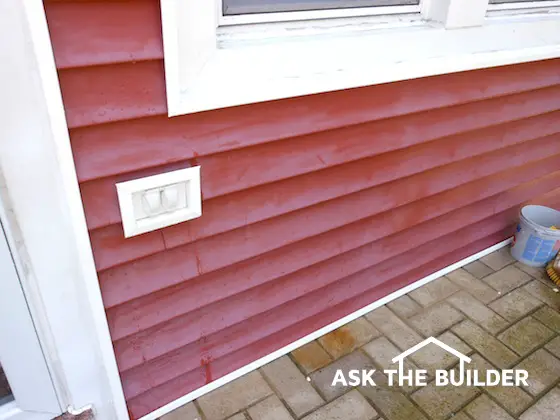
Faded red vinyl siding

Lots of people ask, "Can you paint vinyl siding?"

I have the answer for you in this column.


Become a Sustaining Ask the Builder Member - Should something in this issue save you time or money, you can sustain me with mocha chip ice cream or three cheese coneys and a 5-way.


Steve in France

A few days ago, I did an international consult call with Steve. Actually, we did a ZOOM video call so he could walk around his house to show me the plumbing challenge he faced.

I'm happy to talk with you on the phone too.

Steve is adding a full bathroom and he needed my help understanding how to install both the drain, waste lines, and the vent pipes for each fixture.

I rapidly became aware that Steve is doing much more than the plumbing. He's undertaking a massive remodeling project that involves a large portion of the house.

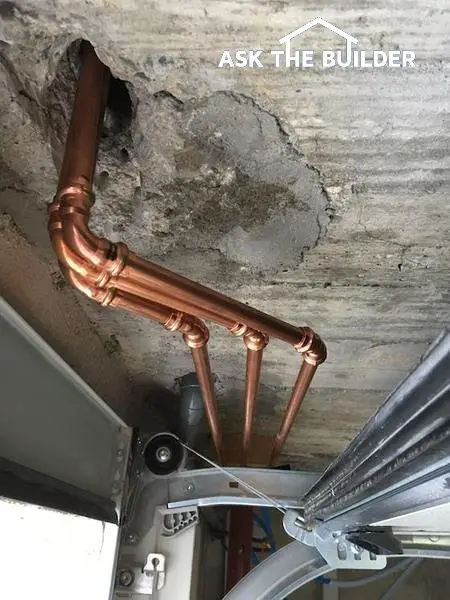
He had already installed some copper water pipes and he used the magical press fittings that require no soldering. Look at Steve's workmanship:
copper tubing with press fittings

I'm sharing Steve's story because I find it inspirational. He's eating an elephant but doing it one bite at a time.

You can do the same - no matter if you want to build a shed, remodel a kitchen, or build a small room addition.

Steve didn't buy the tool to crimp those fittings onto the copper tubing. He was able to rent it for just 50 Euros a day. You'd be surprised by the tools you can rent so you don't break your budget.

I'm not aware if Steve watched my video about a copper press tool to see how easy it is to install tubing, but I suggest you watch it right now.

Be aware that no matter what project you face, I can be your lifeline. Zoe, a young woman in New Mexico, had me on the phone just a few times last spring. I helped save her over $18,000 when she ended up doing all the plumbing in her new home.

No matter what your project is, I can help you on the phone or in a ZOOM call.

Next week, I'm going to tell you about the other inspirational Steve.
old cincinnati bengals logo bengal tiger

Short-Term Rental Cage Fight

Do you know much about private property rights? If you live here in the USA, they're sacrosanct.

Do you know anything about the Game of Thrones? It's played each and every day in each HOA, every company, each town, city, state, and country.

Right now a strategic Game of Thrones is happening where I live in New Hampshire.

"...There is no middle ground."

Imagine these situations. A different group of eight seniors wants to rent your house each week of the summer so they can play Scrabble out on your deck sitting in the breeze at a large shaded table drinking lemonade. They may occasionally giggle.

Or, imagine a national society that wants to rent your home so a different group of young people who are both deaf and mute can come and sit on your deck each week. All they want to do is meditate and look out at the lake all day.

I could go on and on and on with examples of how you might rent your house to people who would never bother your neighbors.

My HOA Board is trying to muster enough votes from the people that live here to prohibit weekly short-term rentals no matter who I'm renting to.

It's a hateful abuse of private property rights.

I've already done my preliminary research and discovered the courts all across the USA don't look favorably on HOAs that try to change the rules like this after the game has started.

If you're aware of lawsuits where a homeowner BEAT her/his HOA in a similar short-term rental battle, I'd LOVE for you to share it so I can add it to my list. Please email me a link to a page on the Internet about the lawsuit.

There are countless court cases ruling in favor of homeowners who want to rent. The HOAs who want to infringe on your private property rights almost always crawl away from the cage fight bleeding, bruised, and beat.

What's shameful about my HOA's stance is they're not offering to help pay my real estate taxes, upkeep, etc. but they have no issue infringing on my ability to raise the money to do such things.

It's a mindset that far too many have who try to tell you what you can do with your life and your property for goodness sake.

It's one thing to have the rule in place when the development is first put on the market and no one has yet purchased in the HOA. However, it's quite another matter to try to enact something like this after everyone has already purchased their home.

One might say that those newer residents of my HOA that don't like renters maybe shouldn't have bought into this development. They knew at the time they purchased that anyone here can rent their home at will.

But what do I know? I ate lunch for 20+ years sitting on overturned empty drywall mud buckets. I'm trying to convince the Board to stop this before it gets ugly and we just enrich the local lawyers.

Do you stand up for your rights when someone tries to put a boot on your throat? If not, you'll suffocate.

Do you recall what General Stark wrote in a letter in response to an invitation to attend a reunion celebrating his Revolutionary War victory in Bennington, VT?

“They were men that had not learned the art of submission, nor had they been trained to the art of war. But our astonishing success taught the enemies of liberty that undisciplined freemen are superior to veteran slaves.”

At the end of his letter, General Stark included the famous line that had been touched upon years before in other historical conflicts of good vs evil. He intended this line to be said in a toast to his men at the reunion so the story goes:

“Live free or die. Death is not the greatest of evils.”

My HOA Board heard a shot whistle about 1 foot above their deck Friday morning when they opened an email I sent around 8 AM. We shall see if they have the courage to do the right thing and back down.

If I were a betting man, I'd wager they're going to hold fast even though I shared that the proposed bylaw amendment is most certainly illegal.

In the email I sent to them, I opened the bomb bay doors and showed them I have an atom bomb.

Just before the next meeting, I'm going to drop it if they don't back away from this initiative.

The reference to the atom bomb comes from a fantastic attorney I served with on Amberley Village's Council. His name is Louis.

Louis taught me in negotiations of any kind if you have the strong hand, you do a low-pass fly over and open your bomb bay doors to show your opponent that you do, indeed, possess the atom bomb.

That said, you never drop the atom bomb unless you have to as utter destruction results. There are no negotiations after you drop an atom bomb.

My HOA Board made a grievous tactical mistake in an email reply to me about ten days ago. That error is going to be shared with all the folks in my HOA just before the meeting where the vote will be cast on this short-term rental agreement.

Yes, I made it crystal clear to the Board in my email that was the atom bomb fashioned by this undisciplined freeman.

Here's one thing about me you may not know. I don't like to start conflict. But by gosh if one is forced upon me, I'm all in like in Texas Hold 'em.

That's enough about bombs, bad jujumagumbo, and royal flushes on a Sunday morning.

I'll be back next Sunday. You didn't know I could fly a B-52 just above stall speed did you? You might even wonder if I've flown in an F/A-18 Hornet.

By gosh, you learn something new each Sunday in an AsktheBuilder.com newsletter! Look just below to toss me a treat.

Tim Carter
Founder - www.AsktheBuilder.com
Hilton Hotels Clean With - www.StainSolver.com
K-2666 POTA - www.W3ATB.com

Do It Right, Not Over!

P.S. Can you guess what it might have cost to build the Old Tech building on the University of Cincinnati campus back in 1901? It was a pretty big brick building, two stories with a big basement. Let me know if you were within 25 percent. Here's a photo of it. It's NOT the giant building with the spire in the right photo. It's the building to the right still partly in the shade.

old tech building at university of cincinnati

WHO DEY?

Become a Sustaining Ask the Builder Member - You can sustain me with mocha chip ice cream or three cheese coneys and a 5-way should something in this issue save you time or money.

Drain Clog Prevention

screened sink strainer

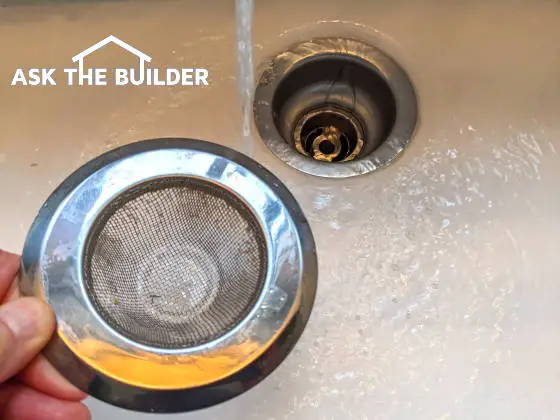
Drain Clog Prevention | This very inexpensive food catcher screened strainer can save you hundreds and thousands of dollars in drain-cleaning fees. It fits perfectly over the basket strainer at the top of the photo. ORDER SEVERAL of them now right here. Copyright 2022 Tim Carter

Drain Clog Prevention

The inspiration for this column came from two different friends of mine who live in Los Angeles (LA), California yet don’t know each other, but do know that I’ve been a master plumber since 1981. One was my best friend Steve who asked me about a mailer he received from a local plumber advertising a high-pressure drain-cleaning service.

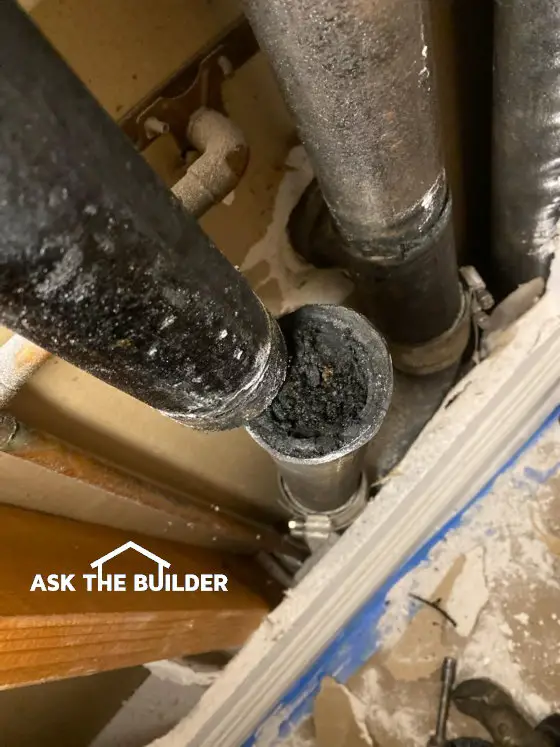
The other friend is Alex, a contractor, who tunes into my new live streaming video each M-F. He sent me a photo of a clogged 2-inch kitchen drain stack and this comment, "I have a client that kept snaking their drains and was reluctant to change out the pipe. He wanted to know why he had to call a plumber to come out each month. I looked at years of plumbing bills and told him, ‘Congratulations, you put this fine plumber’s child through college.’ "

The photo Alex sent me showed the stack completely clogged with gross black organic debris. No wonder the pipe had to be snaked each month to get the sink to drain. All of this misery and expense is preventable not only in the LA house but yours too! Allow me to share decades of experience so you can avoid clogged drains in your home.

cast iron stack completely clogged

This is a cast-iron stack completely clogged with organic debris. Grease was the main cause of the clogging. (C) Copyright 2022 Tim Carter

What Should Be Put Down Plumbing Drains?

First and foremost, the only thing that should flow through the plumbing drains in your home is water, human waste both solid and liquid, and very tiny particles of solid food. Note that I didn’t say toilet paper is okay. Realize that people who live in other parts of the world think the use of toilet paper is actually somewhat unsanitary and unacceptable. They use water to cleanse their body parts.

I find it shocking that major US plumbing fixture manufacturers don’t heavily promote bidets. You should watch my Flushable Wipes video to see how high-quality toilet paper doesn’t break down much at all as it travels through your drain pipes.

What is the Worst Thing to Put Down a Plumbing Drain?

Grease is one of the worst things you can put down your drains as Alex’s client has come to discover. While you can liquefy it and seemingly emulsify it by mixing in liquid dish soap with the grease in the pan, the grease will eventually begin to coat the inside of the drain pipes. This grease can capture larger food particles and rapidly choke off the drain line.

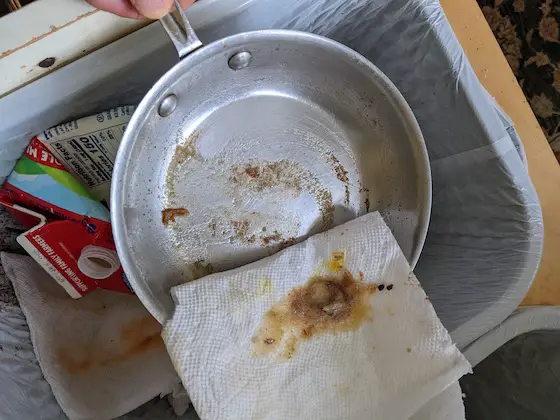
The way to deal with grease is simple. If you use paper towels for light cleaning or to dry your hands as I know some to do, put these wet or damp towels aside and allow them to dry. Use these to sop up warm liquid grease in your pots and pans. Wipe off greasy plates and bowls with these used towels and then throw them in the garbage. Your goal is to minimize the amount of grease you put in your drain system.

greasy pan with paper towel

I've already started to wipe some of the thick grease from the pan. Look at it on the dry used paper towel. NEVER allow grease like this to go down a drain. (C) Copyright 2022 Tim Carter

What about Tampons, Feminine Napkins, and Flushable Wipes?

NEVER put any feminine hygiene products or flushable wipes into a toilet. These are absolutely unacceptable in a septic system and it’s not a good idea if you’re on a city sewer. All of these things should be placed in a nice sanitary waste can in the bathroom. The can should have a plastic liner and a lid. Post a sign in the bathroom for guests to use the can for disposal. You should really watch my past video demonstrating what happens to flushable wipes as they travel through your sewer line.

Should I Use a Food-Catcher Sink Strainer?

Purchase a drop-in stainless-steel screened strainer that fits perfectly in the basket strainer of your kitchen sink. These simple and affordable devices collect food particles with ease. Once the strainer starts to fill, lift it out of the sink and dump the food waste into your garbage can.

Are Garbage Disposals Harmful to Plumbing Drains?

Do you use a garbage disposal in your kitchen thinking these are the answer? They’re not because most homeowners have never been trained how to use one so as to prevent clogs. If you want to see what a garbage disposal creates, just get out your blender with the clear blender jar. Put your food scraps in it, add a little water, turn it on, and look at the sludge you create.

If all of this sludge is not transported to the septic tank or city sewer, it can start to coat the sides of the drain pipes and choke them off over time. If you insist on using your disposal, then you must keep the sink water running for 30 seconds after you turn off the machine. Better yet, after you turn off the water, pour two gallons of water as fast as possible into the kitchen sink to flush the sidewalls of the horizontal branch drain arm in the wall and the vertical drain stack that services the kitchen sink.

How Can I Dissolve Grease in a Plumbing Drain Line?

It’s a great idea, if you can do it, to pour about 15 gallons of very hot water down your kitchen sink once a month. You want to pour this heated water into the sink as fast as possible being careful not to burn yourself. The idea is to put so much water into the pipes that the tubing under the sink and the horizontal branch arm in the wall behind the sink completely fill with hot water. This will dissolve any grease from the sides and top of the pipes keeping them as open as possible.

How Can I Flush Out my Main Sewer Drain Line?

Each week it’s a great idea to pour ten, or even 15, gallons of cold water into your toilet as fast as possible. If you can do this with a helper all the better. Your goal is to create a man-made flash flood in your bathroom drain pipe and stack as well as your main building drain. Just as Mother Nature keeps creeks and stream beds clean of accumulated debris with an occasional flood, you should do the same. This massive surge of water flowing through the pipes goes a long way to keep them wide open.

If Steve does this, he can use the money he would have given the plumber who sent the mailer and take his soulmate out to in nice dinner down the hill in Pasadena!

Column 1442

Building a Front Porch

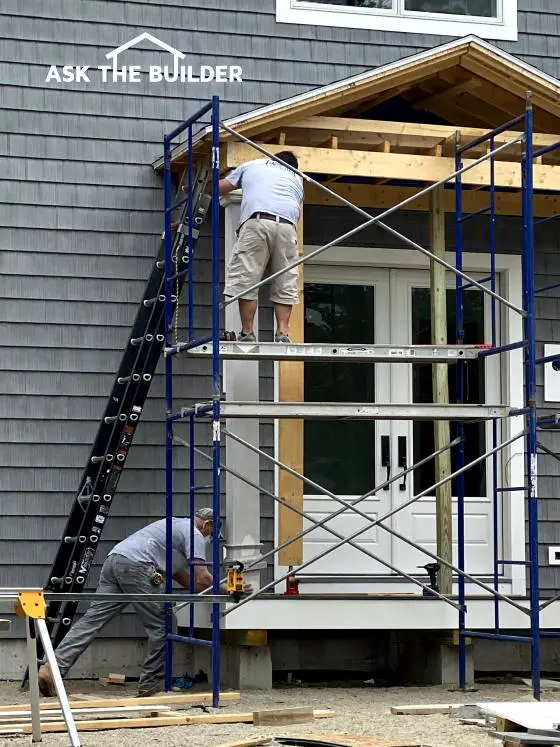
Building a Front Porch

Building a Front Porch - This front porch adds value and interest to the look of this new home. It also acts like a warrior’s shield. Copyright 2022 Tim Carter

Building a Front Porch - Size Matters

Does your home have a covered front porch? Do you need front porch building ideas? If so, I've got valuable ideas about how to build a front porch just below.

Every house I’ve owned, except for the one I live in now, has had one. It’s important to realize I didn’t build the house I live in now.

The first two homes I lived in had magnificent covered front porches that were as wide as the entire house. The first home was a craftsman-style one with the original giant iron eyelets in the ceiling put there to support a two-person porch swing. I’ll never forget that house and each time I visit my hometown, I carve out time to drive by it, park in front of the modest home, and reminisce about the wonderful nights spent on that porch with my new bride!

2865 Minto Ave Cincinnati

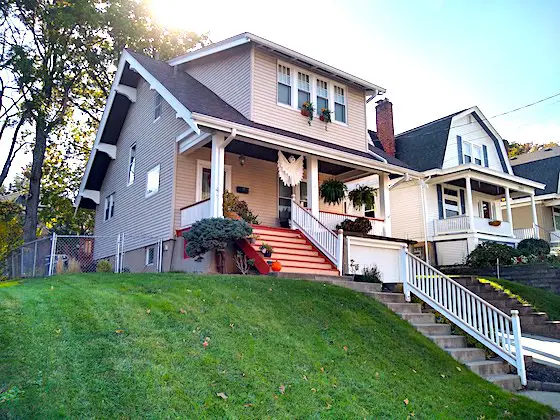
This is the first house I owned! It's at 2865 Minto Ave in Cincinnati, OH. Look at the magnificent covered front porch. It's still in marvelous shape. I remember dumping all the plaster from the second-floor rooms into a chute we had made that went into Tony Albanese's 1-ton dump truck in the driveway. See that lower set of concrete steps? I installed those in the fall of 1975 myself. This photo was shot in 2019 when I went to Cincinnati to visit a very dear friend. The steps were in perfect condition.

I was so lucky to grow up and start my career in Cincinnati, Ohio. The city has an abundance of fine homes built in the late 1800s and early 1900s. While I didn’t appreciate it at the time because of a lack of life experience, I now realize the architects and builders back then were exceptionally wise.

6270 Robison Road 45213 house

This is the second home I owned. Look at that huge covered front porch. You can't really tell from the photo, but the center section of railing next to the steps going up to the front door is curved! The owner before me had taken all the railings down but fortunately had saved them in an old wood shed in the backyard. This photo was taken by a very dear friend of mine who lives less than a mile away. Her childhood home is just behind this house and to the right through the woods behind this house. It's a small world, isn't it?

It’s possible I could write a book about all of what I think they did to create houses that would stand the test of time, but today let’s just focus on front porch building plans.

Is a Front Porch an Outdoor Room?

A covered front porch is really an outdoor room. Today many homeowners are trying to accomplish the same thing by putting a shade sail over an outdoor deck or patio. Little do they know, the concept of staying out of the sun and rain outdoors is by no means new!

Do Covered Front Porches Protect the House?

It’s hard to know exactly what the primary purpose of the covered front porch was years ago, but I can tell you that front doors last so much longer if protected from the rain. Water leaks into homes without covered front doors are common if the requests for help streaming into my Ask Tim page at my AsktheBuilder.com website are any indication.

In fact, two years ago I stopped by a house that was under construction just a mile from my own home. All of the siding was on and the inside drywall had just been finished. Fortunately, there was no finished flooring installed.

There was no porch at the front door. I took a photograph of a huge water stain on the subfloor where water had pooled. A covered front porch would have prevented this as well as professionally installed flashing under the door.

Cost to Build a Front Porch - You can get FREE BIDS from Local Contractors here.

Should a Front Porch Have a Roof?

If you’re planning to build a new home or do an extensive remodel of your existing home, give serious consideration to a front porch that’s got a nice roof over it. Be sure you make it at least 9 feet deep so you can put chairs, a love seat, and possibly a small table and not be cramped for space.

A covered porch makes for a delightful outdoor playroom for children. I have a photo of myself at age five or six playing a board game with my neighbor Cathy Conrad and her sister on their amazing covered porch. Cathy was my age and we’d often play on this porch in the summer during a rain shower. That way we stayed out of Cathy’s mom’s hair who was inside.

What are Good Front Porch Building Ideas?

A covered front porch doesn’t have to be huge if all you want to do is protect your front door from all but the worst driving rainstorms. My daughter installed one on her new home that projects just five feet from the house and is about twelve feet wide. The only unfortunate thing is the front of the house faces west and the door is not fully protected from direct punishing ultraviolet rays.

As you might suspect, I helped my daughter with her house plans. I insisted that the floor of the front porch be completely separated from the house to prevent any water damage to the house floor joists and sheathing.

Two poured concrete brackets were incorporated into the foundation. The top of these angle supports was 4 inches below the top of the foundation. I did this on purpose so no water that got on the brackets could seep into the crawlspace of the home.

The porch floor structure was built on these two brackets and a 2-inch space was maintained between the finish siding of the house and the porch floor structure. This space allows for any water that gets on the porch floor to drain to the ground with no chance of it getting behind the house siding.

I also made sure the porch floor was a simple 7.5-inch step down from the main floor of the house. Once again, I had seen this for decades at all the older homes I worked on in Cincinnati. The architects and builders respected water and didn’t want it flowing under the front door either.

I realize that back 100 years ago homeowners used their front porches as their social media platform. You spent time on the porch to see who was doing what on your street. You were able to have conversations with neighbors walking by as you now do on your smartphone.

For this reason, you may want to put a smaller covered front porch on and spend your money on a much larger one in the back of your home where you can text, tweet, and press the thumbs-up button in a more private setting. Have fun and stay dry!

Column 1441

Concrete Front Steps Makeover – Use Lime

Concrete Front Steps Makeover - Use Cement Stucco

cast concrete steps

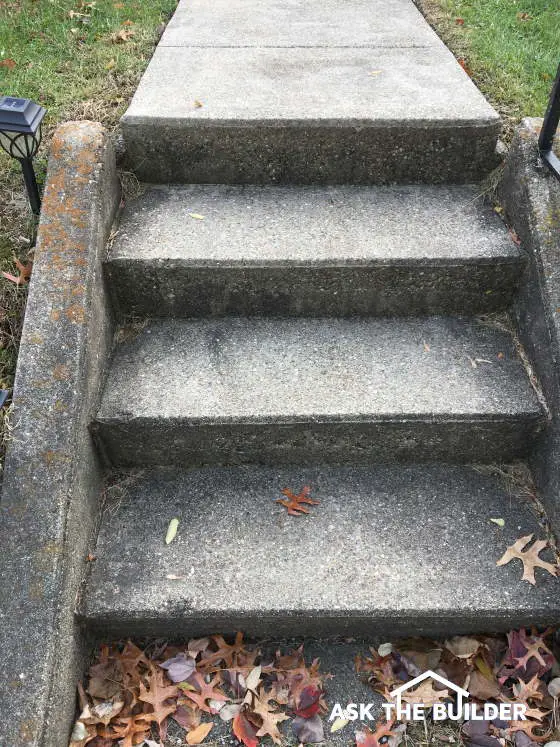
Concrete Front Steps Makeover - These cast concrete steps are very likely over 100 years old and are in nearly perfect condition. The clue to their age is the presence of the sidewalls. Copyright 2022 Tim Carter

Basic Building Products Last Long

A few days ago, I dedicated one of the new LIVE streaming videos I do each M-F on my YouTube channel at 4 PM Eastern Time to one of the first building products used by man. I’m going back thousands of years and referring to hydrated lime. It’s perhaps one of the most amazing multi-purpose building products ever discovered and then put into widespread use.

A more modern example might be steel. While steel was first invented by those living in India thousands of years ago, the widespread manufacturing of normal steel didn’t start until just before the War of Northern Aggression, often referred to as the Civil War, here in the USA. Steel has countless uses and can be found in tens of thousands of items. Hydrated lime can be found all over the world in countless buildings used both as a mortar and as plaster.

You might wonder, “Tim, what does lime have to do with concrete steps or precast concrete steps?” Well, I told that tale in great detail during my LIVE stream and am happy to share it here.

Modern Concrete Steps Can Fall Apart

Let’s begin by talking about modern concrete that you might have at your home or walk on in your city or town. The Internet is littered with hundreds and thousands of woeful homeowner stories about how their new or newer concrete is crumbling. I’ve got no less than ten older columns about concrete resurfacing on my AsktheBuilder.com website that tell you why this happened. I suggest you read those.

I wish you and I could take a road trip to Cincinnati, Ohio. I’d take you to a few neighborhoods, one being Pleasant Ridge on the east side of town. There I’d be able to show you at least twenty or thirty outside sets of concrete steps that are just like the one in the photo that was provided with this column.

These ancient concrete steps are original in almost all cases and installed when the quaint houses were built in Pleasant Ridge in the early 1900s. How is it that these concrete porch steps, all of them coated with cement stucco I might add, have survived nearly a hundred years and look almost brand new?

That’s a great question and one you should ask each time you see some new product fail and wonder about how an older product that was pushed aside is still in service.

Get FREE and FAST BIDS from local concrete contractors right here.

Why are Old Concrete Steps in Great Shape?

The answer as to why the concrete steps lasted so long is really pretty simple. Back then concrete masons knew that if you added more Portland cement to the concrete mix it made it stronger. This magic gray powder is very similar to hydrated lime. When you mix both with water, you start a chemical reaction where trillions of microscopic crystals start to grow.

These crystals act like modern Velcro. They’re the glue that holds together the sand and stones in the concrete mix. While it would take a chemical analysis to determine if this was true, there’s a very good chance the concrete masons who installed the concrete steps in Pleasant Ridge also added hydrated lime to their mix.

I get excited about hydrated lime for two reasons, one being my college degree in geology. I grew up in Cincinnati, Ohio, and as a youngster had no idea that geologists from all across the world visited my city. It turns out Cincinnati is the world-type section for upper Ordovician sedimentary rocks. If you want to see the best plant and animal fossils of that time period, you come and split apart the limestone rocks interbedded in the shale at all the road cuts in greater Cincinnati.

hydrated lime book

I own this book. It contains magic formulas to help you make long-lasting concrete and brick mortar. You can order this book now and have it delivered to your home.

I knew limestone was hard and durable as a geology student but I wasn’t aware that dense fine-grained limestone can be heated to create the lime that’s then used as brick mortar, plaster, and a super-adhesive additive in regular concrete. Yes, when you heat up limestone, its chemical composition is CaCO3, you drive off the CO2 and are left with CaO.

Once you grind up this CaO into a powder and then add water, you end up re-creating the limestone. This is why plaster is so hard. This is why true whitewash made from lime and then painted on brick buildings, fences, or other walls lasts for decades. You’re basically painting on or troweling on a thin layer of limestone for goodness sake!

You can now see why it’s a good idea to add hydrated lime to concrete, can’t you? The Portland cement is strong, but why not give it a little boost. Keep in mind the normal MINIMUM standard for exterior concrete exposed to cold temperatures is a six-bag mix. This means six 94-pound bags of Portland cement are in each cubic yard of concrete. It’s probably a better idea to add seven or eight bags to your exterior concrete.

You can bet the old masons building the steps added extra cement and they most likely put in a shovelful or two of hydrated lime. The railroad bridge engineers did the same. This is why you see concrete railroad bridge abutments in your city or town in such great shape after 100, or more, years.

Column 1440

February 6, 2022 AsktheBuilder Newsletter

Newsletter Issue #1168

You have such great taste in friends! You're right up front with Jack, Elisabeth, Jimmy, Coleen, Iyrs, Joan, and about 120 other new subscribers in the past seven days. WOW! Thanks for your trust.

This should be an interesting issue for you.

How about you, though? Maybe your first issue was #329. It's possible I shared this video about using my favorite caulk gun back then. The video was recorded by Ron Fischer over twenty years ago so that's why it's not HD. Ron was a great man and videographer at Channel Nine News (ABC-TV affiliate) in Cincinnati, Ohio. Ron taught me how to create engaging videos and we became good friends working together. He was so patient with me! Thanks, Ron!

DONATE TODAY - Support Solid Home Improvement Tips & Money-Saving Secrets


Furnace, Boiler, Heat Pump REPLACEMENT Checklist
on SALE Today!
Normally $14.95 - ON SALE $9.95
SPECIAL OFFER AWAITS You Too!


Disappointing Survey Results
🙁

Last Sunday, I was excited about a new Ask the Builder Academy idea and asked you to take part in a survey to help me bring it to life.

Well, the air went out of that thought balloon faster than water flows through a chain-link fence!

First, less than 0.5% of those who read about my Academy idea took the short survey. That's the most important survey takeaway for me. It telegraphed to me there's virtually no interest in the video call academy.

Second, look at the results of the second-last question:

pie chart of academy fee answers
See the purple and blue pieces of the pie? They add up to 62% of the responses. You might be one of the purple people that expected the class to be free. Yeeouch! The blue folks only thought a class would be worth $10.

The bottom line is it appears there's very little interest in the academy idea and those that are interested don't place much value in the content.

This is precisely why I do the surveys before investing the time in a new product. If you took the survey, thanks for your time and input.

Another Interesting Survey Takeaway

It's as obvious as the nose on my face, I do a horrible job of sharing with you how to discover answers on my website.

The last question of the survey gave you a chance to tell me what classes you'd like to see in my new Academy.

It turns out you want to know about things I've already covered in great detail on my website!

Just below is a very small partial list of the ideas you may have entered that you wanted covered in an academy class. I've LINKED each one to a past column or VIDEO on my website about that exact topic. In other words, the content you might want in a new ATB Academy class already exists and you can get it right now.

It's important to realize that I just supply ONE LINK below to the topics. In almost ALL INSTANCES, I have multiple columns and/or videos about the topic:

Insulation Basics
Basement Waterproofing
Diverting Water on a Gravel Driveway
Deck Building
Supervise a Roofing Contractor
Property Groundwater Drainage Problems
Mortar Repair

I received over 150 Academy class ideas and well over 70% of them I've already covered.

When you have a problem at your home, please please please use my search engine, scroll down past the Google ads, and look at all the FREE advice I have for you.

GET FREE BIDS for any job from Local Contractors right now!

Arlen's Not-Happy Wife

Arlen reached out to me two days ago. His better half was none too happy about running out of hot water during a recent shower. It was the first time this happened in twelve years.

No, silly, she takes a shower every day not once every twelve years! But never before did the hot water run out.

Why do you think it happened? Being a master plumber since 1981, I'm pretty sure I know why she turned off the shower tap faster than you'd swat a mosquito on a summer evening. Let's see if you have mystic powers too!

Relocating a BathTub - What Possibly Could Go Wrong?

Peer at this photo with your peepers:

bathtub vent pipe on floor

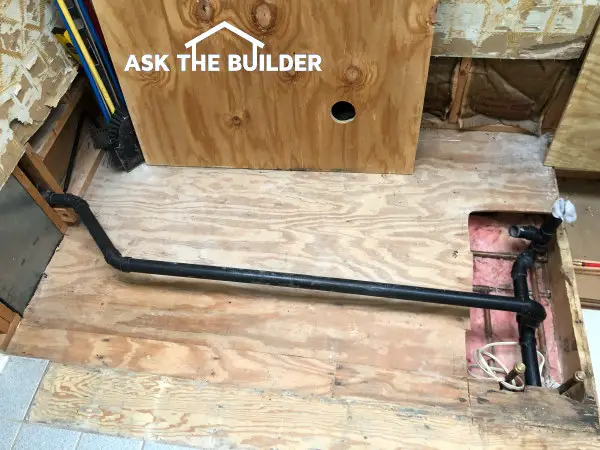
What in the heck is going on? I suggest you read about what can go sideways when you relocate a bathtub. Click the photo to read the article.


Did you discover something that helped you in this issue? If so, maybe you might treat me to a mocha-chip ice cream cone. I like treats and don't get enough of them doled out to me each week. I know, I know, I'll take a piece of cheese with my whine.


Tim Carter
Founder - www.AsktheBuilder.com
Hilton Hotels USE - www.StainSolver.com
Maritime SOS Story Here - www.W3ATB.com

Do It Right, Not Over!

P.S. What about Flushable Wipes? Which side of the fence are you on? Watch my flushable wipes video. Rest assured I saluted the army men before I sent them on their mission!

History of Old Tech Geology Building University of Cincinnati

old tech geology building at uc

This is the north-facing wall of Old Tech. Its west-facing wall was perhaps 175 feet from the McMicken Hall building which is the iconic image of the University of Cincinnati.

A History of Old Tech Geology Building University of Cincinnati

This page has been copied from deep in the bowels of the University of Cincinnati website in case it disappears in the future.

Already the UC website is throwing 404-page errors for the larger full-sized photos of the extra photos that are linked to from this page. Go to that page and click a thumbnail photo and see what happens. It's only a matter of time before this information is lost to posterity. I was a geology undergraduate student who went to class in Old Tech from 1970-74 and don't want the detailed history below to be eroded away like the soft shale of the Lower Fairview Formation. The reproduction of the content from the UC website is a Fair Use as UC is a public institution.

A History of Old Tech

Goetzman & Folmer, Architects

June 1982 

"Old Tech” was built as a result of an agreement between the University of Cincinnati and the Technical School of Cincinnati, a manual training school. The Board of Directors of the Technical School offered to give the University its equipment and charter provided the University would operate the school as the Technical School of the College of Engineering. The trustees of the Technical School further helped facilitate this agreement by raising the money to construct a building on University grounds. James E. Mooney was one of the principal donors.

A report by Howard Ayers, President of the Board of Directors of U.C. on June 24, 1901 states "…..a building thoroughly adapted to the needs of Manual Training and Technical Instruction would form an integral part of our School of Engineering and furnish the preliminary and indispensable shop-training in wood and metalwork, which all of our Engineering students are required to have. In the second place, it would constitute a portion of the experimental course of the Teachers College, and thus serve an important purpose not only in properly training teachers for their profession, but also in giving them adequate practical experience in the fundamental principles of their professional work. The University would maintain the Manual Training course of study of the Technical School until such time as the Board of Education of Cincinnati shall establish a satisfactory Manual Training High School or other Manual Training School in this city."

The cost of the building was estimated to be $12,430.00. It was believed that it would be relatively inexpensive to operate because it would utilize heat, light and power provided by the University's existing plant (The Commons) and because the administration would be handled by the Engineering Department. By the fall of 1901 the foundation was laid and by March of 1902 the building was ready for use, but in 1907 the Technical School was discontinued and the building and equipment were turned over completely to the College of Engineering.  When Baldwin Hall was built in 1912, most of the engineering facilities were moved. The Geology and Geography Department grew eventually to complete occupancy of the structure.

old tech university of cincinnati salvaged brick

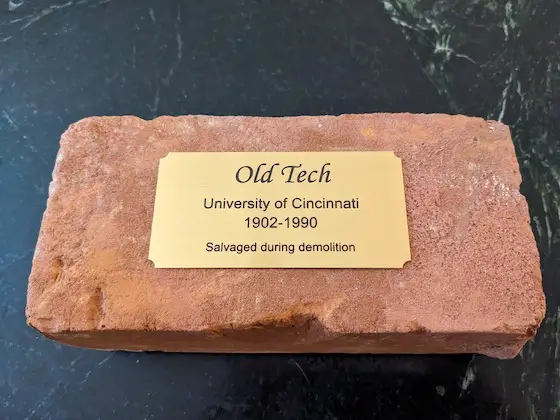
This brick was salvaged by Dr. Kilinc during demolition. He was kind enough to give it to me in 2022. Tim Carter

You can see more photos of Old Tech here.

old tech building university of cincinnati

You can see how close Old Tech was to McMicken Hall.

The "Old Tech" Building has the look of a structure that hasn't seen much change since the day it was built, but that is not the case. It was originally designed with a two-story center section and one story wings. Windows were shorter with arched heads and the entrance was on the east side. The two story central portion originally contained a carpenter shop on the first floor and classrooms on the second. The wings were wide open one-story spaces with roof rafters exposed. The north wing contained a "Forge Shop" and the south wing a "Machine Shop" over a basement. Changes were made so carefully and were kept in such character with the original building that without the original drawings it would be very difficult to tell what is "new." The original drawings by well known Cincinnati architects, Elzner and Anderson, call for omitting the north wing. So it is very possible that this wing did not go with the original building. But it was definitely there by 1907 when drawings by Tietig and Lee, architects, show the second floor being added to that wing. To accomplish this, the exterior walls were taken down to the tops of window openings, arch heads were removed, and the present square transom section added. Footings and columns to support the new floor were added. The first floor of the wing was partitioned into three classrooms, a "large testing lab'" at the north end, two offices, a "toilet room" and a set of stairs to the second floor. The second floor was divided in a similar fashion with a large drafting room at the north end.

Two years later architects Tietig and Lee produced drawings to balance off the building by adding a second story to the south wing. This time exterior walls were taken down all the way to the top of the basement foundation. Stairs to the basement were removed from the inside and the north areaway deepened to allow steps down on the outside in their present location. It was at about this same time that reinforced concrete was coming into common use, so whereas the north addition was done like the main building with wood joists and steel beams, the south wing used reinforced concrete columns and beams and floor panels.

The drawings of 1909 also show that the recently added partitions, toilet room, and stair on the first floor of the north wing were now being removed. Only one office and a large room remained. The toilet room reappeared on the second floor where the stair had been. Two of the second floor classrooms were combined into one and a corridor ran through to a new fire escape on the east side. The top floor on the south side was partitioned off in a fashion similar to the north side with an office taking the place of the toilet room. The first floor was left without partitions. The large lecture room in the center of the building was part of this phase as well as the stone portico centered in the east facade, which gives outside access to it. It also included the addition of a classroom in the second floor roof space where the skylight had been. Second floor classrooms were also reduced in size to allow for a corridor into the wings. It was also at this time that the arches were removed from the windows of the building's center section and openings raised to duplicate those of the wings.

At the end of this phase of construction the elements of the exterior looked almost exactly as they do today. Likewise the second floor was much as it is now. The main exception is that the fire escapes on the east side and the corridors to them were eliminated with new escapes (existing) being located on the west side.

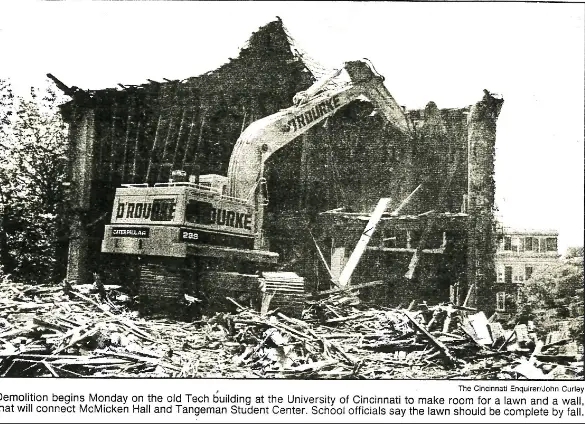
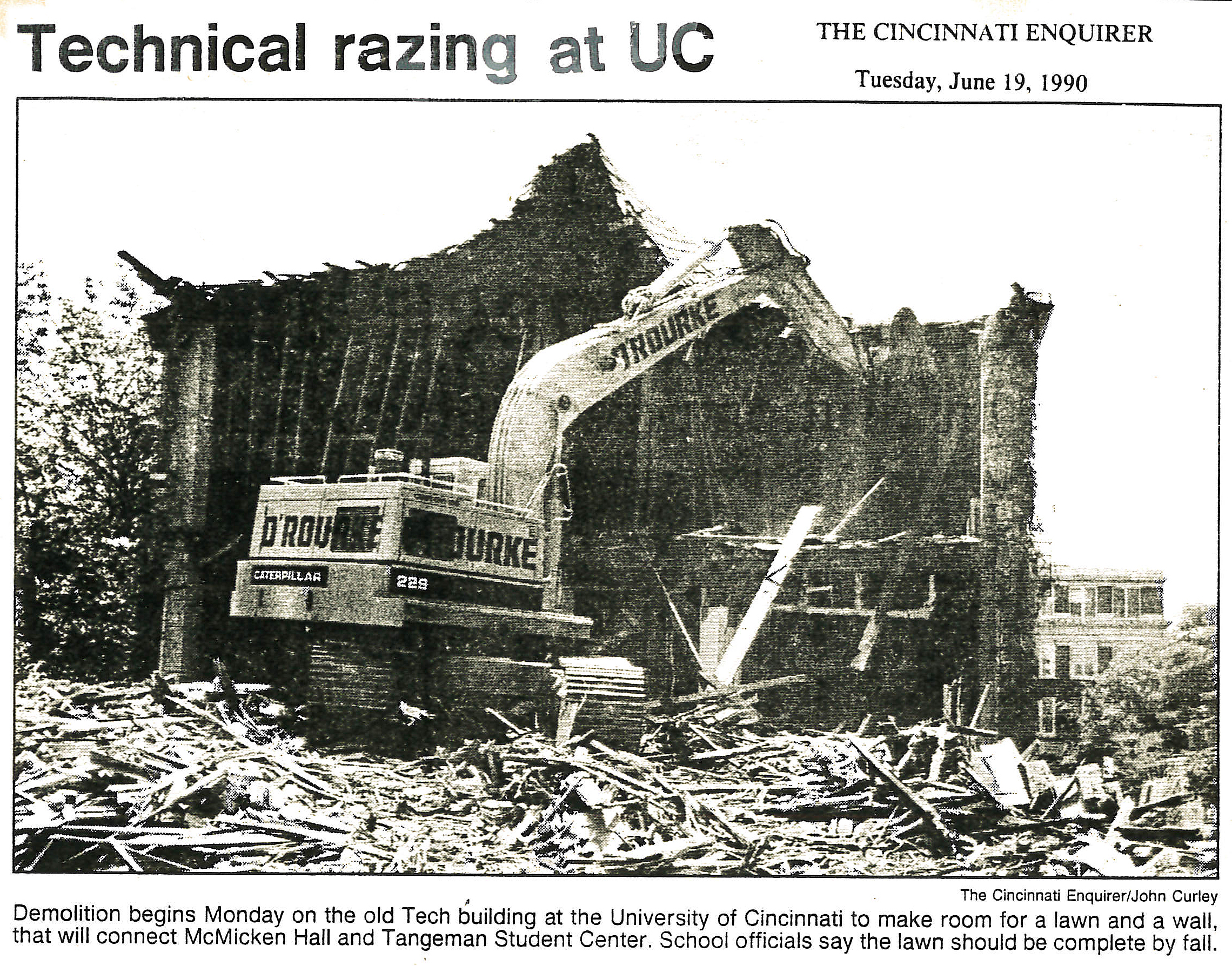
The first floor has been in more of a state of flux with partitions being added, removed and added once again. The museum first appears on 1913 drawings in only the west side of the south wing, then shifts to the north wing where it was later divided and then relocated in its present position in the south wing. It was torn down in 1990 to make room for a wall and some lawn.

Old Tech University of Cincinnati demolition