Interior Design

DEAR TIM: I am in a quandary. Recently I inherited some money from a dear aunt. I purchased an out-of-date home on a gorgeous lot. The entire inside of the house needs to be redone. Money is not really an object yet I don't want to waste nor make planning mistakes. What is the best way to design a perfect interior that will take advantage of the delightful exterior? Robin R. Sunbury, PA

DEAR ROBIN: Uh, let's see, have you given any thought to adopting a brother? You know, one that has extensive building and remodeling experience? Just kidding! I am sorry to hear about your aunt, but I am quite sure she knew you would invest the money wisely. The first thing to do is take a deep breath and relax. Intelligent planning will allow you to achieve exactly what you want.

To accomplish this project you are going to need to assemble three additional teammates around yourself: an interior designer, a seasoned residential architect, and the remodeling contractor who will put the finished plan into action. All three team members will need to work together towards your goal.

Early in the game the interior designer is probably the most valuable player. You need to draft a designer who is accredited by the American Society of Interior Designers (ASID). Many of these professionals have college degrees in interior design. They have been tested and trained to focus on how a room or series of rooms will be used. The designer will work closely with you to develop the best overall floor plan. After the function issues are addressed, they will address the feel and look of each room.

Before the designer gets to work you need to consult with the architect. This professional can quickly tell you what interior walls are the toughest to modify or move. Even though money is not an object, moving bearing walls can be costly and time consuming. Should it become necessary, bearing walls can often be replaced by large overhead or hidden beams. Have the architect draft a preliminary plan showing what walls are load bearing and those that are not. The interior designer will find this plan most useful.

You can assist the interior designer early in the process. Take photographs of any furniture that you currently own that you know you want to use. Begin to look at magazines and books that contain photos of things that you want. Assemble these and tell the designer what you like in each photograph. The designer may be able to detect a theme or color scheme based upon your photo gallery. Feel free to visit furniture stores as well. Fabrics, colors and textures in a simulated setting may trigger a desire in your mind.

Create a priority list. Put the things that are absolute needs at the top and the things that are lavish treats at the bottom. Eventually your budget will shake out what you will finally get.

Using all of your data, the interior designer should be able to draw up a preliminary floor plan. This illustration should be shared with the architect as soon as it is done. The architect will probably make helpful comments or suggestions that will keep the project pointed in the right direction. Once everyone agrees with the preliminary plan, the architect can begin to transform these ideas into working blueprints and specifications.

Once the plans and specifications are complete, the architect and designer can help you locate a reputable contractor. Architects and designers work with solid, knowledgeable contractors on a routine basis. They know the limitations of each contractor. Interview three contractors and ask for references. Go visit jobs that are at least one to two years old. Ask the homeowners about their contracting experience. Ask what they would do differently. If you do your homework, you will quickly spot the right contractor.

Say you can't afford an interior designer or you want to get some great ideas for decorating this may be a great way to start. Better Homes and Gardens' The New Decorating Book picks up where most large decorating books leave off. The illustrations and photos in this book are just fabulous. This 400 plus page book has nearly 500 glossy color photos of everything from whole houses to such details as picture arrangements and tabletop accessories that turn basic spaces into warm personal ones. Special features include, a quick-read format, house tours showing decorating solutions in action, room makeovers and much, much more. To purchase it, just click the photo of the book.

Decking Materials – Synthetic

Important - Read Author's Notes at Bottom of Column

DEAR TIM: I am going to build a deck. Some of the alternative decking materials appeal to me. The manufacturers brag that these products do not require periodic maintenance like traditional wood decks. It appears to me that many of the alternative decking materials cost more than wood. In your opinion, what are the pluses and minuses of wood and synthetic decking systems? What would you do? Mary T., Woonsocket, RI

DEAR MARY: This is a really tough question to answer. There just isn't a clear cut answer. I'm afraid it will boil down to an analysis of your personal texture and color preferences, mathematics, and how much long term work you want to put into your new deck.

Let's start with wood decking materials. I feel that a vast majority of people will agree that natural wood is the most visually appealing deck surface. The grain patterns, hues, and shades of different species such as redwood, cedar, cypress, and treated pine products is unparalleled. The synthetic decking systems have yet to produce a product that rivals the natural beauty of real wood. Wood naturally absorbs and dissipates solar energy. In other words, you can walk across many wood surfaces that have been in direct sunlight for hours without burning your bare feet.

The beauty of wood comes with a price tag. Wood deck surfaces require periodic treatments with synthetic wood preservatives and sealants. These products minimize damage caused by the sun's ultraviolet light and water. Synthetic sealants are not a food source for mildew and algae. Many highly advertised wood sealants contain natural oils that feed these organisms. Even the best deck sealants last only 2 to 3 years before re-treatment is necessary.

There are several types of alternative decking materials. Some are virgin vinyl materials. Others are made from recycled plastics or plastic resins and combinations of wood dust or fibers. You can even get aluminum decking materials. Many of these systems come with accessory railing and trim kits so that your deck will have a truly finished look.

Many, if not all, of these products are applied to a traditional treated lumber joist and beam system. This allows you to do your cost comparisons quite easily since the structural aspects of your deck will be virtually the same no matter how you finish the top of the deck. However, you can now purchase, in some markets, plastic joist and beam systems. These materials are completely rot resistant. Their only drawback is that they are bouncy. To achieve a stiff deck surface you need to oversize the plastic joists and/or space them closer together. This of course requires more labor and money than traditional wood.

EB015 Cleaning & Sealing Deck eBoo CoverA positive aspect of many alternative decking materials is that they require no periodic applications of sealers. The virgin vinyl products will look just like vinyl siding does after 10 or 15 years. Most decking materials that contain recycled plastics or resins and wood fibers or dust will weather to a gray color. The manufacturers tell you that these materials are stainable or paintable to achieve desired coloration, but if you do this, you start the vicious and never ending cycle of periodic maintenance.

The virgin vinyl products probably offer the best choice if you want minimal future work. However, on a sunny day, I guarantee you that you will need sunglasses and a pad while resting on the deck. These light colored materials readily reflect sunlight and can get quite hot. Don't forget that light colored decking products will require annual or monthly washings. They will show airborne dirt much more so than regular wood decks.

Before you make your final decision keep in mind that all decks will have to be cleaned on a routine basis. If you choose to go with natural wood, you will just have to calculate the annual or periodic cost of sealing the deck on a square foot basis and add this to the original installed price. Compare all systems on a simple square foot price completely installed. Factor in how many years you think the deck will last before you want a change. Divide the cost per square foot by the number of years and you will see the annualized cost of your new deck.


Building a deck? Make the best decisions with my helpful and thorough Deck Installation & Repair Checklist. I offer a 100% Money Back Guarantee.


Author's Notes:

February, 1999

After this column ran in the newspapers I received several letters and e-mails from vinyl decking manufacturers. Some of them objected to my editorial comments. Certain vinyl deck manufacturers claim that their materials are actually cooler to the touch in direct sunlight than wood. My advice is for you to visit a home or business that has the material you want to use in place. See for yourself if the decking is hot, warm, or cool. Look to see how clean it is. Take off your sunglasses while you are there as well. In other words, test drive your decking before you buy.

November, 2003

Since this column was written a substantial amount of different alternative decking products have been introduced to the market place. Many are composite products that mix either virgin vinyl or recycled vinyl/plastic with either new wood fibers and/or recycled wood fibers. As with vinyl siding, the manufacturers of many of these products are doing whatever they can to mimic the look and feel of real wood. I think they do this because many of us love the actual look and feel of real wood.

Perhaps the most interesting thing about these products has been the turn-around I have witnessed with respect to the stance on maintenance. Years ago when these products were introduced, many said they were "maintenance-free". I disagreed then and disagree now with that stance. Most of the sales literature from the alternative decking materials now says "low maintenance" not no maintenance.

So therein lies the problem for the average consumer. What does it really cost to maintain a wood deck over time vs. the cost to maintain a deck built with one of the composite materials? Do you really get a payback? Finally, don't ever believe you save money right out of the box when you buy a more expensive product. I have seen literature for these composite decking materials that say they save you money. You never save any money until such future time that you actually have gotten back the extra money you spent originally. Furthermore, to really save money you need to get backany interest you may have made on that money while it sat in a bank account.

July, 2004

I just received this e-mail from Martha Mokarry and had to share it:

I just thought I would add my two cents about vinyl decking. We had Durable Deck(R) (DD) placed over our old wood deck. It was a nightmare. If the wood beneath became dry the DD morphed. The deck was dirty all the time. It was easy to clean but who wants to scrub the deck every single day with full strength Simple Green or 409 and a scrub brush? It had to be swept, scrubbed and even blown off in the direction of the embossing.

The dirt and pine tags and debris collected in the spaces between the stuff and were tedious to remove. It was not hot to walk on like the wood but when it was wet it was very slick even with rubber soled shoes and when we pushed snow off the first time I nearly broke my neck sliding.

We have pulled off about 1/3 of the DD. Not an easy task since the installer put about 70 screws in each 20 foot board. The amount of dirt and debris under that portion was about a 5 gallon bucket worth. The wood under the vinyl was very wet and soft (hence rotting)........ Just thought I'd give you the scoop on DD. It may work fine in Florida on docks and around swimming pools but not on an 800 square foot deck in Virginia.

January 2005

I just finished writing an explosive new column about the newer wood composite decking materials. I urge you to Click Here to read it.

TC

Related Articles:   Vinyl Decking vs. Sealing DecksSynthetic Decking & SealersSynthetic Decking Manufacturers

Vinyl Windows Certification

! ! ! See Author's Notes at Bottom of Column ! ! !

Vinyl Windows Certification

DEAR TIM: We want vinyl windows for our home. After talking with 3 different salespeople I am more confused than when I started. Are there really big differences in the types of glass you can get? What makes a great vinyl window? Do you think I can install them myself? Tony P., North Platte, NE

DEAR TONY: I can surely see why you are attracted to vinyl windows. Since its birth in the 1950's, the industry has made giant strides in product types, styles, and finish options. Vinyl windows are truly a no maintenance item. The energy savings features are dramatic as well. Can you believe that vinyl windows made today are 4 times more efficient than the state of the art windows I installed in my new home just 12 years ago?

Vinyl replacement windows as well as vinyl windows for new homes are growing in popularity. Because these windows are often made at regional factories, you can get custom sizes with little or no problem. This means a window can be made to fit any rough opening without unsightly filler strips or extra wide jambs. Vinyl windows are also warm to the touch much like wood windows. Select the right window company and you can get simulated interior wood finishes in a variety of species like oak and cherry. The interior simulated wood vinyl is so realistic that it even has tiny relief lines that mimic actual wood grain.

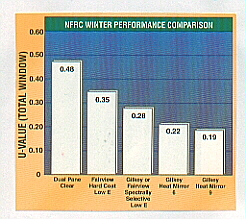
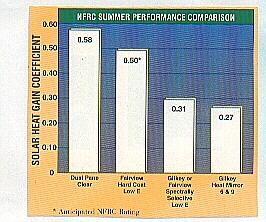
The glass that comes with your windows is extremely important. It makes up the vast majority of the surface area of the actual window. You want glass that has the lowest U-value (U-value is a measurement of resistance to heat loss or heat gain). Vinyl windows that are made with Low E glass and those that contain an invisible heat film that is tightly stretched between the two panes of insulated glass often perform the best. Low E glass reflects low level infrared heat back to its source. This means that winter warmth from your home bounces back inside your house instead of passing through ordinary glass. Low E glass works the same magic each summer as it prevents outside heat from entering your home.

Look for windows that contain inert gases, like argon or krypton, in the insulated glass dead air space. These gases slow heat transfer and help to stop outside noise from entering your home.

There is a wide variance in the quality of vinyl windows. It doesn't take a huge capital investment to set up a simplistic fabrication plant. Those companies committed to producing quality windows can get them certified by three different bodies. Of the three bodies, the most recent one is operated by the Department of Energy and the Environmental Protection Agency in conjunction with the window and door industry. Together they have developed the Energy Star certification program. Windows that carry this certification exceed the most efficient energy building codes in the nation by 10 to 15 percent. These windows are commonly 40 percent more energy efficient than most common building codes.

To attain the Energy Star certification, windows must be first certified by one of the other certification bodies - the National Fenestration Rating Council. The Energy Star program has established three climate zones within the United States with specific testing criteria applied to each zone. If a vinyl window meets or exceeds the energy efficiency standards for the particular region it will be used, it can proudly wear the Energy Star label.

Installation of a vinyl window is not a task for a beginner or amateur do-it-yourselfer. Windows need to be installed plumb, level and square. They need to "float" in the actual rough opening. Concentrated loads can distort window frames and cause a poor fit that allows air and/or water infiltration. To achieve the best fit and finish, your windows should be installed by factory trained employees of the window company. The average homeowner doesn't have the tools or experience to achieve a first classs installation.

Sub-contractors may not be the best installers either. They get paid a fixed sum to install your windows. The faster they work the more money they make. They also may not carry sufficient liability and workman's compensation insurance. Employees of window companies have to answer to the owner. They are also more likely to respond to a future service call.

Author's Notes:

November, 1998

I received an e-mail from a reader of this column. This person was complaining about the last two paragraphs of the column. It was obvious to me from his comments that he has not installed vinyl replacement windows before. Among other things, his comments mentioned the do-it-yourself (DIY) clinics offered on Saturdays at many national Home Center stores. He felt that since these clinics are produced, vinyl replacement window installation must be simple. Nothing could be further from the truth.

I have installed thousands of windows both new and replacement. New windows require a certain level of skill to insure that the fit, operation and finish are perfect. Vinyl replacement windows are a completely different beast. They present extra challenges. Removing an existing window can be a huge task if you don't have the right tools. Existing (and even new houses!) houses can have out of square window openings. The restoration of interior plaster and trim surfaces requires significant coordination and special tools. Exterior caulking, interior insulation installation, etc. all must be accomplished perfectly or you will have a mess - and a drafty window - on your hands.

The point I am trying to make is that be careful of people, companies, stores, and even other writers/columnists who tell you, "...there is nothing to it. You can do it yourself!" This advice is not always accurate. In fact, it may actually cost you extra money.

One final note: If you decide to do-it-yourself, guess what? You become totally responsible - in almost all cases - for the window measurements. If you goof up a measurement and a replacement window doesn't fit, you have to pay to have a new one built.

Related Articles:  Window Glass Performance Comparisons, Energy Star Windows, Window Installation, Vinyl Windows Purchasing Quality

Adding Closet Storage Space

DEAR TIM: Several rooms in my house need closet space. The rooms are large enough such that carving out a corner will not greatly reduce the efficiency of the floor plan. What is involved in framing the closet? What is the optimal size for the closet? Do you think bi-pass or bi-fold doors work best? Is this a realistic project for a beginner? Kara F., Seymour, IN

DEAR KARA: Constructing a closet in an existing room is a perfect project for a beginner. You need minimal tools and just about 15 to 20 hours of actual time to complete the job. Here is a list of some of the necessary tools you will need: circular saw, miter box and saw, plumb bob, framing square, hammer, drill, level, drywall finishing tools, painting tools, etc.

The overall size of the closet is up to you. If it will not be a walk-in closet, I would make the finished interior depth no more than two feet. This distance will accommodate any and all clothes that will be stored on hangers. The width of the closet is up to you. Try to plan the space in such a way that any leftover existing wall space will create a cozy alcove that will be perfect for a desk, chest of drawers, or window seat.

Before you begin to construct the closet walls you should decide whether or not you want the walls to extend to the ceiling. Some of the coolest closets I have built have walls that are just seven foot tall. These partial height walls allow you create an open platform on top of the closet for trophy display, models, stuffed animals, or just plain space for seasonal clothes that can be placed in colorful plastic storage boxes.

If you decide to build your closet with partial walls, you can frame the walls on the ground and simply tilt them into place. Make the closet door as wide as possible. This prevents problems trying to reach items in the far corners of the closet once it is completed. The rough opening for most closet doors is two inches wider and higher than the actual door size.

If your closet walls will extend to the existing ceiling you should install the bottom wall plates first. Align the long wall plate so that it is 24 and one half inches away from and parallel to the existing room wall. Install your sidewall(s) plate that forms the side(s) of the closet. Use a framing square to make sure the sidewall(s) returns to the back wall forming a 90 degree
angle.

Install the top wall plates next. You locate these by using the plumb bob. Drop it from the ceiling until the bob floats just above the outside surface of the bottom plates. Move the bob to several locations along the edges of the bottom plates so that you can create dots on the ceiling that represent the top plate locations.

Cut wall studs to length for the walls. You will need a stud at all corners and at 16 inch intervals until the new walls end at the existing walls. A wall stud needs to be at the end of each wall plate. Use your level to make sure the studs are plumb. Once you are certain the walls are sturdy, the rough opening for the door is correct, and the depth and width are accurate you can install and finish the drywall and trim lumber.

I prefer to use mirrored bi-fold doors for closets. These doors open to allow easy access to the contents of the closet. Most of these come with easy installation instructions. If you choose to use mirrored doors, you must purchase them before you begin the project. The installation instructions will outline the proper rough-in dimensions. Remember, it is impossible to trim a mirrored door!

Forget about using the old plank and pole method for closet storage. Look at the many open and solid panel storage systems that are available. These can be purchased to fit just about any sized closet and will maximize the amount of storage space you have created.

Related Articles: Closet Organizers, Shoe Storage, Two Closet Plans - Materials, Two Closet Plans - Build

Painted Floors

DEAR TIM: I know this sounds crazy but I want to paint my floor. It is an older linoleum floor in very good condition. Is it possible to paint this floor and have it look good for a number of years? Do I need special paint? What else do I need to accomplish this? My dad used to paint our outside porch floor with great results. Do you have any paint design ideas? Paula D., Ludington, MI

DEAR PAULA: Shucks, it isn't a crazy idea - it is a brilliant one! Painting floors is a very economical way to refresh the look of a room. It is one of the few flooring jobs that is do-it-yourself friendly. Painting linoleum is not a bad idea at all. In fact, you can paint just about any flooring material except for carpet. If you or a friend are artistically inclined, you will have a floor that is the talk of the neighborhood.

Painted floors are everywhere. If you watch basketball on television or go to school gymnasiums, you know exactly what I mean. Professional and school teams have their logos painted in the center of the court. The boundary lines are painted as well. You will often hear announcers mention a foul that happened, "in the paint." These floors are subject to immense abuse as the players use them during practice and for games. Since I doubt that you intend to play basketball inside your home, your painted floors will look superb for many years.!

Porch floor paints have been around for years. As you mentioned, they are very durable. When used outside, these paints are subject to much greater wear and tear than they would ever see inside a climate controlled home. Most, if not all, outdoor porch paints are oil based. You don't have to restrict yourself to porch floor paints, as any high gloss oil based paint will work as you create a masterpiece of a floor.

The second step to success - the one very few know about - is coating the paint with multiple coats of a non-yellowing urethane. The urethane protects the painted finish just as it protects the beautiful stains and natural wood grain of hardwood floors or the natural beauty of cork flooring. Without this all-important urethane coating, you would rapidly scuff and scar the beautiful painted surface.

The painting process starts as you would any paint job. Surface preparation is key. The floor must be free of wax and be completely cleaned with soap and water. Rinse the floor with clear water to remove all traces of soap and dirt. If the floor has any type of gloss, you should sand it with medium sandpaper. The sanding process produces more surface area and small grooves that maximize paint adhesion. Be sure to vacuum the sanding dust before you paint.

It is a good idea to use an oil based primer. Feel free to tint the primer if you decide to use darker colors. Apply the finish coat of paint as soon as the primer instructions allow you to do so.

Pollution laws have been passed that have changed the way oil paints are made. The laws restrict the amounts of volatile organic compounds. In the past, some oil paints would dry rapidly and you could urethane the next day. Because of the changes in paint chemistry, some deep colors like purple and green often require a minimum of 48 hours drying time. If you coat the fresh paint with urethane too quickly, the paint may remain soft. To insure a good bond between the freshly painted floor and the protective urethane, you need to let the paint harden (cure) and then lightly sand it with fine sandpaper. Do not use steel wool if you intend to use water based urethane. You could end up with minute rust flecks in your floor.

I think the coolest painted floors are the ones that have geometric designs in them or are stenciled. You can also introduce multiple colors by painting a border in the room. I have seen vines or floral patterns that flow from wallpaper onto hardwood floors. Want to have some fun? Let your kids paint the floor of their playroom. Supervise them closely so their enjoyment doesn't spread to the hallway!

Becky sent an email about painting her floors. CLICK HERE to read her email.

Deadbolt Locks – Electronic Locks

DEAR TIM: There have been some recent burglaries in my neighborhood. I talked with the police and they recommend that I have top quality deadbolt locks installed in my home. What should I know when I purchase deadbolt locks? Should a professional install these devices? Ben C., Sublimity, OR

DEAR BEN: Dead bolt locks are a good starting point in your efforts to protect your home and the possessions inside. I also suggest that you meet with your local police department's crime prevention officer. Perhaps they will do a safety audit on your home as a public service.

Deadbolt locks are separate from the locking mechanism found in most door knobs. A deadbolt is often activated by turning a separate knob or using a key. When you operate a deadbolt a solid steel latch - often one inch long - exits the edge of the door and passes into the door jamb. These locks - as you might expect - come in many different styles and levels of quality. Keep in mind that the best deadbolt lock will not stop a determined burglar, but will in almost all cases thwart an amateur.

For many years deadbolt locks didn't seem to keep pace with innovation. That has changed dramatically in recent years. You can get electronic keyless entry deadbolt locks, ones that contain motion detectors that illuminate the keyhole for dark locations, and ones that have a lifetime tarnish-free polished brass finish.

The keyless entry deadbolts are very slick and come in handy if you come home with armfuls of groceries or packages. They feature both audible and visual signals that tell you if the dead bolt is completely locked. The computer chip inside the lock can also be set to automatically lock the door after a child or forgetful mate leaves the house without locking the door. This deadbolt also is equipped with the latest rolling code technology. This means that shrewd burglars who try to grab the radio signal are wasting their time. The next time your deadbolt operates, it will randomly select a new entry code from 4 billion possibilities.

A simpler deadbolt that might interest you is one that guides your key into the slot with a soft light beam. The beam is created when you are within 5 feet of the lock. Once inside the lock has a small red indicator light that tells you whether or not the deadbolt has been locked.

You will need to decide whether you want to install single or double cylinder deadbolts. A single cylinder lock uses a key on the outside and a simple twist knob on the inside to operate the deadbolt feature. Double cylinder designs use a key on both sides of the door. A double cylinder lock might be mandatory if your door or door sidelights contain glass. Burglars routinely break the glass and then reach inside to operate the knob on a single cylinder deadbolt.

Keep in mind, though, that double cylinder deadbolts can prevent rapid exits from your home in the event of a fire or some other emergency. What's more, a double cylinder lock on an egress(exit) door is against code in many locations. Be sure to check with your building authorities before you go to the trouble of purchasing and installing one.

All too often people feel that if they install a high quality deadbolt they will be safe and secure. A swift kick of a door can cause the actual door to break or the door frame to split. In either case, the door can often be opened with the deadbolt lock still in the locked position.

If you want peace of mind and trouble free deadbolt locks, I suggest you have a professional install your new locks. This person can evaluate your existing doors and door frames. He/she will also make sure that high security strike plates, and heavy duty screws that attach to the rough lumber door frame are used to install your new deadbolt locks. Smooth as silk lock operation is no accident. A skilled or experienced lock installer is required if you want your deadbolt locks to open and close effortlessly.

Author's Notes:

January, 1999

I received several helpful e-mails after this column ran. One locksmith shared a great tip. He suggests that you consider installing the deadbolt lock about 60 inches off the floor. At this height it doesn't take the direct force of a kick delivered by an intruder.

Another person shared an experience with a poor quality deadbolt. It turns out that the lock was easily defeated by a group of neighborhood rookie burglars.

Finally, another person indicated that it really pays to take the time to align the strike plate so that the door is tight once the bolt is fully engaged. A sloppy fit allows an intruder to rattle the door.


A Sturdy but Simple Garage Workbench

DEAR TIM: I am tired of working on projects on my hands and knees in my garage. I really need a sturdy workbench. Surely you have one. Can I build a simple one in an afternoon? If so, what are the most useful dimensions and materials to use? Cathy B., Toledo, OH

DEAR CATHY: Garage and basement floors are not the best work surfaces by any means. There is no substitute for a solid workbench. I prefer to build them so they look and feel rough. That way you don't feel bad denting them with a hammer, nicking them with a saw, or by drilling a hole into them. This is exactly why I always put a small dent in my brand new vehicles. I get rid of that "new" feeling in a hurry! You can build a sturdy workbench, but I feel it will be a long afternoon.

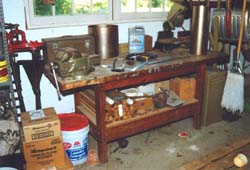
You are looking at my garage workbench. It is so strong, I think it could possibly support 2,000 pounds or more. The shelf below helps make it very stable.

You are looking at my garage workbench. It is so strong, I think it could possibly support 2,000 pounds or more. The shelf below helps make it very stable.

My garage workbench measures 33 inches high, 29 inches deep, and 72 inches long. There is a modest three inch overhang on the front and back. The left and right overhang is 9 inches. The frame upon which the top sits is made from 2x4 leg stock and 2x4 top and bottom braces. Be sure to purchase 2x4s that are as straight as possible. Warped, bowed or twisted material will create problems during assembly. All wood pieces are connected using screws or bolts. Nails have a tendency to loosen over time.

You start building the workbench by building two identical 2x4 frames. These stabilize the legs of the workbench. Each frame has two 54 inch long 2x4 pieces and two 20 inch pieces. The 20 inch long pieces fit in between the 54 inch pieces so that the final outside dimensions of each frame are 54 inches long and 23 inches deep and three and one half inches high.

The workbench only needs 4 legs. You can use 2x4s or 4x4s, whichever you prefer. Each leg is 31 and one half inches long. The legs are attached to the inside corner of one of the frames. Lay a frame on your garage floor and assemble the legs so they stick up into the air. Use three inch long screws or one quarter inch lag bolts to attach the legs. Use a minimum of 4 screws or bolts at each corner - two to a side. Once all four legs are attached, lay the other assembled frame on the garage floor. Have someone help you lift the first frame with the legs attached. Rotate the legs 180 degrees and set the legs inside the second frame.

Slide the second frame up the legs 11 and one quarter inches. Attach this frame exactly as you did the first one to the legs. This frame keeps the legs from spreading and will also act as a handy shelf once you install a piece of 3/4 inch plywood on it. You will need to notch the corners of the plywood so they fit around the legs. It is an easy task and you can get accurate measurements once you have attached the frame to the legs. Your workbench base is now complete.

The top is simple to build. Begin with a piece of 3/4 inch plywood that measures 70 and one half inches long and 27 and one half inches wide. Center this on the workbench base and attach it using L brackets and temporary short screws.

The finishing touch of the workbench top is standard 3/4 inch thick tongue and groove hardwood flooring. Purchase #1 common flooring for economy. Cut the hardwood so it fits flush on all sides of the plywood. Use regular flooring nails to blind nail the hardwood through the tongues. Cut the tongues off the last four pieces to create a 2 inch wide trim band that is applied to the edges of the top. This band hides the plywood and the ends of the hardwood strips on each side edge. Glue and screw these band pieces to the hardwood for a nice fit and finish. Remove the temporary screws from the L brackets and replace them with one and one quarter inch long screws.

Author's Notes:

February, 1999

Wow, did I get mail as a result of this column. Everyone wanted the hard copy plans for the workbench. I also got some great letters from people who built the workbench. Here is one I felt you should see, as the writer included a great feature in his workbench you should know about. I'll let Ron tell you all about it,

"....I did four coats of polyurethane, with a full two days of drying between coats and a light sanding. It looks great.

One other thing that I did was to put a tape measure on the tabletop before coating it. I wanted to find one that was self sticking and was finally able to find it at a sewing/craft store.

On the front of the table, I put the tape measure from left to right and about 4 inches in. I ran one both directions. So that no matter which end of the table I'm working from, I have a correct tape. I also put a tape measure on the endcaps, once again before coating with urethane...."

Ron in North Carolina

Related Articles:  Materials List & Illustrations, Build Simple, Safe & Sturdy Workbench

Column 245

Hardwood Inlays

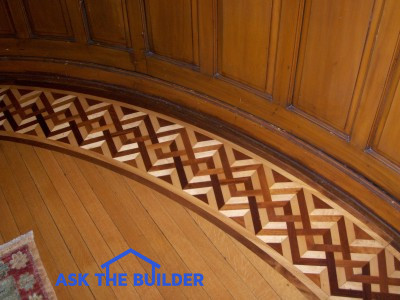
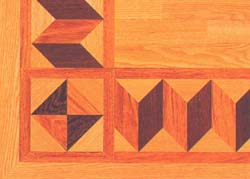
hardwood floor fancy inlay

Hardwood floor inlay located in the The Wiedemann Hill Mansion. PHOTO CREDIT: Roger R Henthorn

Hardwood Inlays

DEAR TIM: It is time to refinish our hardwood floors. Is there something I can have done that will enhance the look of the hardwood?

I have seen floors in old homes that mix different woods to create patterns, but I am sure this can only be done when the floor is installed. What are my options to make my hardwood floor come alive? Brad G., Shinnston, WV

DEAR BRAD: You bet there is something you can do to make your hardwood floor look vastly different than any in your neighborhood. You have several options. Some are very simple and somewhat inexpensive, while others are breathtaking and will set you back quite a few paychecks. In almost all cases, the work required to make the change will probably have to be performed by a professional.

AsktheBuilder Podcast

CLICK this image and listen to the first call on the podcast. I talked to Jill about how to repair wood kitchen flooring, and possibly installing an inlay border as an option. Copyright 2018 Tim Carter


Installing a new hardwood floor? Use my Hardwood Flooring Installation / Refinishing Checklist to avoid costly mistakes. I offer a 100% Money Back Guarantee.


hardwood inlay

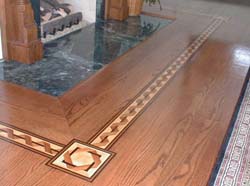
Here is the inlay in my own family room. I wish you could stop by and see it in person. The look is simply magnificent.

The inlaid work you have seen in older homes is still available. The craft's roots penetrate deeply back to the Roman Empire. Precision cutting, shaping and assembly of different colored and grained wood veneers into scenes, images and designs was actually called marquetry. The craft nearly disappeared during the Dark Ages, but fortunately it survived into the Renaissance.

One hundred years ago, labor was inexpensive. Inlaid floors were somewhat common. As labor costs rose, this building art form was only an option for the wealthy. Modern computer aided machinery has now lowered the cost so that many people can incorporate inlaid features into new and existing hardwood floors.

Perhaps the most striking feature you can add to a room is an inlaid border. These products come in multiple designs that will suit any style home. What would you think of a dramatic inlaid compass or navigational medallion in the center of your entrance hall? How about a floral, pheasant or deer head inlaid pattern? Some companies will actually take a photograph or sketch from you and create your own personal inlaid pattern or scene!

The inlaid borders and medallions are made using splendid, unique lumbers. Your selection might include wenge, jatoba, Bolivian rosewood or purple heart. They can also contain cherry, walnut, quartersawn white oak and white ash. The combination of these wood species makes for a most dramatic appearance. If you are installing a new hardwood floor, you can actually install strips of one or more of these various woods to create an inexpensive border in a room.

hardwood inlay

This is just one example of how intricate wood inlays can be. The choices are as plentiful as hand-held signs at a political rally.

To minimize costs many of the inlaid products are commonly only 5/16ths of an inch thick. This is the usable thickness of the wood that is above the tongue in a standard 3/4 inch thick tongue and groove hardwood floor. If you want to add an inlaid border or medallion to an existing floor, the installer simply uses a precision router with a special bit and a template to create a perfect channel to accept the inlaid material. Strong glues are used to bond the inlaid product to the existing flooring. After the glue dries, the installer lightly sands the entire floor and coats it with multiple applications of clear urethane. New floor installations can use thicker inlaid products or install them the same as an existing floor.

If you can't afford or do not like the inlaid materials, you can try to stain selected pieces of your existing flooring a different color to create a pattern or border. If you sand and partially seal the floor before you stain, you can apply the stain across the grain of strip wood flooring without it bleeding or smearing. Creating a border or pattern in this manner is labor intensive and requires lots of hand-eye coordination. You may want to price out a simple inlaid product before you try to create your own.

My wife and I are having an inlaid border installed in our family room. We will use it to highlight the fireplace hearth. One pattern we like costs $20 per lineal foot installed and finished. Another one has a design that matches the rope twisting on our mantel and staircase newel post. Its installed price is $40 per foot. We are digging deeper into our savings to go with the rope twist border. My family will enjoy it. I hope the subsequent owners of our house will too.

Related Articles:  Hardwood Floor Inlays, Hardwood Inlay Manufacturers

This article was the Mystery Link in the May 31, 2015 AsktheBuilder Sunday Newsletter.

Column 247

Some Simple Shelving For Your House

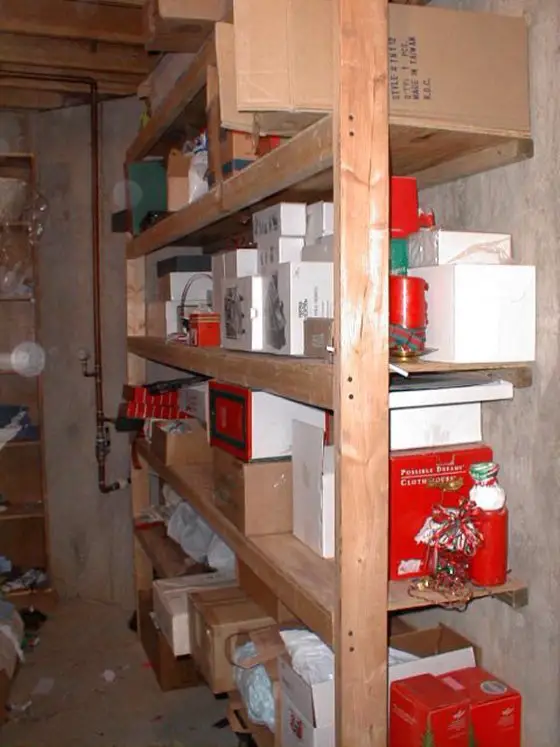
garage storage shelves

The best shelving system I have found requires minimal skills, materials and tools, but yields shelves so strong that I can climb them like a ladder.

DEAR TIM: I need your help. My husband and I seem to accumulate too much stuff. We need a simple storage shelving system for our basement and garage. Surely you know a way to build a strong set of shelves using standard lumber and a few simple tools. I would love to surprise my husband. Is this a project I can do by myself? Ellen R. Waukesha, WI

DEAR ELLEN: It sounds like you have the same disease as I - packratitis. I have found that early treatment of the symptoms relieves a tremendous amount of pain. All too often people deposit items on the floor. This practice creates clutter, is dangerous, and opens the opportunity for items to be damaged by water or footfalls. Simple stacked vertical shelving creates lots of horizontal storage space while using a minimum amount of floor space.


The best shelving system I have found requires minimal skills, materials and tools, but yields shelves so strong that I can climb them like a ladder. I am confident that you can assemble my system by yourself in less than two hours.

My shelving system incorporates 2x2 lumber for the back wall support cleats, one half inch thick standard CDX plywood shelves, 2x3 lumber for front shelf support beams and vertical 2x4s that support the front shelf beams.

Gather a four and a two foot level, a circular saw, a screw gun or drill with a Phillips head bit, a hammer, and possibly a hammer drill with a quarter inch diameter bit. To construct 5 shelves that are 16 inches deep by 8 feet long and 7 foot 8 inches tall you will need the following supplies: two pieces of 4x8 by one half inch thick CDX plywood, two 2x4's 8 feet long, five 2x3's 8 feet long, five 2x2's 8 feet long, twenty 3 inch long coarse thread drywall screws, sixty 1 and 5/8 inch long coarse thread drywall screws and 3 lbs of 16d sinker nails.

Using the circular saw, rip the plywood lengthwise in pieces that are 15 and 7/8 inches wide by 8 feet long. If you cut them exactly 16 inches wide, the final leftover piece will be about 3/8 inch too narrow. The 2x2's and the 2x3's do not need to be cut. The 2x4's are cut after assembly begins.

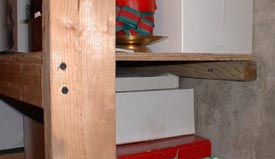
You begin assembly by attaching the 2x2 back wall cleats first. If you have regular wood walls, simply nail them to the wall studs. I like the top of the first cleat to be 24 inches off the floor. Each successive cleat is 16 inches higher than the one below. All cleats must be level and the edges of each cleat must be perfectly plumb. If you need to attach the back wall cleats to a masonry wall, drill a one quarter inch diameter hole through the 2x2 and then continue 2 inches deep into the masonry surface using the hammer drill. Take two 16d sinker nails and drive them at the same time into the hole of the 2x2. If you use a 20 ounce hammer and solid hammer blows, the nails will bite aggressively into the concrete or concrete block wall.

Take a 2x3 and place its 1.5 inch wide edge on the floor. Place a cut piece of plywood on top of the 2x3 so the plywood edge is flush with the vertical face of the 2x3. Attach the plywood to the 2x3 using 5 of the short screws. The 2x3 acts as a miniature I-beam at the front of the shelf. Follow these same steps with all of the other shelves.

Take a partially assembled shelf and place the back edge of the plywood on top of a 2x2 back wall cleat. Use 5 additional short screws to attach the plywood to the cleat in the same manner as you did with the 2x3. The shelf will flop slightly until the 2x3's are attached to the vertical corner 2x4's.

Cut the two 2x4's to match the height of the highest back wall cleat. If the floor is not level, make sure you add or subtract the difference. Keep in mind that the vertical 2x4's will be 16 inches away from the back wall when you check for level. The vertical 2x4's are placed on the side of the front corners of the shelf system. Using the two 3 inch long screws at each connection point, you screw through the vertical 2x4's into the horizontal 2x3's. Use the two foot level to help you level each shelf as you attach the 2x3 beam to the 2x4 corner posts.

Stripping Wallpaper – Now it is Easy!

©2017 Tim Carter

DEAR TIM: I have a big mess on my hands. I started to strip some wallpaper. Progress is very slow. To add insult to injury, the paper facing of the drywall has peeled off in some areas as I removed the wallpaper. What can I do to make the removal job go faster? How can the damaged drywall be repaired? Dorothy M., Ft. Pierce, FL

DEAR DOROTHY: Years ago when I was in college, I worked for a man who hired me to strip real wallpaper from old buildings. It was fairly easy work.

A water-vinegar solution would readily soak into the actual paper and soften the old wallpaper paste. Once the paper was saturated with water, you could practically scrape it using your fingernail. Scraping tools worked better and they rarely gouged the hard plaster walls.

New vinyl coated papers, foil wall coverings, and other types of painted coverings make it tough to strip wallpaper. The coatings on top of the paper work well to make them washable, but they block water from softening the old paste.

Drywall surfaces are tender. Even the most talented and careful person can gouge and score drywall using a traditional putty knife or wallpaper scraper. Fortunately, there are new products, methods and tools that make wallpaper removal an easy job.

CLICK HERE to get FREE & FAST BIDS from local wallpaper removal experts in case you've got cold feet.

The key to removing coated papers from drywall lies in piercing the surface of the paper with thousands of tiny holes so that new fast acting enzyme solutions can break down the wallpaper adhesives.

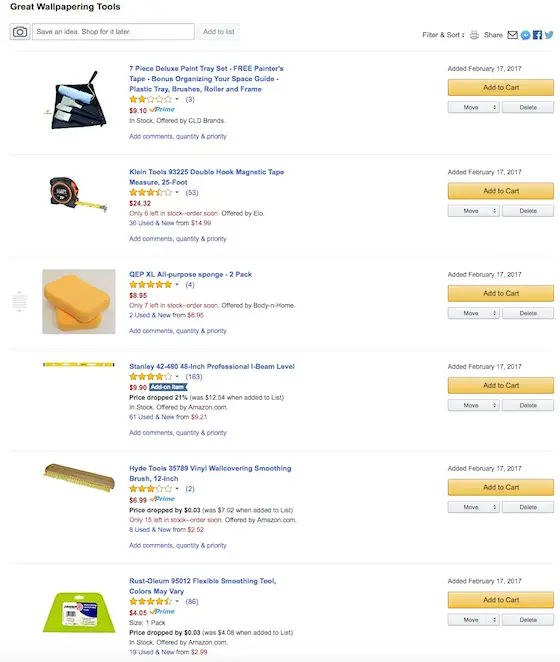
Just A Few Tools

Let's get started with the tools. Fortunately, you don't need many tools to wallpaper.

Here's a list that will get you going on this job:

  • retractable razor knife with snap-off blades
  • 4.5 or 6-inch drywall taping knife
  • smoothing brush or plastic smoother
  • 4-foot level
  • grout sponge
  • measuring tape
  • paint roller & pan
  • paint brush

Click the Image Below to get all, or some, of the tools now:

Wallpaper Tools List

CLICK HERE to get all the tools I recommend in one place. It's easy and fast.

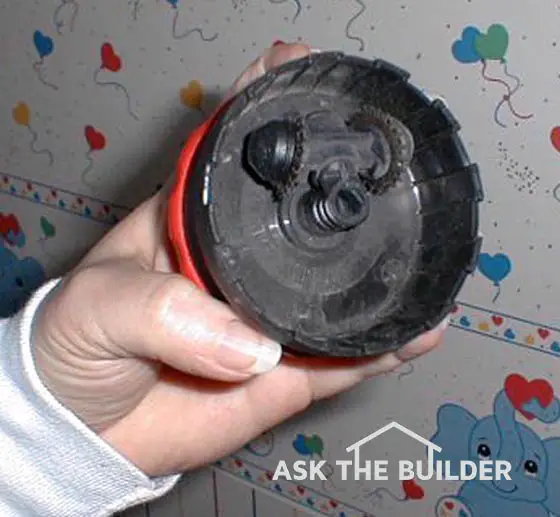
You can purchase nifty tools at most wallpaper or hardware stores that fit into the palm of your hand. These tools have small spiked wheels in the center of the tool that rotate like casters on the bottom of an office chair.

You randomly glide the tool over the wallpaper using moderate force and the tiny wheels make holes that prick the paper, but not the drywall. The more passes you make, the more holes that are created.

Once the paper has been punctured, you apply a liquid or gel like enzyme-based solution that passes through the tiny holes and works quickly to break down the adhesive bonds of the wallpaper glue.

These solutions can often soften old glue in 20 to 30 minutes. The non-toxic enzyme based products clean up easily with soap and water.

If you are patient and allow the soaking solutions to do their job, the paper will often readily pull away from the drywall or plaster in large sheets. If you need to scrape the paper, you can use a new scraping tool that has a preset blade angle.

CLICK HERE to get FREE & FAST BIDS from local wallpaper removal experts in case you've got cold feet.

The moderately sharp blade attacks the paper from a very low angle. This enables you to remove large amounts of softened paper with minimal or no wall surface damage. Once the wallpaper has been removed, you need to clean all residual glue from the surfaces with soap and water.

To repair the areas where the top layer of drywall paper has been removed, you will need some white shellac and regular drywall topping compound. Paint the damaged area of the drywall with the white shellac and let it dry.

The shellac blocks water from penetrating into the base layers of drywall paper. Without this protection, the water in the drywall topping compound will often cause bubbles to form in this absorbent paper.

You will probably need to apply two or three thin layers of topping compound. Be sure to apply the compound 3 inches beyond the edge of the damaged area. This allows you to feather the patching compound and more easily disguise the repair.

Once this compound has dried, sand it lightly. Prime this new compound with a primer/sealer before you paint or re-wallpaper the drywall.

If you really want to get the facts on wallpaper, removal techniques, the facts on primers, sealers, sizing, adhesives, and installation you need to obtain The Complete Guide to Wallpapering.

Written by a second generation paperhanger, this book is invaluable. This book tells you everything you could ever imagine about wallpapering. It is the best book on wallpapering I have ever seen!

Related Articles:  Drywall RepairWallpaper Removal

CLICK HERE to get FREE & FAST BIDS from local wallpaper removal experts in case you've got cold feet.

Column 250