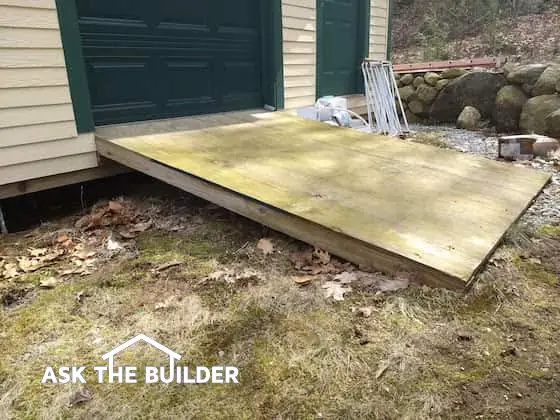
This shed ramp is made with treated plywood and treated 4x4 supports. It's very strong. IMPORTANT NOTE: See the door at the top of the ramp? That's a traditional overhead garage door, but it's only 6-feet wide! Yes, you can get small garage doors. Swinging shed doors don't seal well and are DANGEROUS on windy days. Copyright 2018 Tim Carter
"The shed ramp project is not very difficult, however, it will require some unusual cuts with a circular saw. On a scale of one to ten, with ten being the toughest job, I would rate this project a 2.5."
How To Build A Ramp For a Shed in Hours
DEAR TIM: I'm convinced you know a great deal about shed ramps. I need to know how to build a ramp for a shed because the ground around my shed slopes. It doesn't seem that shed ramp construction would be that difficult, but I don't want to start until I have an outdoor shed ramp plan.
What is the maximum slope you can have on a shed ramp? Do you know how to build a shed ramp with wood? I want the ramp to be safe and very sturdy because my riding lawn mower is quite heavy. Jerry McG., Lees Summit, MO
DEAR JERRY: Although I have built my fair share of shed ramps, I don't know if you could say I am a shed-ramp guru. But I can give you some tips that will allow you to construct a woodshed ramp that with not shudder or snap as you drive your lawn tractor up and into the shed. I suggest we copy the way I built my own shed ramp.
The shed ramp project is not very difficult, however, it will require some unusual cuts with a circular saw. On a scale of one to ten with ten being the toughest job, I would rate this project a 2.5.
Quick Start Guide For Building a Shed Ramp:
design so slope is no greater than 3 inches of rise per foot of run
purchase treated lumber plywood and treated 4x4s and 2x4s
attach a treated 2x4 to the shed that 4x4s rest on
use hot-dipped galvanized or stainless-steel screws to fasten plywood to 4x4s
I feel the maximum slope should be no more than 3 inches of vertical rise per horizontal foot of run. My shed ramp has this slope and it rises 24 inches from the ground to the shed floor.
The total length of my ramp is 8 feet. Try to make your ramp as long as possible so the slope is less than 3 inches for every foot of run.
If a ramp is steeper than this, you might also have a problem when the lawn tractor pulls into the shed. My lawn tractor has a belly mower. The belly mower can scrape the top of the ramp and prevent the tractor from entering the shed.
Lawn tractors with snow plows might also have an issue with a steep ramp. The blade may dig into the ramp if you try to drive the lawn tractor up into the shed.
How Do You Prevent A Ramp From Being Slippery?
The best way to keep a ramp from being slippery is to keep it clean and free of slimy algae. You can also install pure rubber mats. You must keep the rubber clean.
Rubber is excellent because it's not slippery when wet.
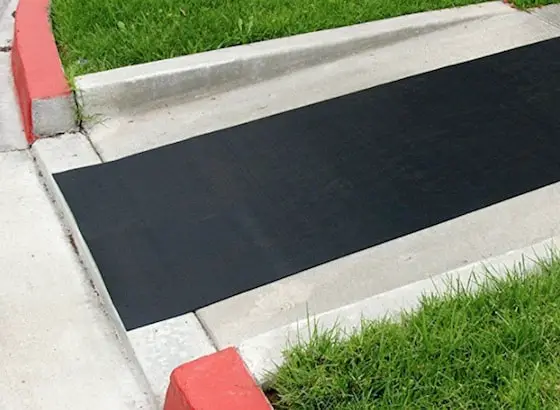
This is a perfect rubber mat for a shed ramp. It's 3-feet wide and 7-feet long. Place two of them side-by-side. CLICK THE IMAGE NOW to have them delivered to your home in days.
Let's discuss the slope issue. The steepness of the ramp can be a safety issue when you are both on and off the lawn tractor. If the ramp is steep and you have not cleaned it for a year or so, it might develop a slippery algae covering.
When this algae gets wet, it is more slippery than a wet bar of soap. Just walking down the ramp may have you on your posterior faster than you can say "Whooops!". If you try to drive a lawn tractor up a slippery ramp, it is possible for the tractor to slide sideways and tip over the ramp. You can get severely injured if this happens.
Stain Solver is MADE in the USA with USA ingredients that are food-grade quality. CLICK THE IMAGE to order some NOW.
Clean shed ramps with certified organic Stain Solver as soon as you see a hint of green algae or black mildew. Both can be very slippery.
The cost of cleaning the ramp is far less than what the ER bill will be. The last thing you need is a broken wrist or tailbone.
What's the Best Shed Ramp Material?
The best shed ramp materials are treated lumber 4x4's, a treated 2x4 and treated three-quarter-inch-thick plywood. You can find treated plywood at traditional lumber yards. Don't count on a big box store to carry this specialty item.
I spaced the 4x4's two feet on center as they project away from the shed. Since my ramp is 6-feet wide, I needed four 4x4s.
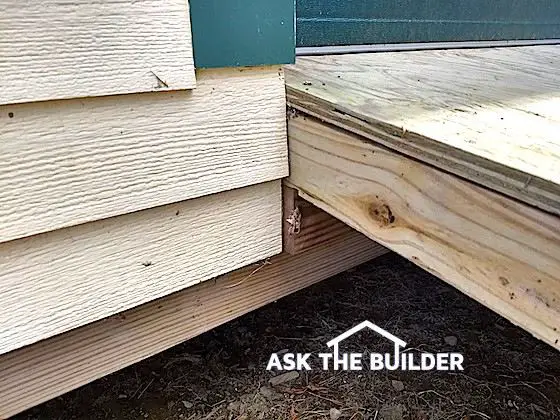
The ends of the 4x4s are notched using a circular saw. This notch allows them to rest on the 2x4 which is through bolted to the end joist of the shed. The notch is only one and one-half inches deep and perhaps an inch high. The two cuts that make up the notch are 90 degrees to one another, but the one cut is not parallel with the end of the 4x4.
You can just barely see the treated 2x4 that's bolted to the side of the shed. The 4x4s are notched to sit flat on the edge of the 2x4. Copyright 2018 Tim Carter
The 2x4 is bolted to the side of the shed joist so the top of the 2x4 is 2.5 inches down from the top of the shed floor joists. If the shed floor has three-quarter inch flooring, this will allow the treated plywood of the ramp to line up nearly perfectly with the top of the shed flooring.
Once the small notches are made on the ends of the 4x4s, you can set them on top of the 2x4 and toenail them into the side of the shed joist. Use special hot-dipped galvanized nails that are 3.5 inches long.
After all of the 4x4s have been secured to the 2x4 ledger board, you cut the plywood to length and nail or screw it to the 4x4s. Use hot-dipped galvanized nails or screws for this task, but they only need to be 2.5 inches long. Recess the screw heads. Your lawn-tractor tires and bare-foot children will love you for this.
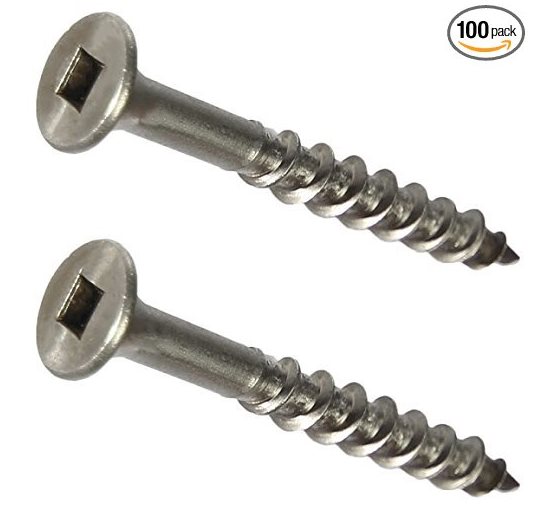
These are great screws to use for a shed ramp. CLICK THE PHOTO to have them delivered to your home.
Are There Other Shed Ramp Materials?
Shed ramps can also be made from aluminum or other metal. There are any number of companies that make ramps that can be placed permanently or used only when you need access in and out of the shed. Some ramps are slightly wider than the width of the lawn tractor tires. These must be placed very precisely so the tractor does not flip over.
If you build a solid-wood ramp like mine, you can use real rubber mats to make pathways for yourself and the lawn-tractor tires. Real rubber, when wet, is not slippery. Get rubber mats that have some bumps on them that will give you superb traction. Clean the ramp and rubber mats on a regular basis to remove any dirt, algae or moss.
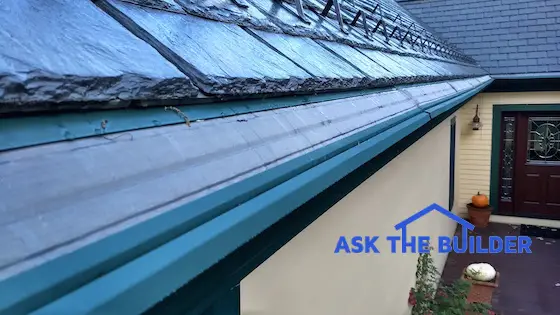
This is the best gutter guard I've ever tested. A stainless-steel micromesh prevents any pine needles from getting into the gutter. Copyright 2018 Tim Carter
"I started to test different products and discovered quickly they all did a great job of keeping leaves out of my gutters. But in the spring, or after two spring seasons, all of the gutter cover products I tested FAILED."
Gutter covers are a huge business. They really came of age back in the 1990s.
Gutter Covers Work - But Most Allow Debris Into Gutters - BEWARE!
I clearly remember seeing these products multiply when I'd attend the different trade shows like the National Hardware Show and the International Builders Show.
Both of these shows have a playpen area that's got smaller booths designed for start-up companies.
If you want to see really new products, that's the best place to go in both shows. All the little guys are there and some have spectacular products such as the metal pegboard I spied at one of the shows back about fifteen years ago. But I digress.
When the gutter covers, or gutter guards as many call them, came about, I was intrigued. My own home had nearly 400 feet of gutter and huge oak, maple and gingko trees surrounded my house. Cleaning gutters was a huge task and it was dangerous.
I started to test different gutter cover products and discovered quickly they all did a great job of keeping leaves out of my gutters. But in the spring, or after two spring seasons, all of the gutter cover products I tested FAILED.
There were two primary designs:
Slots, Grooves, Holes, and Knockouts
Rounded Nose or reverse curve as the industry calls them
Goal: Water In - Everything Else Out
The slots, grooves, holes and knockout-type gutter cover were designed to let water into the gutter through the openings in the gutter cover. Big leaves couldn't pass. But small twigs, pieces of bark, pine needles, tiny leaves, roof shingle granules COULD get into the grooves and slots.
When this happened, some got into the gutter and the larger pieces CLOGGED the slots and grooves causing water to then shoot over the gutter guard onto the ground. That's BAD!
The rounded nose gutter guard works based on water's surface tension. As water flows over the metal roof of the gutter guard it tends to stick to the gutter guard and flows down into the gutter. Large leaves can't get into the slot.
The issue I discovered is, once again, all the small roof debris did get sucked down into the gutter.
Gutter Cover Test FAILURE Results
After a few years, my CLEAN gutters had an inch or two of organic MUCK in them. So much for great gutter covers!
Another reason they failed is that many gutter covers lay very flat over the gutters. This creates a shelf where debris can collect. The best design is to have the gutter cover be sloped and that slope should match the slope or pitch of the roof.
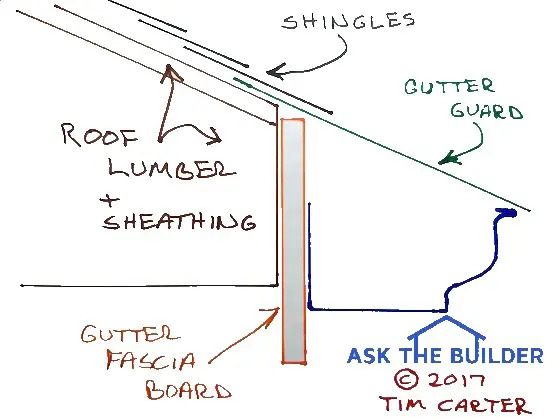
Here's a quickcross-section showing how the gutter guard - in green - is in the same plane as the roofing material. The drawing is not to scale. I used to make drawings like this sitting at customers' kitchen tables. Copyright 2018 Tim Carter
The Best Gutter Cover - Micromesh
Finally, I discovered a new product years ago that was made from a remarkable ultra-fine stainless steel mesh. It reminded me of pantyhose fabric. The openings in the mesh were SO SMALL that you could barely get the head of a pin through it.
I thought they'd never allow water through. I KNEW they'd stop all the small debris from entering the gutter but would water flow through the mesh?
YES! They worked! You can discover MORE about the gutter covers I ended up using on my house just below. Click the link next to the STOP sign after the two videos.
Here are two videos that show you my test results.
Well, I have Amazon affiliate links throughout my site showing you great tools and products I own and use. Thousands of my newsletter subscribers BEG ME to tell them about the products I love and they have no issue with me getting a small commission as does a real estate agent, a car salesman or any other person who invests their time to help you make an INFORMED DECISION.
You could spend years and tens of thousands of dollars testing different gutter covers yourself, or you can just accept that I've invested all that time and money for you. That's fair, isn't it?
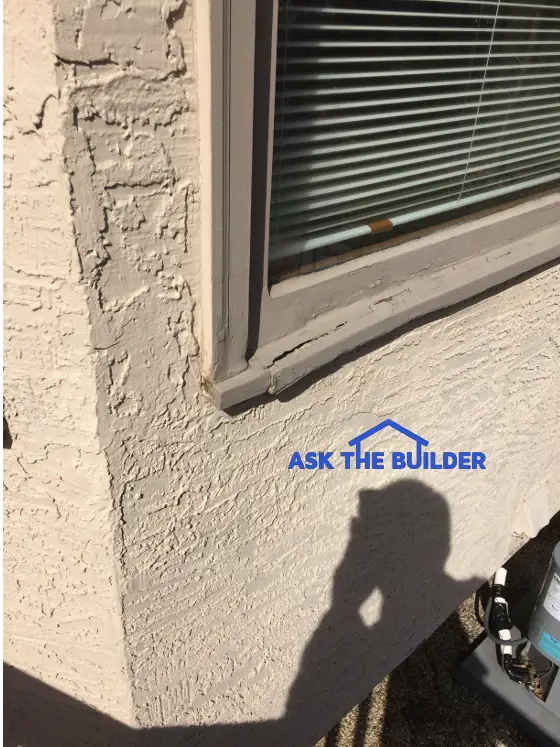
There are two reasons why this wood window sill is rotting. First and foremost, there’s no roof overhang. The second reason is low-quality hybridized lumber was used to build the window sill. (C) Copyright 2018 Tim Carter
Question #1: Tim, the window frame on the back of my house is deteriorating. If you look at the three photos I sent, you’ll see there’s no gutter over this window, but rain diverters up in the shingles. What’s the best way to repair the damage and prevent it in the future? Andy, Westerville, OH
I’ve seen an alarming rise in wood-rot questions like Andy’s. Perhaps it’s happening with your wood windows, exterior house trim, and wood door frames. It’s happening at my own home here in New Hampshire. It’s important to realize I didn’t build the house I live in and would have never used the brand of wood trim that’s all over my house.
Another key point is the lack of roof overhangs on the projecting bay where the problem windows are located at Andy’s house. Roof overhangs are yet another building best practice that are fast becoming myth. All Andy has to do is drive through neighborhoods near him where the houses were built in the early 1900s to see generous roof overhangs.
A roof overhang is not much different than an umbrella. You stay dry using a large umbrella as you walk in the rain because the drip line of the umbrella is a good distance away from your body. Roof overhangs do the same to keep house walls, windows and doors dry except during violent wind-driven rainstorms.
The wood trim on your home may be just like Andy’s. Over the past few decades, there’s been an alarming trend to use hybridized lumber that grows rapidly in the spring. This lighter-colored growth band between the darker summer wood band allows water to soak deep into the wood trim. Fungi spores go along for the ride and the next thing you know your wood is rotting.
You can use two amazing products to repair the wood rot and even rebuild missing wood. The first product is a milky liquid wood hardener that you brush onto the rotted wood. It works best if you apply this to dry wood. After one day you then mix up a heavy-bodied wood epoxy to fill any gaps, holes or large cracks. The epoxy can be sanded, painted and stained.
You can watch a short video how to use the milky liquid and wood epoxy. The video should give you the confidence that you can do this simple repair. I’ve used the products at my own home with great success and feel confident you’ll discover they’re easy to use. Go to: https://www.askthebuilder.com/repair-wood-rot/
Question #2: Tim, I really need your help. I’ve got to attach a piece of 2x4 treated lumber to a concrete block wall. A sidewalk gate will be attached to this piece of wood so it needs to be rock solid. I know the concrete block wall is filled solid with concrete because I watched it being built. How can I install an anchor bolt now in this wall so it never comes out? Teri, Bloomington, IN
You may be in a similar situation as Teri wanting to install a threaded bolt into a concrete slab or perhaps a concrete block wall. Believe me, there are countless anchor designs and products all that may work well.
The good news is you can get a simple hex-headed bolt and three nuts at your local hardware store that will do for you what Teri needs to do at her home. You’ll also need to rent a hammer drill to create a very special hole. The only other thing you’ll need is some easy-to-use concrete epoxy that holds the bolt in place and prevents it from ever being pulled from the concrete or concrete block.
You can borrow a tip from your dentist for this project. The reason the fillings in your teeth don’t come out is because your dentist creates a hole in your tooth that’s wider at the bottom than at the top. You’re going to do the same thing with the hammer drill by drilling into the concrete at different angles as you drill the hole.
I’d want the bolt to be embedded in the concrete at least 1.5 inches. Teri is using a 2x4 which is 1.5 inches thick. She should have about 1 inch sticking past the face of the 2x4 to attach a washer and nut. This means she’ll need a 4-inch-long hex-head bolt. To ensure the bolt doesn’t turn when she’s attaching the wood, she needs to thread on two nuts to within 1/4 inch of the head. Use wrenches to tighten the two nuts against one another.
After the holes are drilled all the dust must be removed from the hole. Don’t blow into it with your mouth! You’ll get a blast of dust in your eyes and be off the the ER. When you’re at the hardware store, get a 2-foot length of 3/8-inch plastic tubing. Insert one end into the hole, bend the tubing to get around the corner and then blow on the other end of the tubing.
Squirt some epoxy onto the end of the bolt that goes into the hole and then add more in the hole so it oozes out when you insert the bolt. Allow the epoxy to cure for 48 hours before attaching anything to the anchor bolt.
Are you a teacher or do you work in a school? I had the pleasure of helping teach a middle-school STEAM class in Missouri about ten days ago.
Ms. Chantell Mason reached out to me to ask if I'd do a video conference with two of her classes. They had an assignment that put them in charge of building a new school.
The photo above was taken during the class and I'm up on that white screen believe it or not.
Each of the kids that had a question would come up to the camera and speak into the microphone. The other kids would tap away at their laptops with my answer.
In one of my answers, I gave an example of where NOT TO BUILD a school and referenced a silly school in Cincinnati, OH that was built in the floodplain of the Ohio River. The entire building is up in the air on giant concrete piers much like a huge table.
Within 60 seconds one of the kids came up to the camera, held up their laptop screen so I could see it and said, "Mr. Carter, is this the school building?"
It's important to realize I didn't ask the kids to go look it up.
This young woman had indeed located the CORRECT school with minimal clues. I didn't say the name of the school. I didn't mention WHERE in Cincinnati it was other than along the Ohio River.
There's HOPE!
If you're a teacher and need me to help you one day in your classroom, you know what to do. Just Ask Tim.
One of the great things about getting back in front of the microphone is I'm rediscovering past columns I forgot about!
I'll be talking to a homeowner about a problem, for example Steve last week, and BOOM!
"Hey Steve, I've got a column that explains how to fix that."
Steve had reached out to me with a common problem - his ancient toilet wasn't flushing correctly.
He told me he had been dealing with this issue for well over TEN YEARS!
The best part is he shot a short video and sent it to me. CLICK HERE and scroll down the page to see the video:
Not only did I fix Steve's toilet making it flush like NEW, but my recommended fix got rid of some horrible staining he had tried to remove for years.
Steve was SO HAPPY he taped a follow-up video showing how his toilet was flushing correctly AND it looked like new! The follow-up video is part of the above video. Go watch it.
WOOT! I love love love getting feedback like that as it reinforces that what I do is really helping you.
I then talked with Andy about a common problem you might have.
Wood rot
In Andy's case it was caused by an idiot builder or architect who didn't provide enough roof overhang on Andy's house.
CLICK HERE to see three photos of Andy's lack of overhang and his wood-rot problem.
CLICK HERE to see how to repair the wood rot. Watch the video I taped last November in Los Angeles.
Fun Construction Quiz
Friday, I was driving back from a journey and I saw a house being built just a few miles south of my home.
Surprisingly, there were just a few workers there and I decided to walk around and get some photos. If the homeowners are expecting to enjoy the summer along the lake here, they better light a huge fire under the builder.
CLICK HERE to see one of my photos and take the FAST two-question quiz.
It's FUN and I GUARANTEE you'll discover something new.
Be sure you SCROLL UP after clicking SUBMIT so you can see your score. If you selected the wrong answer, I tell you the right answer and why it's correct.
" ...you need to have a deep understanding of plumbing waste and vent systems to be able to draw a riser diagram."
CALL ME NOW and I'll draw your riser diagram in days - 603-470-0508
Yes, it's me, Tim Carter! I'm taking a break from installing a garage floor drain in my daughter's home on Mt. Desert Island in Downeast Maine. CALL ME NOW if you need a residential riser diagram for your project: 603-470-0508
How To Draw Riser Diagram - Not Too Easy, Sorry!
You want to know how to draw a riser diagram. I get it. You need to pull your permit and you're stuck.
You've seen the diagrams and feel you can draw the lines and magic happens.
Tim Carter has been a master plumber since 1981 and can draw your residential riser diagram.
The trouble is you need to have a deep understanding of plumbing waste and vent systems to be able to draw a riser diagram correctly to be able to GET A PERMIT.
If you take a piece-of-crap drawing into the building and plumbing department, they'll probably show you the door.
Even if you don't have to use the drawing to get a permit, you still might draw a few of the pipe connections wrong. If you put the wrong pipe fittings in, your system could experience chronic clogging.
In other words, drawing a riser diagram is not something I can teach you in a 300-word column. However, you may be able to watch the following video and start to gain some confidence.
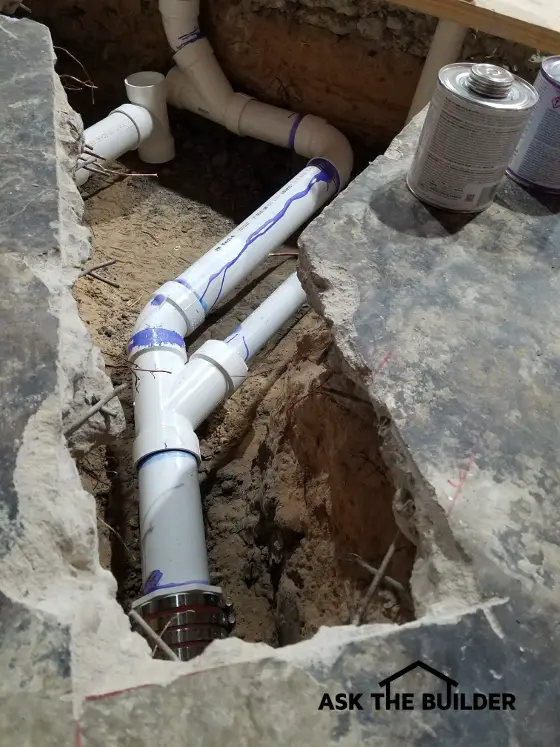
The plastic triangle allows you to draw the proper lines in a 3D format so it's easy for someone to visualize the true relationship of the pipes once they're installed. Here's a typical photo of pipes going in and you need to be able to represent this on paper with just lines:
These are real pipes under a slab. One of the fittings goes against best practices and in some jurisdictions, may be illegal. Do you have a clue which one it is? You need to be able to draw this up on paper so someone can create the same thing looking at your drawing. Do you have those skills? If not CLICK THE PHOTO and hire me now. Copyright 2020 Tim Carter
Solid and Dashed Lines in Riser Diagrams
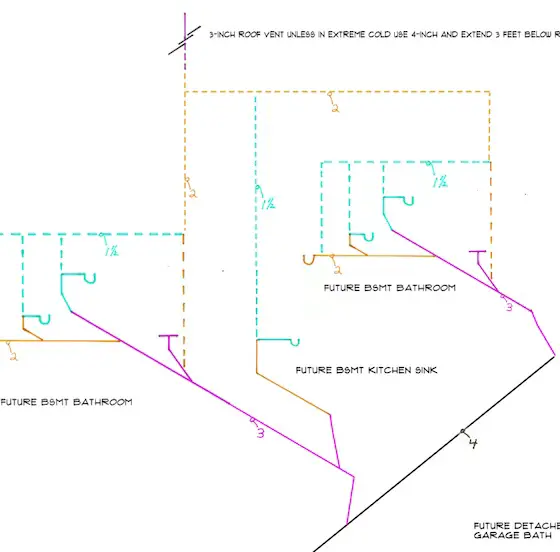
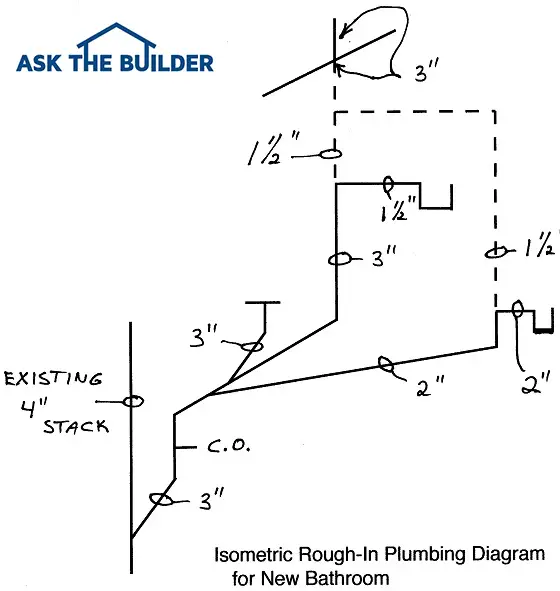
You'll notice both solid and dashed lines in the riser diagrams on this page. The solid lines carry liquid and solid waste and the dashed lines are designed to only contain air.
However, the dashed vent lines do carry liquid in the form of condensate so they need to be installed so they drain by gravity.
The trouble for a rookie like you is that some solid lines in riser diagrams can also be approved vent lines too.
See how you need to be a master plumber to understand what's going on? The diagram below has a short section of this hybrid waste/vent line. See if you can identify it.
I'm a master plumber and I drew this in about ten minutes. It shows the fixtures in a bathroom that's being added to an existing home. The solid lines carry water and waste. The dashed lines only carry air and some condensation water. (C) Copyright 2018 Tim Carter - Master Plumber
I'm A Master Plumber Who Draws For People
I've drawn many many riser diagrams. I'll never forget the day I sat for my master plumber's exam.
We had to draw a riser diagram for a multi-story building that had all sorts of crazy fixtures in it. I loved making these diagrams.
Two weeks after the exam the head of the plumbing department called me to tell me I was the only person to ever get the entire drawing correct. I found that very hard to believe because I knew many many intelligent plumbers in my city that sat for the same exam.
It's important to realize I now draw them for homeowners like you all over the USA. Click here to hire me.
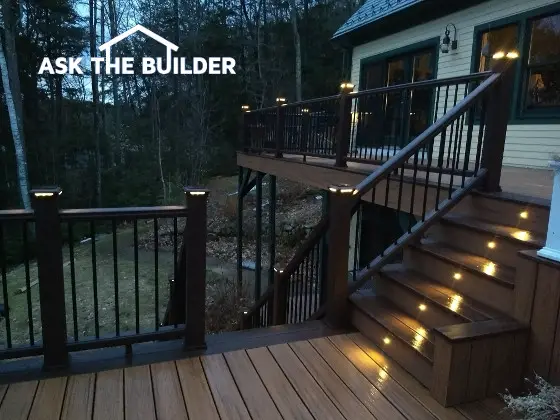
Installing low-voltage lighting around a deck is quite easy. The soft lights create a magical mood and provide safety on steps. (C) Copyright 2018 Tim Carter
Low-Voltage Deck Lights
Question #1: Tim, I’m going to tackle rebuilding my deck soon and have seen lots of photos of low-voltage deck lighting. I’m afraid of electricity and don’t feel I have the skills to do this part of the project. Can you impart any wisdom that will instill the courage in me to try to do this wiring? Have you worked with an easy DIY system? Becky, Riverside, CA
Not a week goes by that I don’t get a question about electricity from a person visiting my website. Many fear lots of things and having respect for invisible electricity is quite understandable.
You may be like Becky. You may want to try to work with electricity, but need someone like me to tell you to be brave. The good news is all the wiring needed for a typical low-voltage deck project can be done with no power connected to the circuit.
That’s how I wired up my enormous outdoor deck last year. I’ve got soft LED lights on all four sides of each post cap along my 100-plus-feet of my deck railing and I’ve got down-facing safety lights at each stair riser. All of the lights and wiring were installed with no electricity at all in the thin low-voltage wires.
Installing low-voltage lighting around a deck is quite easy. The soft lights create a magical mood and provide safety on steps. (C) Copyright 2018 Tim Carter
I happened to use the low-voltage lighting system manufactured by Trex. The engineers who devised the system made it caveman simple. It’s all plug-n-play. It’s impossible to make an incorrect connection.
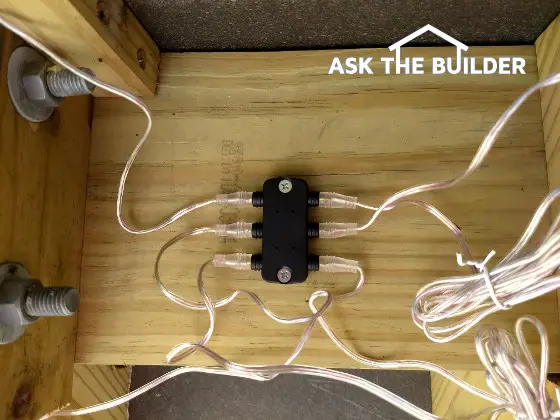
All you have to do is connect the lights in a series. There are tiny splice-block connectors that the wires plug into as you daisy chain all the lights together. Trex provides a handy illustrated manual that helps you make all the right connections.
A transformer converts the normal household 120-volt AC current to low-voltage DC current. After you have all of the low-voltage wires connected to the lights, you plug in this transformer into a photo-voltaic timer just as you’d plug a toaster into a wall outlet. It’s completely safe. The timer plugs into a regular GFCI exterior outlet that you might hire an electrician to install for you under the deck.
Be sure you use special rust-proof tiny cable staples to attach the low-voltage wires to the underside of your decking. You and Becky can do it and I can’t wait for you to reach out to me with your success story!
To help you visualize how simple it is to install the low-voltage lights, look at my collection of superb photos showing my low-voltage connections and parts on my own deck. CLICK HERE
Pergola Problems
Question #2: Tim, this past weekend I was involved in a spirited debate with my husband about building a privacy pergola that would make our small backyard more attractive and private. He insists the pergola needs to have four posts spaced like a table to be stable, but I feel it can be more like a fence with just two, or three, posts in a row. Pick a side and join the fray! Kelly, Columbus, OH
Every time I get a message or email like Kelly’s, I have flashbacks about back-and-forth building and remodeling discussions with She Who Must Be Obeyed, my wife. The memories are so vivid I have to shake my head to clear them away. I discovered many many moons ago it was in my best interest to find a way to make her dreams come true. Maybe that’s one reason we’ll be celebrating our 44th anniversary this September!
If you made the connection between a privacy fence and a smaller pergola like Kelly did, congratulations. Not only can you build a small pergola with two or three posts in a row, but it can also be moored to the ground so it won’t blow or fall over.
The pergola cross members that are connected to the top beam can be up to 6-feet long. It’s important to realize they should be centered on the beams that are going to be connected to each side of the vertical posts for the greatest stability. However, you can cantilever the pergola cross members using a 2:1 ratio for more shade on one side of this privacy structure.
To ensure the pergola will not tip over, the posts need to be embedded in the soil no less than 30 inches if the height of the pergola is above 8 feet. The higher you go in the air, the deeper the posts should be embedded in the ground.
You don’t have to surround the posts with concrete. Concrete becomes a liability in the future if you have to replace a post. I’ve had great success using crushed angular gravel. I surround the post on all sides with at least 4 inches of the gravel. The gravel ranges in size from sand up to pieces not much larger than a big grape.
If you want to see gorgeous photos of a pergola that Kelly will be having her husband build for her, CLICK HERE.
These are the post cap lights on my Trex Transcend deck. It's magical to be on the deck at dusk. Copyright 2018 Tim Carter
Here's a collection of photos showing how I connected up my Trex low-voltage lighting.
Trex Low Voltage Lighting Is Easy to Connect
First, allow me to show you what the lights look like when they're on:
The LED Trex low-voltage lighting in the stair risers allows for safe travel at night. Copyright 2018 Tim Carter
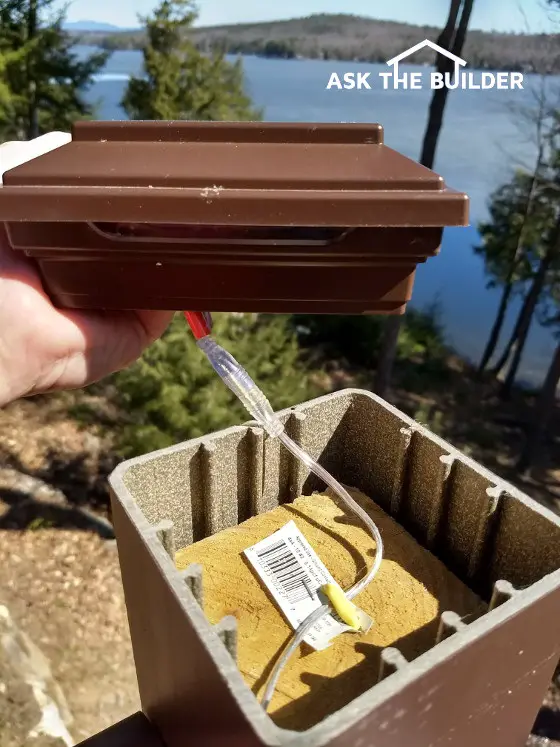
I lifted the post cap off the post so you can see the wiring. The light comes with the pre-wired stub and it just plugs into the extension wire that runs inside the sleeve down to one of the splice blocks under the deck. Copyright 2018 Tim Carter
Here's a Trex splice block. This one has a power wire coming into the block to feed it and one going out to the next splice block. That leaves space to connect four different lights. Copyright 2018 Tim Carter
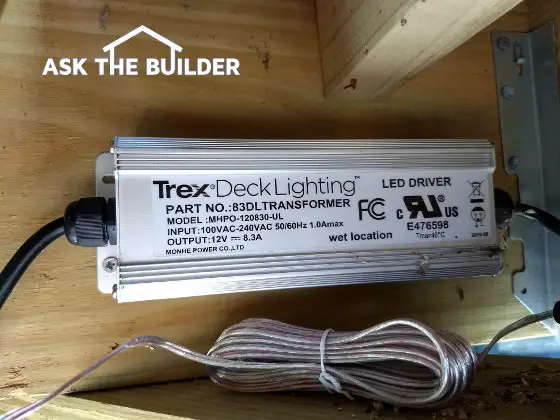
Here's a Trex low-voltage transformer. They come in two sizes. The Trex manual shows you how to calculate what size you need. Copyright 2018 Tim Carter
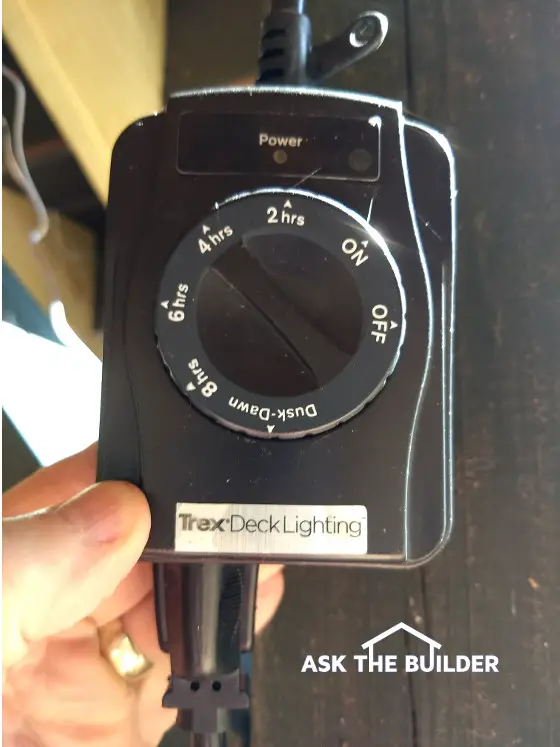
Trex Low Voltage Timer
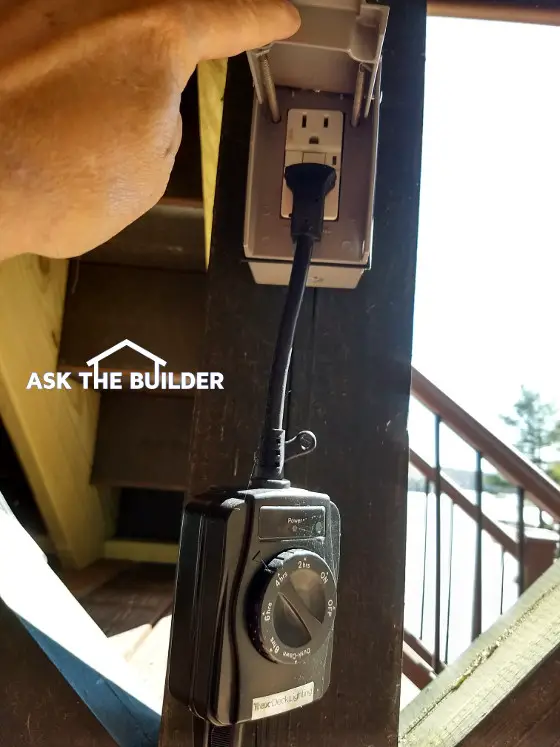
The Trex timer has a very short cord. You plug it into a standard GFCI outdoor outlet. Mine is under the deck to keep it nice and dry. Copyright 2018 Tim Carter
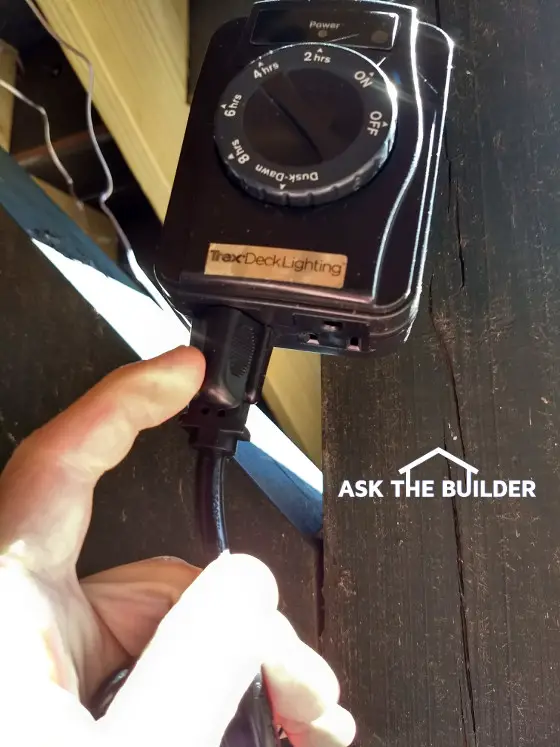
Here's the timer again. The transformer plug goes into the bottom of the timer. It's like plugging in a lamp into a wall outlet at your home. So safe! Copyright 2018 Tim Carter
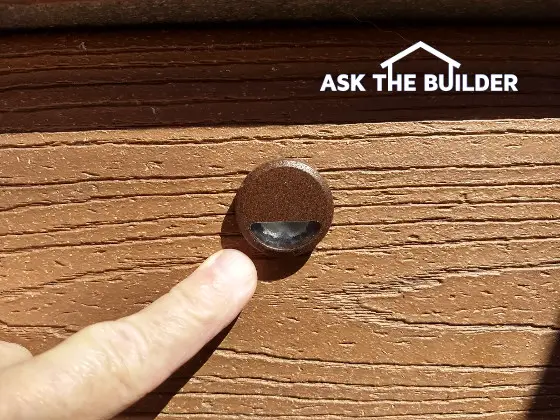
This is the front view of a Trex low-voltage riser light. You can see it's small and the light goes down, not up. Copyright 2018 Tim Carter
What better way to tell your visitors what they're standing on? Copyright 2018 Tim Carter